
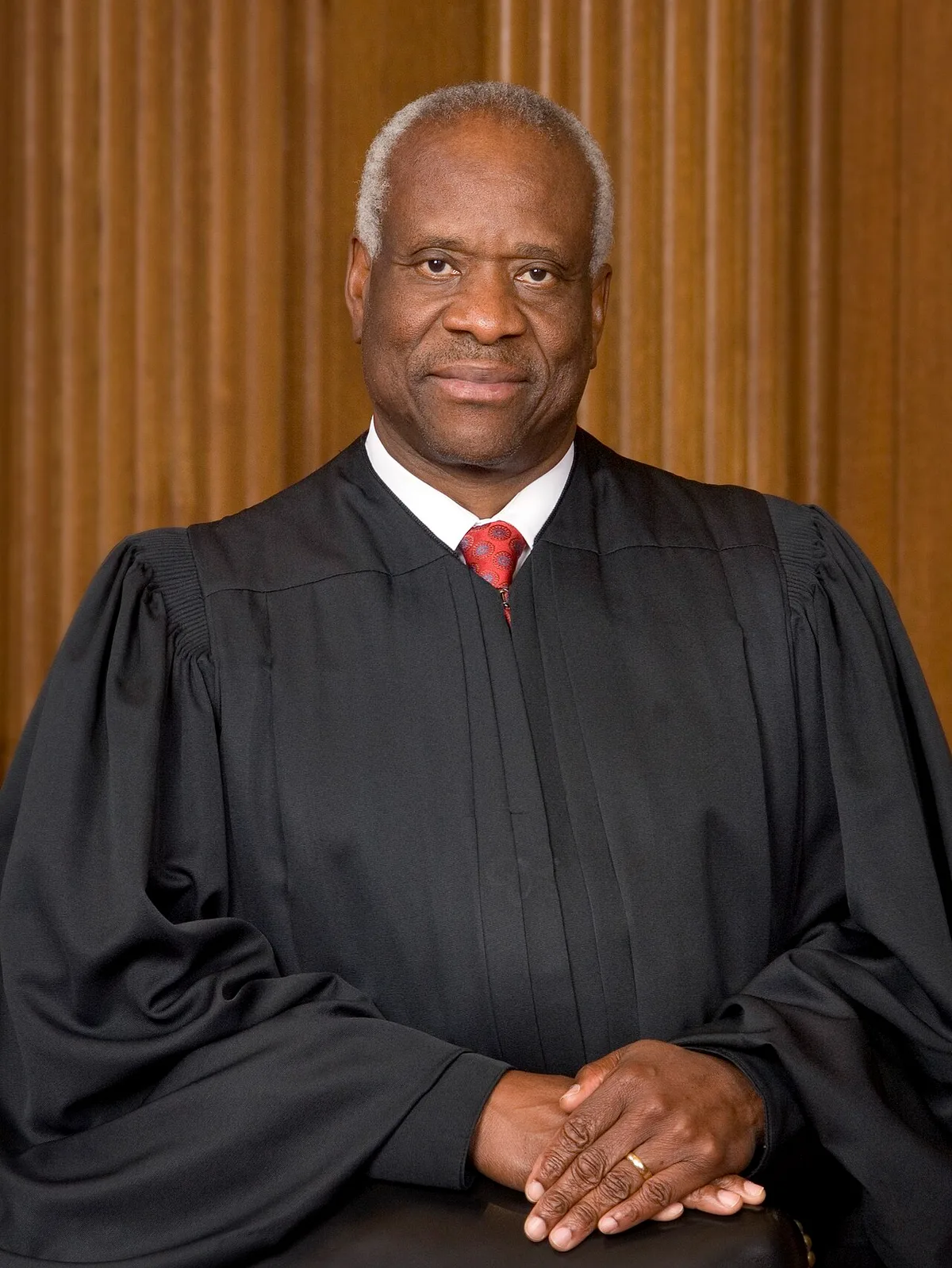
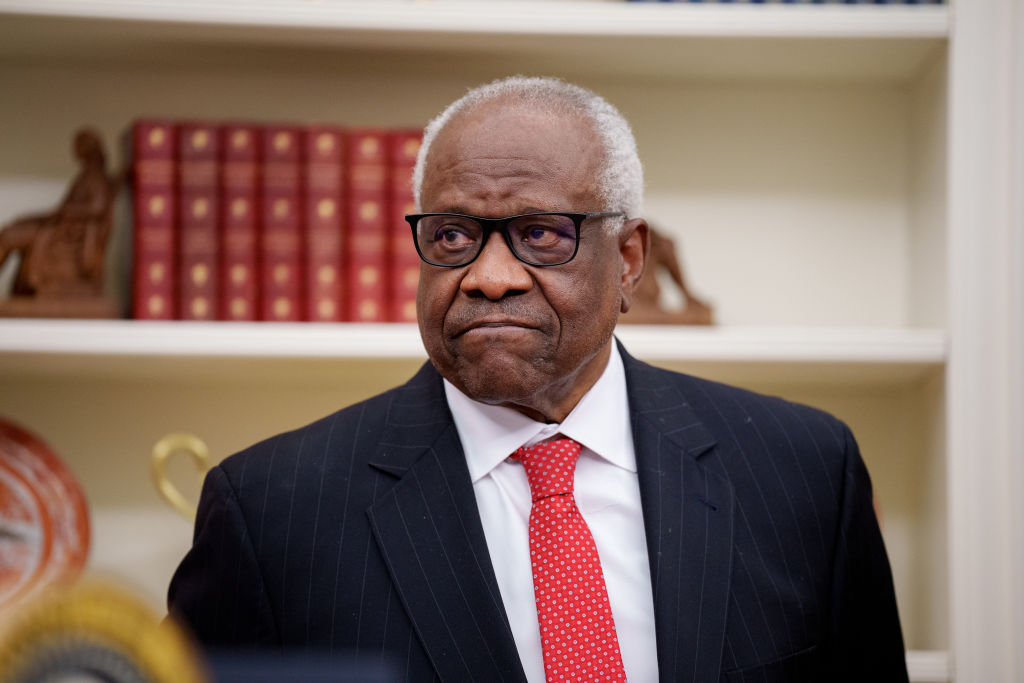
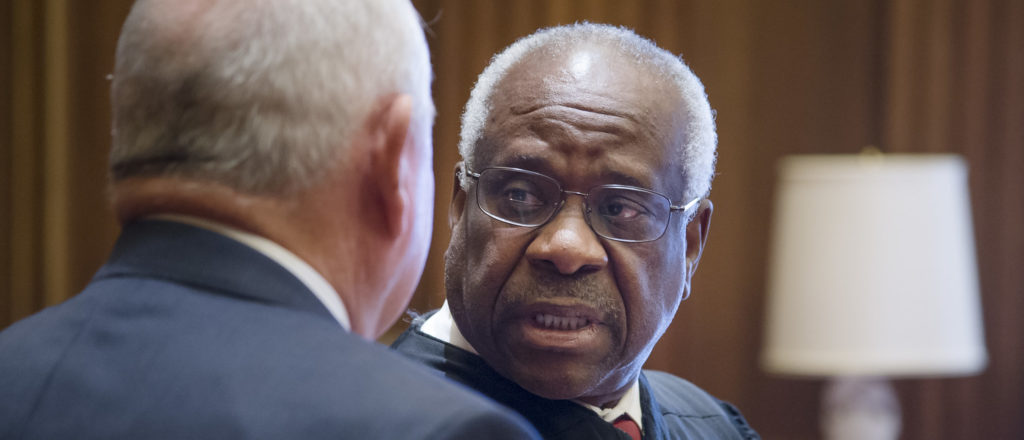
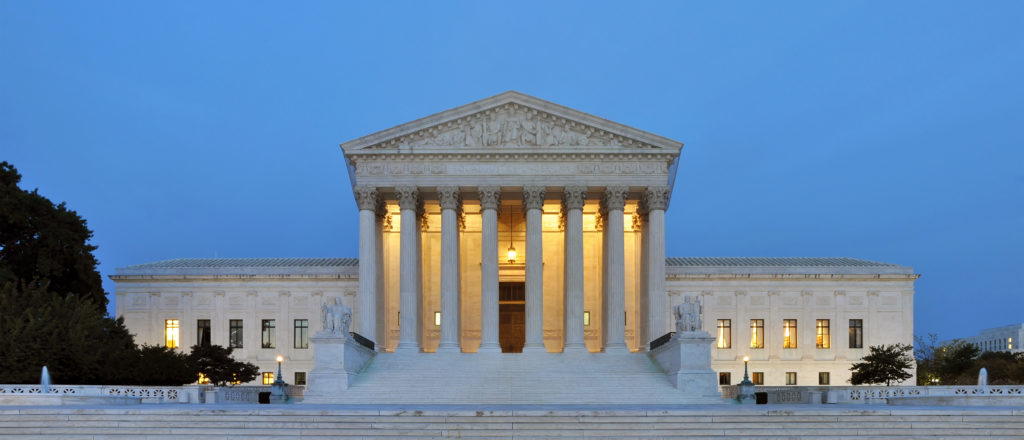
Clarence Thomas (born June 23, 1948) is an American lawyer and jurist who has served as an associate justice of the Supreme Court of the United States since 1991. Nominated by President George H. W. Bush to succeed Thurgood Marshall, Thomas is the second African American to serve on the U.S. Supreme Court and the second longest-serving U.S. Supreme Court justice in history.
Thomas was born in Pin Point, Georgia. After his father abandoned the family, he was raised by his grandfather in a poor Gullah community near Savannah, Georgia. A devout Catholic, Thomas initially intended to be a priest in the Catholic Church but withdrew from seminary after experiencing racism. He graduated with honors from the College of the Holy Cross in 1971 and earned his Juris Doctor in 1974 from Yale Law School. After law school, he became an assistant attorney general in Missouri, a legislative assistant to U.S. senator John Danforth in 1979, and Assistant Secretary for Civil Rights at the U.S. Department of Education in 1981. President Ronald Reagan appointed Thomas as Chairman of the Equal Employment Opportunity Commission (EEOC) in 1982.
President George H. W. Bush nominated Thomas to the United States Court of Appeals for the District of Columbia Circuit in 1990. He served in that role for 19 months before filling Marshall's seat on the Supreme Court. Thomas's confirmation hearings were bitter and intensely fought, centering on an accusation that he had sexually harassed Anita Hill, a subordinate at the Department of Education and the EEOC. The Senate confirmed Thomas by a vote of 52–48, the narrowest margin in a century.
Since the death of Antonin Scalia, Thomas has been the Court's foremost originalist, stressing what he considers the original meaning in interpreting the U.S. Constitution. Until 2020, Thomas was known for his silence during most oral arguments, though he has since begun asking more questions to counsel. He is notable for his majority opinions in Good News Club v. Milford Central School (determining the freedom of religious speech in relation to the First Amendment to the U.S. Constitution) and New York State Rifle & Pistol Association, Inc. v. Bruen (affirming the individual right to bear arms outside the home), as well as his dissent in Gonzales v. Raich (where he argued that the U.S. Congress may not criminalize the private cultivation of medical cannabis). He is widely considered to be the Court's most conservative justice.
Contents
Early life
Thomas was born on June 23, 1948, in his parents' wooden shack in Pin Point, Georgia. Pin Point was a small community near Savannah founded by freedmen in the 1880s. He was the second of three children of M.C. Thomas, a farm worker, and Leola Williams. Williams had been born out of wedlock; after her mother's death, she was sent from Liberty County, Georgia, to live with an aunt in Pin Point. The family were descendants of enslaved people and spoke the creole language Gullah as a first language. Thomas's older sister, Emma, was born in 1946, and his younger brother, Myers, in 1949. His earliest known ancestors were slaves named Sandy and Peggy, who were born in the late 18th century and owned by wealthy planter Josiah Wilson of Liberty County. Sandy Wilson, his distant ancestor, was an enslaved plantation worker who was brought from Georgia to Charleston, South Carolina, and, after the end of the Civil War, registered to vote in 1867.
Upon becoming pregnant with Thomas's older sister, Leola was expelled from her Baptist church and dropped out of high school after the 10th grade; her father ordered her to marry M.C. in January 1947. After three years of marriage, M.C. sued for divorce, claiming that Leola neglected the children, and a judge granted the request in March 1951. After the divorce, M.C. moved to Savannah and later Pennsylvania, visiting his children only once. Leola went to work as a maid in Savannah during the week and returned to Pin Point on the weekends. Custody of the children was awarded to Leola's aunt.
When her aunt's house burned down in 1955, Leola took her children to live with her in the room she rented in a tenement with an outdoor toilet in Savannah, leaving her daughter with the aunt in Pin Point. She asked her father, Myers Anderson, for help. He initially refused but agreed after his wife threatened to throw him out. Thomas and his brother went to live with Anderson, his maternal grandfather, in 1955 and experienced amenities such as indoor plumbing and regular meals for the first time. Despite having little formal education, Anderson had built a successful business delivering coal, oil, and ice. When racial unrest led to widespread protest and marches in Savannah from 1960 to 1963, Anderson used his wealth to bail out demonstrators and took his grandchildren to meetings promoted by the NAACP. Thomas has described his grandfather as the person who has influenced his life the most.
When Thomas was 10 years old, Anderson began putting his grandsons to work during the summers, and Thomas helped build a house on a plot of farmland his grandfather owned. Anderson believed in hard work and self-reliance, never showed his grandsons affection, beat them frequently according to Leola, and impressed the importance of education on his grandchildren. Anderson taught Thomas that "all of our rights as human beings came from God, not man", and that racial segregation was a violation of divine law. Anderson, a convert to Catholicism, sent Thomas to be educated at a series of Catholic schools. Thomas attended the predominantly black St. Pius X High School in Chatham County for two years before transferring in September 1964 to St. John Vianney's Minor Seminary on the Isle of Hope, where he was the only black student in the segregated boarding school. Despite being hazed, he excelled academically, gained a reputation as a hard worker, and became the co-editor of its newspaper, the Pioneer. During this time, he spent many hours at the Carnegie Library, the only library for blacks in Savannah before libraries were desegregated in 1961. His academic accomplishments made him the target of racist remarks by classmates, contributing to a spiritual crisis in which he began to doubt the teachings of the Catholic Church. But because of his academic record, the school's faculty voted to nominate Thomas as a candidate for the priesthood.
College of the Holy Cross and Yale Law School
At a nun's suggestion, Thomas enrolled at the College of the Holy Cross, an elite Catholic college in Massachusetts, as a sophomore transfer student in August 1968. He was awarded a full academic scholarship, endowed in honor of Martin Luther King Jr. He was one of the college's first black students, being one of twenty recruited by President John E. Brooks in 1968 in a group that also included the future trial attorney Theodore V. Wells, Jr., the running back Eddie Jenkins, and the novelist Edward P. Jones. In the fall of 1968, Thomas and other black students founded the college's Black Student Union (BSU), which became an important part of their campus identity. He was first elected the union's secretary-treasurer, then was elected its chairman in his senior year. Without financial support from his grandfather, he defrayed his expenses by working as a waiter and dishwasher in the college's dining hall, Kimball Hall. Thomas later recalled, "I was 19. My only hope was Holy Cross".
Professors at Holy Cross remembered Thomas as a determined, diligent student. He kept to a strict routine of studying alone and stayed on campus during holidays to continue working. Thomas C. Lawler, an English professor at Holy Cross, recalled him as having "never talked very much in class. He was the kind of person you really might not notice". By contrast, he was outspoken at BSU meetings, distinguishing himself as a contrarian who often disagreed with Wells. Jenkins, a BSU member, said Thomas "could turn on a dime and reduce you to intellectual rubble" and described Thomas's disagreements with Wells as "W. E. B. versus Booker T." Jones, who lived across from Thomas as a sophomore, recalled, "there was a fierce determination I sensed from him, that he was going to get as much as he could and get as far, ultimately, as he could".
As an undergraduate at Holy Cross, Thomas became a vocal student activist. He became acquainted with black separatism, the black Muslim Movement, and the black power movement, and displayed a poster of Malcolm X in his dormitory. When some black students were disproportionately punished for violations, he suggested a walkout in protest. The BSU adopted his idea and Thomas left campus along with 60 other black students. Some of the priests negotiated with the protesting black students, allowing them to reenter the school. When administrators granted amnesty to all protesters, Thomas returned to the college and later attended antiwar marches. In April 1970, he participated in the violent 1970 Harvard Square riots. He has attributed his turn toward conservatism and subsequent disillusionment with leftist movements to these protests.
Early legal career
With no job offers from major law firms, Thomas took a position as an associate with Missouri Attorney General John Danforth, who offered him the prospect of practicing what he liked. Thomas moved to Saint Louis to study for the Missouri bar, and was admitted on September 13, 1974. He remained financially destitute even after leaving Yale, trying unsuccessfully on one occasion to make money by selling his blood at a blood bank, and hoped that by working for Danforth he might later acquire a job in private practice.
From 1974 to 1977, Thomas was an assistant attorney general of Missouri—the only African-American member of Danforth's staff. He worked first in the office's criminal appeals division and later in the revenue and taxation division. Thomas conducted lawsuits independently, gaining a reputation as a fair but controversial prosecutor. Years later, after he joined the Supreme Court, Thomas recalled his position in Missouri as "the best job I've ever had".
When Danforth was elected to the U.S. Senate in 1976, Thomas left to become an attorney in Monsanto's legal department in Saint Louis. He found the job unsatisfying, so left to rejoin Danforth in Washington, D.C., as a legislative assistant. From 1979 to 1981, he handled energy issues for the Senate Commerce Committee. As a black conservative who had switched his party affiliation from Democratic to Republican while working for Danforth in Missouri, Thomas soon drew the attention of officials in the newly elected Reagan Administration. Pendleton James, Reagan's personnel director, offered Thomas the position of assistant secretary for civil rights at the U.S. Department of Education. Initially reluctant, Thomas agreed after Danforth and others pressed him to take the post.
On May 1, 1981, President Ronald Reagan nominated Thomas as assistant secretary of education for the Office for Civil Rights (OCR). The Senate received the nomination on May 28, and Thomas was quickly confirmed before the Senate Labor and Human Resources Committee on June 19, succeeding Cynthia Brown at age 32. He held the position for a brief period before James offered him a new position as chairman of the Equal Employment Opportunity Commission (EEOC), a promotion that Thomas believed, as with his position in the OCR, was because of his race. After James consulted the president, Thomas hesitantly took up the chair with Reagan's approval.
D.C. Circuit Court of Appeals
In early 1989, President George H. W. Bush expressed interest in nominating Thomas to a federal judgeship. Thomas, now at age 41, initially rejected the position, believing himself unready to make a lifetime commitment to being a judge. White House Counsel C. Boyden Gray and White House Chief of Staff John H. Sununu advocated for his nomination, and Judge Laurence Silberman advised Thomas to accept an appointment. Anticipating Thomas's nomination, a liberal coalition—including the Alliance for Justice and the National Organization for Women (NOW)—emerged to oppose his candidacy.
On October 30, 1989, President George H. W. Bush nominated Thomas to the United States Court of Appeals for the District of Columbia Circuit to fill the seat vacated by Robert Bork. Thomas gained the support of other African American officials, including former transportation secretary William Coleman, and said that when meeting white Democratic staffers in the United States Senate, he was "struck by how easy it had become for sanctimonious whites to accuse a black man of not caring about civil rights".
In February 1990, the Senate Judiciary Committee recommended Thomas by a vote of 12 to 1. On March 6, 1990, the Senate confirmed him to the Court of Appeals by a vote of 98 to 2. He developed cordial relationships during his 19 months on the federal court, including with Judge Ruth Bader Ginsburg. At age 42, Thomas was also the D.C. Circuit's youngest judge. During his judgeship, Thomas authored 19 opinions. A colleague on the D.C. Circuit described him as "talkative, gregarious on our court, [and] a real participant". He ruled in 145 cases, many of which concerned criminal matters.
Nomination to the Supreme Court
When Justice William Brennan retired from the Supreme Court in July 1990, Thomas was Bush's favorite among the five candidates on his shortlist for the position. However, Bush's advisors, including Attorney General Dick Thornburgh, considered Thomas inexperienced, and he instead nominated David Souter of the First Circuit Court of Appeals. A year later, Justice Thurgood Marshall announced his retirement on June 27, 1991, and Bush nominated Thomas to replace him. Bush announced his selection on July 1, calling Thomas the "best qualified at this time". Thornburgh cautioned Bush that replacing Marshall with any candidate who was not perceived to share Marshall's views would make confirmation difficult.
Liberal interest groups sought to challenge Thomas's nomination by paralleling the same strategy used against Robert Bork's confirmation. Abortion-rights groups, including the National Abortion Rights Action League and the NOW, were concerned that Thomas would be among those to overrule Roe v. Wade. Republican officials emphasized his personal history and gathered support from African American interest groups, including the NAACP. Other civil rights organizations, such as the Southern Christian Leadership Conference and the National Urban League, were convinced not to oppose Thomas, believing that he was Bush's last black nominee. On July 31, 1991, the board of directors of the NAACP voted against endorsing Thomas, announcing their opposition to his confirmation the same day.
The American Bar Association (ABA) appraised Thomas as "qualified" for the Supreme Court. The result came in contrast to the "well qualified" rating some nominees had received previously. The Bush Administration anticipated that the organization would rate Thomas more poorly than it thought he deserved, so pressured the ABA for at least the mid-level qualified rating while simultaneously discrediting it as partisan. Opponents of Thomas's nomination saw the assessment as indicating that he was unfit for the Court. The ABA gave Thomas its highest rankings in integrity and judicial temperament and a middle-grade in professional competence.
On September 10, 1991, formal confirmation hearings began before the Senate Judiciary Committee. Thomas testified for 25 hours, the second-longest of any Supreme Court nominee. He was reticent when answering senators' questions, recalling what had happened to Robert Bork when Bork expounded on his judicial philosophy during his confirmation hearings four years earlier. As many of his earlier writings frequently referenced natural law, his views on the legal theory became a focus of the hearings. Thomas said he regarded natural law as a "philosophical background" to the Constitution.
Anita Hill accusations
At the conclusion of the committee's confirmation hearings, the Senate was debating whether to give final approval to Thomas's nomination. An FBI interview with Anita Hill, a former colleague of Thomas at the EEOC, was soon leaked to the press and allegations of sexual harassment followed. As a result, on October 8, the final vote was postponed, and the confirmation hearings were reopened. It was only the third time in the Senate's history that such an action was taken and the first since 1925, when Justice Harlan F. Stone's nomination was recommitted to the Judiciary Committee.
Hill was raised in Oklahoma and, like Thomas, graduated from Yale Law School. She told James Brudney, a fellow Yale alumnus, about alleged sexual advances Thomas had made, telling him that she also did not wish to testify or make the allegations public to the Senate Judiciary Committee. Hill asked the staff of Senator Joe Biden, the chair of the committee, to make her allegations anonymously if she chose to testify and that Thomas not be informed of them; Biden declined. Hill then notified Democratic staffers the day after the hearings had ended that she wished to make her allegations known to the committee.
Hill's allegations were corroborated by Susan Hoerchner, a judge in California, who also wished to remain anonymous. Hoerchner called Harriet Grant, a chief counsel to Biden, to inform him of her allegations. She recalled that Thomas told Hill in an elevator at the EEOC that he would ruin her career if she spoke about his behavior. When Grant told Hill and Hoerchner that the FBI would be involved, they were reluctant to be investigated. Hill declined to speak with the FBI, as she feared it would misconstrue her words, so she arranged to deliver a written statement. The statement described how Thomas pressured her to date him, and included descriptions of him speaking about sexual interests involving pornographic films. Hill also alleged that Thomas spoke of sex at work despite her discomfort with the subject, adding, "I sensed that my discomfort with his discussions only urged him on, as though my reaction of feeling ill at ease and vulnerable was what he wanted".
The FBI report of its investigation was not made public. The White House announced that the FBI had found the allegations "without foundation". Congressional officials who saw the report told The New York Times that "the bureau could not draw any conclusion because of the 'he said, she said' nature of the subject". The use of the FBI was contentious in the Judiciary Committee because it answers to the president, who was sponsoring Thomas. Biden used the FBI instead of the committee's investigators to avoid the appearance of partisanship.
Senate votes
On October 15, 1991, the Senate voted to confirm Thomas as an associate justice, 52–48. Thomas received the votes of 41 Republicans and 11 Democrats, while 46 Democrats and two Republicans voted to reject his nomination. As of 2024, Thomas is the most recent Supreme Court justice to be confirmed by a Senate controlled by the opposing party of the appointing president.
The 99 days during which Thomas's nomination was pending in the Senate was the second-longest of the 16 nominees receiving a final vote since 1975, second only to Bork's 108 days. The vote to confirm Thomas was the narrowest margin for approval in more than 100 years.
Thomas received his commission on October 23 and took the prescribed constitutional and judicial oaths of office, becoming the Court's 106th justice. He was sworn in by Justice Byron White in a ceremony initially scheduled for October 21, which was postponed because of the death of Chief Justice William Rehnquist's wife, Natalie. His first set of law clerks included future judges Gregory Katsas and Gregory Maggs and U.S. Ambassador Christopher Landau.
Supreme Court of the United States
After joining the Supreme Court, Thomas emerged as a member of the Court's conservative wing. He aligned himself with Justice Antonin Scalia, with whom he shared an originalist approach to constitutional interpretation, and sided with him in 92% of cases during his first 13 years on the bench. Over time, Thomas and Scalia's jurisprudence separated, with Thomas favoring stronger emphasis on the Constitution's original understanding and demonstrating greater willingness to overrule precedent. His appointment represented a decline in the Court's liberal wing, which then comprised only Justices John Paul Stevens and Harry Blackmun.
In his early days on the Court, Thomas adopted a bold style of legal jurisprudence that alienated him from Justices Blackmun and Sandra Day O'Connor. He became the subject of intense media criticism for his decisions, including from figures that supported his appointment. Having previously experienced scrutiny during his confirmation hearings, Thomas believed in producing results without regard for his public image, a characteristic embodied in his lack of questions during oral arguments. His conservative approach moved O'Connor to take liberal positions but attracted Scalia. He formed a friendship with Justice Byron White, with whom he shared multiple interests, and found support from Justice David Souter.
Thomas is a proponent of original meaning, incorporating what had been Scalia's narrower approach to the doctrine and the original intent of the Framers of the Constitution, including those espoused in the Declaration of Independence. As a means to impartiality, he is an advocate of judicial restraint to limit judicial discretion. Thomas has been the most-willing of all justices on the Court to overrule precedent; according to Scalia, "he does not believe in stare decisis, period". By October 1, 2012, he had written 475 opinions, including 171 majority opinions, 138 concurrences, and 166 dissenting opinions—approximately 10 percent of the 1,772 cases the Court had decided since he was elevated. In 2016, Thomas wrote nearly twice as many opinions as any other justice.
Thomas has been called the most conservative member of the Supreme Court, though others gave Scalia that designation while they served on the Court together. Thomas's influence, particularly among conservatives, was perceived to have significantly increased during Donald Trump's presidency, and Trump appointed many of his former clerks to political positions and judgeships. As the Supreme Court became more conservative, Thomas and his legal views became more influential on the Court. This influence increased further by 2022, with Thomas authoring an opinion expanding Second Amendment rights and contributing to the Court's overruling of Roe v. Wade. He was also the most senior associate justice by that time. During Trump's second presidency, Thomas swore in multiple cabinet officials.
Government powers and legal structure
Thomas believes the Court should not follow erroneous precedent, a view not currently held by other justices. He has called to reconsider New York Times Co. v. Sullivan (1964), and criticized Roe v. Wade (1973) and Gideon v. Wainwright (1963). At a 2013 Federalist Society dinner, Judge Diane S. Sykes asked Thomas whether "stare decisis doesn't hold much force for you?" He responded, "Oh, it sure does, but not enough to keep me from going to the Constitution". In 2019, The New York Times reported that data gathered by political scientist Stephen L. Wasby of the University at Albany found that Thomas wrote "more than 250 concurring or dissenting opinions seriously questioning precedents, calling for their reconsideration or suggesting that they be overruled".
In the 2010 gun regulation case McDonald v. City of Chicago, Thomas sought to repeal past precedents and insisted that "stare decisis is only an 'adjunct' of our duty as judges to decide by our best lights what the Constitution means". In Gamble v. United States (2019), he joined the majority opinion, which revisited an exception to the Double Jeopardy Clause, writing separately to state his position against the Court's prevailing view of multi-factor analysis regarding whether to follow precedent:In my view, if the Court encounters a decision that is demonstrably erroneous—i.e., one that is not a permissible interpretation of the text—the Court should correct the error, regardless of whether other factors support overruling the precedent. Federal courts may (but need not) adhere to an incorrect decision as precedent, but only when traditional tools of legal interpretation show that the earlier decision adopted a textually permissible interpretation of the law. A demonstrably incorrect judicial decision, by contrast, is tantamount to making law, and adhering to it both disregards the supremacy of the Constitution and perpetuates a usurpation of the legislative power.In Franchise Tax Board of California v. Hyatt (2019), Thomas wrote the 5–4 decision overruling Nevada v. Hall (1979), which said states could be sued in courts of other states. In his majority opinion, he noted that stare decisis "is not an inexorable command". Thomas explicitly disavowed the concept of reliance interests as justification for adhering to precedent. In dissent from Hyatt III, Justice Breyer asked what other decisions might eventually be overruled, and suggested Roe v. Wade might be among them. Breyer stated that it is best to leave precedents alone unless they are widely seen as erroneous or become impractical.
Thomas has supported a broad interpretation of executive power and has theorized about its constitutional aspects. In Hamdi v. Rumsfeld (2004), he dissented from the majority opinion, arguing that courts should have had complete deference to the executive decision to determine that Yaser Esam Hamdi was an enemy combatant. He wrote in Hamdi that the president does not have the singular authority to detain a citizen who was captured while in enemy service. In addition, Thomas noted that "structural advantages [of the Presidency] are most important in the national-security and foreign-affairs contexts" and thus "the Founders intended that the President have primary responsibility—along with the necessary power—to protect the national security and to conduct the nation's foreign relations".
Individual rights
Thomas has generally written opinions in favor of protections for free speech. He has voted in favor of First Amendment claims in cases involving issues including campaign contributions and commercial speech. A 2002 study by Eugene Volokh found Thomas to be the justice second-most likely to uphold free speech claims (tied with Souter). He has ruled against laws regulating hate speech, as in R.A.V. v. City of St. Paul (1992), United States v. Stevens (2010), and Snyder v. Phelps (2011). Conversely, he has been reluctant to uphold speech deemed intimidating, as in Virginia v. Black (2003).
Thomas's first opinion on free speech was the 1995 case McIntyre v. Ohio Elections Commission, finding that the Founding Era contained the expansive use of anonymous pamphlets and columns. Although he agreed with the result of Justice John Paul Stevens's majority opinion, he disagreed with its methodology and did not join it. With the announcement of McIntyre, the Court also decided Rubin v. Coors Brewing Company, in which Thomas wrote his first majority opinion concerning free speech. In Rubin, Thomas was joined unanimously in ruling unconstitutional a 1935 federal law that prohibited beer labels from disclosing alcohol content. He similarly concurred the next year in 44 Liquormart v. Rhode Island, which struck down a state law that banned the advertisement of prices of alcoholic beverages.
In Colorado Republican Federal Campaign Committee v. FEC (1996), the Supreme Court ruled against the decision of the Federal Election Commission (FEC) to fine the Colorado Republican Federal Campaign Committee for running a political advertisement targeting Senator Tim Wirth. Thomas joined Justice Stephen Breyer's majority opinion in the case, but wrote separately to call against the framework established in the previous campaign finance case of Buckley v Valeo (1976):I believe that contribution limits infringe as directly and as seriously upon freedom of political expression and association as do expenditure limits. The protections of the First Amendment do not depend upon so fine a line as that between spending money to support a candidate or group and giving money to the candidate or group to spend for the same purpose. In principle, people and groups give money to candidates and other groups for the same reason that they spend money in support of those candidates and groups: because they share social, economic, and political beliefs and seek to have those beliefs affect governmental policy.
Thomas has made public his belief that all limits on federal campaign contributions are unconstitutional and should be struck down. In Citizens United v. FEC (2010), he joined the majority but dissented in part, arguing that the Bipartisan Campaign Reform Act's disclaimer and disclosure requirements were unconstitutional. He reinforced his defense of anonymous speech in Doe v. Reed (2010), writing that the First Amendment protects "political association" by means of signing a petition.In Tinker v. Des Moines Independent Community School District (1969), Justice Hugo Black dissented from the Court's opinion invalidating a school's policy to forbid students from wearing armbands in protest of the Vietnam War. Thomas endorsed Black's dissent in Morse v. Frederick (2007), concurring with narrowing the rationale of Tinker and arguing that Tinker be overruled as it was a constitutionally unsupported "sea change in students’ speech rights". In his view, the Constitution does not govern whether public school students may be disciplined for expressive behavior.
Oral arguments
During a 10-year period from February 2006 to February 2016, Thomas read his opinions from the bench but asked no questions during oral arguments. By May 2020, he had asked questions in two oral arguments since 2006 and had spoken during 32 of the roughly 2,400 arguments since 1991. Thomas has given many reasons for his silence, including self-consciousness about how he speaks, a preference for listening to those arguing the case, and difficulty getting in a word.
In 2013, Thomas said it was "unnecessary in deciding cases to ask that many questions ... we should listen to lawyers who are arguing their cases, and I think we should allow the advocates to advocate." His speaking and listening habits may have been influenced by his Gullah upbringing, during which his English was relatively unpolished. In a 2017 paper in Northwestern University Law Review, RonNell Andersen Jones and Aaron L. Nielson wrote that while asking few questions, "in many ways, [Thomas] is a model questioner."
Thomas took a more active role in questioning when the Supreme Court shifted to holding teleconferenced arguments in May 2020 during the COVID-19 pandemic, in which the justices took turns asking questions in order of seniority. Since the court resumed in-person oral arguments at the beginning of the 2021 term, the justices agreed to allow Thomas to ask the first question of each lawyer following their opening statements.
Personal life
Family
In 1971, Thomas married Kathy Grace Ambush. The couple had one child, Jamal Adeen, born in 1973, who is Thomas's sole child. Thomas and his first wife separated in 1981 and divorced in 1984. In 1987, Thomas married Virginia Lamp, a lobbyist and aide to U.S. Representative Dick Armey. In 1997, they took in Thomas's six-year-old great-nephew, Mark Martin Jr., who had lived with his mother in Savannah public housing. Since 1999, Thomas and his wife have traveled across the U.S. in a motorcoach between Court terms.
Virginia "Ginni" Thomas has remained active in conservative politics, serving as a consultant to The Heritage Foundation and as founder and president of Liberty Central. In 2011, she stepped down from Liberty Central to open a conservative lobbying firm, calling herself an "ambassador to the Tea Party". Also in 2011, 74 Democratic members of the House of Representatives wrote that Justice Thomas should recuse himself on cases regarding the Affordable Care Act because of "appearance of a conflict of interest" based on his wife's work.
The Washington Post reported in February 2021 that Ginni Thomas apologized to a group of Thomas's former clerks on the email listserv "Thomas Clerk World" for her role in contributing to a rift relating to "pro-Trump postings and former Thomas clerk John Eastman, who spoke at the rally and represented Trump in some of his failed lawsuits filed to overturn the election results". In March 2022, texts between Ginni Thomas and Trump's chief of staff Mark Meadows from 2020 were turned over to the Select Committee on the January 6 Attack. The texts show Ginni Thomas repeatedly urging Meadows to overturn the election results and repeating conspiracy theories about ballot fraud.
In response, 24 Democratic members of the House of Representatives and the Senate demanded that Thomas recuse himself from cases related to efforts to overturn the results of the 2020 presidential election and the January 6 attack at the U.S. Capitol on the grounds that Ginni Thomas's involvement in such efforts raised questions about his impartiality. An April 2022 Quinnipiac poll found that 52% of Americans agreed that, in light of Ginni Thomas's texts about overturning the results of the 2020 presidential election, Thomas should have recused himself from related cases.
Religion
Thomas was reconciled to the Catholic Church in the mid-1990s. In his autobiography, he criticized the church for failing to grapple with racism in the 1960s during the civil rights movement, saying it was not so "adamant about ending racism then as it is about ending abortion now". As of 2021, Thomas is one of 14 practicing Catholic justices in the Court's history and one of six currently serving (along with Alito, Kavanaugh, Roberts, Sotomayor, and Barrett). Thomas believed that the case of Lee v. Weisman, which ruled that the Establishment Clause did not permit public schools to hold clergy-led religious prayers during graduation, was "wrongly decided", as he did not believe that the Establishment Clause applied to state governments.
Literary influences
In 1975, when Thomas read economist Thomas Sowell's Race and Economics, he found an intellectual foundation for his philosophy. The book criticizes social reform by government and argues for individual action to overcome circumstances and adversity. Ayn Rand's works also influenced him, particularly The Fountainhead, and he later required his staffers to watch the 1949 film version of the novel. Thomas acknowledges "some very strong libertarian leanings", though he does not consider himself a libertarian.
Thomas has said novelist Richard Wright is the most influential writer in his life; Wright's books Native Son and Black Boy "capture[d] a lot of the feelings that I had inside that you learn how to repress". Native Son and Ralph Ellison's Invisible Man are Thomas's two favorite novels.
Moira Smith allegations
In 2016, Moira Smith, vice-president and general counsel of a natural gas distributor in Alaska, said that Thomas groped her buttocks at a dinner party in 1999. She was a Truman Foundation scholar helping the director of the foundation set up for a dinner party honoring Thomas and David Adkins. Smith's roommates at the time confirmed that she had told them about the incident. Thomas denied the allegation.
Louis Blair, who was the head of the Truman Foundation and hosted the dinner at his home, said he had "no recollection of the incident" and that he had neither seen nor heard of Smith's allegation. Blair acknowledged that he was in the kitchen most of the time so, if the incident happened, he wouldn't have seen it, but was also "skeptical that the justice and Moira would have been alone", given that there were approximately 16 people in three rooms. Norma Stevens, who attended the event, said that the incident "couldn't have happened" because Thomas was never alone, as he was the guest of honor.
Nondisclosure of finances
In 2004, the Los Angeles Times reported that Thomas had accepted gifts from Harlan Crow, a wealthy Dallas-based real estate investor and prominent Republican donor, including a Bible that once belonged to abolitionist Frederick Douglass and a bust of Abraham Lincoln. Crow also gave Thomas a portrait of the justice and his wife, according to the painter, Sharif Tarabay. Crow's foundation gave $105,000 to Yale Law School, Thomas's alma mater, for the "Justice Thomas Portrait Fund", tax filings showed.
Spousal income and connections to cases has been redacted from the Justices' ethical disclosure forms. In 2011, Politico reported that Crow gave $500,000 to a Tea Party group founded by Thomas's wife and that Thomas had failed to report her income on his disclosure for more than a decade. Also that year, the advocacy group Common Cause reported that between 2003 and 2007, Thomas failed to disclose $686,589 in income his wife earned from The Heritage Foundation, instead reporting "none" where "spousal noninvestment income" would be reported on his Supreme Court financial disclosure forms. The next week, Thomas said the disclosure of his wife's income had been "inadvertently omitted due to a misunderstanding of the filing instructions". He amended reports going back to 1989.
In April 2023, ProPublica reported that Thomas had "accepted luxury trips virtually every year" from Crow for two decades and failed to report them. They included flights on Crow's private jet, international cruises on Crow's superyacht, and stays at Crow's private resort in the Adirondacks and the private club Bohemian Grove. The Ethics in Government Act requires justices, judges, members of Congress and federal officials to annually disclose gifts they receive. Many elected officials criticized the appearance of impropriety, given Crow's donations to conservative causes and Republican candidates, and his service on the board of trustees for the American Enterprise Institute and the Hoover Institution, which have filed amicus briefs before the Supreme Court.
In May 2023, ProPublica reported that Crow had paid for private school tuition for Thomas's grandnephew, Mark Martin, of whom Thomas had legal custody. Thomas did not report the payments on his financial disclosure forms, while ethics law experts said that they were required to be disclosed as gifts. Mark Paoletta, a longtime friend of Thomas, said that Crow paid for one year each at Hidden Lake and Randolph-Macon Academy, which ProPublica estimated to be worth around $100,000. On the same day, The Washington Post reported that in January 2012 conservative judicial activist Leonard Leo had Republican pollster Kellyanne Conway's polling firm bill the Judicial Education Project $25,000, which her firm then paid to Ginni Thomas's firm, Liberty Consulting, for a total of $80,000 between June 2011 and June 2012. Leo instructed Conway not to mention Thomas's name on the paperwork. The documents the newspaper reviewed did not indicate the nature of the work Thomas did for the Judicial Education Project or Conway's company. In 2012 the Judicial Education Project filed a brief to the Supreme Court in a landmark voting rights case.
Honors and recognition
Thomas was awarded the 1992 Horatio Alger Award by the Horatio Alger Association of Distinguished Americans. In 2001, Thomas was awarded the Francis Boyer Award presented by the American Enterprise Institute. In 2012, Thomas received an honorary degree from the College of the Holy Cross, his alma mater. He was a member of the college's board of trustees in 1990, and also from 2004 to 2006. In 2020, Belmont Abbey College awarded him the Benedict Leadership Award for his devotion to the Catholic faith and government service.
In popular culture
In the 1996 film Jerry Maguire, after Tom Cruise's character makes a pass at his employee (played by Renee Zellweger), he apologizes with, "I feel like Clarence Thomas."
Wendell Pierce portrayed Thomas in the 2016 film Confirmation.
In May 2023, Michael Kirk directed a Frontline documentary about Thomas's life and career, narrated by Will Lyman. John Danforth, who was interviewed for the documentary, wrote in an op-ed published in The Wall Street Journal that the excerpts of his interview included in the film were only "biographical filler" and criticized the film as a whole as "a two-hour hit job on the character of Clarence Thomas".
On February 18, 2024, during a segment on his show Last Week Tonight, comedian John Oliver offered Thomas US$1 (equivalent to $1.03 in 2025) million per year to step down from the Supreme Court. He enhanced the offer with the gift of a new motor coach worth an estimated $2.4 (equivalent to $2.46 in 2025) million. Oliver put a 30 day limit on the offer.
Writings
"Why Black Americans Should Look to Conservative Policies". The Heritage Lectures. Washington, D.C.: The Heritage Foundation. 1987. ISSN 0272-1155. Archived from the original on August 22, 2017.
"Toward a Plain Reading of the Constitution: The Declaration of Independence in Constitutional Interpretation. An Afro-American Perspective". Howard Law Journal. 30: 983–996. 1987.
"Affirmative Action Goals and Timetables: Too Tough? Not Tough Enough!". Yale Law & Policy Review. 5 (2): 402–411. 1987. JSTOR 40239250.
"The Higher Law Background of the Privileges Or Immunities Clause of the Fourteenth Amendment". Harvard Journal of Law and Public Policy. 12: 63. 1989.
"Punishment and Personhood". City Journal. Autumn 1994. Archived from the original on October 31, 2020.
Character. Washington, D.C.: The Heritage Foundation. 1998. Archived from the original on August 16, 2000.
"Personal Responsibility" (PDF). Regent University Law Review. 12: 317–327. 1999.
"Why Federalism Matters (Dwight D. Opperman Lecture, Drake University Law School, September 24, 1999)" (PDF). Drake Law Review. 48: 231–238. 2000.
My Grandfather's Son: A Memoir. New York: Harper. 2007. ISBN 978-0-06-056555-8.