





The National Association for Stock Car Auto Racing, LLC (NASCAR) is an American auto racing sanctioning and operating company that is best known for stock car racing. It is considered to be one of the top-ranked motorsports organizations in the world and is one of the largest spectator sports leagues in America. The privately owned company was founded by Bill France Sr. in 1948. The company is headquartered in Daytona Beach, Florida. Each year, NASCAR sanctions over 1,500 races at over 100 tracks in 48 US states, as well as in Canada, Mexico, Brazil, and Europe.
NASCAR, and stock car racing as a whole, traces its roots back to moonshine runners during Prohibition, who grew to compete against each other in a show of pride. In 1935, Bill France Sr. established races in Daytona Beach, with the hope that people would come to watch races and that racers would race for him, as other organizers tended to fleece the winners of their payouts. This was a success, and the series was founded in 1948. Races were held in several divisions, which eventually morphed into what is the "ladder": the Cup Series at the top, the O'Reilly Auto Parts Series second, and the Truck Series third, with smaller series spread out below. Chevrolet, Ford, and Toyota compete in each series. RAM also competes in the Truck Series.
The vast majority of NASCAR drivers are American, but drivers from Canada, Mexico, Europe, Australasia, and other places have competed. All Cup Series races are held in the United States and Mexico. There are 36 points-paying races in a season, along with the pre-season Clash and mid-season All-Star race. NASCAR runs races primarily on ovals, including superspeedways, short tracks, and previously dirt tracks, but also road courses and street circuits.
Richard Petty holds the Cup Series wins record with 200. He is tied with Dale Earnhardt and Jimmie Johnson for the championship record, with seven each. Entering the 2026 season, Kyle Larson is the defending Cup Series champion.
Contents
History
Early stock car racing
In the 1920s and 1930s, Daytona Beach supplanted France and Belgium as the preferred location for world land speed records. After a historic race between Ransom Olds and Alexander Winton in 1903, 15 records were set on what became the Daytona Beach Road Course between 1905 and 1935. Daytona Beach had become synonymous with fast cars in 1936. Drivers raced on a 4.1-mile (6.6 km) course, consisting of a 1.5–2.0-mile (2.4–3.2 km) stretch of beach as one straightaway, and a narrow blacktop beachfront highway, State Road A1A, as the other. The two straights were connected by two tight, deeply rutted and sand covered turns at each end.
Stock car racing in the United States has its origins in bootlegging during Prohibition, when drivers ran bootleg whiskey made primarily in the Appalachian region of the United States. Bootleggers needed to distribute their illicit products, and they typically used small, fast vehicles to better evade the police. Many of the drivers would modify their cars for speed and handling, as well as increased cargo capacity.
The repeal of Prohibition in 1933 dried up some of their business, but by then the people of the American South had developed a taste for moonshine, and a number of the drivers continued "runnin' shine", this time evading the revenue agents also known as "revenuers" who were attempting to tax their operations. The cars continued to improve, and by the late 1940s, races featuring these cars were being run for pride and profit. These races were popular entertainment in the rural Southern United States, and they are most closely associated with the Wilkes County region of North Carolina. Most races in those days were of modified cars. Street vehicles were lightened and reinforced.
Significant people
Mechanic Bill France Sr. moved to Daytona Beach, Florida, from Washington, D.C., in 1935 to escape the Great Depression. He was familiar with the history of the area from the land speed record attempts. France entered the 1936 Daytona event, finishing fifth. He took over running the course in 1938. He promoted a few races before World War II.
France believed people would enjoy watching stock cars race. Drivers were frequently victimized by unscrupulous promoters who would leave events with all the money before drivers were paid. On December 14, 1947, France began talks with other influential racers and promoters at the Ebony Bar at the Streamline Hotel in Daytona Beach, Florida, that ended with the formation of NASCAR on February 21, 1948.
The first Commissioner of NASCAR was Erwin "Cannonball" Baker, a former stock car, motorcycle, and open-wheel racer who competed in the Indianapolis 500 and set over one hundred land speed records. Baker earned most of his fame for his transcontinental speed runs and would prove a car's worth by driving it from New York to Los Angeles. After his death, the famous transcontinental race the "Cannonball Run" and the film that was inspired by it were both named in his honor.
Baker is enshrined in the Automotive Hall of Fame, the Motorcycle Hall of Fame, and the Indianapolis Motor Speedway Hall of Fame. This level of honor and success in each diverse racing association earned Baker the title of "King of the Road".
In the early 1950s, the United States Navy stationed Bill France Jr. at the Moffett Federal Airfield in northern California. His father asked him to look up Bob Barkhimer in San Jose, California. Barkhimer was a star of midget car racing from the World War II era, and later ran about 22 different speedways as the head of the California Stock Car Racing Association. Young Bill developed a relationship with Bob Barkhimer and his partner, Margo Burke. He went to events with them, stayed weekends with them and generally became very familiar with racing on the west coast. "Barky", as he was called by his friends, journeyed to Daytona Beach and met with Bill France Sr. In the spring of 1954, NASCAR became a stock car sanctioning body on the Pacific Coast under Barky.
Wendell Scott was the first African-American to win a race in the Grand National Series, NASCAR's highest level. He was posthumously inducted into the NASCAR Hall of Fame in Charlotte, North Carolina, January 30, 2015.
Founding
On March 8, 1936, a collection of drivers gathered at Daytona Beach, Florida. The drivers brought coupes, hardtops, convertibles, and sports cars to compete in an event to determine the fastest cars, and best drivers. Throughout the race, the heavier cars got bogged down in the sand, while the lightweight Fords navigated the ruts of the course, eventually claiming the top 6 finishes for the race. Of the 27 cars that started the event, only 10 managed to survive the ordeal, as officials halted the event 10 miles (16 km) short of the scheduled 250-mile (400 km) distance. Driver Milt Marion was declared the winner, and a young Bill France placed 5th at the end of the day.
By early 1947, Bill France saw the potential for a unified series of racing competitors. France announced the foundation of the "National Championship Stock Car Circuit", otherwise known as NCSCC. France approached the American Automobile Association, or AAA, in hopes of obtaining financial backing for the venture. When the AAA declined support of the venture, France proceeded to announce a set of rules and awards for the NCSCC. France declared that the winner of the 1947 NCSCC season would receive $1,000 (equivalent to $14,400 in 2025) and a trophy. The season began in January 1947 at the Daytona Beach track and concluded in Jacksonville that December. Nearly 40 events were held during the season, and attendance often exceeded the venue's capacity. The competitors were paid as promised. Fonty Flock was declared the champion after winning 7 events of the 24 that he entered. Bill France delivered the prize money and 4-foot-high trophy to Flock at the end of the season, along with $3,000 in prize money (equivalent to $43,300 in 2025) to other drivers who competed throughout the season.
At the end of the 1947 season, Bill France announced that there would be a series of meetings held at the Streamline Hotel in Daytona Beach beginning on December 14, 1947. At 1:00 pm, France called to order the 35 men who represented the NCSCC on the top floor of the hotel. The meeting was the first of four seminars in which France would outline his vision of an organized group of race car drivers. The name originally chosen for the series was "National Stock Car Racing Association"; when it was pointed out that that name was already in use by a rival sanctioning body, "National Association for Stock Car Auto Racing", proposed by mechanic Red Vogt, was selected as the organization's name.
NASCAR was founded by Bill France on February 21, 1948, with the help of several other drivers. The original plans for NASCAR included three distinct divisions: modified, roadster, and strictly stock. The roadster division was quickly abandoned, while the modified division now operates as the NASCAR Whelen Modified Tour. The strictly stock division was put on hold as American automobile manufacturers were unable to produce family sedans quickly enough to meet post-war demand. The 1948 schedule featured 52 modified dirt track races. NASCAR hosted its first event at Daytona Beach on February 15, 1948. Red Byron beat Marshall Teague in the modified division race. Byron won the 1948 national championship. The strictly stock division debuted with a 20-mile (32 km) exhibition in February 1949 near Miami.
Sanctioned series
National series
The NASCAR Cup Series (NCS) is the sport's highest level of professional competition. It is consequently the most popular and most profitable NASCAR series. Since 2001, the Cup Series season has consisted of 36 races over 10 months. Writers and fans often use "Cup" to refer to the NCS and the ambiguous use of "NASCAR" as a synonym for the series is common. The record for most championships is 7, held by three drivers: Richard Petty, Dale Earnhardt, and Jimmie Johnson. Johnson has the record for most consecutive with five consecutive Cup Series drivers' championships from 2006 to 2010. Previously, the most consecutive championships had been three in a row by Cale Yarborough in the late 1970s, the only other time when a driver has won three or more NASCAR Cup Series championships in a row.
The Cup Series had its first title sponsor in 1972. R. J. Reynolds Tobacco Company, which had been banned from television advertising, found a popular and demographically suitable consumer base in NASCAR fans and engaged NASCAR as a promotional outlet. As a result of that sponsorship, the Grand National Series became known as the Winston Cup Series starting in 1971, with a new points system and some significant cash benefits to compete for championship points. In 1972, the season was shortened from 48 races (including two on dirt tracks) to 31. 1972 is often acknowledged as the beginning of NASCAR's "modern era". The next competitive level, called Late Model Sportsman, gained the "Grand National" title passed down from the top division and soon found a sponsor in Busch Beer.
In 2004, Nextel Communications took over sponsorship of the premier series, and formally renamed it the Nextel Cup Series. A new championship points system, the "Chase for the Nextel Cup", (renamed "Chase for the Sprint Cup" in 2008) was also developed, which reset the point standings with ten races to go, making only drivers in the top ten or within 400 points of the leader eligible to win the championship. In 2007, NASCAR announced it was expanding "The Chase" from ten to twelve drivers, eliminating the 400-point cutoff, and giving a ten-point bonus to the top twelve drivers for each of the races they have won out of the first 26. Wins throughout the season would also be awarded five more points than in previous seasons. In 2008, the premier series title name became the Sprint Cup Series, as part of the merger between Nextel and Sprint.
In 2011, NASCAR announced a number of major rules changes, the most significant being abandoning the previous points system. The winner of a race would receive 43 points, with one-point decrements for each subsequent position (42 for second, 41 for third, and so on). The winner also would receive 3 bonus points, and single bonus points were awarded to all drivers who lead a lap, plus the driver who led the most laps. Another significant change involved the qualifying process for the Chase. The number of qualifying drivers remained at 12, but only the top 10 qualified solely on regular-season points. The remaining two Chase drivers were the two drivers in the next 10 of the point standings (11th through 20th) with the most race wins in the regular season.
International series
The NASCAR Canada Series is a NASCAR racing series in Canada that derives from the old CASCAR Super Series (founded in 1981 and bought out by NASCAR in 2006). The new series has races through six of Canada's provinces for a total of 13 events with TV coverage on TSN. Many drivers are content running in Canada while others move up to bigger NASCAR series including J. R. Fitzpatrick and D. J. Kennington. The cars are a bit different from the cars seen in America, being more akin to a late model, though steel tube-framed silhouette bodies powered by V8 engines is still the norm.
In December 2006, NASCAR also announced the creation of a new series in Mexico, the NASCAR Corona Series (now Mexico Series), replacing the existing Desafío Corona Series, to begin in 2007.
In 2004, NASCAR also began to sanction a mini stock racing series in Mexico, known as the Mexico T4 Series.
In early 2012, NASCAR announced that it would sanction the existing European-based Racecar Euro Series as a "NASCAR Touring Series". On July 1, 2013, with partnership from NASCAR Whelen Engineering, the series was renamed the NASCAR Whelen Euro Series.
Launched in 2012 as the Sprint Race series, in 2023 the series received NASCAR sanctioning and technical assistance, becoming the newest of the NASCAR international series.
Regional racing series
In addition to the six main national series, NASCAR operates several other racing divisions under the NASCAR Regional banner.
Many local race tracks across the United States and Canada run under the NASCAR Advance Auto Parts Weekly Series banner, where local drivers are compared against each other in a formula where the best local track champion of the nation wins the Whelen All-American Weekly Series National Championship. The Whelen All-American series is split into four car divisions as well as state and track championships separately. Each division champion receives a point-fund money payout and even more goes to the National champion (driver with most points out of the four division winners). The Whelen All-American Series is the base for stock car racing, developing NASCAR names such as Clint Bowyer, Jimmy Spencer, Tony Stewart, the Bodine brothers, and many others along the way.
The Whelen Modified Tour races open-wheel "modified" cars in Northern and Southern divisions. This is NASCAR's oldest division, and the modern division has been operating since 1985 as the Winston Modified Series and later in 1994 as the Featherlite Trailers Modified Series.
The ARCA Menards Series' feeder divisions, which consists of East and West divisions, race pro-stock cars that are similar to older Cup Series cars, although they are less powerful. The east division was originally divided into the Busch North series, which raced in Northeastern states, and the Busch East Series, which raced throughout Southeastern and Mid-Atlantic states. The west division was originally known as the Winston West Series and raced throughout Southwestern and Coastal Pacific states. In 2008, the series came together in east and west divisions under sponsorship from Camping World as the Camping World Series. K&N Filters took over the sponsorship in 2010. 2019 was the last season for both of the series before they are to go under the ARCA banner in 2020 as part of the unification of the NASCAR K&N Pro Series East and West and the ARCA Menards Series. The series became known as the ARCA Menards Series East and ARCA Menards Series West starting in 2020, meaning 2019 was also K&N's last year as the series title sponsor.
In the past, NASCAR also sanctioned the AutoZone Elite Division, which raced late-model cars that were lighter and less powerful than Cup Series cars, and was originally split into four divisions: Northwest, Southwest, Southeast, and Midwest. At the end of 2005, NASCAR announced that the AutoZone Elite Division would be discontinued after the 2006 season due to having trouble securing NASCAR-sanctioned tracks to successfully host AutoZone Elite Division events, plus escalating costs of competing and downsizing of the Division in recent years. In 2003, NASCAR standardized rules for its AutoZone Elite and Grand National divisions regional touring series as to permit cars in one series to race against cars in another series in the same division. The top 15 (Grand National) or 10 (AutoZone Elite) in each series will race in a one-race playoff, called the NASCAR Toyota All-Star Showdown, to determine the annual AutoZone Elite and Grand National champions. This event has been hosted at Irwindale Speedway in California since its inception.
Online racing series
In 2010, NASCAR officially sanctioned its first sim racing esports series, partnering with iRacing to form the NASCAR iRacing.com Series. This sim racing series is made of up of five "Amateur Series" divisions, the NASCAR iRacing.com Pro Series, and the PEAK Antifreeze NASCAR iRacing Series (NPAiS), one of iRacing's World Championship Series. Each year, the champion of the NASCAR iRacing.com World Championship Series is invited to NASCAR's Championship Weekend at Homestead to receive $10,500 prize money and NASCAR championship trophy at the track.
In 2018, iRacing announced a new, sanctioned qualifying ladder system for the NPAiS, the Road to Pro Series, using virtual Chevrolet and Toyota Camping World Trucks. At the same time, the NASCAR iRacing Pro Series would switch to using the Xfinity Series Camaro, Mustang and Camry models, to replicate the progression to the real life Cup series cars used in the NPAiS.
In 2020, Coca-Cola became the entitlement sponsor of the series and it was renamed the eNASCAR Coca-Cola iRacing Series. With the sponsorship, the prize pool increased to $300,000. Additionally, six races will be televised on NBCSN.
The series was created as a developmental league by NASCAR and iRacing for aspiring gamers ages 13–16. The simulator begins with US Legends cars before moving to Modified Tour cars.
Driver safety
NASCAR has often implemented safety measures reactively in response to injuries or fatalities. Fire-retardant driver suits were required after the death of Fireball Roberts, who died from complications of burns suffered in a crash when flames engulfed his car during a Charlotte race. After the deaths of Adam Petty, Kenny Irwin and Tony Roper in 2000 and Dale Earnhardt in 2001, NASCAR revisited the idea of decreasing the G-forces a driver sustained during a crash. The "kill switch" throttle, was mandated after the death of Adam Petty, along with the requirements of an anti-spill bladder in fuel cells. The impact-absorbing "SAFER Barrier" had been in use as early as 1998, but NASCAR hesitated to install those walls out of concerns that they may bring about unintended consequences of aggravating the crashes, and possibly because of the effort needed to clean up the debris from the damaged walls. Dale Earnhardt fatally suffered a fracture to the base of his skull after his car slammed into the concrete wall in the 2001 Daytona 500. Earnhardt's death prompted NASCAR to implement the SAFER barrier and consider drastic improvements to the safety of the drivers. One of these would require all drivers to use the "HANS device" (Head And Neck Support Device), a device that keeps the driver's neck from going forward in a wreck. The mandate came about in October after Blaise Alexander, racing for the ARCA series, died in a crash that resulted in the same injuries sustained as Earnhardt. NASCAR redesigned the racing vehicle with safety improvements, calling it the Car of Tomorrow, which debuted in 2007. The car had a higher roof, wider cockpit, and the driver seat was located more toward the center of the vehicle.
The death of Dale Earnhardt has been seen as a "wake-up" call for NASCAR. NASCAR has been far more aggressive with safety changes since Earnhardt's death, and as of 2024, no NASCAR driver has been involved in a fatal accident since.
Criticism
NASCAR has been the target of criticism on various topics from various sources. Some critics note the significant differences between today's NASCAR vehicles and true "stock" cars. Others frequently cite the dominance of the France family in NASCAR's business structure, policies, and decision making. Recently, the increased number of Cup drivers competing consistently in the O'Reilly Auto Parts Series races has been hotly debated. Another general area of criticism, not only of NASCAR but other motorsports as well, includes questions about fuel consumption, emissions and pollution, and the use of lead additives in the gasoline. Originally scheduled for 2008, NASCAR adopted the use of unleaded fuel in all three of its top series in 2007. In 2011, NASCAR switched to E15 "green" fuel (15% ethanol and 85% gasoline) for all three touring series.
As NASCAR has made moves to improve its national appeal, it has begun racing at new tracks, and ceased racing at some traditional ones – a sore spot for the traditional fan base. Most recently, NASCAR has been challenged on the types and frequency of caution flags, with some critics suggesting the outcome of races is being manipulated, and that the intention is not safety, as NASCAR claims, but closer racing.
There have been a few accidents involving fans during races and even some off the tracks, but no spectator has ever been killed during a race in an accident relating to the race, although a fan was killed by a lightning strike in 2012 after the 2012 Pennsylvania 400 at Pocono was called short due to the storm. It was revealed in 2008 that a wrongful death lawsuit against NASCAR stemming from the crash of a company plane was settled for $2.4 million.
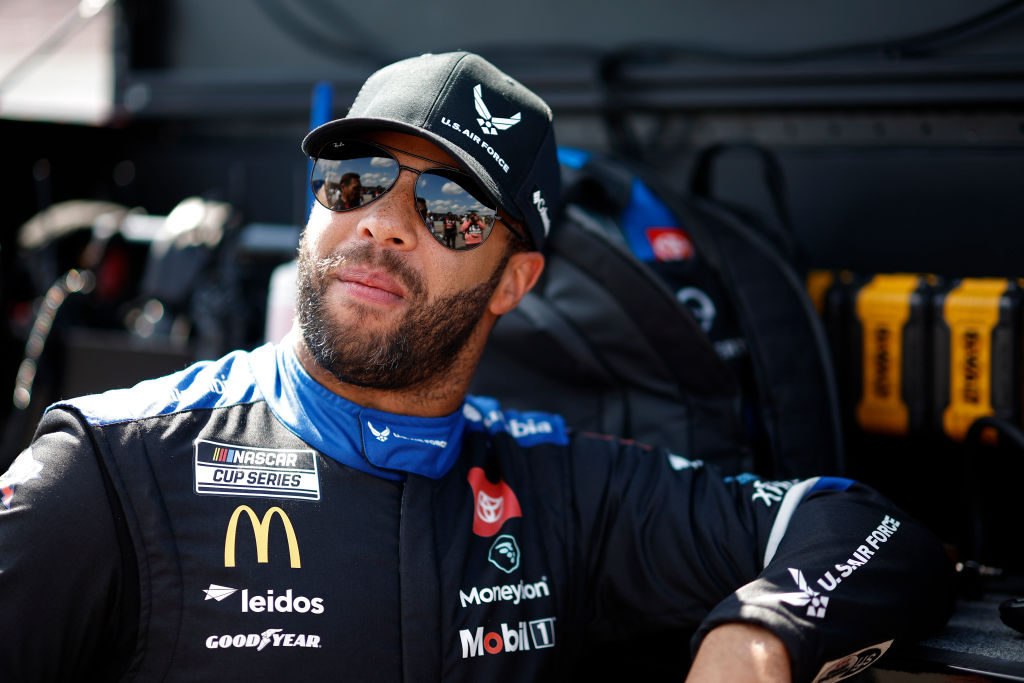
For years, NASCAR had been under criticism for allowing the Confederate flag to be flown during races. Former chairman Brian France tried to ban the flying of Confederate flags at race tracks in 2015, which caused anger among fans. It had previously asked fans to voluntarily stop flying the flag after the 2015 Charleston church shooting, but this did not end the practice. Bubba Wallace, the only African-American NASCAR top-circuit driver, drove the 2020 spring Martinsville race in a car with Black Lives Matter livery, and appeared in an anti-racism video with a number of white drivers. On June 10, 2020, in the wake of protests related to the murder of George Floyd, NASCAR announced that the display of the Confederate flag will be prohibited from all of its events and properties.
Global expansion
In 2006, Toyota announced they would be joining NASCAR's ranks. Toyota generated early success winning several races off performances from Denny Hamlin and Kyle Busch. Any increase in foreign competition is expected to raise the price of putting a car on the track.
Another topic on the NASCAR circuit is the increase in foreign born drivers and the effects they may have on the future of NASCAR. Juan Pablo Montoya, Patrick Carpentier, Dario Franchitti, Kimi Räikkönen, and Jenson Button are among the foreign-born big names who have crossed over from Formula One and the Indy car circuit. These drivers have made an impact on NASCAR not only by winning races and dominating road courses, but by expanding NASCAR's point of view.
NASCAR included a race at the Mexican road course Autódromo Hermanos Rodríguez in the Nationwide Series schedule from 2005 through 2008, as well as a race in Montreal, Canada at Circuit Gilles Villeneuve from 2007 through 2012, with the Camping World Truck Series adding a date at Canadian Tire Motorsport Park in 2013. There has been talk of possible expansion with exhibition races in Japan and a return to Canada.
Expanding into international markets could increase NASCAR's popularity and allow foreign sponsors and manufacturers to get involved in the sport. Some think this could be a very positive move for NASCAR, which has seen its television ratings drop 21 percent between 2005 and 2007. During the same 2-year period, NASCAR also saw the greatest drop in tickets prices observed in over a decade. In 2010, NASCAR saw television ratings drop 10% from the year before, which was down 33% off its peak in 2005. Some think that an increase in international diversity would translate into growth and generate greater opportunities for NASCAR fans.
In 2023, to celebrate their 75th anniversary, NASCAR partnered with Chevrolet and Hendrick Motorsports to enter a Next Gen Camaro ZL1 in the 24 Hours of Le Mans. It coincided with the 100th anniversary of the prestigious endurance race at the Circuit de la Sarthe in Le Mans, Sarthe, France, and the Camaro entered as a Garage 56 (Innovative) entry. Jimmie Johnson and Button were joined by German WEC veteran and Mike Rockenfeller – a 2010 LMP1 category and overall winner at Le Mans – as the drivers. Chad Knaus, Johnson's crew chief during each of his Cup Series championships, was project manager, while the car bore #24 in honor of Jeff Gordon.
NASCAR.com
In October 2000, Turner Sports acquired the digital rights to NASCAR, and subsequently took over its website, which features news, information, and interactive features (such as RaceView and RaceBuddy) surrounding its series. While NASCAR had extended Turner's contract to operate the site through 2016, the association announced in January 2012 that it would take operation of the site back in-house in 2013. As a result, a new NASCAR.com was launched on January 3, 2013, which features a multimedia-oriented design enhanced to provide a higher level of fan interaction, and provide an improved second screen experience for viewers on mobile devices.
On May 7, 2019, NASCAR announced a sports betting content partnership with The Action Network to provide editorial content and analysis to NASCAR.com, including recommended picks and value bets. NASCAR said the partnership was intended to prepare for the spread of legal sports betting in the U.S. following the 2018 U.S. Supreme Court ruling overturning the federal PASPA sports betting prohibition. NASCAR previously struck an exclusive deal with sports data solutions provider Genius Sports to develop an official NASCAR gaming offering for legal sportsbooks.
Subsidiaries and sister organizations
NASCAR Productions
NASCAR Digital Media is a television production company located in Charlotte, North Carolina, United States. The company is a subsidiary of NASCAR and produces programs designed to promote the sport of professional stock car racing. It also manages the NASCAR website, the website for its endurance racing series IMSA, as well as some websites related to the sport such as Racing-Reference and Jayski's Silly Season Site (as of 2019, after ESPN.com stopped hosting the website). They also own NASCAR Classics, a free online base of classic NASCAR races. As of 2025, NASCAR also produces NASCAR O'Reilly Auto Parts Series races broadcast by The CW under the NASCAR on The CW banner.
NASCAR Studios is a production company that produces content including drivers, teams, partners, sponsors, and tracks. Current content includes podcast, documentaries, television shows, and films. The studio also produces content for the NASCAR Channel on Tubi.
ARCA
The Automobile Racing Club of America was purchased by NASCAR in 2018.
Grand-Am
The Grand American Road Racing Association (Grand-Am) was a sanctioning body of sports car racing. While it was founded independently of NASCAR by several members of the France family, NASCAR took over Grand-Am, but allowed it to operate autonomously. The series merged with the American Le Mans Series in 2014 as a part of NASCAR's purchase of IMSA.
Education
NASCAR Technical Institute located in Mooresville, North Carolina, is the country's first technical training school to combine a complete automotive technology program and a NASCAR-specific motor sports program, and is the exclusive educational partner of NASCAR.
NASCAR Kinetics was established in 2009 with the mission of connecting college students nationwide to NASCAR, and mentored its last round of students in 2013.
International Speedway Corporation (defunct)
International Speedway Corporation (ISC) was founded by Bill France Sr. in 1953 to construct and manage tracks at which NASCAR holds competitions. In May 2019, NASCAR announced that it would purchase ISC, including its 12 tracks, for $2 billion. On October 18, 2019, the acquisition was completed. ISC was subsequently folded into NASCAR.
NASCAR in culture
Movies about NASCAR racing include Thunder in Carolina (1960), Speedway (1968), The Last American Hero (1973), Greased Lightning (1977), Stroker Ace (1983), Days of Thunder (1990), Herbie: Fully Loaded (2005), Talladega Nights: The Ballad of Ricky Bobby (2006), Ta Ra Rum Pum (2007), and Logan Lucky (2017).
NASCAR racing heavily influenced Pixar's Cars franchise, with the third film in particular drawing inspiration from NASCAR's history.
NASCAR drivers have made appearances in many television series and TV movies, including The Cleveland Show, Sullivan & Son, and Last Man Standing.
NASCAR partnered up with popular Roblox game Jailbreak, and the partnership was launched on November 5, 2021. NASCAR also partnered with the developers of Jailbreak to launch NASCAR Speed Hub to celebrate NASCAR's 75th anniversary.
In November 2025, it was reported that NASCAR was backing a stock car racing-themed historical drama by John Fusco—Thunder Road—for AMC. The series is planned to star Dennis Quaid .
