




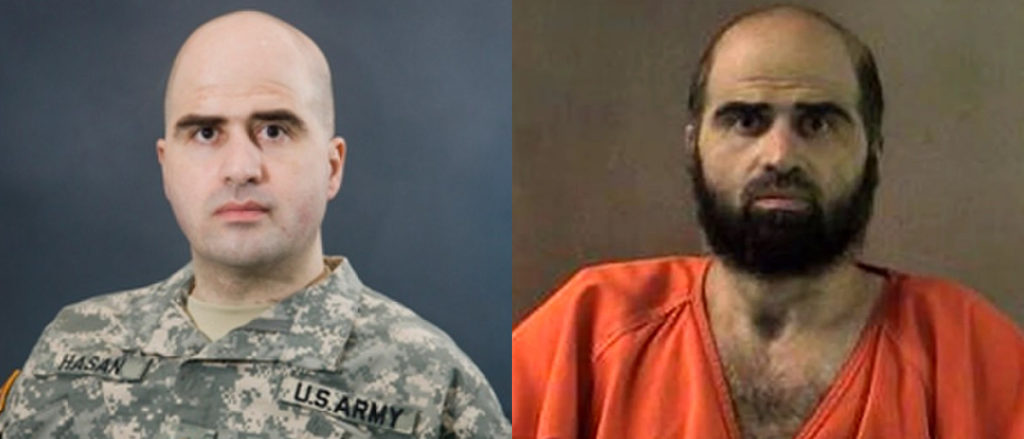
Nidal Malik Hasan (born September 8, 1970) is an American former United States Army major, physician, and mass murderer convicted of killing 13 people and injuring 32 others in the 2009 Fort Hood shooting on November 5, 2009. Hasan, an Army Medical Corps psychiatrist, admitted to the shootings at his court-martial in August 2013.
During the six years Hasan was a medical intern and resident at the Walter Reed Army Medical Center, concerns were raised about his job performance and behavior, specifically comments described by colleagues as "anti-American." Hasan was described as socially isolated, stressed by his work with soldiers, and upset about their accounts of warfare. Two days before the shooting, less than a month before he was due to deploy to Afghanistan, Hasan gave away many of his belongings to a neighbor.
Prior to the shooting, an investigation conducted by the Federal Bureau of Investigation (FBI) concluded Hasan's email correspondence with the late Imam Anwar al-Awlaki were related to his authorized professional research and he was not a threat. The FBI, Department of Defense (DoD), and United States Senate all conducted investigations after the shootings. The Senate released a report describing the shooting as "the worst terrorist attack on U.S. soil since September 11, 2001".
Controversially, the Army decided not to charge Hasan with terrorism. A jury panel of 13 officers convicted him of 13 counts of premeditated murder and 32 counts of attempted premeditated murder, and unanimously recommended he be dismissed from the service and sentenced to death. Hasan is incarcerated at the United States Disciplinary Barracks at Fort Leavenworth, Kansas, awaiting execution.
Contents
Early life
Nidal Hasan was born on September 8, 1970, at Virginia Hospital Center in Arlington County, Virginia. His parents were naturalized American citizens of Palestinian origin; they had immigrated years earlier from al-Bireh, a city in the West Bank near Jerusalem.
Raised in the Muslim faith with his two younger brothers, Hasan attended Wakefield High School in Arlington for his freshman year in 1985. His family moved to Roanoke in 1986, where his father had moved a year before to set up what would become a number of successful family-owned businesses which included a market, restaurant and olive bar.
Hasan graduated from Roanoke's William Fleming High School in 1988. His father died in 1998 at the age of 51; his mother died three years later at the age of 49. One of his brothers continues to live in Virginia while the other moved to the Palestinian territories.
Military service, higher education and medical career
Hasan enlisted in the United States Army in 1988 after graduating from high school. He attended college during this time, earning an associate degree in science from Virginia Western Community College in 1992. In 1995, he graduated from Virginia Tech with a bachelor's degree in biochemistry. He completed both of these programs with Latin honors. He was commissioned as an officer in the Army Medical Department in 1997, and enrolled at the Uniformed Services University of the Health Sciences (USUHS) in Bethesda, Maryland.
Hasan's performance was marginal while enrolled at USUHS. He was on academic probation during much of the six years he required to complete the four-year curriculum and graduate medical school. Upon graduation in 2003, Hasan completed his internship and residency in psychiatry at the Walter Reed Army Medical Center (WRAMC). He completed his psychiatry training with a two-year fellowship in disaster and preventive psychiatry, earning a master's degree in public health. During his training at Walter Reed, he received counseling and extra supervision.
According to The Washington Post, Hasan made a presentation titled "The Quranic World View as It Relates to Muslims in the U.S. Military" during his senior year of residency at WRAMC; it was not well received by some attendees. He suggested the U.S. Department of Defense "should allow Muslims [sic] Soldiers the option of being released as 'Conscientious objectors' to increase troop morale and decrease adverse events." On a previous slide, he explained "adverse events" could be refusal to deploy, espionage, or killing of fellow soldiers.
Retired Colonel Terry Lee, after working with Hasan, recalled the fatal shooting of two recruiters in Little Rock, Arkansas, greatly affected Hasan. Lee told Fox News that Hasan made "outlandish" statements against the American military presence in Iraq and Afghanistan, reportedly saying that "the Muslims should stand up and fight against the aggressor", referring to American soldiers. Hasan expressed hope U.S. president Barack Obama would withdraw troops. He was frequently agitated and argumentative with other Army personnel.
Despite these problems, in May 2009, Hasan was promoted to major. In July 2009 he was transferred to Darnall Army Medical Center in Fort Hood, Texas, moving into the city of Killeen. Two weeks later, he lawfully purchased an FN Five-seven handgun. Prior to his transfer, Hasan had received a 'poor performance' evaluation from supervisors and medical faculty. Despite concerns, his former boss, Lt. Col. Ben Phillips, graded his performance as "outstanding".
Military awards and decorations
Hasan received the Army Service Ribbon as a private in 1988 after completing Advanced Individual Training (AIT), the National Defense Service Medal twice for service during the time periods of the Persian Gulf War and the Global War on Terror, and the Global War on Terrorism Service Medal for support service during the Global War on Terror.
Religious and ideological beliefs
According to one of his cousins, Hasan was Muslim; he became more devout after the early deaths of his parents. His cousin did not recall him expressing any radical or anti-American views, and his family also described Hasan as a peaceful person, and a good American. One of his cousins said Hasan turned against the wars after hearing the stories of soldiers he treated in therapy following their return from Afghanistan and Iraq. His aunt said he did not tell the family he was going to Afghanistan.
In May 2001, Hasan attended the Dar Al-Hijrah mosque in the Falls Church area for the funeral of his mother and occasionally, attended a mosque in Silver Spring, Maryland, close to where he lived and worked; he was well known by the Imam for over a decade. Faizul Khan, the former Imam of the Silver Spring mosque where Hasan prayed several times a week, said he was "a reserved guy with a nice personality. We discussed religious matters. Politics were never brought up. He is Muslim." Khan said Hasan often expressed his wish to get married, and the Imam said, "I got the impression he was a committed soldier."
Air Force Lt. Col. Dr. Val Finnell, a graduate school classmate in the Master's in Public Health program, said in a class on environmental health, Hasan's project dealt with "whether the Global War On Terror is a war on Islam" and the effect on Muslims in the military, which Finnell thought was strange.
According to Colonel Terry Lee, since retired, "He [Hasan] said 'maybe Muslims should stand up and fight against the aggressor'. At first, we thought he meant help the armed forces, but apparently that wasn't the case. Other times, he said we shouldn't be in the war in the first place."
Email exchanges with Anwar Al-Awlaki
In 2001–02, Anwar al-Awlaki was the Imam of the Dar al-Hijrah mosque; during that time, he was considered a moderate Muslim. Serving as the Muslim chaplain at George Washington University, he was frequently invited to speak about Islam to audiences in Washington DC and to members of Congress and the government. Hasan reportedly had deep respect for al-Awlaki's teachings.
Eleven months prior to the shootings, in December 2008, federal intelligence officials captured a series of e-mail exchanges between Al-Awlaki and Hasan. During this period, al-Awlaki was deemed a "radical cleric". However, they determined the e-mails were religious, and did not contain any elements of militancy nor any concerning subject matter. Counter-terrorism specialists for the FBI reading the e-mails stated "they were consistent with authorized research Major Hasan was conducting." The e-mails contained general questions about spiritual guidance with regard to conflicts between Islam and military service, and officials judged them to be consistent with his legitimate mental health research about Muslims in the American armed services.
After the shootings, the Yemeni journalist Abdulelah Hider Shaea interviewed al-Awlaki in November 2009 about their exchanges, and discussed their time with a Washington Post reporter. According to Shaea, Al-Awlaki said he "neither ordered nor pressured ... Hasan to harm Americans". Al-Awlaki said Hasan first e-mailed him on December 17, 2008. By way of introduction, Hasan said: "Do you remember me? I used to pray with you at the Virginia mosque." According to Al-Awlaki, Hasan said he was Muslim around the time the Imam was preaching at Dar al-Hijrah in 2001 and 2002. This coincides with the death of his mother.
Al-Awlaki said, "Maybe Nidal was affected by one of my lectures." He added: "It was clear, from his e-mails, Nidal trusted me. Nidal told me: 'I speak with you about issues I never speak with anyone.'" Al-Awlaki said Hasan arrived at his conclusions regarding the acceptability of violence in Islam, and said he was not the one to initiate this. Shaea summarized their relationship by saying, "Nidal was providing evidence to Anwar, not vice versa."
In October 2008, Charles Allen, US Undersecretary of Homeland Security for Intelligence and Analysis, warned al-Awlaki "targets US Muslims with radical online lectures encouraging terrorist attacks from his new home in Yemen".
Prior to the Fort Hood shooting
Internet activity
The government agents monitoring Islamic websites believe Hasan, using the screenname 'NidalHasan', posted about suicide bombings in May 2009, although, during this period, government agents did not link the posts to Hasan. The postings by 'NidalHasan' likened a suicide bomber to a soldier falling on a grenade to save his colleagues, to sacrifice for a "noble cause". ABC News reported after the fact, anonymous government agents issued a press-release claiming they were allegedly aware Hasan attempted to contact Al Qaeda, then issued a press-release claiming Hasan had "more unexplained connections to people tracked by the FBI" than just Anwar al-Awlaki.
Hasan's business card left in his apartment describes him as a psychiatrist specializing in Behavioral Health – Mental Health – Life Skills, and contains the acronyms SoA (SWT). According to investigators, the acronym "SoA" is used on jihadist websites as an acronym for "Soldier of Allah" or "Servant of Allah." SWT is commonly used to mean "subhanahu wa ta'ala" (Glory to God). A review of Hasan's computer and e-mail accounts show visits to Internet sites espousing radical Islamist ideas, according to a press-release from an anonymous government agent.
Emails to superiors
Hasan expressed concern about the former actions by some of the soldiers he evaluated as a psychiatrist. Days before his attacks on Fort Hood in 2009, Hasan asked his supervisors and Army legal advisers how to handle reports of soldiers' deeds in Afghanistan and Iraq that disturbed him.
Other activity
Hasan was to be deployed to Afghanistan on November 28. Hasan told a local store owner he was stressed about his imminent deployment to Afghanistan since he might be required to fight or kill fellow Muslims. In a press-release from Jeff Sadoski, spokesman for U.S. senator Kay Bailey Hutchison, "Hasan was upset about his deployment".
Hasan gave away furniture from his home on the morning of the shooting, saying he was going to be deployed on Friday. He also distributed copies of the Quran. Kamran Pasha wrote about a Muslim officer at Fort Hood who said he prayed with Hasan on the day of the Fort Hood shooting, and Hasan "appeared relaxed and not in any way troubled or nervous". This officer believed the shootings could possibly be motivated by religious radicalism.
Fort Hood attacks
On November 5, 2009, Hasan reportedly shouted "Allahu Akbar!" (the phrase means "Allah is great"), and opened fire on armed forces in the Soldier Readiness Center of Fort Hood, located in Killeen, Texas, killing thirteen people and wounding over thirty others in the worst shooting against armed forces on an American military base.
Department of the Army police officer Kimberly D. Munley encountered Hasan leaving the building. Munley and Hasan exchanged shots before Munley was shot in the leg twice. Department of the Army police officer Mark Todd shot Hasan several times. Todd kicked the pistol out of Hasan's hand, then cuffed Hasan. The attack lasted about ten minutes.
Post-shooting
To save his life, Hasan was hospitalized in the intensive care unit at Brooke Army Medical Center at Fort Sam Houston in San Antonio, Texas. His condition was described as "stable". News reports on November 7, 2009, indicated he was in a coma. On November 9, hospital spokesperson Dewey Mitchell announced Hasan regained consciousness, and was able to talk since he was removed from a ventilator on November 7. On November 13, Hasan's attorney, John Galligan, announced Hasan was paralyzed from the waist down from the bullet wounds to his spine, and would likely never walk. In mid-December, Galligan indicated Hasan was moved from intensive care to a private hospital room. Galligan said doctors indicated Hasan would need at least two months in the hospital to learn "to care for himself".
On November 7, 2009, while Hasan was communicative, he refused to talk to law enforcement officials. On November 12 and December 2, respectively, Hasan was charged with thirteen counts of pre-meditated murder and thirty-two counts of attempted murder under the Uniform Code of Military Justice, thus making him eligible for the death penalty.
At the time, authorities did not specify if they would seek the death penalty; Colonel Michael Mulligan would serve as the Army's lead prosecutor. Mulligan was lead prosecutor on the Hasan Akbar case, in which a soldier was sentenced to death for the murder of two members of the US military.
John P. Galligan, a retired Army JAG colonel, represented Hasan. On November 21, in a hearing held in Hasan's hospital room, a military magistrate ruled there was probable cause Hasan committed the shooting spree at Fort Hood, and ordered pre-trial confinement until his court-martial. Hasan remained in intensive care in accordance with the magistrate's dictate. On November 23, Galligan said Hasan would likely plead not guilty to the charges against him, and may use an insanity defense at his court-martial. In a press-release, Army public affairs staff stated doctors would evaluate Hasan by mid-January 2010 to determine his competency to stand trial as well as his mental state at the time of the attacks, but delayed the exam on request from Galligan until after the Article 32 hearing. The Army dictated Hasan speak only in English on the phone or with visitors unless an interpreter was present. Hasan was moved from Brooke Army Medical Center to the Bell County Jail in Belton, Texas, on April 9, 2010. Fort Hood negotiated a renewable $207,000 contract with Bell County in March to house Hasan for six months.
Reaction
Some Muslims claimed the events in Islamist terms for political purposes. After the Fort Hood attacks, Anwar al-Awlaki praised Hasan's actions:
Nidal Hassan [sic] is a hero. He is a man of conscience who could not bear living the contradiction of being a Muslim and serving in an army fighting against his people [...] Any decent Muslim cannot live, understanding properly his duties toward his Creator and his fellow Muslims, and yet serve as a member of the US armed forces. The U.S. is leading the war against terrorism which, in reality, is a war against Islam.
Al-Awlaki posted this as part of a lengthy Internet message.
In March 2010, Al Qaeda spokesman Adam Yahiye Gadahn praised Hasan, saying, although he was not a member of Al Qaeda, the
Mujahid brother [...] shown us what one righteous Muslim with an assault rifle [sic] can do for his religion and brothers in faith [...] is a pioneer, a trail-blazer, and a role-model [...] and yearns to discharge his duty to Allah and play a part in the defense of Muslims against the savage, heartless, and bloody Zionist Crusader assault on our religion, sacred places, and homelands.
Hours before the attacks, CNN posted an interview and video of a New York city organization called Revolution Muslim, in which Younes Abdullah Mohammed (a Jew converted to Islam) spoke outside a New York mosque, saying U.S. armed forces are "legitimate targets", and Osama bin Laden was their model. The evening after the attacks, Revolution Muslim posted support for Hasan on their website, one of the few American sites to do so. In the video, RM described American armed forces as "slain terrorists in the eternal hellfire". Some Muslims condemned the organization.
A November 2009 press-release from the Ansar Al-Mujahideen Network cited Hasan as a role model. They congratulated him for his "brave and heroic deed" for standing up to the "modern Zionist-Christian Crusades" against Muslims.
Hasan's perceived beliefs were a cause for concern among some of his peers. According to an anonymous source, Hasan was disciplined for "proselytizing about his Muslim faith with patients and colleagues" while at Uniformed Services University of the Health Sciences (USUHS). The Telegraph reported an incident in which some attendees felt that one of his lectures, expected to be of a medical nature, became a diatribe against "infidels". Air Force doctor Val Finnell, a former medical school classmate, complained to superiors about Hasan's "anti-American rants". Finnell said: "The system is not doing what it's supposed to do. He at least should have been confronted about these beliefs, told to cease and desist, and to shape up or ship out."
Post-conviction life
Following his conviction and sentencing, Nidal Hasan was incarcerated at the United States Disciplinary Barracks at Fort Leavenworth in Kansas to await execution. According to Chris Haug, Fort Hood's Chief of Media Relations, Hasan was stripped of his rank and dismissed from the U.S. Army. Hasan would be referred to as "Inmate Nidal Hasan". On September 5, 2013, prison staff force-shaved Hasan. Fort Leavenworth authorities justified their decision by citing Hasan would be subject to Army regulations although he was dismissed from the Army and forfeited all pay and allowances. Despite Army regulations banning personnel from facial hair, Hasan stopped shaving following the Fort Hood attacks in 2009 by citing his religious beliefs. Although no new photos of Hasan have been released since his incarceration, military authorities confirmed that a video recording of the force-shaving exists, as per military regulations. In response, John Galligan, Hasan's former civilian lawyer, planned to sue the military for violating his religious beliefs. Galligan argued a military council in 2012 allowed Hasan to keep his beard for the duration of the trial, and dismissed the Army's actions as vindictive.
On August 28, 2014, Hasan's attorney said Hasan wrote to Abu Bakr al-Baghdadi, then head of the Islamic State of Iraq and the Levant (ISIL). In the letter, Hasan requested to be made a citizen of the Islamic State, and included his signature and the abbreviation SoA (Soldier of Allah).
In January 2015, it was reported that despite the lengthy appeals process, Hasan was "eager to follow his path to martyrdom" as soon as possible.
Appeals and subsequent developments
On December 7, 2020, the U.S. Army Court of Criminal Appeals upheld Hasan's death penalty.
On September 11, 2023, the U.S. Court of Appeals for the Armed Forces upheld Hasan's death penalty.
On March 31, 2025, the United States Supreme Court denied Hasan's final petition for a writ of certiorari, thereby confirming his death sentence. On September 24, 2025, Secretary of Defense Pete Hegseth announced that he was seeking formal approval for Hasan's execution from President Donald Trump.
In popular culture
The Israeli singer Eric Berman, in his album "Oh Pathetic Ridiculous Heart," composed the song "Not A Simple Story" following the background of the attacks. The song describes Hasan's biography and his deterioration leading him to attack.