




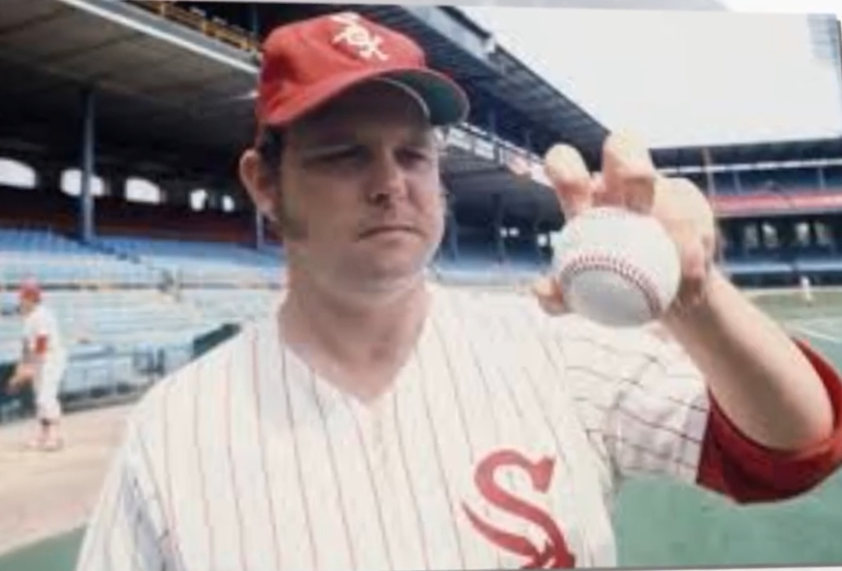
Wilbur Forrester Wood Jr. (October 22, 1941 – January 17, 2026) was an American professional baseball pitcher. In a 17-year Major League Baseball (MLB) career, he pitched for the Boston Red Sox (1961–1964), the Pittsburgh Pirates (1964–1965), and the Chicago White Sox (1967–1978). A knuckleball specialist after joining the White Sox, he threw left-handed and batted right-handed.
Raised in Belmont, Massachusetts, Wood played several sports in high school and was signed by his hometown Boston Red Sox in 1960. He pitched sparingly for them over parts of four seasons before being traded to the Pittsburgh Pirates in 1964. Seldom-used by the team in 1965, he spent all of 1966 in the minor leagues before being traded to the White Sox. Wood, who had previously relied on a fastball and curveball, refined the knuckleball with the help of veteran knuckleball specialist Hoyt Wilhelm. He spent the next four seasons as a relief pitcher for Chicago. In 1968, he set a record (broken the next year) with 88 games pitched and was named the Sporting News American League (AL) Fireman of the Year.
The White Sox tried to trade Wood before the 1971 season, but an injury to starting pitcher Joe Horlen caused them to put him in the starting rotation. That season, pitching coach Johnny Sain suggested that Wood pitch with only two days' rest between starts, since knuckleball specialists do not put as much stress on their arms as other pitchers. Wood proceeded to lead the AL in games started from 1972 through 1975, starting a career-high 49 games in 1972. That season, he also recorded a career-high 376+2⁄3 innings pitched (IP), breaking the live-ball era record of 376 IP set by Mickey Lolich of the Detroit Tigers just one season prior. He won 20 or more games for four consecutive seasons, leading the AL in 1972 and 1973 with 24 wins. In 1973, Wood also matched the 1916 record of Walter Johnson of a pitcher to win and lose 20 or more games in a season. Wood was an All-Star in 1971, 1972, and 1974.
After making 43 starts in 1975, Wood made only seven in 1976. A line drive off the bat of Ron LeFlore fractured Wood's kneecap in a game against the Detroit Tigers. Despite months of rehabilitation, Wood was "gun-shy" upon his return in 1977 and posted the worst earned run average among qualifying AL pitchers in 1978 (5.20). He retired after the season. Wood's 90 wins from 1971–74 were the most by a major league pitcher during that span. A lifelong New England resident, Wood held a number of jobs in the Boston area after his retirement from baseball.
Contents
Early life
Wilbur Forrester Wood Jr. was born in Cambridge, Massachusetts, on October 22, 1941. His parents were Wilbur Sr., a wholesale foods employee, and Svea (née Swenson). Wilbur grew up in Belmont, Massachusetts, with his younger brother, Jimmy. The brothers were athletic and would play sports year-round. Wood attended Belmont High School, where he played in three different sports: baseball, as a pitcher; football, as the starting quarterback; and hockey, as a defenseman. His father, a semi-professional baseball player, taught him how to throw a knuckleball while he was in high school, but Wood relied on his fastball and curveball in actual games. Using just two pitches, he helped the baseball team win the state championship in 1959 (his junior year), and he finished his high school career with a 24–2 record. He also played for American Legion Post 99, winning 42 games.
According to Bill Stone, Wood's high school baseball coach, about 50 colleges wanted the prospect for one sport or another. Wood, however, wanted to play professional baseball, and he was drawing interest from the St. Louis Cardinals, the Milwaukee Braves, and the Boston Red Sox. The Braves paid for him to fly to Milwaukee for a tryout, where minor league director Roland Hemond was unimpressed. "He was a chubby little guy who didn't throw very hard. I watched him throw batting practice (and) couldn't get very excited." The Red Sox, however, hoped to boost ticket sales by having a hometown prospect turn into a sensation. They offered a significant bonus (reportedly from $25,000 to $50,000), and Wood accepted their offer. "I wanted to play for the Red Sox," Wood said of his hometown team in a 1989 interview, "but at that point I wanted the club that offered me the most amount of bonus money."
Professional career
Boston Red Sox (1961–64)
Wood began his professional career in 1960 with the Class D Waterloo Hawks of the Midwest League. He won his only decision in four games with the club, posting a 2.70 earned run average (ERA) before getting promoted to the Raleigh Capitals of the Class B Carolina League. With Raleigh, he had a 3–5 record and a 3.84 ERA in 13 games (12 starts). After the season, Boston added him to its 40-man roster.
In 1961, Wood attended spring training with the Red Sox for the first time. In his first inning of work, he struck out three San Francisco Giants hitters, prompting the Boston Globe to declare that he would have "spectacular success" in his career. Sent to the Class B Winston-Salem Red Sox to begin the season, he posted an 8–5 record with a 3.15 ERA, 103 strikeouts, 33 walks, and 99 hits allowed in 111+1⁄3 innings pitched. Having trouble with their attendance numbers, the Red Sox promoted the young Wood to the major leagues in the middle of June. He made his major league debut at Fenway Park on June 30, allowing three hits and two runs while striking out three over the final four innings of a 10–2 loss to the Cleveland Indians. In the second game of a July 19 doubleheader, he made his first major league start (also against Cleveland), allowing three runs in three innings but not getting the decision in an eventual 9–8 defeat. He appeared in six games (one start) for the Red Sox, posting no record, a 5.54 ERA, seven strikeouts, seven walks, and 14 hits allowed in 14 innings before getting sent back to the minors in late July, this time to the Johnstown Red Sox of the Class A Eastern League. Wood did not pitch well there, losing seven of 10 decisions and posting a 4.62 ERA with 44 strikeouts, 15 walks, and 80 hits allowed in 74 innings.
Boston's Eastern League affiliation became the York White Roses in 1962, and Wood ranked among the league leaders by season's end. He finished tied for second in wins (15, tied with Dave McNally and Sonny Siebert behind Paul Seitz's 16), sixth in ERA (2.84), sixth in strikeouts (178), and third in hits allowed (198, behind Jay Ritchie's 209 and Richard Slomkowski's 202). His 219 innings pitched topped the league. Promoted to Boston in September, he made one start for the Red Sox on the 22nd, allowing three runs in 7+2⁄3 innings but receiving a no decision in a 4–3 loss to the Washington Senators.
In 1963, Wood was one of the last pitchers cut in spring training. He opened the season with the Class AAA Seattle Rainiers of the Pacific Coast League, but after recording a 1.12 ERA and winning five of seven decisions, he joined the Red Sox in early June. Boston initially used him as a starter, but he lost four games and allowed 39 hits in 28 innings before getting moved to the bullpen in early July, where he spent the rest of the season. "The little sonofagun just couldn't throw hard enough," manager Johnny Pesky said. "But he wanted to pitch and tried his hardest." As a relief pitcher, he recorded a 2.45 ERA in 36+2⁄3 innings pitched. In 25 games (six starts), he had an 0–5 record, a 3.76 ERA, 28 strikeouts, 13 walks, and 67 walks in 64+2⁄3 innings pitched.
Pittsburgh Pirates (1964–65)
Wood appeared in three games towards the end of the year with the Pirates, including two starts. On October 2, he held the Braves to two runs through nine innings, but the Pirates only scored two, and the game went to the 10th. The Braves loaded the bases against Wood, who then walked Woody Woodward to force in a run. Though it was his first complete game in the major leagues, he still had yet to win a game in parts of four seasons at the big league level.
1965 was Wood's first full season on a major league roster, though his appearances (all but one of which were out of the bullpen) were seldom. According to Gregory H. Wolf of the Society for American Baseball Research, Wood's "soft-spoken and amiable" nature led to a personality clash with the "brash" Harry Walker, who managed Pittsburgh. On August 29, he relieved Bob Friend in the sixth inning of a 2–2 game against the Houston Astros after Friend had allowed the first two hitters to reach base. Retiring all three men he faced, Wood was ultimately credited with the win, his first, after Pittsburgh took the lead in the seventh. In 34 games, he had a 1–1 record, a 3.16 ERA, 29 strikeouts, 16 walks, and 44 hits allowed in 51+1⁄3 innings pitched.
In 1966, Wood was one of the first Pirates' pitchers cut from major league spring training. He said that he "thought about quitting baseball, but my wife encouraged me to try one more time." "I think he might have gone into the plumbing business with my father," his wife said. With the Class AAA Columbus Jets of the International League, he had what Wolf called "the hitherto best year of his career at arguably the most crucial point." Wood was named the International League's Most Outstanding Pitcher, leading the circuit in ERA (2.41), complete games (15), shutouts (8), and innings pitched (224). Additionally, his 14 wins tied for third in the league (with Billy Rohr behind Gary Waslewski's 18 and Ed Barnowski's 17); he lost just eight times, for a winning percentage of .636. Though the Pirates chose not to call him up after the year, his performance impressed George Maltzberger, a scout for the Chicago White Sox, who recommended the pitcher to general manager (GM) Ed Short. On October 12, the Pirates traded Wood to the White Sox for a player to be named later (ultimately Juan Pizarro).
Chicago White Sox (1967–78)
When Wood arrived at spring training with Chicago in 1967, manager Eddie Stanky immediately informed him he would be the ballclub's mop-up man. Wood realized he needed to make a change to prolong his career. Since high school, he had experimented with a knuckleball, and one of Chicago's relief pitchers was knuckleball specialist Hoyt Wilhelm, who would later be elected to the Hall of Fame. "I went to him right away and asked him if he would explain more to me about the knuckler," Wood said. Wilhelm showed Wood how to throw good knuckleballs consistently. "You either throw the knuckleball all of the time or not at all. It's not an extra pitch," Wilhelm explained. Taking Wilhelm's advice, Wood's career took off, first as a relief pitcher, and then as a starting pitcher. With the White Sox, Wood became well known as a durable workhorse and was among the last pitchers to consistently throw well over 300 innings in a season.
Wood made the roster as a relief pitcher and posted a 1.51 ERA in the first half of the season, beginning to get appearances late in games the White Sox were leading in late May. An injury to Jim O'Toole and struggles by John Buzhardt gave him an opportunity to start in July, and he won the first game of a doubleheader against the Kansas City Athletics on July 16, outpitching Catfish Hunter as he held the A's to one run in 8+1⁄3 innings. He was 3–0 as a starter in July, but after losing his first two starts of August, he returned to more of a relief role, though he did win a start against the New York Yankees on August 22. In 51 games (eight starts), he had a 4–2 record, four saves, a 2.45 ERA, 47 strikeouts, 28 walks, and 95 hits allowed in 95+1⁄3 innings pitched.
Wilhelm continued to help Wood with his knuckleball in 1968 spring training, and White Sox pitching coach Marv Grissom convinced Wood to do away with his pitching windup. Wood had been reducing it since the previous year, but dispensing with it entirely allowed him to sneakily throw his fastball to hitters, making it a deceptive counterpart to the knuckleball. Struggles experienced by Bob Locker led to Stanky utilizing Wood at the end of games more often beginning in May. On June 23, he started the second game of a doubleheader against the Red Sox, holding Boston to one run in eight innings in a 10–1 win. He made one other start on August 10, allowing one earned run in six innings against the Indians, though an error by Duane Josephson led to two unearned runs scoring as well, and Wood took the loss in the 3–2 defeat. On September 1, he pitched the final five innings of a game against the Minnesota Twins, allowing just one run (a home run to Harmon Killebrew) as he picked up the victory in a 5–4 win. He set a major league record on September 21 with his 83rd appearance of the year. Wood finished the season with 88 games pitched, briefly a record until Wayne Granger appeared in 90 for the Cincinnati Reds the next year. As of 2020, his 88 games pitched ties him with four other relievers for 15th-most in a season. He had a 13–12 record (leading the White Sox in wins), a 1.87 ERA, 74 strikeouts, 33 walks, and 127 hits allowed in 159 innings pitched. Though the save would not become an official statistic until 1969, Wood was retroactively credited with 16, second in the American League (AL) to Al Worthington's 18. Wood also led the AL with 46 games finished. Sportswriter Jerome Holtzman said he was "sensational," and Stanky, dismissed partway through the season, said "he's an amazing pitcher." The Sporting News named him its AL Fireman of the Year. Wood also finished 25th in AL Most Valuable Player (MVP) voting.
Career statistics
In a 17-year major league career, Wood compiled a 164–156 record with a 3.24 ERA in 661 games. He had 1,411 strikeouts in 2,684 innings pitched, completing 114 games (24 of which were shutouts) of his 297 games started. Wood started 70 games on two days' rest, the highest total since 1914 with the exception of Grover Cleveland Alexander, who did so 72 times in that period.
At the plate, Wood posted a .084 batting average (27 hits in 322 at bats) with only two extra-base hits (both doubles) and just 13 RBI. As a fielder, he recorded a .977 fielding percentage.
First eligible for the Hall of Fame in 1984, Wood received votes for six years. His best year was 1988, when he garnered seven percent of the vote. After receiving just 3.1% of the vote in 1989, he became ineligible to appear on further ballots, as players must receive at least five percent each year to remain potential selections.
Pitching style
In the prime of his career, Wood would throw his 60 to 70 mph knuckleball about 80 percent of the time. Multiple observers called the pitch "tantalizing." It was slower than Wilhelm's or Phil Niekro's, but Wood's tricky delivery compensated for the diminished speed. He continued to use his fastball as well; though he did not have much velocity on it, the pitch would deceive hitters because it traveled straight, unlike the knuckleball. On the knuckleball's unpredictability, Wood said, "We just aim it for the middle of the plate and hope like hell it goes somewhere before it gets there." His ability to keep the pitch in the strike zone set him apart from other knuckleball pitchers. "I'm nervous every time I go out there," Wood explained how he felt on the mound. "It's a thrill – and a challenge. If you are not exciting when you come in, you're lost. But I don't lose my concentration because of a hit or a wild pitch." Pitching coach Johnny Sain said, "Wilbur has tremendous poise. He has the perfect temperament [and] never gets rattled."
"The release, you see, is everything," Wood said as he described how to throw the knuckleball. "You must try to release each pitch the same way. It's a very fine point, but you have to find the spot to let it go. You throw it just like a fastball, only at three-quarter speed. There should be no strain on the shoulder and the elbow. Ideally, there should be no wrist break. This means the ball will not rotate. A really good pitch makes no more than 1½ revolutions. The wind will affect the ball when it is not rotating, causing it to change directions. You will get more break if the wind is blowing in your face, but if it is blowing behind you, your control will be better." He thinks the reason more pitchers do not throw the knuckleball is because it takes several years to get used to.
Hall of Famer Rick Ferrell caught four knuckleballers with the Senators in the 1940s. "I have seen most of the great knuckleballers," he said in 1973, "but it is hard to say that anyone has ever been better than Wood, regardless of time or whatever." "I guess they always said, 'Poor Wilbur, he just doesn't have enough natural ability to pitch in the big leagues. What they call natural ability is standing six-four and being able to throw a ball 100 miles per hour. Well, it turns out that he has as much God-given ability as any man I've ever met. He can throw the knuckleball [and] it requires [a] natural feel," said Sain. "I tell you the sensation I get," Gene Tenace of the Athletics said in describing an at bat against Wood. "I see the ball floating up and then I swing. I get a feeling that the bat has made a ripple in the air and has caused the ball to wriggle like a roundworm." Mike Epstein of the Angels said, "...feeling fully prepared, we go out there and face the thing Wood throws. It looks like a batting practice pitch—soft, tempting. Like the one he struck me out with today, it breaks three or four directions. I didn't know where it was headed. The catcher, I'm sure, didn't know where it was headed. And I'm pretty certain not even Wood knew where it was headed." Paul Blair of the Orioles said, "Obviously, the knuckleball makes Wilbur effective, but what makes him even more effective is the fact that he throws it over for strikes. It never goes the same way, but it is always in the strike zone."
Highlights
3-time All-Star (1971, '72, '74)
AL The Sporting News Fireman of the Year Award winner in 1968
AL The Sporting News Pitcher of the Year Award winner in 1972
Led the AL in wins twice (1972, '73)
Led the AL in games started four times (1972, '73, '74, '75), with his career high coming in 1972 (49)
2nd in the AL in shutouts twice (1971, '72), tied with Mel Stottlemyre in 1971
2nd in AL Cy Young Award voting (1972)
Set a single-season record for games pitched in 1968 (88, including 2 starts), broken by Wayne Granger in 1969
Personal life and death
On November 6, 1963, Wood married Sandra Malcolm, in whom he had been interested since high school. Wendy, Derron, and Christen were their three children. Athleticism ran in the family, as Wendy received top ranking in the 18s category for the New England Lawn Tennis Association in 1981.
Though he last pitched for the Red Sox in 1964, Wood continued to make his home in the Boston area, working in the food industry during the offseason. Following his career, he purchased Meister's Seafood, a fish market in Belmont that he operated for five years before selling the business. Then, he worked for Carolina Medical as a pharmaceutical salesman and account manager in the Boston region. "Being a ballplayer or being a salesperson,
you have to sell yourself," he said.
Fishing was a hobby of Wood's. He would often go out and catch snook during Chicago's spring training in Sarasota. Wood also gardened and cooked and continued to follow baseball, though not as much as he did while still playing. After Wood's 300+ inning seasons, he was not a fan of the later-inning relief pitchers that were becoming so prevalent in baseball by 2001. He was good friends with Jim Price, his catcher at Columbus in 1966.
During his career, Wood stood 6 feet (1.8 m) tall and was listed at 180 pounds (82 kg). Edgar Munzel of The Sporting News offered the following description: "There isn't anyone in the major leagues ... who looks less like a ballplayer. He's a chubby, pot-bellied guy with thinning blond hair, blue eyes, and a pleasant round face." Soft-spoken with a distinct Boston accent, he had a sense of humor he would display around teammates.
Wood died on January 17, 2026 at a hospital in Burlington, Massachusetts, at the age of 84.