



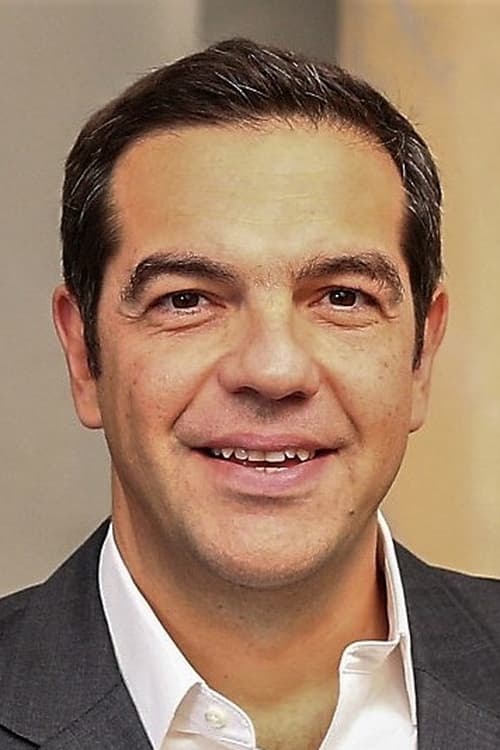

Alexis Tsipras (Greek: Αλέξης Τσίπρας [aˈleksis ˈt͡sipras]; born 28 July 1974) is a Greek politician who served as Prime Minister of Greece from 2015 to 2019. He is the founder and leader of the Greek Left Alliance political party. A prominent leftist figure, Tsipras served as the leader of the Greek political party Syriza (Coalition of the Radical Left) from 2008 to 2023. Tsipras is the fourth prime minister who has governed in the course of the 2010s Greek government-debt crisis. Originally an outspoken critic of the austerity policies implemented during the crisis, his tenure in office was marked by an intense austerity policy, mostly in the context of the third EU bailout to Greece (2015–18).
Born in Athens in 1974, Tsipras joined the Communist Youth of Greece in the late 1980s and in the 1990s was politically active in student protests against education reform plans, becoming the movement's spokesperson. He studied civil engineering at the National Technical University of Athens, graduating in 2000, and later undertook post-graduate studies in urban and regional planning. He worked as a civil engineer in the construction industry, based primarily in Athens. From 1999 to 2003, Tsipras served as the secretary of Synaspismos Youth. He was elected as a member of the Central Committee of Synaspismos in 2004 and later the Political Secretariat. In the 2006 local election, he ran as Syriza's candidate for Mayor of Athens, winning 10.5%. In 2008, he was elected as leader of Syriza, succeeding Alekos Alavanos. He was first elected to the Hellenic Parliament representing Athens A in the 2009 election and was re-elected in May and June 2012, subsequently becoming Leader of the Opposition and appointing his own shadow cabinet.
In January 2015, Tsipras led Syriza to victory in a snap legislative election, winning 149 out of 300 seats in the Hellenic Parliament and forming a coalition with the Independent Greeks. On 20 August 2015, seven months into his term as prime minister he lost his majority after intraparty defections after the 2015 Greek bailout referendum, announced his resignation, and called for a snap election to take place the following month. In the September 2015 election that followed, Tsipras led Syriza to another victory, winning 145 out of 300 seats and re-forming the coalition with the Independent Greeks. As prime minister, he oversaw negotiations regarding the Greek government-debt crisis, initiated the Greek bailout referendum, responded to the European migrant crisis, and signed the Prespa agreement. In 2015, he was named by Time as one of the 100 most influential people globally. By 2017, he was on the same magazine's list of the least popular (less than 40% approval rating) heads of government in the world.
After the double defeat of Syriza in both the May and the June 2023 snap elections, Tsipras decided to resign on 29 June 2023. In his resignation statement, he stressed that Syriza had come full circle and that the party needs a profound renewal in order to be able to regain its credibility among citizens, stating: "It would be hypocritical of me to propose the need for a process of profound renewal and refoundation only with my words, if I do not serve it at the same time with my attitude..." In October 2025, he resigned from his post as Syriza MP, and through this move heralded the founding of a new political party. In November 2025, Gutenberg Publications published his political autobiography titled Ithaca. In May 2026, he founded the Greek Left Alliance political party.
Contents
Early life and career
Alexios (Alexis) Tsipras was born 28 July 1974 in Athens. His father, Pavlos, was from Athamania in Epirus and was a well-off public works contractor, while his mother, Aristi, was born in Eleftheroupoli, a town in Greek Macedonia. His maternal grandparents were from the village of Babaeski, Eastern Thrace, Turkey and moved to Eleftheroupoli as a result of the 1923 population exchange between Greece and Turkey.
Tsipras joined the Communist Youth of Greece in the late 1980s. In the early 1990s, as a student at Ampelokipoi Multi-disciplinary High School, he was politically active in the student uprising and the school occupations against the controversial law of Education Minister Vasilis Kontogiannopoulos. He rose to prominence as a representative of the student movement when he was featured as a guest on a television show hosted by journalist Anna Panagiotarea. During the interview, Panagiotarea implied that Tsipras was being disingenuous in defending middle and high school students' right to absenteeism without parental notification in the context of protests. Newspapers and opposition politicians contrasted his early activism for the free state education to his choice to enroll his children in private schools when he became prime-minister.
Tsipras studied civil engineering at the National Technical University of Athens, graduating in 2000, before undertaking postgraduate studies in Urban and Regional Planning following an inter-departmental MPhil at the School of Architecture of NTUA. Alongside his postgraduate studies, he began working as a civil engineer in the construction industry. He wrote three studies and projects on the theme of the city of Athens.
As a university student, Tsipras joined the ranks of the renascent left-wing movement, particularly the "Enceladus" (Greek: Εγκέλαδος) group, and as member of it, he was elected to the executive board of the students' union of the Civil Engineering School of NTUA and also served as student representative on the University Senate. From 1995 to 1997 he was an elected member of the Central Council of the National Students Union of Greece (EFEE).
Political career
After the departure of the Communist Party of Greece from Synaspismos in 1991, Tsipras remained in the coalition. In May 1999 he became the first political secretary of Synaspismos' youth-wing, the Synaspismos Youth. During this period he was described as a centrist, different from the very clear radical, left-wing profile he would later maintain as leader of Synaspismos. He won many awards during this time. In November 2003, he was succeeded by Tasos Koronakis and moved on to the mother party. He managed quite efficiently to maintain a strong adherence to the policy of the party, effectively out talking both the left and right political wings. As secretary of Synaspismos Youth, he took an active part in the process of creating the Greek Social Forum and attended many of the international protests and marches against neoliberal globalization. In December 2004, at the 4th Congress of Synaspismos, he was elected a member of the party's Central Political Committee and consequently to the Political Secretariat, where he was responsible for educational and youth issues.
Tsipras first entered the limelight of mainstream Greek politics during the 2006 local election when he ran for Mayor of Athens under the "Anoikhti Poli" (Greek: Ανοιχτή Πόλη, "Open City") Syriza ticket that gained 10.51% of the Athenian vote, finishing third overall. Tsipras won a seat on the Municipality of Athens council by virtue of him being first on the Syriza list. He did not run for the Greek Parliament in the 2007 election, choosing to continue the completion his term as a member of the municipal council of Athens.
Tsipras was elected Leader of Synaspismos during its 5th Congress on 10 February 2008, after its previous Leader Alekos Alavanos decided not to stand for election again for personal reasons. Tsipras became leader of Synaspismos at the age of 33, thus becoming the youngest leader of a Greek political party since 1931. In the 2009 election, he was elected to the Hellenic Parliament for Athens A and was subsequently voted unanimously to be the head of the Syriza parliamentary group. Tsipras led SYRIZA through the 2012 elections, overseeing a swing of over 22% to the party and becoming the Leader of the Opposition and head of the Shadow Cabinet of Alexis Tsipras.
In March 2013 Tsipras visited Karamanlis Foundation (Karamanlis was the founder of Nea Dimokratia)
In December 2013, Tsipras was the first candidate proposed for the position of president of the Commission of the European Union by the European United Left–Nordic Green Left (GUE/NGL). The vote was an EU member states election to the European Parliament in May 2014.
Prime minister (2015–2019)
First term (January–August 2015)
Tsipras led Syriza to victory in the general election held on 25 January 2015, falling short of an outright majority in Parliament by just two seats. The following morning, Tsipras reached an agreement with the right-wing populist Independent Greeks party to form a coalition.
On the same day he was sworn in by President Karolos Papoulias as the youngest prime minister in Greek history, using the words "I declare in my name, honour and conscience to uphold the Constitution and its laws." Tsipras was also the first prime minister to take a civil oath rather than a religious oath of office, marking a rupture with Greek orthodox ceremonial culture. While reaffirming the good relations between his party and the Church, he generated further religious controversy during a meeting with Archbishop Ieronymos. Tsipras explained that as an atheist who neither married in a religious ceremony nor baptised his children, he would not take a religious oath of office.
In his first act after being sworn in, Tsipras visited the Resistance Memorial in Kaisariani, laying down red roses to commemorate the 200 members of the Greek Resistance executed by the German Wehrmacht on 1 May 1944.
During the first meeting of the new cabinet, Tsipras declared the priorities of his government to be the fight against the "humanitarian crisis" in Greece, negotiations with the EU and the International Monetary Fund on restructuring the Greek debt, and the implementation of promises made by SYRIZA such as the abolition of the previous government's privatization policies.
On 3 February, Tsipras made his first official state visit, meeting with his Italian counterpart Matteo Renzi in Rome. They held a joint press conference expressing concerns about austerity measures imposed by the Juncker Commission and stated that economic growth is the only way to exit from the crisis. After the press conference, Renzi presented Tsipras with an Italian tie as a gift. Tsipras, who is notable for never wearing ties, thanked Renzi and said that he would wear the gift in celebration when Greece had successfully renegotiated the austerity measures.
On 20 February, the Eurogroup came to an agreement with Greece to extend the Greek bailout for four months. Tsipras had also announced a trip to Moscow on 8 April, in a bid to secure Russian support.
Second term (September 2015 – July 2019)
Despite a low turnout of only 57% versus 64% in previous elections, at the 20 September election, Tsipras received a solid vote of confidence, with Syriza achieving 35.50% of the vote, enough to form a coalition with ANEL. Among others, Tsipras appointed in his new government Dimitris Kammenos, a politician from ANEL, as deputy minister for infrastructure, transport and networks, causing reactions because of Kammenos's anti-Semitic, racist and homophobic comments on Twitter, such as accusations of 9/11 being a 'Jewish' plot. The outcry against him eventually forced Kammenos to resign, being a minister for less than 12 hours.
In October 2015, Tsipras sacked Greece's top tax collection official, Katerina Savvaidou, because she had allegedly granted an extension to television stations to pay a 20% tax on advertising. The government's fiscal measures prompted some backlash, with farmers threatening to bring their tractors into Athens and pharmacists going on strike. In November 2015, Tsipras received an angry reception at a refugee camp in Lesbos by around a hundred protesters, wearing life jackets and brandishing placards calling on the European Union to stop deaths by allowing asylum seekers safe and legal passage to Europe.
In November 2015, Tsipras became the first Greek prime minister to visit Turkey's Aegean province of İzmir since the days of the Occupation of Smyrna, meeting Prime Minister Ahmet Davutoğlu; they agreed to cooperate on the refugee crisis and to establish technical cooperation between Greek and Turkish coast guards.
In December 2015, he introduced the Cohabitation agreement for the same sex-couples.The bill was approved by the Greek Parliament on 23 December 2015. in May 2018, a law allows adoption for same-sex couples.
On 19 March 2016, Tsipras spoke at a conference of the "Alliance Against Austerity for Democracy in Europe" held in Athens. In his speech, he expressed concern over the possibility of Donald Trump becoming US president. He said as follows: "Tell me who of you would believe a few months ago that in the US today, the front-runner on behalf of the Republicans for the nomination of the candidate President would be Mr. Trump? And of course, what this nomination marks, the ideas it represents, the appeal it reaches, and the threat to become even President – I hope we will not face this evil."
Personal life
Tsipras is not married. His registered partner is Peristera "Betty" Baziana, an electrical and computer engineer. They met in 1987, at the age of 13, at Ampelokipoi Branch High School. Both eventually became members of the Communist Youth of Greece. They live together in Athens with their two sons. Their younger son's middle name is Ernesto, a tribute to the Marxist revolutionary Ernesto "Che" Guevara. Tsipras has claimed to be a football fan and a supporter of Panathinaikos. Tsipras is an atheist. His cousin, Giorgos Tsipras, is a Syriza MP.