

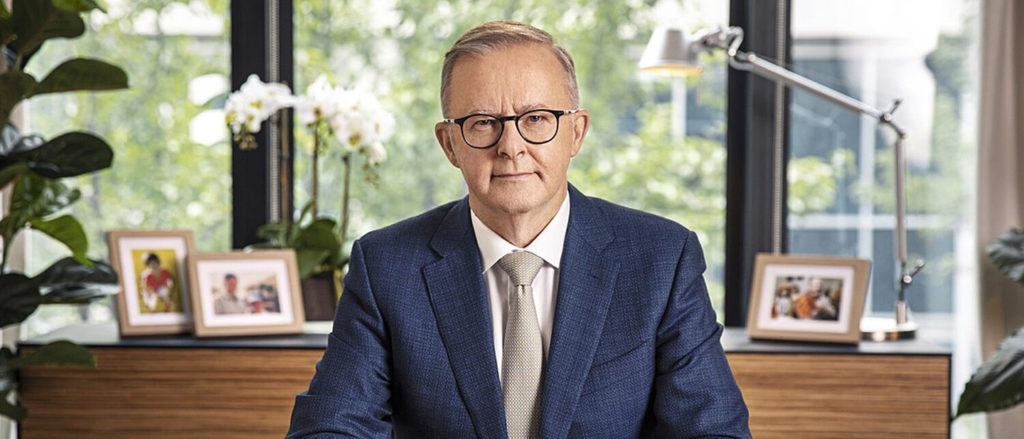
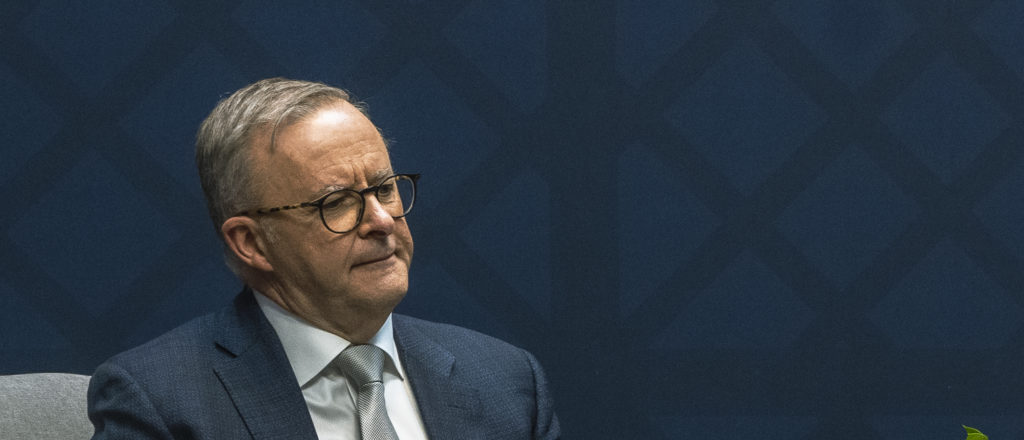
Anthony Norman Albanese (born 2 March 1963) is an Australian politician who has served as the 31st prime minister of Australia since 2022. He has been the leader of the Labor Party since 2019 and the member of Parliament (MP) for the New South Wales division of Grayndler since 1996.
Born in Sydney, Albanese attended St Mary's Cathedral College and studied economics at the University of Sydney. As a student, he joined the Labor Party and later worked as a party official and research officer before entering Parliament. He was elected to the House of Representatives at the 1996 federal election, winning the seat of Grayndler in Inner West Sydney. He was appointed to the shadow cabinet in 2001 by Simon Crean. After Labor's victory in the 2007 election, Albanese was appointed Leader of the House, and was also made Minister for Regional Development and Local Government and Minister for Infrastructure and Transport, a role he retained after Kevin Rudd was replaced as prime minister by Julia Gillard in 2010. He supported Rudd's challenges against Gillard in 2012 and 2013. Following a final leadership ballot in June 2013, which saw Rudd return as prime minister, Albanese was elected the deputy leader of the Labor Party and sworn in as deputy prime minister the following day, a position he held for less than three months, as Labor was defeated at the 2013 election.
After the party's election defeat, Albanese stood for leadership of the Labor Party against Bill Shorten in a leadership election. Although Albanese won a large majority of the membership, Shorten received more support from Labor MPs and became leader. Shorten subsequently appointed Albanese to his Shadow Cabinet. After Labor's surprise defeat in the 2019 election, Shorten resigned as leader, with Albanese becoming the only person nominated in the leadership election to replace him; he was subsequently elected unopposed as leader of the Labor Party, becoming Leader of the Opposition. He led the party to victory at the 2022 election, defeating the Liberal–National Coalition.
In his first term, Albanese led his government's response to a cost-of-living crisis caused by the 2021–2023 inflation surge, held an unsuccessful referendum to enshrine an Indigenous Voice to Parliament in the Constitution, updated Australia's climate targets to reach carbon neutrality by 2050, oversaw an acceleration of renewable energy projects, made major changes to industrial relations laws, enacted the Future Made in Australia industrial policy, created the National Anti-Corruption Commission, introduced a ban on children under sixteen from using social media platforms, established the Royal Commission into the Robodebt Scheme and expanded access to paid parental leave and subsidised childcare. In foreign policy, Albanese pledged further logistical support to Ukraine to assist with the Russo-Ukrainian war, attempted to strengthen relations in the Pacific region, and oversaw an easing of tensions and trade restrictions put on Australia by China. He also administered the official commencement of the AUKUS security pact between Australia, the United States, and the United Kingdom, and navigated Australia's response to the Gaza war.
Albanese's government was re-elected in a landslide victory in the 2025 election, resulting in one of the largest Labor governments in Australian history. In his second term, Albanese's government reduced university education fees, responded to Australia's housing unaffordability crisis, set the country's first 2035 emissions reduction targets, established the National Environmental Protection Agency and Centre for Disease Control, responded to the 2025 Bondi Beach shooting and the oil crisis caused by 2026 Iran war, and initiated the Royal Commission on Antisemitism and Social Cohesion. On matters of foreign policy, his government recognised the State of Palestine, responded to President Donald Trump's tariffs, pledged support for US and Israeli attacks on Iran and finalised a free trade agreement with the European Union. Despite being ideologically aligned with the Labor Left faction, Labor has shifted towards the political centre during Albanese's tenure as prime minister.
Contents
Early life
Family and background
Anthony Norman Albanese was born on 2 March 1963 at St Margaret's Hospital in the Sydney suburb of Darlinghurst. He is the son of Carlo Albanese and Maryanne Ellery (1936–2002). His mother was Australian, while his father was from Barletta in Italy. They met in March 1962 on a passenger ship from Sydney to Southampton, England, on which Albanese was conceived. His parents did not maintain contact after the journey. Albanese's mother adopted Carlo's surname, and named Anthony after his cousin Anthony Howett, who had died in a car accident four years earlier.
Growing up, Albanese was told that his father had died in a car accident; he did not meet his father until 2009. He made contact with his father in 2009, visiting him a number of times in Italy, and also took his family there. His father died in 2014. He subsequently discovered that he had two half-siblings. During the Australian parliamentary eligibility crisis of 2017, it was noted that although birth to an Italian father would ordinarily automatically confer Italian citizenship, Albanese's father was not recorded on his birth certificate and thus he met the parliamentary eligibility requirements of section 44 of the Constitution.
Childhood and education
Albanese grew up with his mother and maternal grandparents in a Sydney City Council home in the Inner West suburb of Camperdown, opposite the Camperdown Children's Hospital. His grandfather died in 1970, and the following year his mother married James Williamson. He was given his stepfather's surname, but the marriage lasted only ten weeks, as Williamson proved to be an abusive alcoholic. Albanese's mother worked part-time as a cleaner but suffered from chronic rheumatoid arthritis, with the family living on her disability pension and his grandmother's age pension.
Albanese attended St Joseph's Primary School in Camperdown and then St Mary's Cathedral College. While at school, he worked part-time selling newspapers. He captained St Mary's on several episodes of the children's game show It's Academic in 1978. Albanese joined the Australian Labor Party (ALP) in 1979 at the age of 15, as a member of Young Labor. He subsequently helped found a Labor Club at his high school.
After finishing school, Albanese worked briefly at the Commonwealth Bank before enrolling in an economics degree at the University of Sydney. There, he became involved in student politics and was elected to the Students' Representative Council (SRC). He stood unsuccessfully for the SRC presidency in 1983, losing to Belinda Neal. It was also there where he started his rise as a key player in the ALP's Labor Left. During his time in student politics, Albanese led a group within Young Labor that was aligned with the left faction's "Hard Left", which the Australian politician Andrew Leigh said maintained "links with broader left-wing groups, such as the Communist Party of Australia, People for Nuclear Disarmament and the African National Congress".
Pre-parliamentary career and travel
After completing his economics degree in 1984, Albanese took on a role as a research officer to the then Minister for Local Government and Administrative Services, Tom Uren, who became a mentor to him. In 1989, the position of Assistant General Secretary of the New South Wales branch of the Labor Party became vacant when John Faulkner was elected to the Senate. The election to replace him was closely disputed between the Labor Left's Hard Left and Soft Left groupings, with Albanese being elected with the backing of the Hard Left, taking on that role for the next six years. In 1995, he left the position to work as a senior adviser to New South Wales Premier Bob Carr.
Albanese's first overseas trip was in 1986, accompanying his friend Jeremy Fisher to Vanuatu. In 1987, Albanese joined his boss Tom Uren on a visit to South-East Asia, which included: a meeting of the United Nations Economic and Social Commission for Asia and the Pacific in Bangkok, Thailand; an Anzac Day dawn service at the Kanchanaburi War Cemetery with John Carrick; and a tour of Cambodia alongside Bill Hayden's daughter Ingrid. He then travelled extensively in 1988, visiting Zimbabwe, Zambia, Botswana, Western Europe on a Contiki tour, and Eastern Europe and Scandinavia as a backpacker. Upon returning to Australia, he began dating Carmel Tebbutt, with whom he would holiday in Europe and South-East Asia, plus a backpacking trip to India in 1991. Sometime during his 20s, Albanese also took part in a tour of the United States by the U.S. State Department, with a thematic focus on the interaction of advocacy groups with the U.S. Government.
In 1990, Albanese bought a semi-detached two-bedroom house in the Inner West Sydney suburb of Marrickville.
Early political career
Entry to Parliament
When Jeannette McHugh announced she would not seek re-election in her seat of Grayndler at the 1996 election, Albanese won preselection for the seat. The campaign was a difficult one, with aircraft noise a big political issue following the opening of the third runway at Sydney Airport, and the newly established No Aircraft Noise party (NAN) having polled strongly in the local area at the 1995 New South Wales election. Veteran political pundit Malcolm Mackerras predicted NAN would win the seat. However, NAN's candidate finished third, with less than 14% of the vote. Despite suffering a six-point swing against Labor, Albanese was elected with a comfortable 16-point margin.
In his maiden speech to the House of Representatives, Albanese spoke about the building of a third runway at Sydney Airport, aircraft noise and the need to build a second airport to service Sydney, as well as his support for funding public infrastructure in general, multiculturalism, native title, the social wage and childcare. He concluded by saying, "For myself, I will be satisfied if I can be remembered as someone who will stand up for the interests of my electorate, for working-class people, for the labour movement, and for our progressive advancement as a nation into the next century."
In his first year in Parliament he continued this theme, speaking in favour of the Northern Territory's euthanasia legislation, the rights of the Indigenous community in the Hindmarsh Island bridge controversy, and entitlement to superannuation for same-sex couples.
This last issue became a cause to which he was particularly dedicated. In 1998 he unsuccessfully moved a private member's bill that would have given same-sex couples the same rights to superannuation as de facto heterosexual couples. Over the next nine years, he tried three more times without success, until the election of the Rudd government in 2007 saw the legislation passed. Albanese subsequently turned his attention to campaigning for same-sex marriage.
Appointment to Shadow Cabinet
In 1998, Albanese was appointed a parliamentary secretary, a position which assists ministers and shadow ministers and is often a stepping stone to a full ministerial position.
In 2001, Albanese was promoted to the opposition Shadow Cabinet, taking the portfolio of ageing and seniors. A 2002 reshuffle saw him become Shadow Minister for Employment Services and Training, and in 2004 he became Shadow Minister for Environment and Heritage. It was during this latter role that then prime minister John Howard and science minister Brendan Nelson started raising the idea of nuclear power for Australia. Albanese campaigned strongly against them, as well as elements within his own party, arguing that "Nuclear energy doesn't add up economically, environmentally or socially, and after more than 50 years of debate, we still do not have an answer to nuclear proliferation or nuclear waste."
In 2005, Albanese was given the additional role of Shadow Minister for Water alongside his existing responsibilities, and was also appointed Deputy Manager of Opposition Business in the House. In December 2006, when Kevin Rudd first became Leader of the Labor Party, Albanese took over from Julia Gillard as Manager of Opposition Business in the House, a senior tactical role on the floor of the parliament, and was appointed Shadow Minister for Water and Infrastructure.
Cabinet minister
Rudd government
Following Labor's victory at the 2007 election, Albanese's rise in standing within the party was evidenced by his appointment as Minister for Infrastructure and Transport, Minister for Regional Development and Local Government and Leader of the House in the Rudd ministry. Rudd was sworn in alongside his colleagues on 3 December 2007.
The Labor Party had gone to the election criticising the previous government for ignoring "long-term nation building in favour of short-term political spending". One of Albanese's first moves as Minister for Infrastructure and Transport was the establishment of an independent statutory body, Infrastructure Australia, to advise the Government on infrastructure priorities. Armed with advice from this independent body and his own persuasive skills in the Cabinet, he was able to argue for a doubling of the roads budget and a tenfold increase in rail investment. The establishment of Infrastructure Australia was regarded by many as a success; projects delivered through the Infrastructure Australia process included Melbourne's Regional Rail Link, the Hunter Expressway, the Ipswich Motorway, the Gold Coast light rail system G:link, the Redcliffe Peninsula railway line, the extension of the Noarlunga Centre railway line to Seaford, South Australia and various projects along the Pacific Highway in NSW and Bruce Highway in Queensland.
Gillard government
After Julia Gillard replaced Rudd as prime minister following the leadership spill in June 2010 she retained Albanese in his roles. Following the 2010 election, which resulted in a hung parliament, Albanese was a key player in negotiating the support of independent members Tony Windsor and Rob Oakeshott through his role of Leader of the House. Albanese was also responsible for managing legislation through the House in the first hung parliament since the 1940s.
In 2011, Albanese introduced two more major policy reforms. The first on urban planning drew on the work of Danish designer Jan Gehl and set out plans for urban design with better transport links and safety. The second, on shipping, was notable for gaining the approval of both the conservative Australian Shipowners Associations and the radical Maritime Union of Australia. However, he also attracted controversy when a convoy of trucks from North Queensland dubbed the "convoy of no confidence" descended on Canberra's Parliament House to protest against rising fuel costs and carbon pricing. During question time, Albanese labelled the protesters outside as "the convoy of no consequence". This caused outrage among supporters of the protest and a week later a public rally in support of the truckies was held outside Albanese's electorate office in Marrickville, New South Wales.
Following a series of poor polls, leadership instability descended again on the Labor government. Former prime minister Kevin Rudd resigned as Minister for Foreign Affairs in February 2012 to unsuccessfully challenge Julia Gillard for the leadership. Shortly before the ballot, Albanese came out in support of Rudd, stating that he had always been unhappy with the manner of Rudd's removal. He tearfully explained how he had offered his resignation as Leader of the House to the prime minister, but that she had refused to accept it, and called on Labor to cease leadership divisions and unify. In response to a question on his personal feelings around the leadership spill, he stated "I like fighting Tories. That's what I do."
Deputy Prime Minister of Australia
In June 2013, Rudd defeated Gillard in a final leadership election. That same ballot saw Albanese elected by the caucus as Deputy Leader of the Labor Party, and the following day Albanese was sworn in as deputy prime minister. He held this role until Labor's defeat at the 2013 election, and was replaced by Warren Truss on 18 September.
Return to Opposition
2013 leadership election
Following the defeat of Labor at the 2013 election, Albanese announced his candidacy to be Leader of the Labor Party, standing against Bill Shorten. Shorten was announced as the winner after a month-long contest that was the first to involve a combined vote of MPs and rank-and-file members. Although Albanese won comfortably among party members, Shorten held a greater lead among MPs, and was subsequently elected.
Shorten Opposition
In October 2013, shortly after the leadership election, Shorten appointed Albanese Shadow Minister for Infrastructure and Transport and Shadow Minister for Tourism; he held these roles throughout Shorten's time as leader. In September 2014, Albanese was given the additional role of Shadow Minister for Cities. Following Labor's narrow loss in the 2016 federal election, it was reported by Sky News that Albanese was preparing to challenge Shorten for the leadership of the party. However, Albanese ruled out such a challenge, and Shorten was re-elected unopposed as Labor leader.
Leader of the Opposition (2019–2022)
2019 leadership election
Bill Shorten announced his resignation as Leader of the Labor Party on 18 May 2019, following Labor's unexpected defeat in the 2019 election. The day after, Albanese announced his candidacy in the subsequent leadership election. On 21 May, Chris Bowen announced he would also contest the ballot; however, the next day, he announced his withdrawal, citing his lack of support among the party membership. With no other candidate stepping forward, Albanese took the leadership unopposed on 30 May, with Richard Marles as his deputy. Albanese unveiled his shadow ministry on 1 June 2019.
Parliamentary activities
Under his leadership, Labor supported the Morrison government's stage three tax cuts, despite the party being earlier opposed. Albanese led the Opposition during the COVID-19 pandemic, during which he took bipartisan positions on the government's response. On 4 July 2020, Labor won the 2020 Eden-Monaro by-election, despite a swing against it. On 22 November 2021, Albanese accused prime minister Scott Morrison of lying to Parliament. In December 2021, Albanese held a major campaign rally, unveiling Labor's slogan, "A Better Future".
In February 2022, Albanese announced Labor would support the Morrison government's controversial religious discrimination bill. Labor successfully passed amendments to the bill to add protections for transgender school students after five Liberal MPs crossed the floor to vote in favour. After this, the government shelved the bill due to being unwilling to accept the amendments.
2022 federal election
The 2022 federal election was called on 10 April. On the first day of campaigning, Albanese was unable to name either the official cash rate or unemployment rate, which drew criticism. On 20 April, Albanese faced prime minister Morrison in a debate hosted by Sky News, with Albanese being deemed the winner through an audience vote. However, the next day, Albanese tested positive for COVID-19, forcing him to isolate at home in Sydney. He returned to campaigning the following week and, on 1 May, hosted Labor's campaign launch in Perth which was the first time any major party launched in Western Australia. At the launch, Labor unveiled policies to reduce the cost of medicine and childcare, increase manufacturing in Australia, and introduce a shared equity housing scheme to assist first-time home buyers. Albanese faced Morrison in two further debates, hosted by Channel Nine and Channel Seven, respectively. Opinion polling indicated that support for the two major parties had reached record lows, due to high levels of support for minor parties and independent candidates.
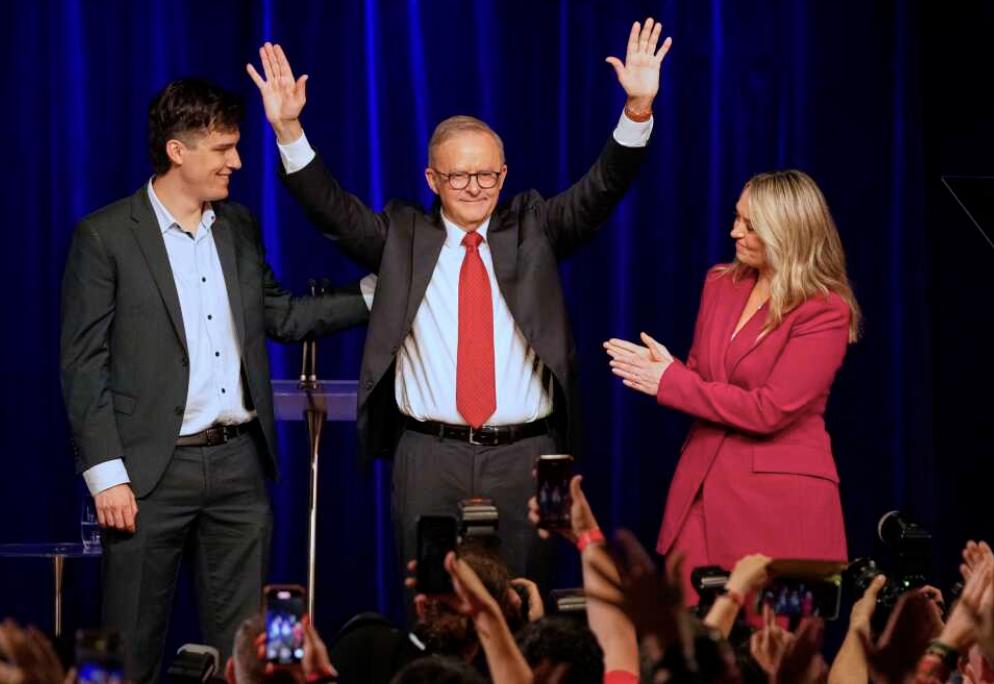
At the election on 21 May 2022, Labor was victorious over the Liberal–National Coalition, with Albanese becoming the 31st prime minister of Australia. Despite a decrease in the party's primary vote, Labor received a 3.66-point two-party-preferred swing towards it. The Coalition also lost several seats to "teal independents", allowing Labor to become the party with the most seats in Parliament.
Although it was not certain on election day that Labor would win a majority of seats, it soon became apparent that no other party could realistically form a government. Accordingly, two days after the election, Albanese, deputy Labor leader Richard Marles, Jim Chalmers, Penny Wong and Katy Gallagher were sworn in as an interim five-person ministry. With his victory, Albanese became the first Italian-Australian prime minister in the country's history.
Albanese secured confidence and supply from several crossbenchers in the event that he was unable to form majority government. However, on 30 May, it was projected that Labor had won at least 76 seats, enough to win a majority for the first time at the federal level since the 2007 election.
Prime Minister of Australia (2022–present)
First term (2022–2025)
Albanese's first term was dominated by Australia's cost-of-living crisis, attributed to the worldwide inflation surge of 2021–23. Monthly inflation peaked at a high of 8.4% in December 2022, and the Reserve Bank of Australia increased interest rates twelve times, reaching a rate of 4.35% by November 2023, the highest since 2011. In the 2023 Australian federal budget, the Albanese government delivered a surplus of $22.1 billion (equivalent to 0.9% of Australia's GDP); this was Australia's first budget surplus in 15 years, and the largest ever Australian budget surplus. In the 2024 budget, the government posted a second consecutive surplus of $9.3 billion. The budget returned to a $42.1 billion deficit in the 2025 budget.
In January 2024, the Albanese government made changes to the previously legislated stage three tax cuts, which would see individuals earning less than A$150,000 receive a larger tax cut than under the original plan. These changes were met with some criticism, particularly by the Opposition and conservative media outlets, and was viewed as a breach of a pre-election promise, as Albanese had repeatedly stated he would not alter the tax cuts if elected. Despite this, the changes proved popular with the public, and the overhauled tax cuts were passed by the Senate on 27 February 2024. His government announced a further $17 billion in tax cuts in the 2025 budget, which will reduce the bottom tax bracket from 16% to 15% in 2026, and to 14% in 2027.
Albanese took office amid a major housing affordability crisis, with the average Australian house price being nine times the average household income by 2024. To remedy supply-side issues that contribute to rising prices, in August 2023, Albanese reached an agreement with National Cabinet to build 1.2 million houses over five years. On 13 September 2023, the government passed the Housing Australia Future Fund (HAFF), a $10 billion investment fund controlled by the Future Fund that is designed to build 30,000 new social and affordable homes over the following five years in a further effort to increase supply. On 25 September 2024, his government instructed the Treasury to examine negative gearing. As a divisive wedge issue in Australian politics, changes to negative gearing rules were proposed by Labor prior to the 2019 election, in which they were defeated. Albanese had previously pledged not to modify negative gearing as Opposition Leader, leading to criticism from the Coalition and conservative media outlets for appearing to backtrack on this promise. After intense media speculation, Albanese ruled out making changes to negative gearing the next day. In November 2024, the Albanese government legislated a "help-to-buy" shared equity scheme that aims to allow up to 40,000 first-time home buyers to purchase a home with a shared contribution with the government, and a tax concession to incentivise developers to build houses specifically for the purpose of renting. In February 2025, his government placed a two-year ban on non-citizens buying existing houses.
2025 federal election
On 28 March 2025, Albanese called a federal election for 3 May. The first week of campaigning was dominated by the imposition of tariffs on Australia by U.S. President Donald Trump, to which Albanese responded by urging Australians to buy locally made products. He participated in a Sky News debate against Opposition Leader Peter Dutton on 8 April, which he narrowly won according to a poll of 100 undecided voters interviewed by Sky. He took part in three further debates with Dutton over the course of the campaign. On 13 April, Albanese launched Labor's campaign, announcing flagship policies to aid first home-buyers by allowing them to buy a house with a five percent deposit and build 100,000 homes exclusively for first-time home purchasers. The predominant issues of the campaign were cost-of-living, housing affordability, healthcare and immigration.
Albanese led his government to a landslide victory at the election, defying a global anti-incumbency surge and becoming the first prime minister since John Howard at the 2004 election to lead his government to re-election. Several media outlets attributed Albanese's victory to anti-Donald Trump sentiment and drew parallels to the 2025 Canadian federal election, which saw similar results for the incumbent Canadian Liberal Party. Labor gained 17 seats to hold a total of 94 seats in the House of Representatives, the joint most seats ever held by a party in federal Parliament, tied with Howard's Coalition government in the 1996 election. Labor also retained every seat they occupied prior to the election, making Albanese's government the first to retain all of its seats since Harold Holt's Coalition in 1966. The second Albanese ministry was sworn in on 13 May 2025.
Second term (2025–present)
On 1 October 2025, Albanese's government fulfilled an election commitment by expanding a pre-existing scheme to allow first-time home buyers to purchase a home with a five percent deposit, in an effort to address Australia's growing housing crisis. However, economists and figures in the real estate industry noted that the scheme will likely cause property prices to increase further due to heightened demand. In the 2026 federal budget, the Albanese government enacted reforms to capital gains tax (CGT) and negative gearing, limiting negative gearing to new residential builds and replacing the capital gains tax discount with an inflation-indexation model for future gains, while grandfathering existing investments. These measures, designed to address the growing housing crisis by disincentivising tax breaks primarily used by investors, led to criticism from media outlets and conservative opponents that Albanese had breached his pre-election commitment to not modify either negative gearing or CGT; Albanese defended his government's decision as "not the easy thing" but insisted it was "the right thing" to "help people get into a home of their own".
Albanese pledged his first act in his second term would be to reduce tertiary education loans by 20%. Legislation to put this reduction into effect passed on 31 July 2025. The Albanese government made further reforms to the tertiary education system in 2026, establishing an independent body called the Australian Tertiary Education Commission, introducing caps on university enrolments to reduce competition at major universities and increasing funding to enable more students from low-socioeconomic backgrounds and regional areas to study at university. In July 2026, Albanese announced an expansion to the government's "Paid Prac" scheme, enabling students studying a variety of healthcare related degrees to access a payment while undertaking their work practicum, alongside students studying teaching, nursing, midwifery and social work who were covered by the program's initial scope.
In his second ministry, Albanese created the new role of Special Envoy for Climate Change Adaptation and Resilience, appointing Kate Thwaites as its inaugural holder. On 18 September 2025, Albanese announced his government's 2035 emissions reduction target, set at a range of 62 to 70%. He also announced new supports for industries to decarbonise. In November 2025, the Albanese government passed legislation to overhaul Australia's main environmental and biodiversity law, the Environment Protection and Biodiversity Conservation Act 1999, and create the National Environmental Protection Agency (NEPA) after failing to do so in its first term. Following the 2026 Strait of Hormuz crisis which strained global supply chains of oil and caused a worldwide energy crisis, Albanese negotiated agreements with several countries in the Indo-Pacific region to bolster fuel supplies. In April 2026, he refused to introduce a tax on gas exporters in spite of internal party pressure and widespread public support, arguing increasing taxes on resources during the Hormuz crisis would not be appropriate.
Political views
Albanese has described his political views as progressive, and is aligned with the Labor Left faction within the Labor Party. Once described as "a leading figure of NSW Labor's minority Hard Left faction", several journalists and analysts have noted his ideological shift toward centrism since becoming Labor leader. In May 2025, he described his ideology as "progressive patriotism", and has further explained his government as occupying the "radical centre".
Albanese is a republican, and supports replacing Australia's current constitutional monarchy. In a debate to mark the Queen's Platinum Jubilee, he told the Australian Parliament, "Even many Australians who do not hold with the principle of monarchy feel regard for her. You can be a republican, as I am, and still have the deepest respect for the Queen. She has done her duty with fidelity, integrity, humanity and, as she sometimes lets slip, a sly sense of humour." He stated his desire to give constitutional recognition to Indigenous Australians, and pledged to hold a referendum regarding an Indigenous Voice to Parliament upon becoming prime minister. He stated that this recognition should come before any referendum regarding Australia's status as a constitutional monarchy vs. a republic. The Indigenous Voice to Parliament referendum occurred on 14 October 2023 and was defeated. Following a meeting with King Charles III in September 2025, he ruled out holding a republic referendum during his term as prime minister.
Environmental issues
While serving in the Gillard government, Albanese supported the introduction of carbon pricing, and voted, along with the rest of the Labor Party, to establish the Clean Energy Act 2011, which instituted a carbon pricing scheme in Australia. After the Abbott government abolished the scheme in July 2014, Albanese stated that carbon pricing was no longer needed, as "the circumstances have changed".
Albanese is a prominent backer of renewable energy in Australia and has declared that the country's "long-term future lies in renewable energy sources". Upon his election in 2022, he said he would "end the climate wars" and mitigation and policies to address climate change in Australia would be a priority for his government, in contrast with those preceding it. Albanese supported the introduction and sale of electric vehicles.
Foreign policy
Albanese's foreign policy beliefs have been the subject of media attention. Writing for the Australian Financial Review, James Curran noted his shift from an "idealistic left-wing critic of globalisation" to "a true believer in the American alliance". Albanese was staunchly opposed to the US-led invasion of Iraq, saying in February 2003 that "Whatever criticisms can be made of the Iraqi regime, Islamic fundamentalism is not one of them. This is one of the reasons the United States supported Saddam Hussein in the 1980s, including supplying his regime with weapons of mass destruction, which he then used against both the Iranians and the Kurds." Albanese repeatedly urged for the release of Australian whistleblower and WikiLeaks founder Julian Assange, who was being held in custody in the United Kingdom until 2024.
In February 2022, Albanese condemned Russia's invasion of Ukraine, remarking in a press release that it was a "grave moment for humanity".
In May 2022, Albanese said Australia's relationship with China would remain "a difficult one". He said that "Australia values human rights. We have spoken out about the treatment of Uyghurs, about what's occurred in Hong Kong, about Taiwan, about other minorities including in Tibet, that are suffering from human rights abuses."
Albanese's views on the Israeli–Palestinian conflict have been the subject of media interest, with The Times of Israel categorising him as a supporter of Palestine. Alongside Joe Hockey, Albanese established the parliamentary "Friends of Palestine" group in 1998. Despite this, he has been a critic of the Boycott, Divestment and Sanctions movement, calling it "clumsy and counterproductive". During the 2014 Gaza War, he called Israel's bombardment of the Gaza Strip a "collective punishment" that was "completely unacceptable". In 2018, he challenged a decision by the Australian government to vote against a UN human rights council motion calling for an investigation into the killings of Palestinian protesters during the Great March of Return. Shortly before the 2022 election, Albanese told The Australian Jewish News that any decision he takes on Israel-Palestine will contribute "to a peaceful resolution of the conflict and to progress towards a two-state solution". When asked about a 2018 resolution to recognise the State of Palestine, Albanese insisted the motion "has no greater or lesser weight" than it did previously. In October 2022, his government reversed the Morrison government's decision to recognise West Jerusalem as Israel's capital. In December 2023, Albanese signed a joint statement, along with the prime ministers of Canada and New Zealand, calling for a ceasefire in the Gaza war. Albanese has been criticised by conservative and pro-Israel opponents for his perceived inaction in combatting antisemitism during his term. In December 2024, Israeli prime minister Benjamin Netanyahu linked the firebombing of a Melbourne synagogue to Albanese's "extreme anti-Israel position", which included supporting United Nations resolutions critical of Israel's conduct in the Palestinian territories, and also accused his government of "pouring fuel on the antisemitic fire" following the 2025 Bondi Beach shooting.
Social issues
Albanese supports abortion rights, stating in an interview in August 2019 that he believes "women do have a right to choose". He is also in favour of legalising voluntary euthanasia; in December 2022, his government repealed the Euthanasia Laws Act 1997, which prevented the territories of Australia from legalising euthanasia.
Albanese is a supporter and advocate for LGBT rights, and has regularly participated in the Sydney Gay and Lesbian Mardi Gras since 1983. When Labor Party members were granted a conscience vote on the Marriage Amendment Bill 2012, which would have legalised same-sex marriage in Australia, Albanese voted in favour of the bill, which was unsuccessful. He opposed holding a plebiscite for same-sex marriage, stating that "we shouldn't be having a public vote where we get to judge other families". In 2017, Albanese also voted in favour of the Marriage Amendment (Definition and Religious Freedoms) Act 2017, the bill which ultimately legalised same-sex marriage. Albanese has voiced support of transgender rights, saying that "people coming to terms with their identity and who they are, I think that they need to be respected", although has voted against bills and motions intended to improve transgender rights in the past.
Early in his political career, Albanese supported drug decriminalisation, telling Parliament in 1997 that "drug use by individuals is a health issue, not a criminal issue". However, in February 2022, he declined to commit to decriminalisation of hard drugs, commenting that the "current settings are appropriate".
In July 2015, Albanese stated his opposition to the government's policy of turning back asylum seekers who arrive to the country via boat, saying: "I couldn't ask someone else to do something that I couldn't see myself doing ... if people were in a boat including families and children, I myself couldn't turn that around." During the 2022 federal election campaign, Albanese clarified that boat turnbacks would be incorporated into his government's policy, leading to some critics accusing him of "flip-flopping" on the issue. In August 2021, after the Taliban seized control of Afghanistan, Albanese urged the Morrison government to give Afghan refugees permanent residency in Australia.
In May 2024, Albanese voiced his support for raising the age at which a child can open a social media account from 13 to 16, citing concerns over the mental health of young people, with his government passing legislation to compel social media companies to do so. He has referred to social media as a "scourge".
Personal life
In 2000, Albanese married Carmel Tebbutt, a future Deputy Premier of New South Wales. They had met in Young Labor during the late 1980s, and have one son together. The two separated in January 2019. In June 2020, it was reported that Albanese was in a relationship with Jodie Haydon. Albanese said they had met at a dinner event in Melbourne a year after his separation from Tebbutt. Albanese is the first divorcee to be appointed prime minister. In February 2024, Albanese announced his engagement to Haydon after proposing to her at The Lodge in Canberra. On 29 November 2025, Albanese and Haydon were married in a private ceremony at The Lodge. Albanese is the first prime minister of Australia to be engaged or wed while in office.
Albanese describes himself as "half-Italian and half-Irish" and a "non-practising Catholic". He is also a music fan who, not long after becoming prime minister, attended a Gang of Youths concert at the Enmore Theatre and previously intervened as transport minister to save a Dolly Parton tour from bureaucratic red tape. In 2013, he co-hosted a pre-election special of music program Rage and his song selection included the Pixies, the Pogues, the Smiths, the Triffids, PJ Harvey, Nirvana, Hunters & Collectors and Joy Division. On 30 November 2023, Albanese posted his Spotify Wrapped to his Instagram story, indicating his top artists for the year to be Lana Del Rey, Taylor Swift, Hilltop Hoods, Bruce Springsteen, and Lily Allen. In January 2026, he posted his picks for Triple j's Hottest 100 of 2025, among of which included Olivia Dean, Hatchie, Hilltop Hoods (again), Kita Alexander, Lily Allen (again), Ocean Alley, Ruby Fields, Spacey Jane, G Flip and Wolf Alice.
As a lifelong supporter of the South Sydney Rabbitohs rugby league club, Albanese was a board member of the club from 1999 to 2002 and influential in the fight to have the club readmitted to the National Rugby League (NRL) competition. During October 2009, The Sydney Morning Herald reported that Albanese had opposed an attempt to appoint the former Liberal prime minister John Howard to a senior position in the NRL. Albanese stated he had phoned the NRL chief executive, David Gallop, as well as other league officials, to advise them against the idea. He then implored officials at Souths to help stop the suggestion from gaining momentum. In 2013, he was made a life member of the club. He is also a fan of Australian rules football, and supports the Hawthorn Football Club, with Albanese attending the 1991 AFL Grand Final which saw Hawthorn claim its 9th premiership.
Honours
Foreign honours
28 January 2026 Grand Collar of the Order of Timor-Leste, by the President of Timor-Leste, José Ramos-Horta.
6 July 2026 Honorary Companion of the Order of Fiji, by the President of Fiji, Naiqama Lalabalavu.