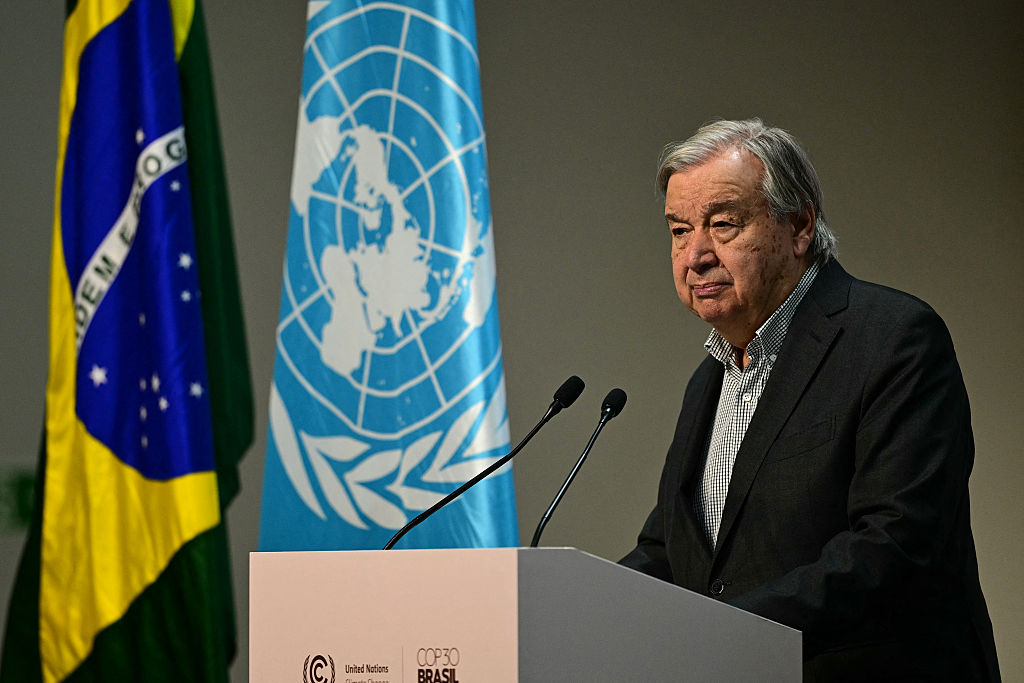
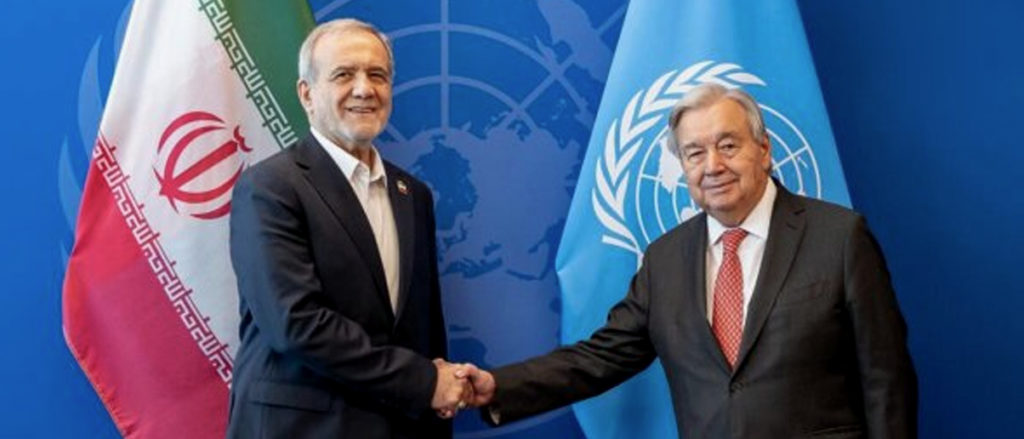
António Manuel de Oliveira Guterres (born 30 April 1949) is a Portuguese politician and diplomat who, since 2017, has served as the ninth secretary-general of the United Nations. A member of the Portuguese Socialist Party, Guterres served as the prime minister of Portugal from 1995 to 2002.
Born in Lisbon, Guterres studied physics and electrical engineering at Lisbon's Instituto Superior Técnico, briefly taught systems theory and telecommunications, and became involved in politics while active in a Catholic youth group. Guterres served as secretary-general of the Socialist Party from 1992 to 2002. He was elected prime minister in 1995. He led the party to legislative victories in 1995 and 1999. Guterres announced his resignation as Socialist Party leader in 2002 following the party's losses in the 2001 local elections, with Eduardo Ferro Rodrigues succeeding him while he remained prime minister until losing the subsequent general election to José Manuel Barroso's Social Democratic Party. Despite this defeat, polling of the Portuguese public in both 2012 and 2014 ranked Guterres the best prime minister of the previous 30 years.
Guterres served as President of the Socialist International from 1999 to 2005. He was the United Nations High Commissioner for Refugees from 2005 to 2015. He reformed the agency and addressed multiple global refugee crises. Guterres was elected secretary-general in October 2016, succeeding Ban Ki-moon at the beginning of the following year and becoming the first European to hold this office since Kurt Waldheim in 1981. As secretary-general, he has focused on peace, human rights, climate change, refugee protection, and diplomatic engagement with controversial global actors.
Guterres has held numerous advisory, board, and leadership roles in international organizations, foundations, and councils spanning journalism, finance, humanitarian aid, innovation, gender equality, and global policy. Guterres, a multilingual practicing Catholic, was married twice and has two children. He has received numerous national and international honors, honorary doctorates, and prestigious awards recognizing contributions to diplomacy, democracy and global leadership.
Contents
Early life, education, and early career
António Manuel de Oliveira Guterres was born on 30 April 1949, in the parish of Santos-o-Velho in Lisbon, the son of Virgílio Dias Guterres and Ilda Cândida dos Reis Oliveira Guterres.
Guterres attended the Camões Lyceum (now Camões Secondary School), where he graduated in 1965, winning the National Lyceums Award (Prémio Nacional dos Liceus) as the best student in the country. He studied physics and electrical engineering at Instituto Superior Técnico – Technical University of Lisbon. He graduated in 1971 and started an academic career as an assistant professor teaching systems theory and telecommunications signals, before leaving academic life to start a political career. During his university years, he joined the Group of Light, a club for young Roman Catholics, where he met Father Vítor Melícias, a prominent Franciscan priest and church administrator who remains a close friend and confidant.
Political career
Guterres's political career began in 1974, when he became a member of the Socialist Party. Shortly thereafter, he quit academic life and became a full-time politician. In the period following the Carnation Revolution of 25 April 1974 that put an end to Caetano's dictatorship, Guterres became involved in Socialist Party leadership and held the following offices:
Head of Office of the Secretary of State of Industry (1974 and 1975)
Deputy for Castelo Branco in the Portuguese National Parliament (1976–2002)
Leader of the parliamentary bench of the Socialist Party, succeeding Jorge Sampaio (1989–1990)
Guterres was a member of the team that negotiated the terms of Portugal's entry into the European Union in the late 1970s. He was a founding member of the Portuguese Refugee Council in 1991.
In 1992, after the Socialists' third consecutive defeat in Parliamentary elections, Guterres became secretary-general of the Socialist Party and leader of the opposition during Aníbal Cavaco Silva's government. At the time, he was the party's third leader in six years. He was also selected as one of the 25 vice presidents of the Socialist International in September 1992.
His election represented a break with tradition for the Socialists: not only was Guterres not associated with either the faction around then-president and former prime minister Mário Soares or the party's left wing led by Guterres's predecessor Sampaio, but he was also a devout Catholic, running counter to the party's historical secularism. He consulted with Portugal's civil society in formulating policy, meeting a range of intellectuals, scientists and entrepreneurs from across the country and the political spectrum in the run-up to the next general election.
Prime minister of Portugal
Aníbal Cavaco Silva did not seek a fourth term as prime minister of Portugal (in order to run for the 1996 presidential election) and the Socialist Party won the 1995 parliamentary election. President Soares appointed Guterres as prime minister and his cabinet took the oath of office on 28 October that year.
Guterres ran on a platform of keeping a tight hold on budget spending and inflation in a bid to ensure that Portugal met the Euro convergence criteria by the end of the decade, as well as increasing rates of participation in the labor market, especially among women, improving tax collection and cracking down on tax evasion, increased involvement of the mutual and nonprofit sectors in providing welfare services, a means-tested guaranteed minimum income (known as the Rendimento Mínimo Garantido), and increased investment in education. During his time as prime minister, various reforms were carried out in areas such as education, housing, social welfare, healthcare, health and safety, sex discrimination, and family leave.
He was then one of seven social democratic prime ministers and two social democratic parties in coalitions in Western Europe, joining political allies in Spain, Denmark, Finland, Sweden, Greece and the Netherlands. Social democratic parties were also in coalitions in Ireland and Luxembourg.
With a style markedly different from that of his predecessor, and based on dialogue and discussion with all sections of society, Guterres was a popular prime minister in his first years in office. Portugal was enjoying an economic expansion that allowed the Socialists to reduce budget deficits while increasing welfare spending and creating new conditional cash transfer programs. His government also accelerated the program of privatizations that Cavaco Silva's government had begun: 29 companies were privatized between 1996 and 1999, with proceeds from privatizations in 1996–97 greater than those of the previous six years, and the public sector's share of GDP halved from 11% in 1994 to 5.5% five years later. Share ownership was also widened, with 800,000 people investing in Portugal Telecom upon its privatization in 1996 and 750,000 applying for shares in Electricidade de Portugal.
In 1998, Guterres presided over Expo 98 in Lisbon, commemorating the 500th anniversary of the voyage of Vasco da Gama. Also in 1998, two nationwide referendums were held. The first one was held in June and asked voters whether abortion rules should be liberalized. The Socialist Party split over the issue of liberalization, and Guterres led the anti-abortion side, which eventually won the referendum. A second referendum was held in November, this time over the regionalization of the mainland. Both Guterres and his party supported such an administrative reform, but the voters rejected it.
President of Socialist International
Guterres was elected president of Socialist International in November 1999, overlapping with his second term as prime minister of Portugal until his resignation from the latter post in December 2001. He remained president of the Socialist International until June 2005.
Diplomatic career
In 2005, following Guterres's proposal, George Papandreou was elected vice president of the Socialist International; in 2006, Papandreou succeeded him as president of the Socialist International.
In May 2005, Guterres was elected High Commissioner for Refugees for a five-year term by the UN General Assembly, replacing Ruud Lubbers.
High Commissioner for Refugees
As High Commissioner, Guterres headed one of the world's largest humanitarian organizations, which at the end of his term had more than 10,000 staff working in 126 countries providing protection and assistance to over 60 million refugees, returnees, internally displaced people and stateless persons. His time in office was marked by a fundamental organizational reform, cutting staff and administrative costs in the UNHCR's Geneva head office and expanding UNHCR's emergency response capacity during the worst displacement crisis since the Second World War.
From 19 to 23 March 2006, Guterres visited Beijing, China, and expressed his objection to repatriation of North Korean refugees by the Chinese government.
In a February 2007 NPR interview devoted mainly to the plight of Iraqi refugees, Guterres said that this was one of the greatest refugee crises in the Middle East since 1948. Among poorly publicized refugee crises, he cited those in the Central African Republic and the Democratic Republic of the Congo. During his final years as High Commissioner, he worked chiefly to secure international aid for the refugees of the Syrian civil war, calling the refugee crisis an "existential" one for host countries (such as Lebanon and Jordan), and calling additional aid a "matter of survival" for the refugees. He was an outspoken advocate for a more coordinated and humane approach by European countries to the Mediterranean refugee crisis. In June 2013, he launched a US$5 billion aid effort, its biggest ever, to help up to 10.25 million Syrians that year.
In what was widely considered a very effective PR move, Guterres appointed American actress Angelina Jolie as his special envoy to represent UNHCR and himself at the diplomatic level in 2012. Together they visited the Kilis Oncupinar Accommodation Facility in Turkey (2012); the Zaatari refugee camp in Jordan (2013); and the Maritime Squadron of the Armed Forces of Malta (2015). They also appeared jointly before the United Nations Security Council (2015).
In early 2015, the General Assembly voted to extend Guterres's mandate by 61⁄2 months to 31 December, on recommendation of United Nations Secretary-General Ban Ki-moon. In light of the European migrant crisis, the UNHCR's 98-member executive committee (EXCOM) later requested that Ban recommend extending Guterres's term by another year, but Ban disregarded the request. Guterres left office on 31 December 2015, having served the second-longest term as High Commissioner in the organization's history, after Prince Sadruddin Aga Khan.
United Nations secretary-general
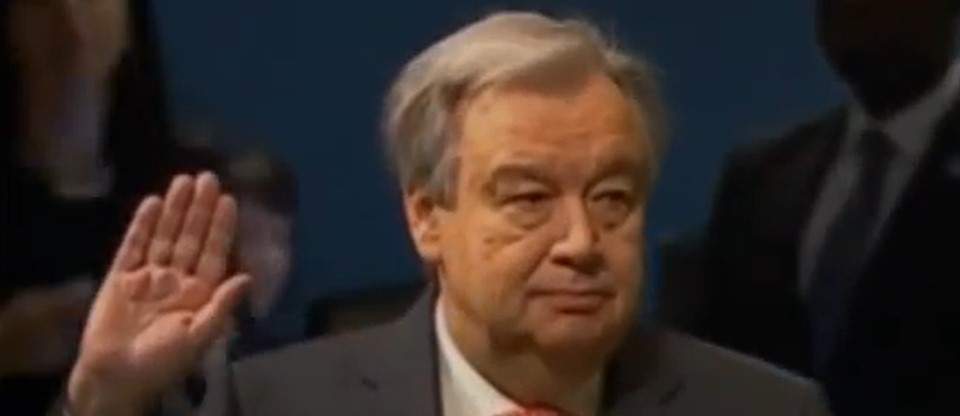
Guterres became United Nations Secretary-General on 1 January 2017, following his formal election by the UN General Assembly on 13 October 2016.
On 29 February 2016, Guterres submitted his nomination as Portugal's candidate for the 2016 UN secretary-general selection. This was the first time candidates for secretary-general had to present their platform in public hearings in the UN General Assembly, a process during which Guterres emerged as a much stronger candidate than had been initially expected, given that he fit the bill on neither the gender nor the geographic scores.
On 5 October, the 15-member United Nations Security Council announced that it had agreed to nominate Guterres, after an informal secret ballot in which he gained 13 "encourage" votes and two "no opinion" votes. The Security Council officially nominated Guterres in a formal resolution on 6 October. A week later, he was formally elected by the United Nations General Assembly in its 71st session. Guterres took office on 1 January 2017. Guterres is the first national leader to become the U.N. Secretary-General.
The UN's role in the Haiti cholera outbreak was widely discussed and criticized after the Ban Ki-moon administration denied the issue for several months. According to the Boston-based Institute for Justice & Democracy in Haiti as well as numerous conclusive scientific studies, the UN is the proximate cause for bringing cholera to Haiti. Peacekeepers sent to Haiti from Nepal in 2010 were carrying asymptomatic cholera and failed to treat their waste properly before dumping it into one of Haiti's main water streams. During his UNSG informal dialogue, Jamaica, on behalf of the Caribbean Community, asked if the UN should assume liability for any deaths within local populations that result from the introduction of infectious disease by its peacekeepers. Jamaica also asked if Guterres believed compensation should be provided. Guterres responded by calling the situation a "particularly complex question," saying it was difficult to preserve diplomatic immunity while also ensuring there is no impunity, but that he would "pay a lot of attention in trying to find the right equilibrium between these two aspects that are absolutely crucial." In a UN General Assembly meeting in late October 2016, the representative from Haiti called the UN's current and future response to the cholera epidemic "a litmus test of the system's commitment to the promotion of human rights". Though many had hoped Guterres's term would mark a break with the inaction that characterized Ban's response to the epidemic, Guterres has done little to signal a commitment to Haitian cholera victims. As of April 2017, five months into his term as secretary-general, only $10 million had been contributed to the $400 million fund to fight cholera and provide material assistance to victims the UN announced in 2016.
Other activities
Dag Hammarskjöld Fund for journalists, chairman of the Honorary Advisory Council
Caixa Geral de Depósitos, advisor to the board (2003–2005)
Champalimaud Foundation, member of the Vision Award Jury
Clean Cooking Alliance, member of the Leadership Council
Club of Madrid, member (since 2002)
European Council on Foreign Relations (ECFR), member
International Gender Champions (IGC), member
European Regional Innovation Awards, chairman of the Jury (2004)
Friends of Europe, member of the board of trustees
Calouste Gulbenkian Foundation, non-executive member of the board of trustees (2013–2018)
World Economic Forum (WEF), member of the Global Agenda Council on Humanitarian Assistance (2008–2009)
He resigned from the International Peace Institute in October 2020.
Personal life
In 1972, Guterres married child psychiatrist Luísa Amélia Guimarães e Melo, with whom he had two children, Pedro Guimarães e Melo Guterres (born 1977) and Mariana Guimarães e Melo Guterres (born 1985). His wife died of cancer at the Royal Free Hospital in London in 1998 at the age of 51.
In 2001, Guterres married Catarina Marques de Almeida Vaz Pinto (born 1960), a former Portuguese state secretary for culture and culture secretary for the City Council of Lisbon.
In addition to his native Portuguese, Guterres speaks English, French and Spanish.
Guterres is a practicing Catholic.
Electoral history
Recognition
Honours
: Grand Cross of the Military Order of Christ (9 June 2002)
: Grand Cross of the Order of Liberty (2 February 2016)
Belgium: Grand Cordon of the Order of Leopold (9 October 2000)
Brazil: Grand Cross of the Order of the Southern Cross (23 July 1996)
Pará: Grand Collar of the National Order of Merit of Grão Pará (4 April 2002)
Cape Verde: First Class of the Order of Amílcar Cabral Order (27 April 2001)
Chile: Grand Cross of the Order of Merit (30 September 2001)
France: Grand Cross of the National Order of Merit (4 February 2002)
Greece: Grand Cross of the Order of Honour (17 March 2000)
Italy: Knight Grand Cross of the Order of Merit of the Italian Republic (3 December 2001)
Japan: Grand Cordon of the Order of the Rising Sun (4 April 2002)
Mexico: Sash of Special Category of the Order of the Aztec Eagle (2 July 1999)
Niger: Grand Cross of the Order of Merit of Niger (2 May 2022)
Oman: First Class of the Order of Oman (15 December 2025)
Poland: Grand Cross of the Order of Merit of the Republic of Poland (22 September 1997)
Honorary degrees
2010 – Honorary Doctorate, University of Beira Interior
2014 – Honorary Doctorate, Meiji University
2016 – Honorary Doctorate of Laws, Carleton University
2016 – Honorary Doctorate, University of Coimbra
2016 – Honorary Doctorate, European University of Madrid
2017 – Honorary Doctorate, University of South Carolina
2021 – Honorary Doctorate of Law, University of Cambridge
2022 – Honorary Doctorate, National University of Córdoba
2022 – Honorary Degree, Seton Hall University
Other awards
2005 – Personality of the Year by the Foreign Press Association in Portugal (Associação de Imprensa Estrangeira em Portugal, AIEP)
2007 – Freedom Award (shared with Angelina Jolie)
2009 – Calouste Gulbenkian International Prize (shared with the Peace Research Institute in the Middle East)
2009 – Forbes List of The World's Most Powerful People in 2009
2015 – W. Averell Harriman Democracy Award
2015 – The National German Sustainability Award
2019 – Charlemagne Prize
2025 – Atatürk International Peace Prize