
The Australian Football League (AFL) is the pre-eminent professional competition of Australian rules football. It was originally named the Victorian Football League (VFL) and was founded in 1896 as a breakaway competition from the Victorian Football Association (VFA), with its inaugural season in 1897. It changed its name to Australian Football League in 1990 after expanding its competition to other Australian states in the 1980s. The AFL publishes its Laws of Australian football, which are used, with variations, by other Australian rules football organisations.
The AFL competition currently consists of 18 teams spread over Australia's five mainland states, with Tasmania to join the league as its 19th team in 2028. AFL premiership season matches have been played in all states and mainland territories, as well as in New Zealand and China to expand its audience. As of 2024 the AFL is the richest Australian football and overall sports league in Australia by revenue and the 16th richest sports league in the world by revenue.
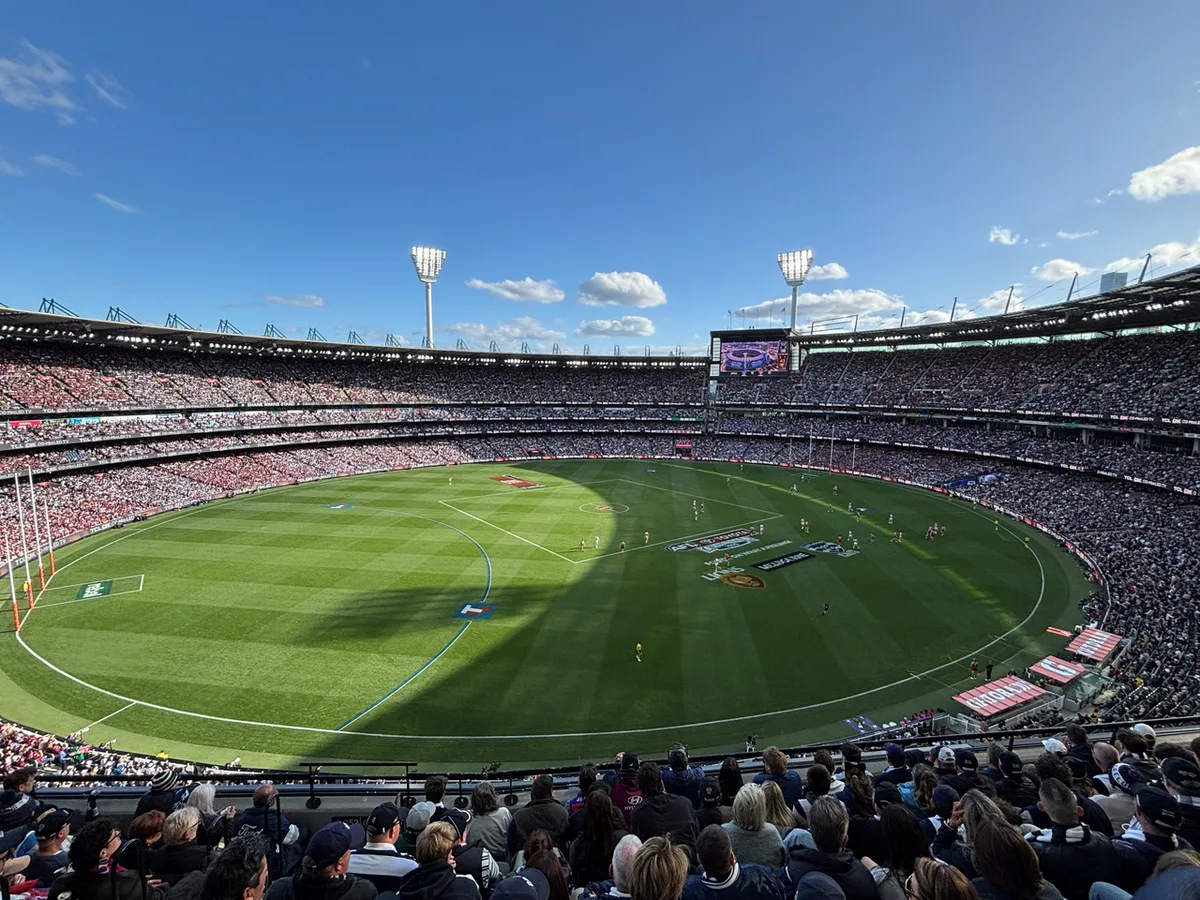
The AFL premiership season currently consists of a 24-match regular (or home-and-away) season, which runs from March to September. The team with the best record at the end of the home-and-away season is awarded the minor premiership; the top ten teams then play off in a five-round finals series, culminating in the AFL Grand Final, which is normally held at the Melbourne Cricket Ground each year. The grand final winners are termed the premiers, the most important team prizes for which are the premiership cup and flag. Carlton, Collingwood and Essendon are the joint-most successful clubs in the competition, having each won 16 premierships. The Brisbane Lions are the reigning premiers, having won the 2025 AFL Grand Final.
Contents
History
VFL era (1897–1989)
Several of the AFL's current member clubs date back to the origins of Australian football and were instrumental in establishing the sport's popularity and the AFL. The oldest club is Melbourne Football Club, which wrote the first laws of the code, and Geelong, which date back to 1858 and 1859 respectively, while Melbourne University, also founded in 1859, is also one of the oldest clubs to have later participated in the competition.
The Victorian Football Association (VFA) was established in 1877 and quickly went on to become Victoria's football competition. During the 1890s, an off-field power struggle occurred between the VFA's stronger and weaker clubs, the former seeking greater administrative control commensurate with their relative financial contribution to the game. This came to a head in 1896 when it was proposed that gate profits, which were always lower in matches involving the weaker clubs, be shared equally among all teams in the VFA. After it was intimated that the proposal would be put to a vote, six of the strongest clubs—Collingwood, Essendon, Fitzroy, Geelong, Melbourne and South Melbourne—seceded from the VFA and later invited Carlton and St Kilda to join them in founding a new competition, the Victorian Football League (VFL). The remaining VFA clubs—Footscray, North Melbourne, Port Melbourne, Richmond and Williamstown—were given the opportunity to compete as junior sides at a level beneath the VFL but rejected the offer and remained for the 1897 VFA season.
The VFL's inaugural season occurred in 1897. It made several innovations early on to entice the public's interest, including an annual finals tournament, rather than awarding the premiership to the team with the best record through the season; and, the formal establishment of the modern scoring system, in which six points are awarded for a goal and one point for a behind.
Although the VFL and the VFA continued to compete for spectator interest for many years, the VFL quickly established itself as the premier competition in Victoria. In 1908, the league expanded to ten teams, with Richmond crossing from the VFA and University Football Club from the Metropolitan Junior Football Association. Professionalism began from the 1911 season, with clubs permitted to pay players beyond the reimbursement of expenses for the first time. University, after three promising seasons, finished last each year from 1911 until 1914, including losing 51 matches in a row, in part caused by its players' focus on their studies rather than football and in part because it had chosen to remain amateur; as a result, the club withdrew from the VFL at the end of 1914.
AFL era (1990–present)
The league was renamed the Australian Football League in 1990 to reflect its national composition.
In 1990 the AFLPA, the players union, signed its first Collective Bargaining Agreement (CBA) with the league which outlined wages and conditions in what was becoming a sole source of income for players who had previously had part-time or full-time jobs outside of football. Functionally, the AFL gave up control over its Victorian-based minor grades at the end of 1991 – clubs continued to field reserves teams in a competition run by the new Victorian State Football League and the under-19s competition and zone-based recruiting were abolished and replaced with an independent system.
Midway through 1990, the SANFL's most successful club, Port Adelaide, made a bid for an AFL licence. In response, the SANFL gained an injunction via Glenelg and Norwood against Port Adelaide, allowing it time to establish a composite South Australian team called the Adelaide Crows, which was awarded the licence and joined the league in 1991 as the fourth non-Victorian club. The same year saw the West Coast Eagles become the first non-Victorian club to reach the grand final, which was won by Hawthorn (the same year saw the Brisbane Bears win the reserves premiership). The Eagles would then win the premiership in 1992 and 1994. In 1994, Fremantle obtained an AFL licence and joined the AFL in 1995, becoming the fifth non-Victorian club, and the second from Western Australia.
The VFA took over the Victorian Football League name in 1996. In 1996 several Victorian clubs were in severe financial difficulties, most notably Fitzroy and Hawthorn. Hawthorn proposed to merge with Melbourne to form the Melbourne Hawks but the merger ultimately fell through and both teams continued as separate entities. Fitzroy, however, was too weak to continue by itself. The club nearly merged with North Melbourne to form the Fitzroy-North Melbourne Kangaroos but the other clubs voted against it. In 1994 Port Adelaide was awarded an AFL licence but could not enter until a Victorian team had folded or merged. At the end of 1996 Fitzroy played its last match and merged with Brisbane to form the Brisbane Lions. This allowed Port Adelaide to enter the AFL for the 1997 season as the sixth and only pre-existing non Victorian club.
Through the 1990s there was a significant trend of Melbourne-based teams abandoning the use of their small (20,000–30,000 capacity) suburban venues for home matches in favour of the MCG and VFL Park, which have and had larger seating capacities. The 1990s saw the last matches played at Windy Hill (Essendon), Moorabbin Oval (St Kilda), Western Oval (Footscray) and Victoria Park (Collingwood) and saw Princes Park abandoned by its long-term co-tenant, Hawthorn. The transition to the use of only two venues in Melbourne was ultimately completed in 2005 when Carlton abandoned the use of Princes Park. In 1999, the league sold VFL Park and used the funds in a joint venture to begin construction of a brand-new stadium situated at Melbourne's Docklands. Representative state football came to an end, with the last State of Origin match held in 1999.
Clubs
The AFL operates on a single table system, with no divisions and conferences, nor promotion and relegation from other leagues.
The league was founded as the Victorian Football League (VFL) in 1897, comprising eight teams only based in the state of Victoria. Over the next century, a series of expansions, a relocation, a merger and a club withdrawal saw the league's teams expand to the 18 teams there are today.
In 1990, the national nature of the competition resulted in the name change to the Australian Football League (AFL). The current 18 teams are based across five states of Australia; the majority (ten) still remain in Victoria, nine of which are located in the Melbourne metropolitan area. The states of New South Wales, Queensland, South Australia and Western Australia have two teams each, and a team from Tasmania will enter the competition in 2028.
The Australian Capital Territory and Northern Territory are the only mainland territories not to have AFL clubs, although the Greater Western Sydney Giants have a contract to play at least three home games in Canberra until 2032, while at least two games per year are played in Darwin.
Former clubs
Since the league commenced in 1897 as the VFL, only one club, University, has withdrawn from the competition. It last competed in 1914 and withdrew because, as an amateur club, it was unable to remain competitive in a time when player payments were becoming common; the club still competes to this day in the Victorian Amateur Football Association (VAFA). Two other clubs, Fitzroy and the Brisbane Bears, merged in 1996 to form the Brisbane Lions: however, after coming out of financial administration in 1998, Fitzroy resumed its playing operations in 2009 and competes in the VAFA.
Timeline
Non-formal/junior competitions †Victorian Football Association (1877) †Victorian Football League (1897, later renamed AFL)Australian Football League (1990, formerly VFL)South Australian National Football League (1877) †
† Not all teams shown. These competitions are current.
Venues
Throughout the history of the VFL/AFL to 2023, there have been 50 grounds used. The largest-capacity ground in use is the Melbourne Cricket Ground (MCG), which has a capacity of over 100,000 people and hosts the grand final each year (see AFL Grand Final location debate). The MCG is shared by six teams as a home ground, while the other grounds used as home venues by multiple teams are Docklands Stadium in Melbourne (five teams), Adelaide Oval in Adelaide (two teams) and Perth Stadium in Perth (two teams). The AFL has had exclusive ownership of Docklands Stadium (commercially known as Marvel Stadium) since late 2016.
Prior to the expansion of the competition, most grounds were located in suburban Melbourne, with Princes Park, Victoria Park, the Junction Oval, Waverley Park and the Lake Oval each having hosted over 700 games. However, since the introduction of a national competition, each state and territory of Australia has hosted AFL games. On 25 April 2013 (Anzac Day), a match took place between St Kilda and Sydney at Wellington Regional Stadium in Wellington, New Zealand, being the first AFL match played outside Australia for premiership points.
Current venues
Below are the venues that are hosting AFL matches during the 2025 season.
Players
AFL players are drawn from a number of sources; however, most players enter the league through the AFL draft, held at the end of each season. A small number of players have converted from other sports, or been recruited internationally. Prior to the nationalisation of the competition, a zoning system was in place. At the end of the season, the best 22 players and coach from across the competition are selected in the All-Australian team.
The AFL has tight controls over the player lists of each club. Currently, apart from the recently added expansion clubs who have some additional players, each team can have a senior list of 38 to 40 players plus 4 to 6 rookie players, to a total of 44 players (following a reduction by two of the number of rookies in 2012) and up to three development rookies (international, alternative talent or New South Wales scholarship players). Changes to playing lists are permitted only in the off-season: clubs can trade players during a trade period which follows each season and recruit new players through the three AFL drafts, the national draft, the pre-season draft and the rookie draft, which take place after the trade period. A mid-year draft was conducted between 1990 and 1993. The national draft is the primary method of recruiting new players and has been used since 1986. The draft order is based on reverse-finishing position from the previous year but selections can be traded. Free agency player movements have only been permitted since the 2012/13 offseason, previously having been rejected by the AFL.
Salary cap
A salary cap (known as the Total Player Payments or TPP) is also in place as part of the league's equalisation policy; this was $9,130,000 for the 2013 season with a salary floor of $8,673,500 except for the Gold Coast, whose salary cap was $9,630,000 with a salary floor of $9,171,500 and Greater Western Sydney, whose salary cap was $9,987,000 with a floor of $9,530,500. As part of the AFL's enhanced equalisation policies, in 2014 the league announced an increase of the TPP for the 2015 and 2016 seasons. TPP increased an additional $150,000 per club in 2015 above previously contracted amounts, increasing from $9.92m to $10.07m in 2015 and $10.22m to $10.37m in 2016.
The salary cap was set at $1.25 million for 1987–1989 as per VFL agreement, with the salary floor set at 90% of the cap or $1.125 million; the salary floor was increased to 92.5% of the cap in 2001 and 95% of the cap for 2013 due to increased revenues. Both the salary cap and salary floor has increased substantially since the competition was rebranded as the AFL in 1990.
Salaries of draft selections are fixed for two years. Salaries for senior players are not normally released to the public, though the average AFL player salary at the conclusion of the 2012 season was $251,559 and the top few players can expect to earn up to and above $1,000,000 a year. Upon successfully trading to the Sydney Swans in 2013, marquee player Lance Franklin signed a 9-year contract with the club, reportedly worth over $10 million and resulting in subsequent payments of $1.8 million annually in consecutive seasons. The Total Player Earnings (TPE) – or total amount of revenue spent on reimbursement of AFL listed players – at the conclusion of the 2012 season was $173.7 million, up by 13 per cent from $153.7 million in 2011.
In June 2017, the AFL and AFL Players Association agreed to a new CBA deal which resulted in a 20% increase in players' salaries. The six-year deal, which began in 2017 and ends in 2022 means that the average player wage rises from $309,000 to $371,000 and the player salary cap from $10.37m to $12.45m. In 2022, the final year of the agreement, the average player wage will be $389,000 with a salary cap of $13.54m.
The breaches of the salary cap and salary floor regulations outlined by the AFL are: exceeding the TPP; falling below the salary floor; not informing the AFL of payments; late or incorrect lodgement or loss of documents; or engaging in draft tampering. Penalties include fines of up to triple the amount involved ($10,000 for each document late or incorrect lodged or lost), forfeiture of draft picks and/or deduction of premiership points. The most significant breach of the salary cap was that of the Carlton Football Club in the early 2000s.
Demographics
There were 801 players on AFL club senior, veteran, rookie and international lists in 2011, including players from every state and mainland territory of Australia. As of 2014, there were 68 Indigenous Australian players on AFL club lists, comprising approximately 9% of the overall playing population.
There were 12 players recruited from outside Australia on AFL lists in 2011, including 10 from Ireland, all converts from Gaelic football drafted as part of the Irish Experiment and one each from the United States and Canada. There were also another five overseas-born players who emigrated to Australia at an early age on AFL lists.
An international rookie list and international scholarship list were introduced in 2006. The international rookie list includes up to two players between the ages of 15 and 23 who are not Australian citizens. These players may remain on this list for up to three years before they must be transferred to the senior or rookie list. For the first year, payments made to international-rookie-listed players fell outside the salary cap. The international scholarship list gives AFL clubs the option of recruiting up to eight players from outside Australia (other than Ireland). Irish players are required to either be placed on clubs' senior or rookie lists. At the beginning of 2011, there were 14 international scholarship players.
Of the 121 multicultural players, more than half have one parent from Anglophone countries, mainly the United Kingdom, Ireland and New Zealand.
Season structure
Pre-season
From 1988 until 2013, the AFL ran a pre-season competition that finished prior to the commencement of the premiership season, which served as both warm-up matches for the season and as a stand-alone competition.
It was mostly contested as a four-week knock out tournament but the format changed after the expansion of the league beyond sixteen clubs in 2011 and has frequently been used to trial rule changes.
In 2014, the competition format was abandoned and practice matches are now played under the sponsored name Marsh Community Series. This consists of all 18 clubs playing two matches each, which are played on some weekdays and weekends, throughout February and early March.
Premiership season
The AFL home-and-away season at present lasts for 25 rounds, starting in early March and ending in late August. As of the 2026 AFL season, each team plays 23 matches, consisting of 11 home games, 11 away games, 1 neutral game, and two byes. Teams receive four premiership points for a win and two premiership points for a draw. Ladder finishing positions are based on the number of premiership points won. "Percentage", calculated as the ratio of points scored to points conceded throughout the season, is used as a tie-breaker when teams finish with equal premiership points. Further tie-breakers, if required, are the premiership points accumulated in head-to-head matches between the tied teams and then the percentage earned in such matches, with a final tie-breaker being a random drawing of lots.
Several teams also play against each other at set times each year, with the most prominent of these being when Collingwood play Essendon in the annual Anzac Day clash at the MCG. Other prominent matches include the King's Birthday match between Collingwood and Melbourne and the Easter Monday clash between Geelong and Hawthorn.
As of November 2023 the men's league had no plans to introduce a Pride Round in the men's game, although the AFLW had established their pride round in 2021.
There are separate trophies for matches between several clubs.
Perhaps the most well-known of the themed rounds is the Indigenous Round. In 2007, following the success of the Dreamtime at the 'G matches in 2005 and 2006, the AFL nominated a specific Indigenous Round (round 9), which has become an annual event in which the Dreamtime at the 'G match takes centre stage on a Saturday night. The success of the annual match, which now usually features crowds in excess of 80,000, led to the two clubs agreeing to cement the match arrangement for an additional decade in May 2016.
In 2016, the round was named after Sir Doug Nicholls, the only VFL player to have been knighted and who served as a state governor (of South Australia). The round is now officially named the Sir Doug Nicholls Round. Each year, each player in all 18 clubs wears a specially commissioned artwork by an Indigenous artist on their guernsey, and some clubs rebrand with Indigenous club names in place of their regular names for the duration.
Finals series
As introduced in the 2026 AFL Season, only the top 6 are locked into finals whilst places 7-10 are to play in a 'Wildcard Round' as outlined in the new AFL final ten system. Places 7 and 10, 8 and 9 play to finalise the top 8 teams who will progress into week 2 of the finals. The finals series is played throughout September, culminating in a grand final to determine the premiers. The grand final is traditionally played at the Melbourne Cricket Ground on the afternoon of the last Saturday in September.
The winning team receives a silver premiership cup, a navy blue premiership flag – a new one of each is manufactured each year – and is recorded on the perpetual E. L. Wilson Shield. The flag has been presented since the league began and is traditionally unfurled at the team's first home game of the following season. The Wilson Shield, named after Edwin Lionel Wilson, was first awarded after the 1929 premiership. The premiership cup was first introduced in 1959 and is manufactured annually by Cash's International at their metalworks in Frankston, Victoria. Additionally, each player in the grand final–winning team receives a premiership medallion.
Awards
Brownlow Medal – to the fairest and best player in the league, voted by the umpires
Coleman Medal – to the player who kicks the most goals during the home-and-away season
All-Australian team – a squad of 22 players deemed the best in their positions, voted by an AFL-appointed committee
Rising Star Award – to the fairest and best young player (under the age of 21 and with fewer than ten games' experience at the beginning of the year), voted by the All-Australian committee
Norm Smith Medal – the best player on the ground in the grand final, voted by a committee
Jock McHale Medal – the coach of the premiership-winning team
Mark of the Year – to the player who takes the best or most spectacular mark during the season
Goal of the Year – to the player who kicks the best or most spectacular goal during the season
Leigh Matthews Trophy – to the best player in the league, voted by the players through the AFL Players' Association
Ron Barassi Medal - to the winning captain in the Grand Final. Introduced in 2024 in honour of the late Ron Barassi, who died in September 2023, aged 87. Ron Barassi was an inaugural member and earnt the Legend status within the AFL Hall of Fame when it was founded in 1996. Barassi won 10 premierships, 6 as a player for Melbourne Demons (1955, 1956, 1957, 1959, 1960, and 1964) and 4 as a coach (2 with the Carlton Blues in 1968 & 1970, and the other 2 with the North Melbourne Kangaroos in 1975 & 1977). AFL Chief Executive Andrew Dillon said, "it was only fitting the Ron Barassi Medal was now etched into our game's history".
Team of the Century
To celebrate the 100th season of the VFL/AFL, the "AFL Team of the Century" was named in 1996.
Jack Elder was declared the Umpire of the Century to coincide with the Team of the Century. Since the naming of this side, most AFL clubs have nominated their own teams of the century. An Indigenous Team of the Century was also selected in 2005, featuring the best Aboriginal players of the previous 100 years from both the VFL/AFL and other state leagues.
Representative football
State football
State representation football in the AFL initially ended in 1999. The concept has been revived twice since then in 2008 and 2020 when a Victorian state team took on all stars teams (in 2008 against The Dream Team and in 2020 against the All Stars).
VFL players first represented the Victoria representative team in 1897 regardless of their state of origin.
Being the dominant league drawing many of the country's best players, the Victoria Australian rules football team (nicknamed the "Big V" and composed mostly of VFL players) dominated interstate matches until the introduction of State of Origin selection criteria by the Australian Football Council in 1977, after which Victoria's results with the other main Australian football states became more even.
The AFL assumed control of interstate football in 1993 and coordinated an annual State of Origin series typically held during a mid-season bye round.
However, after the 1999 series, the AFL declared the concept of interstate football "on hold", citing club unwillingness to release star players and a lack of public interest. Indeed, the 1999 series, where Victoria defeated South Australia by 54 points, was played in wet conditions in front of a crowd of 26,063, whereas 10 years earlier, the same match-up with a plethora of star players attracted a crowd of 91,960.
The AFL shifted its focus of representative football to the International Rules Series, where at the time in the late 1990s, drew a greater television revenue. A once-off representative match, known as the AFL Hall of Fame Tribute Match, was played in 2008 to celebrate the 150th anniversary of the sport between a team of players of Victorian origin and a team of players of interstate origin (the "Dream Team"), which was won by Victoria.
In 2020, the AFL hosted a special one-off State of Origin match, with the money raised from the event going towards affected bushfire communities. On 28 February, the game took place at Marvel Stadium, with Victoria defeating an All-Stars team and Dustin Martin being declared best on ground.
Global market
Although no professional leagues or teams exist outside Australia, the AFL has stated that it wishes to showcase Australian rules football to other countries such as the United States of America to create a global following, thus creating more exposure for its sponsors in the increasing North America markets. On 17 October 2010, AFL clubs Melbourne Demons and Brisbane Lions played an exhibition game in front of 7,000 people at the Jiangwan Sports Center in Shanghai. This was the first professional AFL game to be played in China. Since then, AFL premiership matches have been played in New Zealand and China, and the competition developed some interest in North America amidst the COVID-19 pandemic.
International Rules Series
The AFL has garnered increased interest in Ireland due to the introduction of the International Rules Series played between an AFL-picked Australian Team (sourced entirely from All-Australian players since 2004) and Ireland international rules football team beginning from 1984. The series is organised under the auspices of the AFL and the Gaelic Athletic Association. The game itself is a hybrid sport, consisting of rules from both Australian football and Gaelic football. The series provides the only outlet for AFL players to represent their nation. This series encouraged young Irish footballers switching code to join AFL teams because, whilst the Gaelic Football is strictly amateur, the AFL is fully professional, thus players can make a living out of playing AFL. However, some Irish players fail to make the grade into the very competitive AFL. This also paved the way for extended news coverage and increased broadcasting in the United Kingdom and Ireland.
Around the same time that the inaugural International Rules Series commenced, Australian Football Hall of Fame Legend Ron Barassi launched the Irish experiment, which scouted and recruited dozens of Irishmen (usually Gaelic footballers) with potential for crossing over to playing in the AFL. This resulted in successful recruitmant and training of Australian Hall of Famer Jim Stynes among other successful players.
Corporate governance
The AFL is governed by directors known as the AFL Commission. The commission was established in December 1985 and replaced the board of directors elected by and representing the original member clubs in 1993, after the club parochialism and self-interest which came with the traditional club delegate based administrative structure threatened to undermine the competition.
The commission chairman is Craig Drummond, who took over from Richard Goyder on 4 March 2026. The CEO of the AFL is Andrew Dillon.
In addition to administering the national competition, the AFL is heavily involved in promoting and developing the sport in Australia. It provides funds for local leagues and in conjunction with local clubs, administers the Auskick program for young boys and girls.
The AFL also plays a leading role in developing the game outside Australia, with projects to develop the game at junior level in other countries (e.g. South Africa) and by supporting affiliated competitions around the world (See Australian football around the world).
The players of the AFL are represented by the AFL Players Association, the coaches are represented by the AFL Coaches Association, the umpires are represented by the AFL Umpires Association and the related media employees are represented by the Australian Football Media Association.
Audience
The AFL was the best-attended sporting league in Australia in 2012. According to market research, the AFL is the second-most-watched sporting event in Australia, behind cricket. Currently, broadcast rights for the AFL are shared between the Seven Network (free-to-air), Foxtel (pay TV) and Kayo Sports (internet). In 2019, a record 1,057,572 people were members of an AFL club. TV audiences during the 2022 AFL season totalled 125.4 million viewers, with an average of 537,000 people watching each match; the TV audience for the 2023 AFL Grand Final was 4.98 million—plus an additional 756,000 on 7plus, for a total of 5.736 million—and the game was seen by 100,024 stadium spectators, which was exactly the same as the 2022 AFL Grand Final. Excluding the grand final (which is exclusive to Seven Network in Australia), 54% of viewers watched using the paid services of Foxtel or Kayo in 2022, while 46% watched the Seven Network's free-to-air broadcasts.
Attendance
The following are the most recent season attendances:
1 Finals total and Finals average include grand final crowds.
2 Record.
3 Capacity reduced due to MCG refurbishment.
4 Crowd for the drawn grand final.
5 Crowd for the grand final replay, played one week after the drawn grand final.
6 Attendance reduced due to the COVID-19 pandemic.
7 Capacity reduced due to the COVID-19 pandemic.
8 Waverley Park was used for the Grand Final due to the Great Southern Stand at the MCG being under construction.
Television
AFL matches are currently broadcast in Australia by the free-to-air Seven Network and subscription television provider Foxtel. The current deal was announced in September 2022 and covered the inclusive 2025–2031 seasons.
The Seven Network broadcasts an average of three-and-a-half games a round; Friday Night, Saturday Night, Sunday Afternoon and any Thursday or Monday Night matches that may occur throughout the year. Channel Seven also airs the AFL Finals Series and the AFL Grand Final. Foxtel broadcasts every match through their Fox Footy channels, including simulcasts from the Seven Network except for the grand final, which is aired exclusively on Channel Seven. Foxtel also has the rights to air rounds on their internet protocol television platform titled Foxtel Now, as well as via the sports streaming service Kayo.
The 1957 VFL season was the first broadcast after the commencement of television in Australia (introduced in 1956 to coincide with the Melbourne Olympic Games). During the late 1950s and 1960s, all Melbourne stations (ABV2, HSV7, GTV9 and, after it commenced in 1965, ATV0/ATV10) broadcast some games. However, in the late 1950s and early 1960s, the VFL was concerned that direct telecasts may affect attendances and stations were only permitted to telecast a delayed replay of the last quarter of games. From 1974 until 1986, the Seven Network and the Australian Broadcasting Corporation (ABC) were given exclusive rights to VFL/AFL games. The only year Seven did not telecast games was 1987 when the rights were bought by Broadcom, which on-sold the rights to the ABC in Victoria. Seven regained the rights in 1988 and also exclusive rights.
With the launch of subscription television in Australia, AFL match coverage commenced on cable television. Optus Vision bid for and won exclusive pay-TV rights from 1996 to 2001, screening coverage on its own 24-hour AFL channel, branded Sports AFL in Brisbane, Sydney and Melbourne (where available). The Sports AFL channel was later closed due to financial issues and relaunched in March 1999 as C7 Sport by the Seven Network with AFL match coverage also transferred to the new channel. C7 Sport became available in regional areas not in the Foxtel or Optus Vision licence area via Austar soon after the re-launch. The AFL coverage was not available through Foxtel at this time as the Seven Network and Foxtel disagreed on the cost of carrying the C7 channel. These issues regarding C7 and AFL broadcasting rights evolved into a court case between not just the Seven Network and News Limited but Seven against the owners of the Nine Network and Network Ten in the years that followed.
International broadcasts
Historically AFL broadcasts in other countries have varied.
In late 1979, the brand new ESPN cable network signed the league's first international TV contract. Coverage began with the 1980 season with matches airing on late Friday and Saturday nights, sometimes live but usually one or two week tape delayed to up to 2.5 million subscribers. At the time, reports indicated ESPN paid the VFL nearly $100,000 (the VFL's Australian TV rights deal at the time was just $600,000). The 1983 VFL Grand Final was the first time in history that the Grand Final was broadcast live into the US. Coverage continued on ESPN until 1986, when the sport was dropped after which it was not broadcast in the US for over a decade.
New Zealand was the second country which held broadcast rights in 1980, with highlight packages with the Grand Final going live into the country.
In the early 1990s, American regional sports network Prime Sports (unrelated to the Australian regional television network) aired Seven's weekly highlight show as well as the grand final. Some other English speaking countries have shown the game, however, it has been since 2008 that channels in other countries began televising matches. From 1998 to 2006 games were broadcast in the United States by the Fox Sports World network.
In 2007, after the record domestic television rights deal, the AFL secured an additional bonus: greater international television rights and increase exposure to overseas markets, including a five-year deal with Setanta Sports and new deals with other overseas pay-TV networks. The deal ended early in 2009 when Setanta stopped broadcasting into Great Britain. ESPN again took up the contract.
Additionally, AFL games can be shown in Irish pubs and sport pubs by request in Bangkok. Thai's broadcasting rights is under ABC Asia.
The following countries are ranked by the approximate extent of their current television coverage (and whether it is free to air):
Radio
The first broadcast of a VFL game was by 3AR in 1923, the year that licensed broadcasting commenced in Australia. The first commentator was Wallace (Jumbo) Shallard, a former Geelong player who went on to have a long and respected career in print and broadcast media. The VFL/AFL has been broadcast every year since then by the ABC and (since 1927) by various commercial stations. The saturation period was the early 1960s when seven of the eight extant radio stations (3AR, 3UZ, 3DB, 3KZ, 3AW, 3XY and 3AK) broadcast VFL games each week, as well as broadcasts of Geelong games by local station 3GL. (At this time, the only alternative that radio listeners had to listen to the football on a Saturday afternoon were the classical music and fine arts programs that were broadcast by 3LO).
The AFL's contracted radio broadcast partners are:
National:
ABC Sport (broadcasts matches across Australia to selected major cities in ACT/NSW/QLD/SA/TAS/WA)
Triple M Adelaide *
Triple M Brisbane *
Triple M Hobart
Triple M Melbourne
Triple M Perth *
Triple M Sydney *
Community & Local:
SEN SA Radio Adelaide
FIVEAA Radio Adelaide
98.9FM Radio Brisbane
K-Rock Radio Geelong *
3AW Radio Melbourne
1116 SEN Radio Melbourne
6PR Radio Perth
Triple M Adelaide (broadcasts only Adelaide and Port Adelaide matches, including the Showdown)
Internet
The AFL's contracted internet/mobile broadcast partner is Telstra. The AFL also provides exclusive broadband content, including streaming video for international fans, via its website. Telstra also hosts the websites of all the 18 AFL clubs.
However, the website is frequently derided by users for its convoluted information architecture and bloated presentation.
Since 2012, Telstra has broadcast live matches over its Next G mobile network for a pay-per-view or season fee.
Since 2019, Kayo has broadcast every game, except the Grand Final, live. In Feb 2021, Telstra terminated the AFL Live Pass service, replacing it with access to Kayo at a discount for Telstra customers.
Streaming rights outside of Australia for full games are currently held by the Watch AFL subscription service operated by Fox Sports Australia.
Corporate relations
Sponsorship
The VFL/AFL's competition naming sponsors have been:
Carlton & United Breweries (1980–81, 86, 89–94, 2001–03)
Holden (1982–83)
Nissan (1984–85)
Sportsplay (1987)
Elders IXL (1988)
Coca-Cola (1995–2000)
Toyota (2004–present)
The AFL's contracted print media partner is News Corp Australia. The AFL Record is a match-day magazine published by the AFL and is read by around 225,000 people each week.
Membership
The AFL sells memberships that entitle subscribers to reserve seats for matches at Docklands Stadium and the Melbourne Cricket Ground in Melbourne. AFL members also receive priority access to finals. Three levels of memberships are offered, bronze, silver and full (gold). Only full members have guaranteed access to preliminary and grand final matches. Bronze members are restricted to fewer matches at the MCG only.
The following is a list of all the video games from the AFL video game series:
Activism
LGBTIQ policy
The AFL has declared its support for LGBTIQ community, organising pride games in June 2017. In September 2017, in conjunction with the Australian Marriage Law Postal Survey, the AFL modified its logo sign at Docklands Stadium support of same-sex marriage (however, only for 24 hours). In August 2025, Mitch Brown came out publicly as bisexual, becoming the AFL's first openly LGBTQ past or present player. Before his coming out, the AFL was the only major professional men's sport league worldwide to have never had an openly LGBTQ past or present player. Brown revealed that the weight of hiding his sexuality had taken its toll on his AFL career, where homophobic insults and conversations were commonplace on and off the field. AFL CEO Gillon McLachlan had previously stated that "the pressure and the weight of being... the first AFL player who comes out and plays as an out, gay man" was too much of a burden for the known gay players in the league to come out. Former players and officials suggested that a cause for the previous lack of openly queer players was a culture of homophobia and silence within the AFL, with former captain and ally Bob Murphy recalling shamefully his offhanded use of homophobic slurs as a young player. Homophobic language remains a problem at games with legal recommendations from the Australian Sports Commission made in 2000 to address this still not implemented.
In 2015 the Sydney Swans played a pre-season game at Drummoyne Oval against Fremantle Dockers as a Pride Game. This became an annual event, which has grown from year to year in strength and support. The club has an official LGBTQIA+ supporter group, Rainbow Swans.
In September 2017 the AFL ruled that Hannah Mouncey, a transgender woman, was ineligible for selection in the 2018 AFLW draft. There has been some opposition to the AFL's decision.
It has been suggested that the men's game could do more to promote inclusivity, as has been done in the AFLW. The AFLW Pride Round has been officially held since 2021, although there were individual AFLW clubs who had played Pride games since 2018. The intention of the Pride Round is to celebrate gender diversity, promote inclusion for LGBTIQA+ players, and to help stamp out homophobia. All 18 clubs support the round. As of November 2023 the men's league had no plans to introduce a Pride Round in the men's game.
Voice to Parliament
The AFL supported the creation of an Indigenous Voice to Parliament, ahead of the 2023 Australian Indigenous Voice referendum.
Lawsuits
In 2023, a group of former players began a class-action lawsuit against the league regarding the concussions that they suffered while playing. The case is similar to the cases including cases against the NFL and the NHL.
In 2023, former female umpire Libby Toovey took the league to the Fair Work Commission, claiming that she was dismissed after uncovering systemic abuse of female umpires by the league.