Cinematic style
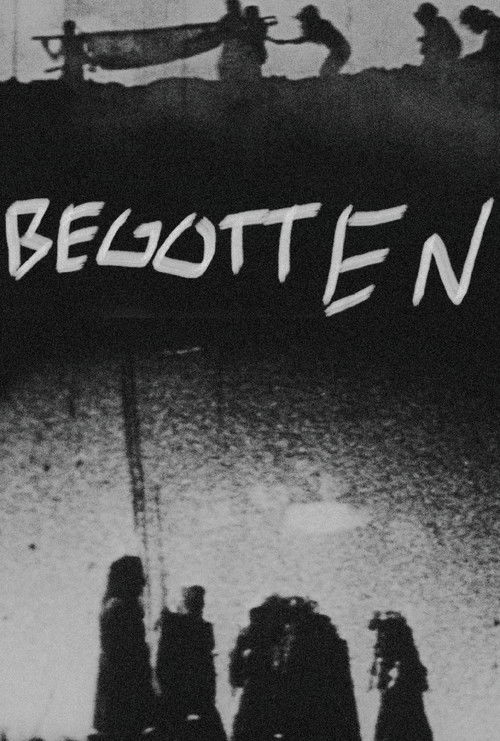
Begotten is shot in a dark, grungy and visceral style. Distorted perspectives and degraded image quality were used to evoke an ancient and otherworldly atmosphere. The film has been described as "a cinematic Rorschach test of grotesque, imagery" and "a feature-length fever dream". Merhige was interested in crafting imagery through analog format and sought a decayed look that suggested the footage had been damaged through time and wear. He said:
I wanted Begotten to look, not as if it were from the twenties, not even as if it were from the nineteenth century, but as if it were from the time of Christ, as if it were a cinematic Dead Sea Scroll that had been buried in the sands, a remnant of a culture with customs and rites that no longer apply to this culture, yet are somewhere underneath it, under the surface of what we call "reality."
The influences for Begotten's visual style include The Cabinet of Dr. Caligari (1920), Blood of the Beasts (1949), Seven Samurai (1954) and The Act of Seeing with One's Own Eyes (1971). He also lists the unconventional style Andrzej Munk, Sergei Eisenstein and Luis Buñuel. Other influences identified by critics include David Lynch's Eraserhead (1977), Dimitri Kirsanoff's Ménilmontant (1926) and Tobe Hooper's The Texas Chain Saw Massacre (1974), as well as tribal art, ethnographic studies and the paintings of Piero della Francesca. Visual underminings from 1930s horror films, such as intertitles, was also commented on by David Annwn Jones, who wrote that it was utilized to express its own set of evolving visual ideas and techniques.
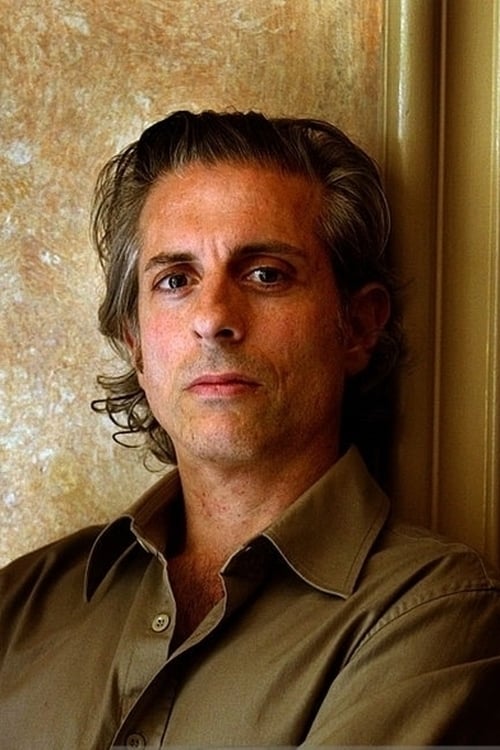
Before and during Begotten's shooting, Merhige experimented with different types of film. In one experiment, he ran an unexposed negative against sandpaper to scratch its surface before shooting on the damaged reel, and in another Merhige modified the film emulsion and frame rate to create a staggered time and motion effect. Footage was deliberately shot overexposed, to reduce the details of the image. Unsatisfied with the results, Merhige decided on an optical printer for further processing. He was unable to find an optical printer priced within his budget, so he built one himself. The printer was constructed in eight months with spare parts from camera stores and special effects houses where he had worked. Merhige had worked as a special effects designer for various companies, including a Disney television series that involved the animation technique of rotoscoping. This experience gave him the technical knowledge needed to handle the film's post-production and visual effects on his own.
The post-production process was time-consuming, with each minute of footage generated by the optical printer taking between eight and ten hours to complete. Each frame of raw footage was fed into the optical printer and projected onto an unused film negative; multiple photographic filters, including color and neutral-density filters, were used to alter the image. Developing the Kodak Plus-X film stock presented a significant challenge. Unprocessed reels required a dust-free environment as the Kodak film stock is notorious for its fragility; each reel was handled with protective gloves to avoid unintended imperfections. Three months of extensive tests were implemented during photographic processing. When a test shot was sent to the laboratory for processing, minuscule calibration errors sometimes ruined the shot and the process had to be restarted. Merhige asked that laboratories adjust their usual development procedures to his custom specifications, but was repeatedly turned away. Eventually, he found Fred Schreck's Kin-O-Lux Labs. Merhige began a friendship with Schreck who taught him to hand-develop his footage.
Merhige hired his father for a number of scenes, stating that his father was "very open-minded" to the project. Editor and film-maker Aram Avakian, whom Merhige had become acquainted with, also supported and encouraged Merhige to complete the project. Results of the rephotography process removed almost all of the gray midtones from the visible spectrum, leaving only extreme contrasts of black and white. He used similar techniques for segments of his next film, Shadow of the Vampire (2001).