
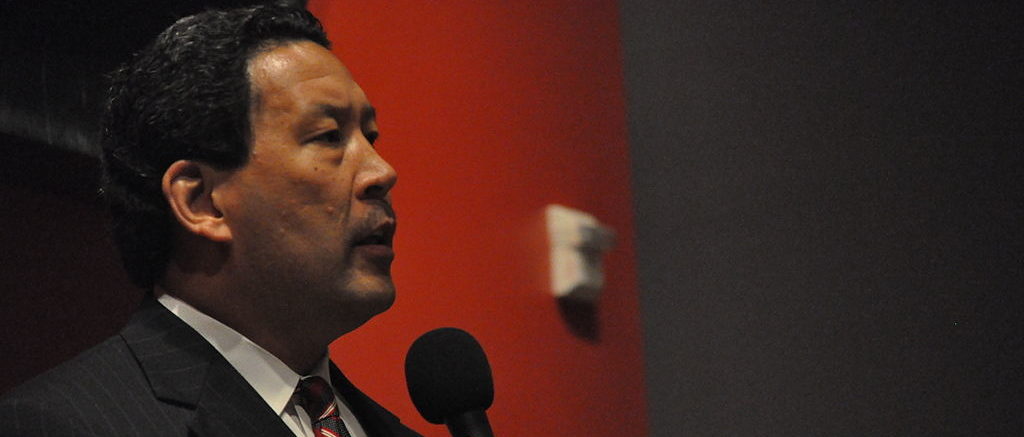
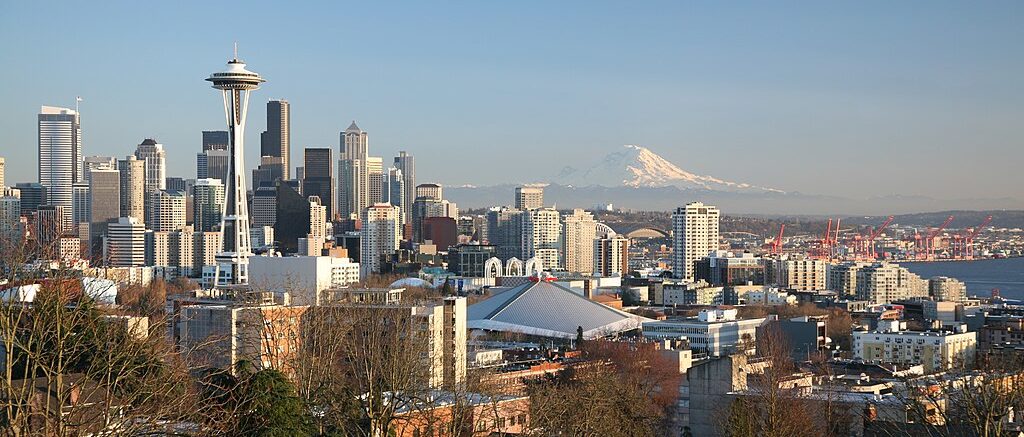
Bruce Allen Harrell (born October 10, 1958) is an American politician and attorney who was the 54th and 57th mayor of Seattle. He was a member of the Seattle City Council from 2008 to 2020. From 2016 to 2020, he was president of the city council. He was acting mayor of Seattle from September 13 to 18, 2017 following the resignation of Ed Murray. He was elected mayor in his own right in 2021, becoming the city's second African-American mayor and its first Asian-American mayor. In the 2025 Seattle mayoral election, he was defeated by progressive challenger Katie Wilson in his bid for reelection to a second term.
Contents
Early life
Harrell was born in 1958 in Seattle, to an African American father who worked for Seattle City Light and a Japanese-American mother who worked for the Seattle Public Library. As a child during World War II, Harrell's mother was incarcerated with her family at Minidoka internment camp in Idaho. Growing up, Harrell and his family lived in the Central District in Seattle in a minority neighborhood. He attended Garfield High School and played football there as a linebacker, being named to the all-Metro team. He captained the football team during his senior season, during which the team played in the 1975 Metro League championship. He was also named the most valuable player of his high school baseball and wrestling teams, and received nine varsity letters. He graduated from Garfield in 1976 as class valedictorian. Keith Harrell, fellow Garfield alumnus and Seattle college sports star, was his cousin.
College football career and post-secondary education
After high school, Harrell attended the University of Washington on a football scholarship, rejecting an offer to attend Harvard University. He played for the Washington Huskies football team from 1976 to 1979 and was named to the 1979 All-Pacific-10 Conference football team. He received the National Football Foundation Scholar-Athlete Award, made the national Academic All-American First Team in football, and was named the Husky defensive player of the year. In 2013, he was inducted into the NW Football Hall of Fame. Harrell was a starting linebacker, and was named both a First-team Academic All-American. During his senior season in 1979, he led the team in tackles and the Huskies won the Sun Bowl.
Harrell graduated in 1980 with a Bachelor of Arts in political science. He continued his education at the university and earned a Juris Doctor from the UW Law School in 1984. In 1994, he earned a master's degree in organizational design and improvement from City University of Seattle. Harrell received the University of Washington Distinguished Alumni Award in 2007 and its Timeless Award in 2012.
Early career
After attending law school, Harrell joined US West, now Lumen Technologies, in 1987. Harrell was chief legal advisor to the Rainier Valley Community Development Fund, chief legal advisor to the First A.M.E. Church and First A.M.E. Housing Corporation, chief counsel to US West, and the Alpha Phi Alpha fraternity, Zeta Pi Lambda chapter.
Harrell was nominated to the public housing board in Omaha in 1996. Harrell claimed to have received threats after his nomination by individuals preferring the appointment of someone who lived in public housing to the board seat. On the evening of September 27, 1996, Harrell allegedly pointed a gun at a man, his mother, and his pregnant wife, in a Council Bluffs casino in response to a parking dispute, which resulted in his arrest. At the time, Harrell told reporters he had only "displayed" his gun and had been carrying the weapon for protection due to death threats he had received following his housing board nomination. He did not have permit for gun in Iowa at the time of his arrest. Charges against Harrell were dismissed six months later in what County Prosecutor Rick Crowl described as an “unofficial deferred prosecution.” Crowl cited Harrell's claim of having felt threatened by "a Hispanic group" during the exchange as among his reasons for dropping the charges. According to Crowl, Harrell was required to apologize to the arresting officers. A letter written by Crowl in 2024 described Harrell's display of the weapon as “non-threatening” and the incident as “minor.”
Seattle City Council (2008–2020)
From 2008 to 2020, Harrell served as a member of the Seattle City Council, first in the city-wide Position 3 seat (2008–2016) and then in the south-end District 2 seat (2016–2020).
Elections
In 2007, councilmember Peter Steinbrueck chose not to run for re-election, which drew five challengers for the open seat, which included Harrell, former city councilmember John Manning, and former mayoral candidate Al Runte. Prior to the primary election, Harrell and Venus Velázquez, a private public-affairs consultant, were the only candidates in the race to raise more than $100,000 and were considered front-runners. In the August primary, Velázquez came in first, earning 43.72% of the vote, and advanced to the general election with Harrell, who earned 28.43%.
Harrell focused his campaign on public safety, pushing for increased funding for the police and fire departments, with education being another top priority. Velázquez, who Steinbrueck endorsed, emphasised city growth without displacing low and middle-income individuals, and increasing affordability. Velázquez was seen as a frontrunner in the election until weeks before the election, when she was arrested on suspicion of DUI. Although she was later found not guilty in a jury trial, she stated her prosecution was politically motivated since the city attorney, Tom Carr, endorsed Harrell.
In the November general election, Harrell defeated Velázquez, 59.88% to 39.66%.
Harrell ran for reelection in 2011 and faced one challenger, Brad Meacham, a former financial journalist and chair of the Municipal League of King County.
Harrell ran on his work on the council overseeing Seattle City Light, pushing the utility to sell surplus property, build a $100 million savings account, and raise rates. Meacham criticized Harrell's oversight of the utility and accused Harrell of raising rates without a strategic plan in place. Harrell stated that the rate increase “was absolutely necessary” and that his work has brought stability to City Light. The candidates differed on public safety, with Harrell endorsing the use of police body cams, which he said would improve trust, while Meacham called them "cynical," saying they avoided firing bad officers. Meacham was supported by the People's Waterfront Coalition and the Sierra Club, due to his opposition to the Alaskan Way Viaduct replacement tunnel, while Harrell was supported by business and labor groups.
In the November general election, Harrell defeated Meacham, 61% to 38%.
Tenure
While on the council, Harrell served as chair of the Governance, Equity and Technology Committee; vice chair of the Human Service, Equitable Development, and Renter Rights Committee; and a member of the Finance and Neighborhoods Committee.
Harrell participated in launching the Beacon Hill Broadband Pilot project, which expanded the city's fiber-optic cable network into underserved South End neighborhoods.
In 2013, the city adopted and enacted the Job Assistance Ordinance, a so-called "ban the box" ordinance introduced and sponsored by Harrell, which restricts private employers from asking job applicants to answer on their applications whether they have a criminal record. Its passage had been led by Harrell and leaders from the Sojourner Place Transitional Housing organization. It took three years of local debate and compromise for the ordinance to be adopted which involved Harrell's engagement with local businesses, legal advocates, and members of the city's Human Rights Commission. The council unanimously adopted the final version of the ordinance in June 2013.
In 2011, Harrell wrote a letter to then-US Attorney Jenny Durkan asking that the federal government mandate body cameras in Seattle. In December 2014, he announced a pilot program to equip 12 officers with body cameras in the East Precinct, with a department wide program by 2016. In 2017, Mayor Ed Murray has signed an executive order to require officers and sergeants to wear body cameras while on duty, which Harrell supported.
In 2014, Harrell was the only dissenting vote when the City Council's land use committee voted to rezone the area around the Mount Baker Light Rail Station to permit dense housing construction. Harrell unsuccessfully introduced amendments that would have delayed the upzoning indefinitely for further study and reduced the amount of housing that could be constructed near the public transit station. When the upzoning was put up to a vote in the City Council, Harrell was the only member to vote against it.
On January 4, 2016, he was sworn in to the District 2 office and elected council president by fellow councilmembers. Later that year, Harrell supported a measure to attempt to bring back the Seattle SuperSonics, but the measure was defeated in a 5–4 vote.
Mayor of Seattle
Elections
In January 2013, Harrell announced his candidacy for Seattle mayor against incumbent Michael McGinn. Harrell called McGinn's leadership style as ineffective, and criticized the mayor over his handling of the federal probe into the Seattle Police Department over use of force and biased policing. During a primary debate, Harrell stated that McGinn's successes as mayor were legislation passed by the council, like the passage of paid sick leave.
In the August primary, Harrell came in fourth with 15.22% of the vote. He endorsed then-state senator Ed Murray in the general election.
After Mayor Jenny Durkan announced in 2021 that she would not seek reelection, Harrell announced his candidacy. In his announcement, he said "Look at what Seattle has become," referring to the ongoing homelessness crisis, business closures, property destruction, and racial violence. Harrell joined a crowded primary field of 15 candidates, which included Council President Lorena González, Chief Seattle Club Executive Director Colleen Echohawk, former state representative Jessyn Farrell, and architect Andrew Grant Houston. In the August primary, Harrell came in first, with 34% of the vote, and advanced to the general election with González, who earned 32.11%.
Harrell ran as a moderate, focusing on expanding the police force and addressing visible homelessness, and was endorsed by former governor Gary Locke, and former Seattle Mayors Norm Rice and Wesley C. Uhlman. González ran as a progressive, focusing on increasing corporate taxes and ending forced sweeps of homeless people, and was endorsed by Senators Bernie Sanders and Elizabeth Warren along with a majority of the city council.
On October 8, Harrell attended a dinner event at China Harbor restaurant. This event generated criticism, including Gonzalez, after photographs emerged of Harrell and other attendees without face masks, despite restrictions for events of its size at the time requiring attendees to be masked while not eating, drinking or sitting at their table. In the final week of the campaign, an ethics complaint was filed accusing accused Harrell of influencing a wage-theft investigation at a men's-only club that he was a member of while he was council president. Harrell released a statement in response which accused González of trying to distract voters from issues like homelessness and public safety. In the waning days of the campaign, González released an advertisement criticizing Harrell's initial support of Mayor Murray during the early stages of the abuse scandal, but pulled the ad due backlash with alleged racialized undertones of her advertisement.
Tenure
Deputy Mayor Kendee Yamaguchi resigned in July 2022. Harrell informed his cabinet that Greg Wong, the Director of the Department of Neighborhoods, would be promoted to deputy mayor. Harrell appointed Gino Bettis, the former assistant state's attorney for Cook County, Illinois, as director of the Office of Police Accountability on August 1, 2022.
Harrell appointed Adrian Diaz, the interim chief of the Seattle Police Department, to become permanent in September 2022. In May 2024, Harrell announced Diaz' demotion from police chief to a new role in "special projects" and appointed former King County Sheriff Sue Rahr as interim chief. The demotion occurred amid lawsuits and allegations involving sexual harassment, gender discrimination, and creating a misogynistic culture in the police department, but Harrell praised Diaz in the press conference. In October 2024, Diaz was placed on paid leave during watchdog investigations into 51 allegations against him and the department. In December 2024, Harrell fired Diaz after an internal investigation found that Diaz had hired and directly supervised a romantic partner and attempted to cover it up. In May 2025, Diaz filed a lawsuit against the city over wrongful termination and discrimination, after he came out as gay.
Harrell named his niece and former campaign manager Monisha Harrell as senior deputy mayor in 2021, becoming the first black, openly gay deputy mayor in Seattle history. She resigned the position in 2023, stating her departure was amicable and over disagreements on public safety issues. In 2025, Monisha Harrell stated her departure was due to a toxic workplace against her and other women in the office. In 2025 Monisha Harrell spoke to KUOW to allege that Harrell had created a toxic work environment where he repeatedly undermined the authority of the women staffers, including herself. Six other anonymous women with ties to the Mayor's office were interviewed by KUOW, supporting Monisha Harrell's characterizations of the work environment.
Throughout his term, Harrell focused on increasing staffing within the Seattle Police Department (SPD) by 500 officers through higher pay and recruitment bonuses. In the first quarter of 2025, SPD saw a 500% increase in applications compared to the same period in 2024. In July 2025, the city announced that 100 new officers were hired in the first half of the year.
In the first month of his term, Harrell launched "Operation New Day," starting by expanding police presence in the Little Saigon neighborhood, which had experienced increased crime and public drug use since the start of the COVID-19 pandemic. In his February State of the City speech, Harrell vowed to clean-up crime in Little Saigon and touted that early success of the program in the neighborhood, stating "...police officers in the first 21 days of January made 23 felony arrests, 14 misdemeanor arrests." By March 2022, the drug market and illegal goods market were cleared due to daily police patrols, and the program was expanded to other "hotspots" in the city, including Downtown, due to it "successfully" working in Little Saigon.
Personal life
Harrell and his wife Joanne married in 1992; they have three children and live in Seward Park.
Harrell has a fourth child, and a third biological child, from a previous relationship. He estranged himself from this son throughout much of his childhood.
In 2022, Harrell was honored by Gold House (which honors those of Asian Pacific descent). The organization honored him and fellow mayors Aftab Pureval and Michelle Wu as having made the "most impact" in the field of advocacy and policy.