Charles Edward "Buddy" Rogers (August 13, 1904 – April 21, 1999) was an American film actor and musician. During the peak of his popularity in the late 1920s and early 1930s, he was publicized as "America's Boyfriend".
Contents
Early life
Rogers was born to Maude and Bert Henry Rogers in Olathe, Kansas. He studied at the University of Kansas, where he became an active member of Phi Kappa Psi. In the mid-1920s, he began acting professionally in Hollywood films. A talented trombonist skilled on several other musical instruments, Rogers performed with his own dance band in motion pictures and on radio. During World War II, he served in the United States Navy as a flight training instructor.
According to American Dance Bands on Record and Film (1915–1942), compiled by Richard J. Johnson and Bernard H. Shirley (Rustbooks Publishing, 2010), Rogers was not a bandleader in the usual sense of the term. Instead, he was a film actor who fronted bands for publicity purposes. In 1933–34, Rogers took over the popular Joe Haymes orchestra, to which he added drummer Gene Krupa. His later bands were organized by Milt Shaw.
In 1930, he recorded two records for Columbia as a solo singer with a small band accompanying. In 1932, he signed with Victor and recorded four dance-band records with a group organized by drummer, and later actor, Jess Kirkpatrick. In 1938, he signed with Vocalion and recorded six swing records (see discography below).
Career
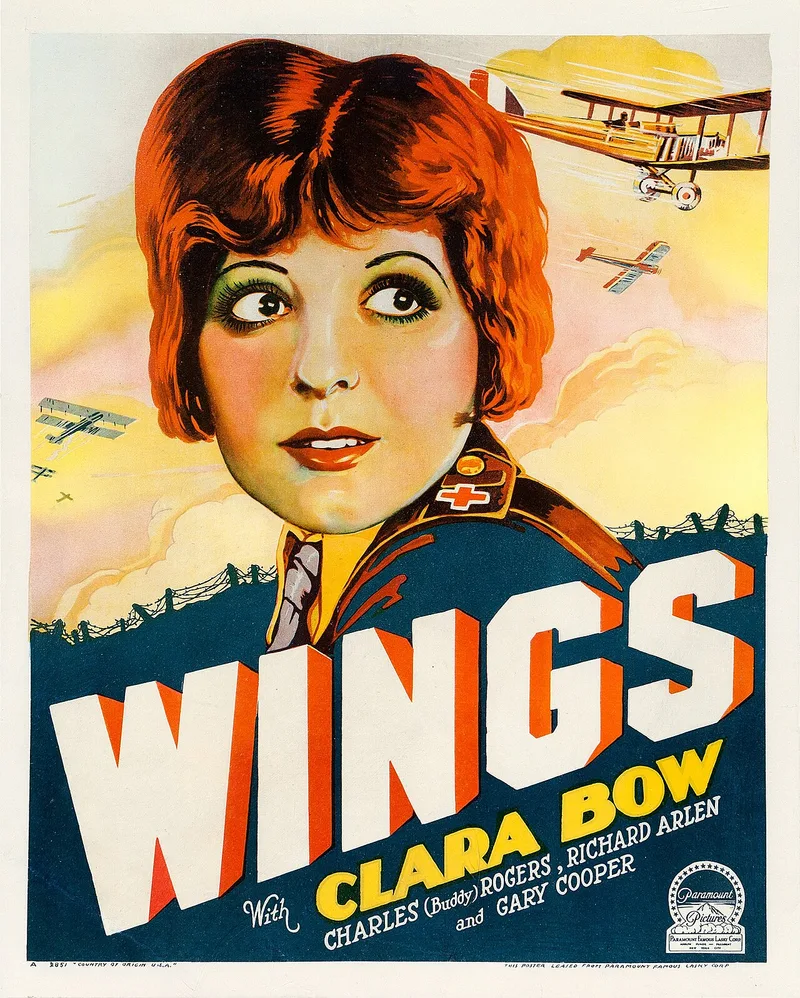
Nicknamed "Buddy", his most-remembered performance in film was opposite Clara Bow in the 1927 Academy Award winning Wings, the first film ever honored as Best Picture. In 1968, he appeared as himself in an episode of Petticoat Junction titled "Wings", a direct reference to the silent movie.
Recognition
For his contribution to the motion picture industry, Rogers has a star on the Hollywood Walk of Fame at 6135 Hollywood Blvd, which was dedicated on February 8, 1960.
Respected by his peers for his work in film and for his humanitarianism, the Academy of Motion Picture Arts and Sciences honored Rogers in 1986 with The Jean Hersholt Humanitarian Award.
A Golden Palm Star on the Palm Springs Walk of Stars was dedicated to him in 1993.
Personal life
On June 24, 1937, Rogers became the third husband of silent film actress Mary Pickford. Their romance had begun in 1927, when they co-starred in My Best Girl, but the two kept their relationship hidden until Pickford's separation and 1936 divorce from Douglas Fairbanks. The couple adopted two children—Roxanne and Ronald—and remained married for 42 years until Pickford's death in 1979.
In 1981, Rogers married real estate agent Beverly Ricono.
Death
Rogers died at his home in Rancho Mirage, California, on April 21, 1999, at the age of 94. He was interred at Forest Lawn Cemetery, Cathedral City, near Palm Springs.
Discography
As Charles "Buddy" Rogers (America's Boy Friend)
February 27, 1930 & March 4, 1930
"(I'd like to be) A Bee in Your Boudoir" / "My Future Just Passed" (Columbia 2183-D)
March 4, 1930
"Any Time's the Time to Fall in Love" / "(Up on Top of a Rainbow) Sweepin' the Clouds Away" (Columbia 2143-D)
As Buddy Rogers and His California Cavaliers
April 18, 1932
"You Fascinate Me" / "Hello, Gorgeous" (Victor 24001)
May 11, 1932
"In My Hideaway" / "Happy-Go-Lucky You (And Broken-Hearted Me)" (Victor 24015)
May 18, 1932
"I Beg Your Pardon, Mademoiselle" / "With My Sweetie in the Moonlight" (Victor 24031)
"Please Handle with Care" / "Ask Yourself Who Loves You" (Victor 24049)
As Charles "Buddy" Rogers and his Band (recorded in London)
February 9, 1935
"I Hate to Say Goodnight" / "The Valparaiso" (vocals by Rogers) (Decca F. 5681)
"Someone to Sew Your Buttons On" (vocal by Eve Becke) / "Jack O' Diamonds" (vocals by Rogers, Brian Lawrance, Ronnie Hill) (Decca F. 5464)