


The Chicago White Sox are an American professional baseball team based in Chicago. The White Sox compete in Major League Baseball (MLB) as a member club of the American League (AL) Central Division. The club plays its home games at Rate Field, which is located on Chicago's South Side. They are one of two MLB teams based in Chicago, alongside the National League (NL)'s Chicago Cubs. The White Sox are known as the "South Siders", a reference to the location of their home park.
The White Sox originated in the Western League, founded as the Sioux City Cornhuskers in 1894, moving to Saint Paul, Minnesota, as the Saint Paul Saints, and ultimately relocating to Chicago in 1900. The Chicago White Stockings were one of the American League's eight charter franchises when the AL asserted major league status in 1901. The team, which shortened its name to the White Sox in 1904, originally played their home games at South Side Park before moving to Comiskey Park in 1910, before demolishing and rebuilding Comiskey Park in 1990, which is now known as Rate Field.
The White Sox won their first World Series, the 1906 World Series against the Cubs, with a defense-oriented team dubbed "the Hitless Wonders", and later won the 1917 World Series against the New York Giants. Their next appearance, the 1919 World Series, was marred by the Black Sox Scandal in which eight members of the White Sox were found to have conspired with gamblers to fix games and lose the World Series to the Cincinnati Reds. In response, the new Commissioner of Baseball, Kenesaw Mountain Landis, banned the players from the league for life. The White Sox have only made two World Series appearances since the scandal. The first came in 1959, where they lost to the Los Angeles Dodgers, before they finally won their third championship in 2005 against the Houston Astros. The 88 seasons it took the White Sox to win the World Series stands as the longest MLB championship drought in the American League, and the second longest in both leagues, to the Cubs' 108 seasons.
From 1901 to 2025, the White Sox have an overall win-loss record of 9,654–9,714–103 (.498).
Contents
History
The White Sox originated as the Sioux City Cornhuskers of the Western League, a minor league under the parameters of the National Agreement with the National League. In 1894, Charles Comiskey bought the Cornhuskers and moved them to St. Paul, Minnesota, where they became the St. Paul Saints. In 1900, with the approval of Western League president Ban Johnson, Charles Comiskey moved the Saints into his hometown neighborhood of Armour Square, where they became the Chicago White Stockings, the former name of Chicago's National League team, the Orphans (now the Chicago Cubs).
In 1901, the Western League broke the National Agreement and became the new major league American League. The first season in the AL ended with a White Stockings championship. However, that would be the end of the season, as the World Series did not begin until 1903. The franchise, now known as the Chicago White Sox, made its first World Series appearance in 1906, beating the crosstown Cubs in six games.
The White Sox won a third pennant and a second World Series in 1917, beating the New York Giants in six games with help from stars Eddie Cicotte and "Shoeless" Joe Jackson. The Sox were heavily favored in the 1919 World Series, but lost to the Cincinnati Reds in eight games. Huge bets on the Reds fueled speculation that the series had been fixed. A criminal investigation went on in the 1920 season, and although all players were acquitted, commissioner Kenesaw Mountain Landis banned eight of them for life, in what was known as the Black Sox Scandal. This set the franchise back, as they did not win another pennant for 40 years.
The White Sox did not finish in the upper half of the American League again until after founder Charles Comiskey died and passed ownership of the club to his son, J. Louis Comiskey. They finished in the upper half most years between 1936 and 1946, under the leadership of manager Jimmy Dykes, with star shortstop Luke Appling (known as "Ol' Aches and Pains") and pitcher Ted Lyons, who both had their numbers 4 and 16 retired.
After J. Louis Comiskey died in 1939, ownership of the club was passed down to his widow, Grace Comiskey. The club was later passed down to Grace's children Dorothy and Chuck in 1956, with Dorothy selling a majority share to a group led by Bill Veeck after the 1958 season. Veeck was notorious for his promotional stunts, attracting fans to Comiskey Park with the new "exploding scoreboard" and outfield shower. In 1961, Arthur Allyn, Jr. briefly owned the club before selling to his brother John Allyn.
Ballparks
In the late 1980s, the franchise threatened to relocate to Tampa Bay (as did the San Francisco Giants), but frantic lobbying on the part of the Illinois governor James R. Thompson and state legislature resulted in approval (by one vote) of public funding for a new stadium. Designed primarily as a baseball stadium (as opposed to a "multipurpose" stadium), the new Comiskey Park (redubbed U.S. Cellular Field, often nicknamed "The Cell", in 2003 and Guaranteed Rate Field in 2016 (later renamed to Rate Field following a rebrand in 2024), after mortgage company Guaranteed Rate) was built in a 1960s style, similar to Dodger Stadium and Kauffman Stadium. There were ideas for other stadium designs submitted to bring a more neighborhood feel, but ultimately they were not selected. The park opened in 1991 to positive reaction, with many praising its wide-open concourses, excellent sight lines, and natural grass (unlike other stadiums of the era, such as Rogers Centre in Toronto). The park's inaugural season drew 2,934,154 fans — at the time, an all-time attendance record for any Chicago baseball team.
In recent years, money accrued from the sale of naming rights to the field has been allocated for renovations to make the park more aesthetically appealing and fan-friendly. Notable renovations of early phases included reorientation of the bullpens parallel to the field of play (thus decreasing slightly the formerly symmetrical dimensions of the outfield); filling seats in up to and shortening the outfield wall; ballooning foul-line seat sections out toward the field of play; creating a new multitiered batter's eye, allowing fans to see out through one-way screens from the center-field vantage point, and complete with concession stand and bar-style seating on its "fan deck"; and renovating all concourse areas with brick, historic murals, and new concession stand ornaments to establish a more friendly feel. The stadium's steel and concrete were repainted dark gray and black. In 2016, the scoreboard jumbotron was replaced with a new Mitsubishi Diamondvision HDTV screen.
The top quarter of the upper deck was removed in 2004, and a black wrought-metal roof was placed over it, covering all but the first eight rows of seats. This decreased seating capacity from 47,098 to 40,615; 2005 also had the introduction of the Scout Seats, redesignating (and reupholstering) 200 lower-deck seats behind home plate as an exclusive area, with seat-side waitstaff and a complete restaurant located underneath the concourse. The most significant structural addition besides the new roof was 2005's FUNdamentals Deck, a multitiered structure on the left-field concourse containing batting cages, a small Tee Ball field, speed pitch, and several other children's activities intended to entertain and educate young fans with the help of coaching staff from the Chicago Bulls/Sox Training Academy. This structure was used during the 2005 American League playoffs by ESPN and the Fox Broadcasting Company as a broadcasting platform.
Previous ballparks
The St. Paul Saints first played their games at Lexington Park. When they moved to Chicago's Armour Square neighborhood, they began play at the South Side Park. Previously a cricket ground, the park was located on the north side of 39th Street (now called Pershing Road) between South Wentworth and South Princeton Avenues. Its massive dimensions yielded few home runs, which was to the advantage of the White Sox's Hitless Wonders teams of the early 20th century.
After the 1909 season, the White Sox moved five blocks to the north to play in the new Comiskey Park, while the 39th Street grounds became the home of the Chicago American Giants of the Negro leagues. Billed as the Baseball Palace of the World, it originally held 28,000 seats and eventually grew to hold over 50,000. It became known for its many odd features, such as the outdoor shower and the exploding scoreboard. When it closed after the 1990 season, it was the oldest ballpark still in Major League Baseball.
Spring-training ballparks
The White Sox have held spring training in:
On November 19, 2007, the cities of Glendale and Phoenix, Arizona, broke ground on a new Cactus League spring-training facility. Camelback Ranch, the $76 million, two-team facility, is the home of both the White Sox and the Los Angeles Dodgers for their spring training, featuring state-of-the-art baseball facilities and an over 10,000-seat stadium. The facility is also home to amenities such as 118,000 sq ft. of clubhouse space, 13 full fields, citrus groves, and a large lake and river system stocked with fish running throughout the complex.
Logos and uniforms
Over the years, the White Sox have become noted for many of their uniform innovations and changes. In 1960, they became the first team in the major sports to put players' last names on jerseys for identification purposes.
In 1912, the White Sox debuted a large "S" in a Roman-style font, with a small "O" inside the top loop of the "S" and a small "X" inside the bottom loop. This is the logo associated with the 1917 World Series championship team and the 1919 Black Sox. With a couple of brief interruptions, the dark-blue logo with the large "S" lasted through 1938 (but continued in a modified block style into the 1940s). Through the 1940s, the White Sox team colors were primarily navy blue trimmed with red.
The White Sox logo in the 1950s and 1960s (actually beginning in the 1949 season) was the word "SOX" in Gothic script, diagonally arranged, with the "S" larger than the other two letters. From 1949 through 1963, the primary color was black (trimmed with red after 1951). This is the logo associated with the Go-Go Sox era.
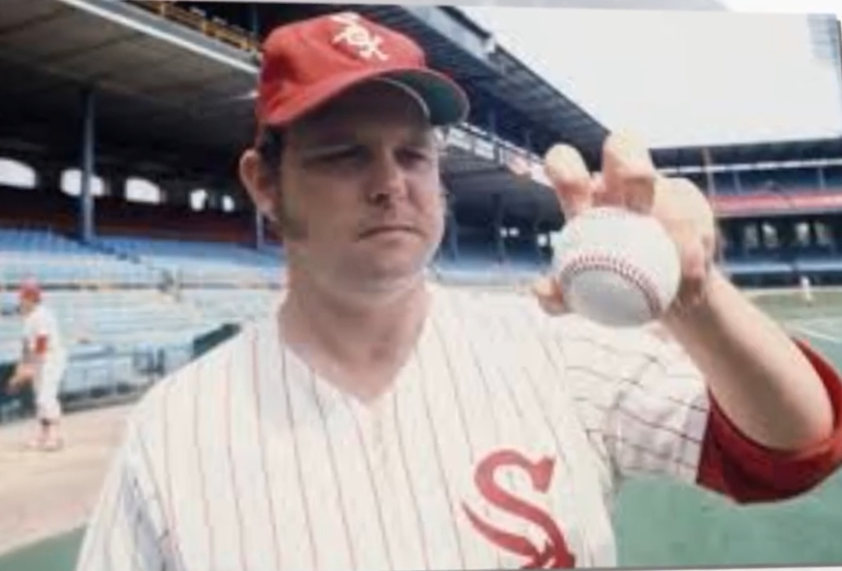
In 1964, the primary color went back to navy blue, and the road uniforms changed from gray to pale blue. In 1971, the team's primary color changed from royal blue to red, with the color of their pinstripes and caps changing to red. The 1971–1975 uniform included red socks.
In 1976, the team's uniforms changed again. The team's primary color changed back from red to navy. The team based their uniforms on a style worn in the early days of the franchise, with white jerseys worn at home, and blue on the road. The team brought back white socks for the last time in team history. The socks featured a different stripe pattern every year. The team also had the option to wear blue or white pants with either jersey. Additionally, the team's "SOX" logo was changed to a modern-looking "SOX" in a bold font, with "CHICAGO" written across the jersey. Finally, the team's logo featured a silhouette of a batter over the words "SOX".
The new uniforms also featured collars and were designed to be worn untucked — both unprecedented. Yet by far, the most unusual wrinkle was the option to wear shorts, which the White Sox did for the first game of a doubleheader against the Kansas City Royals in 1976. The Hollywood Stars of the Pacific Coast League had previously tried the same concept, but it was also poorly received. Apart from aesthetic issues, as a practical matter, shorts are not conducive to sliding, due to the likelihood of significant abrasions. The White Sox attempted to bring these back in 2016, however, former White Sox pitcher Chris Sale cut up the team uniforms a few days before the game because he didn't like them.
Awards and accolades
American League championships
Note: American League Championship Series began in 1969
Award winners
1959 – Nellie Fox
1972 – Dick Allen
1993 – Frank Thomas
1994 – Frank Thomas
2020 – Jose Abreu
1959 – Early Wynn (MLB)
1983 – LaMarr Hoyt (AL)
1993 – Jack McDowell (AL)
1951 – Orestes "Minnie" Miñoso (Sporting News)
1956 – Luis Aparicio
1963 – Gary Peters
1966 – Tommie Agee
1983 – Ron Kittle
1985 – Ozzie Guillén
2014 – José Abreu
1983 – Tony La Russa
1990 – Jeff Torborg
1993 – Gene Lamont
2000 – Jerry Manuel
2005 – Ozzie Guillén
Team captains
Willie Kamm 1927–1928
Art Shires 1929
Luke Appling 1930–1950
Ozzie Guillén 1990–1997
Carlton Fisk 1990–1993
Paul Konerko 2006–2014
Retired numbers
The White Sox have retired a total of 12 jersey numbers: 11 worn by former White Sox and number 42 in honor of Jackie Robinson.
Luis Aparicio's No. 11 was issued at his request for 11-time Gold Glove winner shortstop Omar Vizquel (because No. 13 was used by manager Ozzie Guillén; Vizquel, like Aparicio and Guillen, play(ed) shortstop and all share a common Venezuelan heritage). Vizquel played for team in 2010 and 2011.
Also, Harold Baines had his No. 3 retired in 1989; it has since been 'unretired' 3 times in each of his subsequent returns.
6: Since Charley Lau's death in 1984, no White Sox player or coach (except Lau disciple Walt Hriniak, the Chicago White Sox's hitting coach from 1989 to 1995) has worn his No. 6 jersey, although it has not been officially retired.
Players and personnel
Front office and key personnel
Source:
Culture
Former U.S. President Barack Obama has been a fan of the White Sox since the 1980s.
Nicknames
The White Sox were originally known as the White Stockings, a reference to the original name of the Chicago Cubs. To fit the name in headlines, local newspapers such as the Chicago Tribune abbreviated the name alternatively to Stox and Sox. Charles Comiskey would officially adopt the White Sox nickname in the club's first years, making them the first team to officially use the "Sox" name. The Chicago White Sox are most prominently nicknamed "the South Siders", their home stadium having always been located on Chicago's South Side, distinguishing them from their crosstown rivals the Cubs (whose longtime home stadium Wrigley Field is in the North Side neighborhood of Lake View). Other nicknames include the synonymous "Pale Hose"; "the ChiSox", a combination of "Chicago" and "Sox", used mostly by the national media to differentiate them between the Boston Red Sox (BoSox); and "the Good Guys", a reference to the team's one-time motto "Good guys wear black", coined by broadcaster Ken Harrelson. Most fans and Chicago media refer to the team as simply "the Sox". The Spanish language media sometimes refer to the team as Medias Blancas for "White Socks".
Several individual White Sox teams have received nicknames over the years:
The 1906 team was known as the Hitless Wonders due to their .230 batting average, worst in the American League. Despite their hitting woes, the Sox would beat the crosstown Cubs for their first world title.
The 1919 White Sox are known as the Black Sox after eight players were banned from baseball for fixing the 1919 World Series.
The 1959 White Sox were referred to as the Go-Go White Sox due to their speed-based offense. The period from 1951 to 1967, in which the White Sox had 17 consecutive winning seasons, is sometimes referred to as the Go-Go era.
The 1977 team was known as the South Side Hitmen as they contended for the division title after finishing last the year before.
The 1983 White Sox became known as the Winning Ugly White Sox in response to Texas Rangers manager Doug Rader's derisive comments that the White Sox "...weren't playing well. They're winning ugly." The Sox went on to win the 1983 American League West division on September 17.
Mascots
From 1961 until 1991, lifelong Chicago resident Andrew Rozdilsky performed as the unofficial yet popular mascot "Andy the Clown" for the White Sox at the original Comiskey Park. Known for his elongated "Come on you White Sox" battle cry, Andy got his start after a group of friends invited him to a Sox game in 1960, where he decided to wear his clown costume and entertain fans in his section. That response was so positive that when he won free 1961 season tickets, he decided to wear his costume to all games. Comiskey Park ushers eventually offered free admission to Rozdilsky. Starting in 1981, the new ownership group led by Jerry Reinsdorf introduced a twosome, called Ribbie and Roobarb, as the official team mascots, and banned Rozdilsky from performing in the lower seating level. Ribbie and Roobarb were very unpopular, as they were seen as an attempt to get rid of the beloved Andy the Clown.
In 1988, the Sox got rid of Ribbie and Roobarb; Andy the Clown was not permitted to perform in the new Comiskey Park when it opened in 1991. In the early 1990s, the White Sox had a cartoon mascot named Waldo the White Sox Wolf that advertised the "Silver and Black Pack", the team's kids' club at the time. The team's current mascot, SouthPaw, was introduced in 2004 to attract young fans.
Fight and theme songs
Nancy Faust became the White Sox organist in 1970, a position she held for 40 years. She was one of the first ballpark organists to play pop music, and became known for her songs playing on the names of opposing players (such as Iron Butterfly's "In-A-Gadda-Da-Vida" for Pete Incaviglia). Her many years with the White Sox established her as one of the last great stadium organists. Since 2011, Lori Moreland has served as the White Sox organist.
Similar to the Boston Red Sox with "Sweet Caroline" (and two songs named "Tessie"), and the New York Yankees with "Theme from New York, New York", several songs have become associated with the White Sox over the years. They include:
"Let's Go, Go-Go White Sox" by Captain Stubby and the Buccaneers – A tribute to the "Go-Go White Sox" of the late 1950s, this song serves as the unofficial fight song of the White Sox. In 2005, scoreboard operator Jeff Szynal found a record of the song and played it for a "Turn Back the Clock" game against the Los Angeles Dodgers, whom the Sox played in the 1959 World Series. After catcher A. J. Pierzynski hit a walk-off home run, they kept the song around, as the White Sox went on to win the 2005 World Series.
"Na Na Hey Hey Kiss Him Goodbye" by Steam – Organist Nancy Faust played this song during the 1977 pennant race when a Kansas City Royals pitcher was pulled, and it became an immediate hit with White Sox fans. Faust is credited with making the song a stadium anthem and saving it from obscurity. To this day, the song remains closely associated with the White Sox, who play it when the team forces a pitching change, and occasionally on Sox home runs and victories.
"Sweet Home Chicago" – The Blues Brothers version of this Robert Johnson blues standard is played after White Sox games conclude.
"Thunderstruck" by AC/DC – One of the most prominent songs for the White Sox player introductions, the team formed a bond with AC/DC's hit song in 2005 and it has since become a staple at White Sox home games. The White Sox front office has tried replacing the song several times in an attempt to "shake things up", but White Sox fans have always showed their displeasure with new songs and have successfully gotten the front office to keep the fan-favorite song.
Rivalries
Crosstown Classic
The Chicago Cubs are the crosstown rivals of the White Sox, a rivalry that some made fun of prior to the White Sox's 2005 title because both of them had extremely long championship droughts. The nature of the rivalry is unique; with the exception of the 1906 World Series, in which the White Sox upset the favored Cubs, the teams never met in an official game until 1997, when interleague play was introduced. In the intervening time, the two teams sometimes met for exhibition games. The White Sox currently led the regular-season series 48–39, winning the last four consecutive seasons. The BP Crosstown Cup was introduced in 2010 and the White Sox won the first three seasons (2010–2012) until the Cubs first won the Cup in 2013 by sweeping the season series. The White Sox won the Cup the next season and retained the Cup the following two years (series was a tie - Cup remains with defending team in the event of a tie). The Cubs took back the Cup in 2017. Two series sweeps have occurred since interleague play began, both by the Cubs in 1998 and 2013.
An example of this volatile rivalry is the game played between the White Sox and the Cubs at U.S. Cellular Field on May 20, 2006. White Sox catcher A. J. Pierzynski was running home on a sacrifice fly by center fielder Brian Anderson and smashed into Cubs catcher Michael Barrett, who was blocking home plate. Pierzynski lost his helmet in the collision, and slapped the plate as he rose. Barrett stopped him, and after exchanging a few words, punched Pierzynski in the face, causing a melee to ensue. Brian Anderson and Cubs first baseman John Mabry got involved in a separate confrontation, although Mabry was later determined to be attempting to be a peacemaker. After 10 minutes of conferring following the fight, the umpires ejected Pierzynski, Barrett, Anderson, and Mabry. As Pierzynski entered his dugout, he pumped his arms, causing the sold-out crowd at U.S. Cellular Field to erupt in cheers. When play resumed, White Sox second baseman Tadahito Iguchi blasted a grand slam to put the White Sox up 5–0 on their way to a 7–0 win over their crosstown rivals. While other major league cities and metropolitan areas have two teams co-exist, all of the others feature at least one team that began playing there in 1961 or later, whereas the White Sox and Cubs have been competing for their city's fans since 1901.
Historical
A historical regional rival was the St. Louis Browns. Through the 1953 season, the two teams were located fairly close to each other (including the 1901 season when the Browns were the Milwaukee Brewers), and could have been seen as the American League equivalent of the Cardinals–Cubs rivalry, being that Chicago and St. Louis have for years been connected by the same highway (U.S. Route 66 and now Interstate 55). The rivalry has been somewhat revived at times in the past, involving the Browns' current identity, the Baltimore Orioles, most notably in 1983.
The current Milwaukee Brewers franchise were arguably the White Sox's main and biggest rival, due to the proximity of the two cities (resulting in large numbers of White Sox fans who would regularly be in attendance at the Brewers' former home, Milwaukee County Stadium), and with the teams competing in the same American League division for the 1970 and 1971 seasons and then again from 1994 to 1997. The rivalry has since cooled off, however, when the Brewers moved to the National League in 1998. However, with the start of the 2023 season, all teams will play each other at least once a year, leading to the Brewers-White Sox series to return on a yearly basis.
Divisional
The rivalry between the White Sox and Minnesota Twins re-emerged in the 2000s, as the two teams consistently battled for the AL Central Crown. The Twins won the division in 2002, 2003, 2004, 2006, and 2009, with the Sox winning in 2000, 2005, and 2008, many of those years their rival was the division runner-up. The teams met in the 2008 American League Central tie-breaker game, which was necessitated by the two clubs finishing the season with identical records. The White Sox won this game 1–0 on a Jim Thome home run.
The series between the White Sox and Detroit Tigers is one of the oldest active rivalries in the league today. Both teams joined the American League in 1901 after being charter members of the original Western League. They have played one another annually for over 120 seasons. The rivalry is similar to the one that exists between the Chicago Bulls and Detroit Pistons of the NBA. Despite playing one another for over 2,200 games, the White Sox and Tigers have yet to meet in the postseason in their 122-year series.
Community Outreach
In 1990, then new White Sox owners Eddie Einhorn and Jerry Reinsdorf began Chicago White Sox Charities, a 501(c) (3) charitable organization that is the team's philanthropic arm, donating over $27 million over time to a plethora of Chicago organizations. White Sox Charities began centering on early childhood literacy programs, then expanded to focusing on encouraging high school graduation and college matriculation so the team can monitor its success. It also supports children at risk as well as promotes wellness and health.
Home attendance
Broadcasting
Radio
The White Sox did not sell exclusive rights for radio broadcasts from radio's inception until 1944, instead having local stations share rights for games, and after WGN (720) was forced to abdicate their rights to the team in the 1943 after 16 seasons due to children's programming commitments from their network, Mutual. The White Sox first granted exclusive rights in 1944, and bounced between stations until 1952, when they started having all games broadcast on WCFL (1000). Throughout this period of instability, one thing remained constant, the White Sox play-by-play announcer, Bob Elson. Known as the "Commander", Elson was the voice of the Sox from 1929 until his departure from the club in 1970. In 1979, he was the recipient of the Ford Frick Award, and his profile is permanently on display in the National Baseball Hall of Fame.
After the 1966 season, radio rights shifted from WCFL to WMAQ (670). An NBC-owned and -operated station until 1988 when Westinghouse Broadcasting purchased it after NBC's withdrawal from radio, it was the home of the Sox until the 1996 season, outside of a team nadir in the early '70s, where it was forced to broker time on suburban La Grange's WTAQ (1300) and Evanston's WEAW-FM (105.1) to have their play-by-play air in some form (though WEAW transmitted from the John Hancock Center, FM radio was not established as a band for sports play-by-play at the time), and a one-season contract on WBBM (780) in 1981. After Elson's retirement in 1970, Harry Caray began his tenure as the voice of the White Sox, on radio and on television. Although best remembered as a broadcaster for the rival Cubs, Caray was very popular with White Sox fans, pining for a "cold one" during broadcasts. Caray often broadcast from the stands, sitting at a table set up amid the bleachers. It became a badge of honor among Sox fans to "Buy Harry a beer..." By game's end, one would see a large stack of empty beer cups beside his microphone. This only endeared him to fans that much more. In fact, he started his tradition of leading the fans in the singing of "Take Me Out To The Ballgame" with the Sox. Caray, alongside color analyst Jimmy Piersall, was never afraid to criticize the Sox, which angered numerous Sox managers and players, notably Bill Melton and Chuck Tanner. He left to succeed Jack Brickhouse as the voice of the Cubs in 1981, where he became a national icon.
The White Sox shifted through several announcers in the 1980s, before hiring John Rooney as play-by-play announcer in 1989. In 1992, he was paired with color announcer Ed Farmer. In 14 seasons together, the duo became a highly celebrated announcing team, even being ranked by USA Today as the top broadcasting team in the American League. Starting with Rooney and Farmer's fifth season together, Sox games returned to the 1000 AM frequency for the first time in 30 years. By then, it had become the ESPN owned and operated WMVP. The last game on WMVP was game 4 of the 2005 World Series, with the White Sox clinching their first World Series title in 88 years. That also was Rooney's last game with the Sox, as he left to join the radio broadcast team of the St. Louis Cardinals.
Television
White Sox games appeared sporadically on television throughout the first half of the 20th century, most commonly announced by Jack Brickhouse on WGN-TV (channel 9). Starting in 1968, Jack Drees took play-by-play duties as the Sox were broadcast on WFLD (channel 32). After 1972, Harry Caray (joined by Jimmy Piersall in 1977) began double duty as a TV and radio announcer for the Sox, as broadcasts were moved to channel 44, WSNS-TV, from 1972 to 1980, followed by one year on WGN-TV.
Don Drysdale became the play-by-play announcer in 1982, as the White Sox began splitting their broadcasts between WFLD and the new regional cable television network, Sportsvision. Ahead of its time, Sportsvision had a chance to gain huge profits for the Sox. However, few people would subscribe to the channel after being used to free-to-air broadcasts for many years, along with Sportsvision being stunted by the city of Chicago's wiring for cable television taking much longer than many markets because of it being an area where over-the-air subscription services were still more popular, resulting in the franchise losing around $300,000 a month. While this was going on, every Cubs game was on WGN, with Harry Caray becoming the national icon he never was with the White Sox. The relatively easy near-national access to Cubs games versus Sox games in this era, combined with the popularity of Caray and the Cubs being owned by the Tribune Company, is said by some to be the main cause of the Cubs' advantage in popularity over the Sox.
Three major changes to White Sox broadcasting occurred in 1989-1991: in 1989, with the city finally fully wired for cable service, Sportsvision was replaced by SportsChannel Chicago (itself eventually turning into Fox Sports Net Chicago), which varied over its early years as a premium sports service and basic cable channel. In 1990, over-the-air broadcasts shifted back to WGN. And in 1991, Ken Harrelson became the play-by-play announcer of the White Sox. One of the most polarizing figures in baseball, "Hawk" has been both adored and scorned for his emotive announcing style. His history of calling out umpires has earned him reprimands from the MLB commissioner's office, and he has been said to be the most biased announcer in baseball. However, Harrelson has said that he is proud of being "the biggest homer in baseball", saying that he is a White Sox fan like his viewers. The team moved from FSN Chicago to the newly launched NBC Sports Chicago in March 2005, as Jerry Reinsdorf looked to control the rights for his team rather than sell rights to another party; Reinsdorf holds a 40% interest in the network, with 20% of that interest directly owned by the White Sox corporation.
Minor league affiliates
The Chicago White Sox farm system consists of six minor league affiliates.
Silver Chalice subsidiary
Silver Chalice is a digital and media investment subsidiary of the White Sox with Brooks Boyer as CEO.
Silver Chalice was co-founded by Jerry Reinsdorf, White Sox executive Brooks Boyer, Jason Coyle and John Burris in 2009. The company first invested in 120 Sports, a digital sports channel, that launched in June 2014. Chalice then partnered with IMG on Campus Insiders, a college sports digital channel, in 2015. These two efforts merged with Sinclair Broadcasting Group's American Sports Network into the new multi-platform network Stadium in September 2017.
In May 2023, Sinclair sold its controlling interest in Stadium to Silver Chalice.