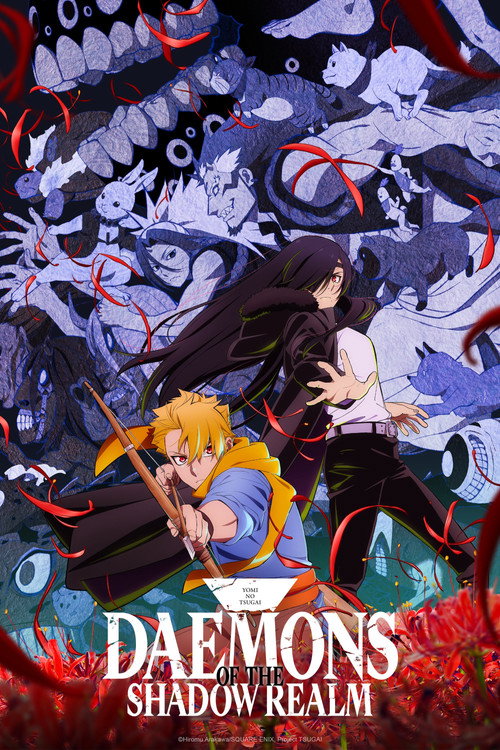






Daemons of the Shadow Realm (Japanese: 黄泉のツガイ, Hepburn: Yomi no Tsugai; lit. 'Pairs from the Underworld') is a Japanese anime television series produced by Bones Film, based on the manga series Daemons of the Shadow Realm by Hiromu Arakawa. It premiered in April 2026 on Tokyo MX and other networks. The series follows young hunter Yuru, who awakens two ancient guardians called "Daemons", which he uses to protect his village. He explores the outside world to understand the truth behind his missing sister, Asa.
The series was directed by Masahiro Andō and written by Noboru Takagi. The team worked on the anime to be faithful to the source material while carefully expanding content. Crunchyroll licensed the series for an English release.
Critical reception has been positive due to the production values of Bones Film and the way fight scenes and drama are blended. Critics also praised the early plot twists presented in the story.
Contents
Synopsis
Set in a world where certain humans can control a duo of supernatural creatures called Daemons, twins Yuru and Asa, "born between day and night" in a premodern Higashi village, are prophesied to wield great power. As a teenager, Yuru learns that he was separated from his sister at a young age, and that the Higashi village has been cut off from the now modern world (called "Lowlands" by the villagers) for centuries, where Asa grew up. Along the way to find each other, the twins learn of their abilities to control all Daemons and eventually discover they must unite to save the world from destruction.
Production
The anime adaptation was primarily written by Noboru Takagi, who had previously worked at Bones prior to his involvement with Daemons of the Shadow Realm. Bones approached Takagi to collaborate on the project. He was drawn to the manga's simultaneous treatment of ordinary life and supernatural events, believing that this balance enriched the original series' storytelling and ensured a consistent tone. From the outset, the staff aimed to remain faithful to the source material, with only minor deviations. The series was directed by Masahiro Ando, who frequently suggested expanding certain moments from the manga to create cliffhangers while still honoring the original work.
Early in production, the team agreed on a 24‑episode run, a decision they found challenging as it required careful planning for a suitable conclusion or climax. Determining these cliffhangers placed considerable pressure on Takagi during the writing process. In hindsight, he expressed admiration for Hiromu Arakawa's writing, particularly its originality. Although the staff had no prior knowledge of Yuru and Asa's eventual character arcs when the anime began, they suspected that the series' title indicated the pair would become pivotal figures. By the second episode, Takagi was already impressed by the studio's work on the series.
Cast
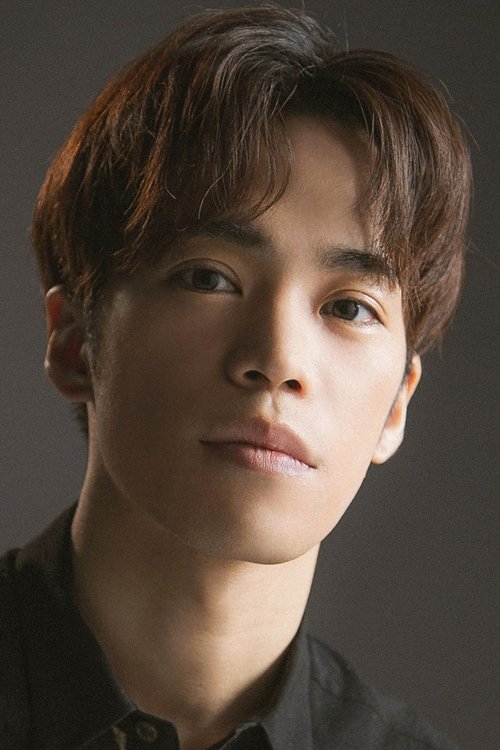
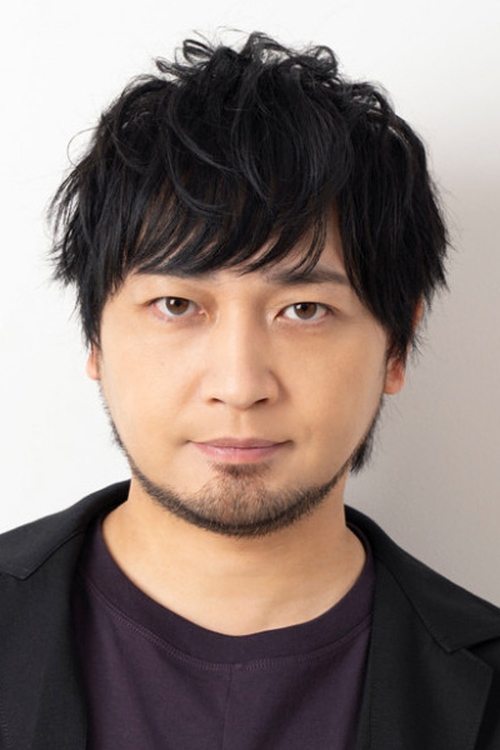
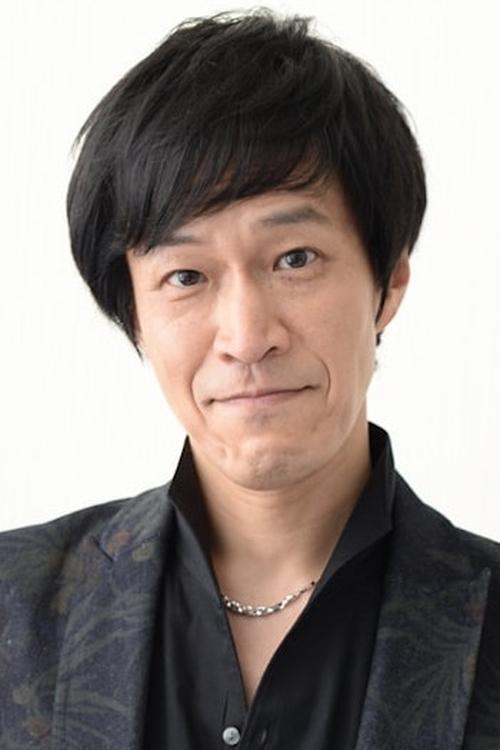
The two lead characters, Yuru and Asa, were voiced by Kensho Ono and Yume Miyamoto, respectively. During his audition, Ono was unfamiliar with the series but began reading it upon learning that its author had written Fullmetal Alchemist. He noted that the protagonist often behaved comically when confronted with the modern world, a trait stemming from his mountain upbringing, and he enjoyed this aspect of the character. He found the first two episodes particularly challenging because Yuru was constantly confused by the events in his village, though he ultimately expressed satisfaction with the recording process. Miyamoto, meanwhile, learned of the manga through a longtime high school friend. Regarding Asa's character, she initially struggled with her performance until sound director Kazuhiro Wakabayashi suggested that Asa's early behavior reflected an attempt to suppress her feelings for her brother. Miyamoto found the series demanding due to the need to balance serious moments with comedy.
In the English dub of the series, Yuru is voiced by Ben Stegmair. He was guided by fellow director Shawn Gann in how to portray the character. He claimed having "three Yurus"; a calm one, an innocent one exploring the world, and then a protector who acts like a hunter. Gann supported Stegmair's ideas afterwards. Stegmair had already read the manga in 2021 and grew attached to it thanks to Arakawa's storytelling. Stegmair was supported by his fellow actors when dealing with the parts where Yuru is shocked by the world. Asa's voice actress in the English dub is Molly Zhang who enjoyed doing the two versions of her character appearing in the anime. Upon watching the first episode of the series, Zhang was shocked by the story which allowed her to be more familiar with her role.
Release
The series was announced during Crunchyroll's panel at Anime Expo in July 2025. The series is produced by Bones Film and directed by Masahiro Andō, with Noboru Takagi handling series composition, and Nobuhiro Arai designing the characters. It premiered on April 4, 2026, on Tokyo MX and other networks, and is scheduled to run for two consecutive cours. The episodes are being collected into eight Blu-ray and DVD sets, which are set to be released from July 8, 2026, to February 10, 2027.
The music for the series was composed by Kenichiro Suehiro. The original soundtrack album is set to release on September 16, 2026. The first opening theme song is "Tobu Toki" (飛ぶ時; lit. 'Time to Fly'), performed by Vaundy, while the first ending theme song is "Tobō yo" (飛ぼうよ; lit. 'Let's Fly'), performed by Yama. The second opening theme song is "Back Shot", performed by Masanori Otoda, while the second ending theme song is "Kujaku" (孔雀; lit. 'Peacock'), performed by Kei Sugawara.
Crunchyroll is streaming the series. Netflix and Hulu also began streaming the series on July 4, 2026. Muse Communication licensed the series in Southeast Asia.
Reception
The anime adaptation has received positive reviews from critics. Both Anime News Network and Esquire listed the series among the best anime of 2026, with both publications commending its unexpected premise and polished production values.
Critics highlighted the plot twists of the early episodes, which subverted expectations by revealing advanced technology within the ostensibly rustic setting of protagonist Yuru's village. Tony Sun Prickett of Anime Feminist drew comparisons between the series and Demon Slayer: Kimetsu no Yaiba and The Elusive Samurai, observing that all three featured protagonists who lived peacefully until a shocking event forced them to flee their homes; however, the reviewer refrained from disclosing the full extent of the twist. Prickett also praised Yuru's character design as consistent with Hiromu Arakawa's established archetypes. Rafael Motomayor of IGN similarly noted that Yuru's life was upended by a violent external attack, compelling him to wield supernatural powers in a manner reminiscent of the debut of Attack on Titan. Polygon acclaimed the early twists, particularly the revelation of the true nature of Yuru's existence as he encountered unfamiliar modern technology outside his mountain home—a device likened to the effective twists in M. Night Shyamalan's films. The review drew parallels to the isekai genre, wherein a character discovers a new world, though in Yuru's case the dynamic was reversed, as the audience was familiar with the modern world that the protagonist did not know. Collider meanwhile compared it to the 2003 Fullmetal Alchemist adaptation which followed a different path of Arakawa's narrative and had the protagonist Edward Elric finding himself trapped in Germany during the 20th Century. Although Edward's arc was compared as "jumping the shark" in regards to how poorly was this twist received, Collider found Yuru's story engaging instead.
Moumita Chakraborty of FandomWire praised Yuru's characterization, describing him as an intelligent fighter who relied on strategy rather than brute force, while also demonstrating a strong bond with his two Tsugai that led to a well-earned victory against an antagonist. Richard Einsbeins of Anime News Network commended the development of his complex relationship with his true sister Asa, whom he learned to care for by the 21st episode. Although Mariló Delgado of Espinof praised Bones' animation in environmental and action sequences, she observed that the series did not attain the level of execution for which Demon Slayer and Jujutsu Kaisen were known.