

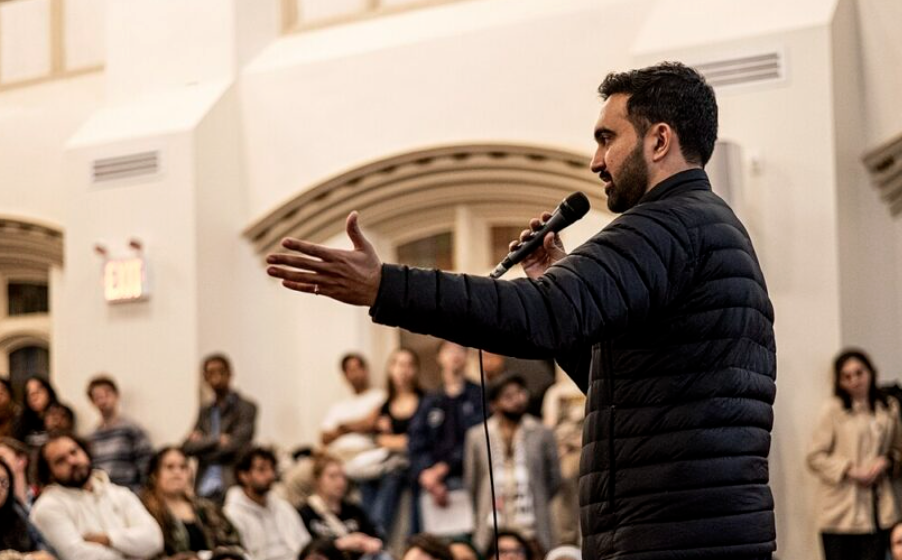
The Democratic Socialists of America (DSA) is a socialist political organization in the United States, and the largest such organization in US history, with more than 120,000 members as of July 2026. A big tent on the left wing of the political spectrum, it is primarily organized around the principles of democratic socialism, with its members active in electoral politics, labor organizing, and direct action campaigns.
DSA was founded in 1982 from a merger of the Democratic Socialist Organizing Committee (DSOC) and the New American Movement (NAM). The merger was seen as a symbolic healing of the rift between the Old Left, represented by DSOC's social democrats and trade unionists, and the New Left, represented by NAM's activists who emerged from the social movements of the 1960s. Initially led by Michael Harrington, the DSA continued DSOC's strategy of "realignment" by working within the Democratic Party to push it to the left, functioning as a small advocacy group for its first three decades. After the 2016 presidential campaign of Senator Bernie Sanders, a self-identified democratic socialist, and the election of Donald Trump, the organization's membership swelled from about 6,000 members in 2015 to more than 120,000 in 2026. This growth gave DSA a much younger and more activist base, who shifted its strategy toward building an independent political force, though this remains a subject of internal debate.
DSA's platform calls for reforms such as a Green New Deal, single-payer healthcare, and tuition-free higher education, with a long-term aim of social ownership and democratic control of the American economy. DSA's foreign policy is anti-imperialist, strongly supporting spending cuts and footprint reductions to the US military while also supporting pro-Palestinian and anti-Zionist causes.
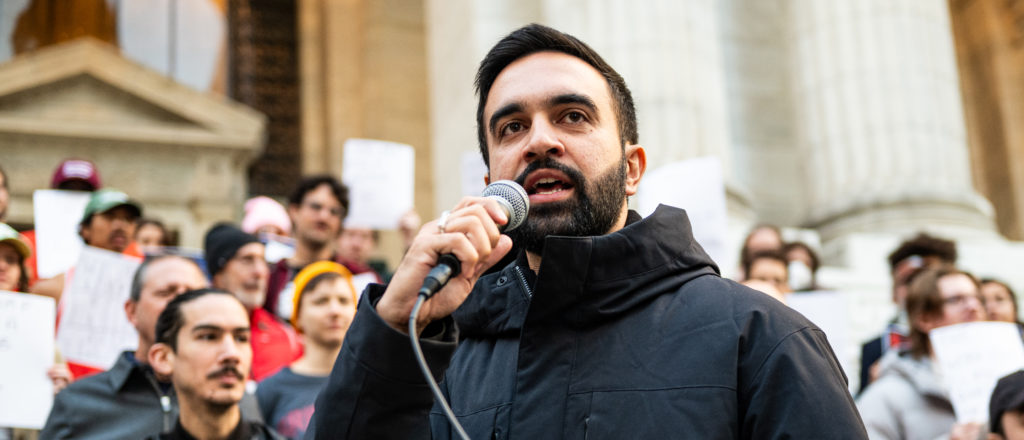
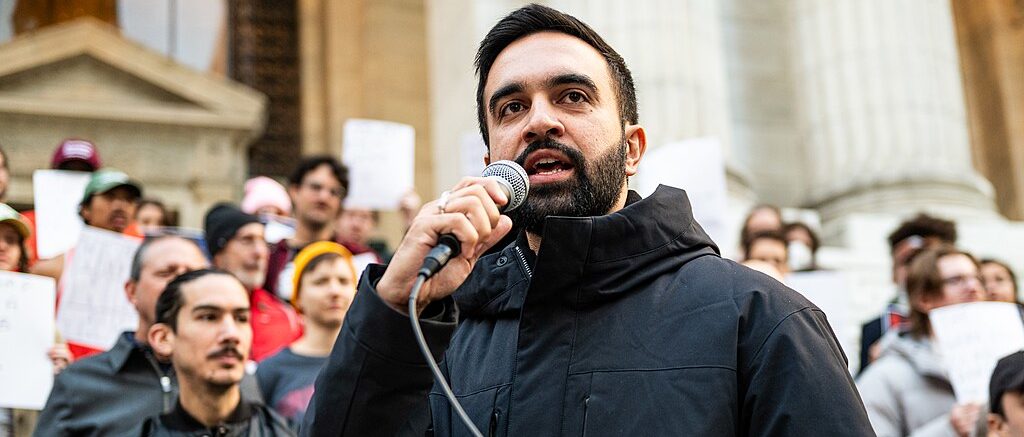
DSA engages in electoral politics by endorsing and canvassing for candidates who align with its values, including Democrats, Working Families, Greens, and independents. Unlike most American political parties, DSA does not maintain its own ballot line. Notable DSA elected officials include US representatives Alexandria Ocasio-Cortez and Rashida Tlaib (both elected in 2018), and New York City mayor Zohran Mamdani (elected in 2025). In 2025, over 250 DSA members held elected public office across 40 states, with 90% elected after 2019.
DSA has a decentralized structure in which local chapters and ideological caucuses have significant autonomy. The organization's largest chapters include those in New York City (where it is headquartered), Los Angeles, and the Washington metropolitan area.
Contents
History
Origins and founding (1973–1982)
The Democratic Socialists of America was formed in 1982 through the merger of two left-wing organizations: the Democratic Socialist Organizing Committee (DSOC) and the New American Movement (NAM).
DSOC was founded in 1973 by the socialist intellectual Michael Harrington. Harrington had become a prominent national figure after his book The Other America (1962) helped inspire the War on Poverty, and he was a leader of a faction within the Socialist Party of America. He served as national chairman (later co-chairman) of the Socialist Party from 1968 until he resigned in 1972 in protest against the party's rightward drift and its stance on the Vietnam War.
Growing from a few hundred members to nearly 5,000 in less than a decade, DSOC was a union of Old Left social democrats, trade union leaders, and progressive youth dedicated to working as a left-wing pressure group within the Democratic Party. Harrington envisioned the DSOC as the "left wing of the possible", and its main strategy was "realignment", the idea that socialists could work with labor unions and social movements to push the Democratic Party to the left, drive out its conservative Southern wing, and transform it into a social democratic party. A key project for this strategy was the Democratic Agenda, a DSOC-inspired coalition of labor and liberal activists that challenged the centrist policies of the Jimmy Carter administration from within the party during the late 1970s.
The New American Movement (NAM) was founded in 1971 by Michael Lerner and other former members of Students for a Democratic Society (SDS), the main campus-based organization of the New Left. Emerging from SDS and the socialist-feminist women's unions of the period, NAM was led by New Left veterans who sought to recover the early SDS's humanistic, revolutionary spirit while rejecting the Maoism and vanguardism that had led to its implosion.
In 1974, the organization was bolstered by the entry of Dorothy Ray Healey, a longtime leader of the Communist Party who had broken with the party over its lack of internal democracy and its support for the Soviet invasion of Czechoslovakia. NAM developed a socialist feminist and Eurocommunist orientation, emphasizing Gramscian Marxism and building a grassroots presence through local struggles around affordable housing, utility rates, and reproductive rights.
The Harrington era (1982–1989)
In the 1980s, DSA functioned as a home for a diverse group of activists, including democratic Marxists, Fabians, religious socialists, former Communists, and labor Zionists. All were united by opposition to Reaganism. DSA continued the DSOC strategy of working within the Democratic Party to support progressive candidates and policies. It did not endorse Jesse Jackson's 1984 presidential campaign, but was part of the Rainbow Coalition that supported his 1988 campaign. A central ambition for Harrington was to build a "conscience constituency" of educated professionals who, he argued, were predisposed to social planning and could become allies of the poor and the labor movement in a new progressive coalition.
DSA's membership and influence during this era extended across academia, the labor movement, and politics. Its intellectual wing included Irving Howe, Michael Walzer, Frances Fox Piven, Richard Rorty, and Iris Marion Young. Cornel West became an honorary chair of DSA and developed his "prophetic pragmatism" in dialogue with the organization's multi-tendency traditions.
At the 1983 convention, after DSA passed a resolution calling for male and female co-chairs, Barbara Ehrenreich became co-chair with Harrington. The organization also had influential allies in the labor movement, including AFSCME presidents Jerry Wurf and Victor Gotbaum, UAW president Douglas Fraser, and Machinists president William Winpisinger. Its political reach extended to elected officials like Congressmen John Conyers, Bella Abzug, Ron Dellums, and Robert Kastenmeier; New York mayor David Dinkins; and feminist icon Gloria Steinem.
DSA played a significant role in Central American solidarity activism, opposing the Reagan administration's policies in El Salvador and Nicaragua in solidarity with the Sandinistas and leftist rebels. DSA was also particularly active in the anti-apartheid movement, linking struggles for social justice abroad to those at home. Despite these efforts, DSA's membership remained small, growing to 8,000 by 1983 but never surpassing that number during Harrington's lifetime. Harrington's final book, Socialism: Past & Future (1989), written as he was dying of cancer, served as a "letter to the next left", urging it to adapt socialist values to the newly globalized, post-industrial world.
Stagnation and opposition (1990–2015)
After Harrington's death in 1989, DSA struggled for relevance in the 1990s and early 2000s, a period during which Gary Dorrien has said the organization struggled "merely to hang on". With the collapse of Communism in 1989 and the rise of Third Way neoliberalism under President Bill Clinton, the political space for democratic socialism seemed to vanish. In many parts of the country, DSA chapters functioned primarily as study groups for "scattered, stubborn types holding out against the 1990s", with the youth wing, the Young Democratic Socialists (YDS), largely responsible for keeping the organization afloat. Direct-mail campaigns in the early to mid-1990s boosted paper membership to 10,000.
Despite its small size, DSA maintained a principled opposition to the Democratic Party's neoliberal turn. In 1995, DSA updated its foundational document, "Where We Stand", placing economic globalization and the power of multinational corporations at the center of its analysis. It called for a humane social order based on democratic planning and market mechanisms and for "economic democracy... from below, through a democratic transformation of the institutions of civil society."
The DSA also initiated key campaigns during this period. In the early 1990s, it made the fight for a single-payer healthcare system a major national priority, sponsoring a multi-city tour by Canadian health advocates to promote the model. It actively campaigned against President Clinton's signature policies, including the North American Free Trade Agreement (NAFTA), the 1994 crime bill, and the gutting of welfare in the Personal Responsibility and Work Opportunity Act of 1996. It also founded the Prison Moratorium Project in 1997 to oppose mass incarceration. In 1999, DSA activists participated in the anti-globalization protests surrounding that year's World Trade Organization conference in Seattle.
In the 2000 presidential election, the organization was divided and took no official position, with prominent members like Cornel West supporting Green Party nominee Ralph Nader while others reluctantly supported Democratic nominee Al Gore. After the 9/11 attacks, DSA actively participated in the anti-war movement against the wars in Iraq and Afghanistan and developed an "Economic Justice Agenda" that prefigured many of the proposals of the 2016 Sanders campaign.
In 2011, longtime YDS leader Maria Svart was hired as National Director. In the wake of movements like Occupy Wall Street in 2011, Fight for $15 in 2012, and Black Lives Matter in 2013, the socialist movement began to gain new steam. By 2012, membership stood at 6,500. In 2014, an internal Left Caucus formed that challenged some of DSA's stances and advocated a pro–Boycott, Divestment and Sanctions (BDS) position, which at the time was difficult to discuss within the organization.
Resurgence (2016–present)
The 2016 presidential primary campaign of Bernie Sanders was a turning point for DSA. An independent senator from Vermont and self-described democratic socialist, Sanders brought the term democratic socialism into mainstream US politics. DSA, which had been urging Sanders to run, endorsed him in December 2014, becoming one of the only major socialist organizations to do so, and its members became active volunteers in his campaign.
The campaign, followed by the election of Donald Trump in November 2016, triggered a massive influx of new, mostly young, members, a phenomenon known as the "Trump bump". The organization grew from 6,500 members in the fall of 2014 to 8,500 by Election Day 2016. The day after Trump's election, 1,000 new members joined. By July 2017, DSA's membership had reached 24,000; by the end of 2018, it was 55,000; and by 2021, it peaked at 94,000 before experiencing a decline.
The median age of members dropped from 68 in 2013 to 33 in 2017. The organization was transformed, in the words of one commentator, from a "musty debate club for retired social democrats into an electoral powerhouse of young, ecumenical radicals". At its 2017 national convention, the new membership officially took over, passing proposals to leave the Socialist International, formally endorse the BDS movement, and prioritize a national campaign for Medicare for All.
This resurgence was reinforced by electoral victories. In 2017, fifteen DSA members were elected to local and state offices across the country, including Lee J. Carter to the Virginia House of Delegates. In the 2018 midterm elections, DSA member Alexandria Ocasio-Cortez won a primary upset against incumbent Congressman Joe Crowley in New York's 14th congressional district, becoming a national political star. The victory of Ocasio-Cortez, who had been endorsed and supported by DSA, triggered another large influx of members in July 2018.
In 2018, DSA member Rashida Tlaib won a primary for a congressional seat in Detroit. Both Ocasio-Cortez and Tlaib won in the general election, though DSA noted that these were not "home-grown" DSA campaigns in the way that later victories were, such as Julia Salazar's 2018 win in the New York State Senate, the election of a six-member socialist slate to the Chicago City Council in 2019, a five-member slate to the New York State Legislature in 2020, and two members to the New York City Council in 2021.
Ideology and political positions
DSA is a multi-tendency organization, encompassing a wide range of socialist and left-wing viewpoints. The organization's core commitment is to democratic socialism, which it distinguishes from both bureaucratic forms of socialism and capitalist social democracy, arguing that democratic socialism goes further than the latter's model of a strong welfare state operating under capitalism. This has sometimes led to internal semantic debates; some longtime members have argued for emphasizing the word democratic to distinguish the movement from authoritarian states, while others have argued the term is redundant, as true socialism's interest in equity "encompasses democracy". The DSA says it rejects "authoritarian visions of socialism".
Economic policy
DSA's economic vision calls for a "democratic transformation of the institutions of civil society, particularly those in the economic sphere". The organization defines this as wanting "to collectively own the key economic drivers that dominate our lives, such as energy production and transportation". This involves a mixture of public ownership, worker ownership, and market mechanisms. The organization's 2016 "Resistance Rising" strategy document advocated that large, strategically important sectors like housing, utilities, and heavy industry be subject to democratic planning, while market-driven worker-owned firms would produce and distribute consumer goods.
The organization supports a broad range of what democratic socialist writer André Gorz termed "non-reformist reforms" or "structural reforms". Acknowledging that an immediate end to capitalism is unlikely, this strategy involves fighting for reforms that weaken corporate power, increase the power of working people, and point toward a world beyond capitalism. At the local level, this has included campaigns for government-run grocery stores, free public transportation, and universal rent freezes. Key platform planks include:
Labor rights: Strengthening protections for workers' rights to strike and form a union, and implementing a 32-hour work week with no reduction in pay or benefits. Support union members organizing rank and file caucuses to democratize their unions.
Healthcare for All: guaranteeing universal healthcare with no cost to individuals, co-pays, or deductibles, and with guarantees for reproductive and gender-affirming care. Ensure free medical education and training along with expanding public healthcare facilities.
Taxing the wealthy: Raising taxes on the highest earners, for-profit corporations, and large inheritances, and establishing a wealth tax.
Universal education: Free public education from pre-kindergarten through college, including tuition-free higher education with no out-of-pocket costs for room and board and cancellation of all student loan debt; universal child care; and expansive paid family leave for all workers. These universal programs are seen as "engines of solidarity" that build a broad constituency for social rights, in contrast to means-tested programs that can create division.
Electoral strategy
For much of its history, DSA followed Michael Harrington's strategy of political realignment, working to elect progressives within the Democratic Party in the hope of transforming it from within. Following its post-2016 growth, DSA's strategy shifted significantly. The organization now prioritizes building its own independent electoral capacity to run socialist candidates who are accountable to DSA's agenda, often in primaries against incumbent Democrats.
This strategy is often called a "dirty break" from the Democratic Party, an approach influenced by a 2016 article in the socialist magazine Jacobin, "A Blueprint for a New Party". The goal is not to immediately form a third party, which is seen as "suicidal in America's two-party tyranny", but to "bore from within in guerrilla insurgency fashion" by using the Democratic ballot line to build an independent political force.
The New York City chapter, DSA's largest and most electorally successful, developed a blueprint that became a model for the national organization. This involves a democratic process to select races and candidates, a massive volunteer-led field organizing program, and a coordinated fundraising arm called "DSA For The Many". Other strategic orientations within the organization include the "realignment" strategy of shifting the Democratic Party leftward and the "clean break" strategy of immediately forming a third party.
The dirty break approach involves building a national movement organization with strong local chapters that can contest elections on a case-by-case basis, sometimes in Democratic primaries and sometimes independently, with the long-term goal of a "mass socialist political formation". This approach was formalized at the organization's 2023 national convention, which passed a resolution to "Act Like an Independent Party" by developing its own fundraising, candidate schools, and voter lists.
This strategy has also produced internal debate about the proper role of socialist legislators. One view is that their primary role is agitational—to "fight people who are against our policies" and politicize the obstacles to socialist reform. Another view is that socialists must also participate in the legislative process, working with progressives and even centrists to pass reforms that benefit the working class. The strategy includes holding its endorsed candidates accountable to the organization's platform. Candidates endorsed by the NYC chapter, for instance, are expected to function as a bloc and attend weekly "Socialists in Office Committee" meetings to coordinate strategy.
Social issues
DSA's platform describes itself as "deeply feminist and antiracist". According to the organization's 2016 strategy document, democratic socialism "connects antiracist, feminist, LGBTQ, labor, anti-ableist, and anti-ageist movements to each other" because each struggle's success depends on the success of the others. At its 2019 national convention, DSA passed a resolution calling for the full decriminalization of sex work.
Its platform includes calls for:
Ending mass incarceration: Abolish mandatory minimums and cash bail, demilitarize police departments, treat drug addiction as a health issue rather than a criminal one.
Feminism for All: Fight for freedom of all working class women. Universal childcare. Fair compensation for all work, including care work. End gendered violence and end policies that restrict reproduction like abortion and childbirth along with restrictions on marriage and divorce.
Finishing Reconstruction, including reparations for slavery and fully honoring tribal sovereignty
Housing for All: Establish universal rent control and a right to counsel for all tenants. Build more public housing and strictly regulate investment properties.
Queer rights: End discrimination against LGBTQ people and gendered violence against gay and transgender people. Affirm rights to marry and to gender-affirming care.
The DSA also opposes the rapid expansion of hyperscale, corporate AI data centers and is actively organizing against them.
Foreign policy and immigration
DSA advocates an anti-imperialist foreign policy based on international working-class solidarity.
Its platform calls for:
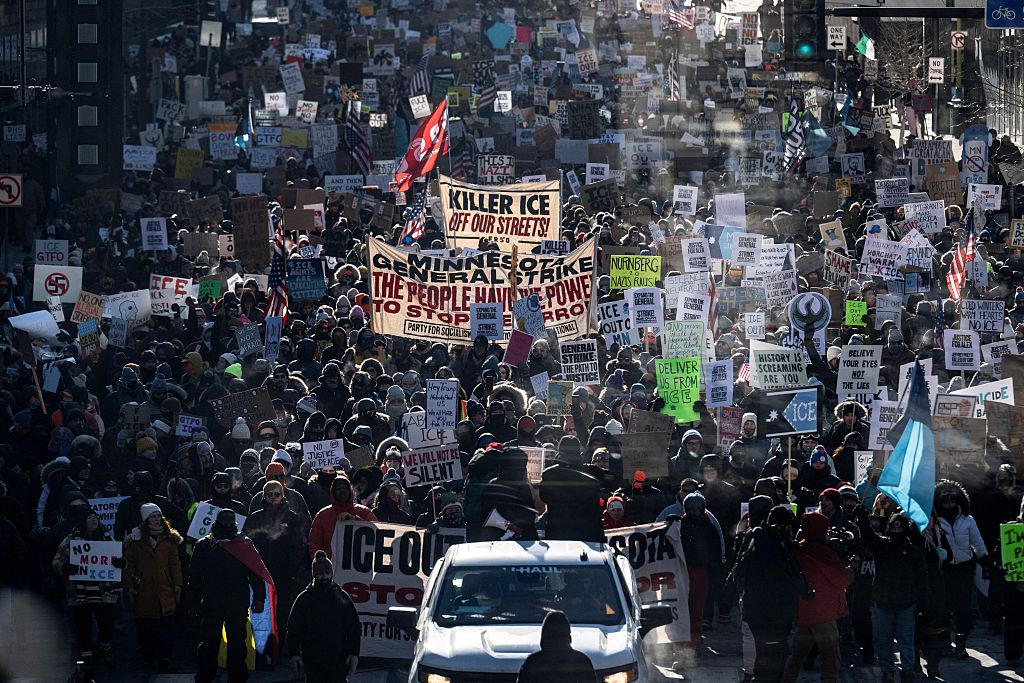
Abolish ICE: End ICE deportations and prosecute all federal ICE agents. Legalize migration and grant amnesty to immigrants regardless of status. End caps and quotas and provide a path to citizenship for all.
Ending the US war machine: significantly reduce the US military budget, close overseas military bases, and bring US troops home
Ending economic sanctions: End sanctions on countries such as Cuba, Venezuela, and Iran.
Free Palestine: Recognize the rights of Palestinian people, including the right of return. Recognize Jerusalem as the capital of a free Palestine. Prosecute US and Israeli leaders responsible for the Gaza genocide.
Withdraw from NATO and end foreign military aid.
The DSA condemned the invasion of Ukraine and accused NATO and the US of provoking Russia. The DSA opposes US military aid to Ukraine.
DSA supports Palestinian rights, calling for an immediate ceasefire in Gaza and an end to US military and economic aid to Israel. The organization's anti-Zionist position was further defined at its 2025 national convention. Delegates passed a resolution that established "red lines" for members and endorsed officials, threatening expulsion for providing "material support to Israel or related lobbying groups like AIPAC or J Street" or affirming that "Israel has a right to defend itself". An amendment to remove the expulsion clause was defeated, though 40% of delegates opposed the final resolution. The resolution's passage followed years of internal debate over the actions of endorsed representatives like Jamaal Bowman and Alexandria Ocasio-Cortez concerning Israel.
Democratic reform
The organization's platform calls for fundamental reforms to the US political system. These include:
Universal suffrage: Extending full voting rights to all residents, including noncitizens and people with criminal convictions, and establishing statehood for Washington, D.C.
Electoral reform: Replacing the Electoral College with a national popular vote for president, and replacing the two-party system with a multi-party democracy through proportional representation elections.
Legislative reform: Expanding the number of seats in the House and abolishing the Senate.
Judicial reform: Limiting the Supreme Court's power of judicial review.
Labor strategy
After its post-2016 resurgence, DSA embraced a "rank-and-file strategy" for the labor movement, influenced by Kim Moody's writings. This approach involves socialist organizers taking jobs in key industries to become active shop-floor union members in order to agitate against bosses and concessionary union bureaucracies, democratize unions, and develop organic leaders from the rank and file. This strategy holds that change must come from the bottom up by building a "militant minority" of rank-and-file unionists.
At its 2019 national convention, DSA passed a resolution formally adopting the rank-and-file strategy as part of its labor work. In 2020, during the COVID-19 pandemic, DSA and the United Electrical Workers founded the Emergency Workplace Organizing Committee (EWOC) to provide training and resources to non-union workers. Despite the formal adoption of the rank-and-file strategy, some members have argued that electoral campaigns receive disproportionate attention and resources compared to labor and tenant organizing.
In 2021, YDSA began the Rank-and-File Pipeline Project to place young organizers in strategic industries. DSA members were active in the reform movement in the Teamsters union that elected Sean O'Brien as president and have been involved in organizing drives at Starbucks and Amazon. This work has faced setbacks; the YDSA pipeline project was narrowly voted down at a convention, and internal divisions have arisen among DSA members within the Teamsters and United Auto Workers reform movements.
Structure and organization
DSA is a membership-based organization with a national structure and local chapters across the United States. Its highest decision-making body is its National Convention, held every two years. Between conventions, the organization is led by the 27-member National Political Committee (NPC), which is elected by delegates at the convention.
The red rose is part of DSA's logo, having been a symbol of socialism since the 1886 Haymarket Affair and resulting May Day marches. It was drawn from the logo of DSOC, its precursor organization, and previously of the Socialist International, which shows a stylized fist clenching a red rose, the fist replaced by a biracial handshake symbolizing DSA's antiracism. The fist and rose logo was originally designed for the French Socialist Party in 1969 and later shared by socialist and labor political organizations worldwide.
Chapters
In the DSA, chapters are the organization's basic local units. Chartered by the NPC for a defined geographic area, chapters carry out most of DSA's routine political work at the local level. This includes campaign organizing, political education, mutual aid, labor and tenant organizing, electoral activity, and social events, with each chapter adapting its work to local conditions. Chapters are member-led bodies governed by by-laws, elected officers, and general meetings open to members in good standing, and they may also create branches or other subgroups. They link local members to DSA's national structure by electing delegates to the National Convention, with representation apportioned by chapter size. Chapters remain subject to national oversight, since the NPC controls chartering and can place chapters into trusteeship or revoke their charters under specified conditions.
As of July 2026, the DSA has 201 chapters and 42 organizing committees (OC) in 48 US states (Alaska and Wyoming have no active DSA chapter or OC). The largest concentration of DSA membership is in states such as New York, Oregon, Maine, Massachusetts, and Minnesota. The biggest chapter by membership is New York City (14,000 members), followed by Los Angeles (4,700) and Washington, D.C. (3,300).
Members
Anyone who pays dues, or files a dues waiver, may join DSA. The post-2016 membership is significantly younger than the pre-2016 organization. The new membership's demographics are "primarily white and largely made up of college-educated members" and DSA has undertaken campaigns to root itself more deeply in the multiracial working class. In 2026, Democratic Left reported that a new survey showed a 66% white and 34% nonwhite membership. Since its rebirth, the organization has also focused on developing a layer of "cadre"—politically developed and dedicated organizers—in numbers not seen on the American left in decades.
Caucuses and factions
Following its rapid growth after 2016, DSA developed a number of internal caucuses organized around specific ideological tendencies or strategic priorities. These factions are often broadly grouped into a "left wing", which supports revolutionary socialism and a clear break from the Democratic Party, and a "right wing", which advocates reformist socialism or the democratic road to socialism and a more flexible electoral strategy. The caucuses are a visible presence at DSA's national conventions, where the vast majority of attendees are affiliated with at least one caucus. Many members view the open disagreement and debate between and within caucuses as an intentional and healthy feature of the organization's political life.
International affiliations
DSA was a member of the Socialist International from 1982 to 2017. A majority of delegates at the 2017 DSA National Convention voted to leave the International due to its alleged support for neoliberal economic policies. Delegates at the 2021 DSA National Convention voted to apply to join the São Paulo Forum, and DSA became an Associate Member organization in 2023. In August 2023, the DSA National Convention voted to join the Progressive International, and DSA became an official member in October 2023.