




Denis Arkadyevich Vertov (born David Abelevich Kaufman; 2 January 1896 [O.S. 21 December 1895] – 12 February 1954), better known as Dziga Vertov, was a Soviet pioneer documentary film and newsreel director, as well as a cinema theorist. His filming practices and theories influenced the cinéma vérité style of documentary movie-making and the Dziga Vertov Group, a radical film-making cooperative which was active from 1968 to 1972. He was a member of the Kinoks collective, with Elizaveta Svilova and Mikhail Kaufman.
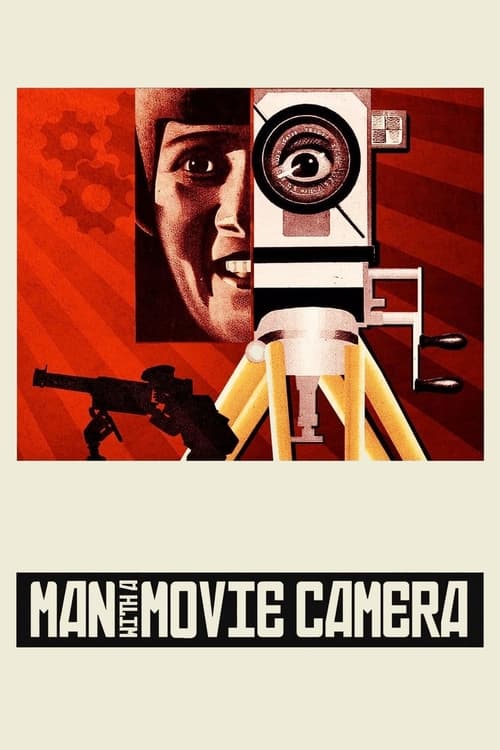
In the 2012 Sight & Sound poll, critics voted Vertov's Man with a Movie Camera (1929) the eighth-greatest film ever made.
Vertov's younger brothers Boris Kaufman and Mikhail Kaufman were also noted filmmakers, as was his wife, Yelizaveta Svilova. He worked with Boris Kaufman and cinematographer Mikhail Kaufman on his most famous film Man with a Movie Camera.
Contents
Biography
Early years
Vertov was born David Abelevich Kaufman into a Jewish family in Białystok, Poland, then a part of the Russian Empire. He Russified his Jewish name and patronymic, David Abelevich, to Denis Arkadievich at some point after 1918. Vertov studied music at Białystok Conservatory until his family fled from the invading German Army to Moscow in 1915. The Kaufmans soon settled in Petrograd, where Vertov began writing poetry, science fiction, and satire. In 1916–1917 Vertov was studying medicine at the Psychoneurological Institute in Saint Petersburg and experimenting with "sound collages" in his free time. He eventually adopted the name "Dziga Vertov", which translates loosely from Ukrainian as 'spinning top'.
Early writings
Vertov is known for many early writings, mainly while still in school, that focus on the individual versus the perceptive nature of the camera lens, which he was known to call his "second eye".
Most of Vertov's early work was unpublished, and few manuscripts survived after the Second World War, though some material surfaced in later films and documentaries created by Vertov and his brothers, Boris Kaufman and Mikhail Kaufman.
Vertov is known for quotes on perception, and its ineffability, in relation to the nature of qualia (sensory experiences).
After the October Revolution
After the Bolshevik Revolution of 1917, at the age of 22, Vertov began editing for Kino-Nedelya (Кино-Неделя, the Moscow Cinema Committee's weekly film series, and the first newsreel series in Russia), which first came out in June 1918. While working for Kino-Nedelya he met his future wife, the film director and editor, Elizaveta Svilova, who at the time was working as an editor at Goskino. She began collaborating with Vertov, beginning as his editor but becoming assistant and co-director in subsequent films, such as Man with a Movie Camera (1929), and Three Songs About Lenin (1934).
Vertov worked on the Kino-Nedelya series for three years, helping establish and run a film-car on Mikhail Kalinin's agit-train during the ongoing Russian Civil War between Communists and counterrevolutionaries. Some of the cars on the agit-trains were equipped with actors for live performances or printing presses; Vertov's had equipment to shoot, develop, edit, and project film. The trains went to battlefronts on agitation-propaganda missions intended primarily to bolster the morale of the troops; they were also intended to stir up revolutionary fervor of the masses.
In 1919, Vertov compiled newsreel footage for his documentary Anniversary of the Revolution; he also supervised the filming of his project The Battle for Tsaritsyn (1919). in 1921 he compiled History of the Civil War. The so-called "Council of Three," a group issuing manifestoes in LEF, a radical Russian newsmagazine, was established in 1922; the group's "three" were Vertov, his (future) wife and editor Elizaveta Svilova, and his brother and cinematographer Mikhail Kaufman. Vertov's interest in machinery led to a curiosity about the mechanical basis of cinema.
His statement "We: Variant of a Manifesto" was published in the first issue of Kino-Fot, published by Aleksei Gan in 1922. It commenced with a distinction between "kinoks" and other approaches to the emergent cinematic industry:
"We call ourselves kinoks – as opposed to "cinematographers", a herd of junkmen doing rather well peddling their rags.
We see no connection between true kinochestvo and the cunning and calculation of the profiteers.
Late career
Vertov's successful career continued into the 1930s. Enthusiasm: Symphony of the Donbass (1931), an examination into Soviet miners, has been called a 'sound film', with sound recorded on location, and these mechanical sounds woven together, producing a symphony-like effect. Many Soviet critics did not receive the film positively, but critics abroad lauded its sonic experimentation.
Three years later, Three Songs About Lenin (1934) looked at the revolution through the eyes of the Russian peasantry. For his film, Vertov had been hired by Mezhrabpomfilm. The film, finished in January 1934 for Lenin's obit, was only publicly released in the Soviet Union in November of that year. From July 1934 it was shown at private screenings to various high-ranking Soviet officials and also to prominent foreigners including H. G. Wells, William Bullitt, and others, and it was screened at the Venice Film Festival in August 1934. A new version of the film was released in 1938, including a longer sequence to reflect Stalin's achievements at the end of the film and leaving out footage of "enemies" of that time. Today there exists a 1970 reconstruction by Yelizaveta Svilova. With the rise and official sanction of socialist realism in 1934, Vertov was forced to cut his personal artistic output significantly, eventually becoming little more than an editor for Soviet newsreels. Lullaby, perhaps the last film in which Vertov was able to maintain his artistic vision, was released in 1937.
Dziga Vertov died of cancer in Moscow in 1954.
Family
Vertov's brother Boris Kaufman was a cinematographer who worked with Jean Vigo on L'Atalante (1934) and much later for directors such as Elia Kazan in the United States who won an Oscar for his work on On the Waterfront. His other brother, Mikhail Kaufman, worked with Vertov on his films until he became a documentarian in his own right. Mikhail Kaufman's directorial debut was the film In Spring (1929).
In 1923, Vertov married his long-time collaborator Elizaveta Svilova.
After the October Revolution, Vertov's parents returned to Białystok, which became part of Poland. According to his brother, they were later murdered by the Nazis during the Holocaust.
Influence and legacy
Vertov's legacy still lives on today. His ideas are echoed in cinéma vérité, the movement of the 1960s named after Vertov's Kino-Pravda. The 1960s and 1970s saw an international revival of interest in Vertov.
The independent, exploratory style of Vertov influenced and inspired many filmmakers and directors like the Situationist Guy Debord and independent companies such as Vertov Industries in Hawaii. The Dziga Vertov Group borrowed his name. In 1960, Jean Rouch used Vertov's filming theory when making Chronicle of a Summer. His partner Edgar Morin coined the term cinéma vérité when describing the style, using direct translation of Vertov's KinoPravda.
The Free Cinema movement in the United Kingdom during the 1950s, the Direct Cinema in North America in the late 1950s and early 1960s, and the Candid Eye series in Canada in the 1950s all essentially owed a debt to Vertov.
This revival of Vertov's legacy included rehabilitation of his reputation in the Soviet Union, with retrospectives of his films, biographical works, and writings. In 1962, the first Soviet monograph on Vertov was published, followed by another collection, "Dziga Vertov: Articles, Diaries, Projects". In 1984, to recall the 30th anniversary of Vertov's death, three New York cultural organizations put on the first American retrospective of Vertov's work.
New Media theorist Lev Manovich suggested Vertov as one of the early pioneers of database cinema genre in his essay Database as a symbolic form.
Vertov's work has inspired notable artist and filmmaker William Kentridge.
Filmography
1918 Кинонеделя (Kino Nedelya/Cinema Week)
1918 Годовщина революции (Anniversary of the Revolution)
1921 История гражданской войны (History of the Civil War)
1922 Киноправда (Kino-Pravda)
1924 Советские игрушки (Soviet Toys)
1924 Кино-глаз (Kino-Eye), cameraman Ilya Kopalin
1926 Шестая часть мира (A Sixth Part of the World)
1926 Шагай, Совет! (Stride, Soviet!)
1928 Одиннадцатый (The Eleventh Year)
1929 Человек с киноаппаратом (Man with a Movie Camera)
1931 Энтузиазм (Симфония Донбаса) (Enthusiasm)
1934 Три песни о Ленине (Three Songs About Lenin)
1937 Памяти Серго Орджоникидзе (In Memory of Sergo Ordzhonikidze)
1937 Колыбельная (Lullaby)
1938 Три героини (Three Heroines)
1942 Казахстан – фронту! (Kazakhstan for the Front!)
1944 В горах Ала-Тау (In the Mountains of Ala-Tau)
1954 Новости дня (News of the Day)
Lost films
Some early Vertov's films were lost for many years. Only 12 minutes of his 1918 Anniversary of the Revolution were known; in 2018 Russian film historian Nikolai Izvolov found the lost film in the Russian State Documentary Film & Photo Archive and restored it. In 2022 he reconstructed another lost film, 1921 The History of the Civil War using archive materials.