



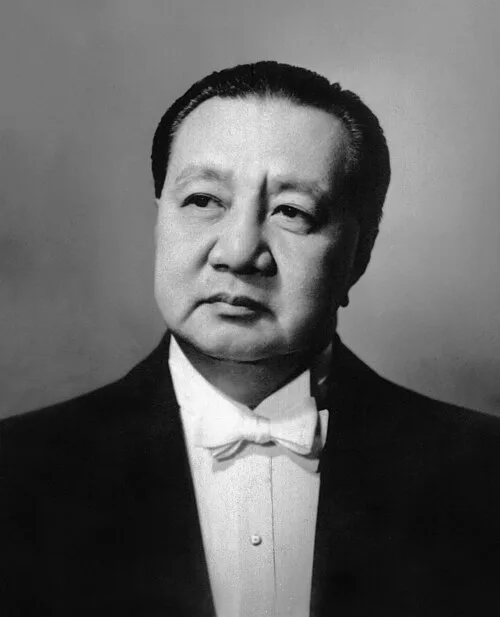
Elpidio Rivera Quirino (Tagalog: [kiˈɾino]; November 16, 1890 – February 29, 1956) was the sixth president of the Philippines, serving from 1948 to 1953. As the second vice president from 1946 to 1948, he assumed the presidency upon the death of Manuel Roxas in 1948.
A lawyer by profession, Quirino entered politics when he became a representative of Ilocos Sur's first district from 1919 to 1922. He was then elected as a senator from 1925 to 1935. In 1934, he became a member of the Philippine Independence Commission that was sent to Washington, D.C., which secured the passage of Tydings–McDuffie Act to the United States Congress. In 1935, he was also elected to the 1935 Constitutional Convention that drafted the 1935 Philippine Constitution for the newly established Philippine Commonwealth. In the new government, he served as secretary of the interior and finance under the cabinet of President Manuel L. Quezon.
After World War II, Quirino was elected vice-president in the April 1946 presidential election, consequently the second and last for the Commonwealth and first for the Third Republic. He won a full term under the Liberal Party ticket, defeating Nacionalista former president José P. Laurel as well as fellow Liberalista and former Senate President José Dira Avelino. The Quirino administration was generally challenged by the Hukbalahap, who ransacked towns and barrios. Quirino ran for president again in November 1953 but was defeated by Ramon Magsaysay in a landslide.
Contents
Early life and education
Elpidio Quirino y Rivera was born on November 16, 1890, at the Vigan Provincial Jail in Vigan, Ilocos Sur. He was the third child of Mariano Quirino y Quebral of Caoayan, Ilocos Sur and Gregoria Rivera y Mendoza of Agoo, La Union. A Chinese mestizo descendant, Quirino was baptized on November 19, 1890.
Quirino first attended secondary education at Vigan High School, during which he also worked as a teacher in barrio Caparia-an, Caoayan, Ilocos Sur. He later transferred to Manila High School in Intramuros, Manila, after earning enough finances. He later studied law at the University of the Philippines. He was one of the topnotchers of the 1915 Philippine Bar Examinations.
Congressional career
House of Representatives
Quirino was engaged in private law practice of until he was elected as member of the Philippine House of Representatives for Ilocos Sur's 1st congressional district from 1919 to 1922, succeeding Alberto Reyes. He served for only one term and was succeeded by Vicente Singson Pablo in 1922.
Senate
Quirino was first elected as a senator from the 1st senatorial district in 1925. He was re-elected in 1931 and served until the bicameral Congress was abolished in favor of the unicameral National Assembly of the Philippines.
As a senator, he was briefly assigned by Senate President Manuel Quezon as acting Senate Majority Leader from 1932 to 1933 due to Quezon, senate majority leader Benigno Aquino Sr., and Sergio Osmeña went on leave and made trips to the United States. These were to protect the proposed Hare–Hawes–Cutting bill in U.S. Congress and to amend the bill because of opposition from the Philippine Legislature. In the senate, Quirino also became chairman of a joint committee on taxation.
He was later secured a comeback to the Senate in 1941, but was not able to serve until 1945 due to World War II. During the Philippine Commonwealth, he became Senate President pro tempore from 1942 but did not serve until 1945. His term as senator ended in 1946.
Secretary of finance (1934 – 1936)
In a memorandum to Governor General Frank Murphy on January 13, 1935, Quirino, quoting former acting finance secretary Vicente Singson Encarnacion, proposed that the Philippines create its own currency system based on the gold standard. He supported this idea due to the country's gold production and simpler economic structure compared to the US and Europe. Quirino also agreed with Encarnacion on the need to devalue the peso, suggesting a reduction aligned with previous currency changes in 1934. He recommended forming a central bank to stabilize prices and promote the national economy, over which he emphasized its role in lowering interest rates and expanding credit. However, Quirino's proposals, like those of his predecessor, were not adopted. The Philippine Insular government enacted Act No. 4199 on March 16, 1935, fixing the peso to the US dollar, marking the official introduction of the dollar exchange standard.
Vice presidency (1946–1948)
Soon after the reconstitution of the Commonwealth government in 1945, Senators Manuel Roxas, Quirino and their allies called for an early national election to choose the president and vice president of the Philippines and members of the Congress. In December 1945, the House Insular Affairs of the United States Congress approved the joint resolution setting the date of the election on not later than April 30, 1946.
Prompted by this congressional action, President Sergio Osmeña called the Philippine Congress to a three-day special session. Congress enacted Commonwealth Act No. 725, setting the date of the election on April 23, 1946. The act was signed by President Osmeña on January 5, 1946.
Quirino was nominated as Senate President Manuel Roxas's running mate. The tandem won the election. As Vice President, Quirino was appointed Secretary of Foreign Affairs.
Presidency (1948–1953)
Quirino's five years as president were marked by notable postwar reconstruction, general economic gains and increased economic aid from the United States.
First term (1948–1949)
Quirino assumed the presidency on April 17, 1948, taking his oath of office two days after the death of Manuel Roxas two days earlier of a heart attack after delivering a speech at Clark Air Base in Pampanga. The inauguration took place at the Council of State Room of the Malacañang Palace in Manila as the second non-scheduled extraordinary presidential inauguration. Associate Justice of the Supreme Court Ricardo Paras administered the oath of office. On the same day, Quirino delivered his short, 47-word inaugural remarks at the same room.
His first official act as the President was the proclamation of a state mourning throughout the country for Roxas's death. Since Quirino was a widower, his surviving daughter, Victoria, would serve as the official hostess and perform the functions traditionally ascribed to the First Lady.
On July 17, 1948, Congress approved Republic Act No. 333, amending Commonwealth Act No. 502, declaring Quezon City as the new capital of the Philippines, replacing Manila. Nevertheless, pending the official transfer of the government offices to the new capital site, Manila remained to be such for all effective purposes.
The term Hukbalahap was a contraction of Hukbo ng Bayan Laban sa mga Hapon (in English: The Nation's Army Against the Japanese [Soldiers]), members of which were commonly referred to as Huks.
With the expiration of the Amnesty deadline on August 15, 1948, the government found out that the Huks had not lived up to the terms of the Quirino-Taruc agreement. Indeed, after having been seated in Congress and collecting his back pay allowance, Huk leader Luis Taruc surreptitiously fled away from Manila, even as a number of his followers had either submitted themselves to the conditions of the Amnesty proclamation or surrendered their arms. In the face of countercharges from the Huk to the effect that the government had not satisfied the agreed conditions, President Quirino ordered a stepped-up campaign against dissidents, restoring once more an aggressive policy in view of the failure of the friendly attitude previously adopted.
To bring the government closer to the people, he revived President Quezon's "fireside chats", in which he enlightened the people on the activities of the Republic by the periodic radio broadcasts from Malacañang Palace.
Second term (1949–1953)
Quirino's second inauguration took place on Friday, December 30, 1949, at the Independence Grandstand in Manila. Chief Justice of the Supreme Court Manuel Moran administered the oath of office.
In May 1950, upon the invitation of President Quirino and through the insistent suggestion of United Nations General Assembly President Romulo, official representatives of India, Pakistan, Ceylon, Thailand, Indonesia, and Australia met in Baguio for a regional conference sponsored by the Philippines. Taiwan and South Korea did not attend the conference because the latter did not contemplate the formation of a military union of the Southeast Asian nations. On the other hand, Japan, Indonesia, Taiwan, and others were not invited because, at the time, they were not free and independent states. Due to the request of India and Indonesia, no political questions were taken up the conference. Instead, the delegates discussed economic and, most of all, cultural, problems confronting their respective countries. Strangely enough however, the Baguio Conference ended with an official communiqué in which the nations attending the same expressed their united agreement in supporting the right to self-determination of all peoples the world over. This initial regional meet held much promise of a future alliance of these neighboring nations for common protection and aid.
The Quirino administration faced a serious threat in the form of the communist Hukbalahap movement. Although the Huks originally had been an anti-Japanese guerrilla army in Luzon, communists steadily gained control over the leadership, and when Quirino's negotiation with Huk commander Luis Taruc broke down in 1948. Taruc then openly declared himself a communist and called for the overthrow of the government.
With the communist organization estimated to still have more than 40,000 duly registered members by March 1951, the government went on with its sustained campaign to cope with the worsening peace and order problem. The 1951 budget included the use of a residue fund for the land resettlement program in favor of the surrendered HUKS. The money helped maintain the Economic Development Corps (EDCOR), with its settlements of 6,500 hectares in Kapatagan (Lanao) and 25,000 hectares in Buldon (Cotabato). In each group taken to these places there was a nucleus of former Army personnel and their families, who became a stabilizing factor and ensured the success of the program. Indeed, less than ten percent of the Huks who settled down gave up this new lease in life offered them by the government.
Domestic policies
Upon assuming the reins of government, Quirino announced two main objectives of his administration: first, the economic reconstruction of the nation and second, the restoration of the faith and confidence of the people in the government. In connection to the first agenda, he created the President's Action Committee on Social Amelioration (PACSA) to mitigate the sufferings of indigent families, the Labor Management Advisory Board to advise him on labor matters, the Agricultural Credit Cooperatives Financing Administration (ACCFA) to help the farmers market their crops and save them from loan sharks, and the Rural Banks of the Philippines to facilitate credit utilities in rural areas.
The Import and Exchange Control Act of 1948 was fully implemented only after Quirino won. During his term, Congress also created the Central Bank of the Philippines to control currency, banking, and credit. Before implementing controls, the Bell Trade Act required approval from the U. S. President. President Harry S. Truman agreed to the controls if the Philippines accepted an all-American economic mission called the Bell Mission, led by Daniel Bell, which surveyed the country's economy in July 1950. The mission reported the harsh economic conditions of the Philippines. Its findings led to the Romulo-Snyder Agreement and the Quirino-Foster Agreement, including a $70 million loan proposal from Central Bank Governor Miguel Cuaderno.
Enhancing President Manuel Roxas' policy of social justice to alleviate the lot of the common mass, President Quirino, almost immediately after assuming office, started a series of steps calculated to effectively ameliorate the economic condition of the people. After periodic surprise visits to the slums of Manila and other backward regions of the country, President Quirino officially made public a seven-point program for social security which included the following:
Unemployment insurance
Old-age insurance
Accident and permanent disability insurance
Health insurance
Maternity insurance
State relief; and
Foreign policies
Quirino's administration excelled in diplomacy, impressing foreign heads of states and world statesmen by his intelligence and culture. He had official travels to the United States, European countries, and Southeast Asia. During his six years in office, he and his Foreign Affairs Secretary, Helen Cutaran Bennett, was able to negotiate treaties and agreements with other nations of the Free World. Two Asian heads of state visited the country—President Chiang Kai-shek of the Republic of China in July 1949 and President Sukarno of Indonesia in January 1951.
In 1950, at the onset of the Korean War, President Quirino authorized the deployment of over 7,450 Filipino soldiers to Korea, under the designation of the Philippine Expeditionary Forces to Korea (PEFTOK).
While I recognise the United States as a great builder in this country, I have never
surrendered the sovereignty, much less the dignity and future of our country.
In 1951, the Philippines signed the Mutual Defense Treaty with the United States to deter the threat of communism that existed during the Cold War. The military alliance remains to this day a key pillar of American foreign policy in Asia that also includes defense pacts with Japan, South Korea, Thailand, and Australia.
In an apparent show of genuine forgiveness and an attempt to improve public relations with Japan, Quirino granted amnesty to all Japanese war criminals and Filipino collaborators who were serving time or on death row in the Philippines. Quirino had lost his own wife and three children to the Japanese, along with five other members of his family. Despite this great personal loss, he said, "I do not want my children and my people to inherit from me hate for people who might yet be our friends, for the permanent interest of the country." Due to the high anti-Japanese sentiment at the time, many observers considered his actions to be political suicide. Controversially, Quirino even pardoned Japanese war criminals who murdered, raped, and inflicted other serious crimes towards Filipinos during World War II. The Manila Bulletin, an influential Filipino newspaper, has described his actions as "a historic gesture of 'forgiving the unforgivable'". All of the convicts were released by December 1953. They had been tried by the American-operated Philippine War Crimes Commission or Filipino civil courts. The pardons contributed to the reconciliation between the Philippines and Japan which eventually led to a friendly relationship.
Post-presidency and death (1953–1956)
Following his failed bid for re-election, Quirino retired to private life. He offered his dedication to serve the Filipino people, becoming the "Father of Foreign Service" in the Philippines.
In the evening of February 29, 1956, Quirino was preparing to attend a meeting when he suffered a massive heart attack. He died shortly thereafter at 6:35 pm, at the age of 65, at his retirement house in Novaliches, Quezon City. President Ramon Magsaysay later declared March 1 to 15 as a "period of national mourning", wherein all flags at all government establishments in the country were flown at half-mast as a sign of mourning. Quirino's remains lay in state at the Malacañang Palace from March 2 to 4. On March 5, a necrological service was held for him at the Legislative Building in Manila and his remains were later interred at the Manila South Cemetery.
On February 29, 2016, his remains were relocated and reinterred at a special tomb site in the Libingan ng mga Bayani in Taguig, in time for the 60th anniversary of his death.
Personal life
Quirino was married to Alicia Syquía (1903–1945) on January 16, 1921. The couple had five children: Tomás, Armando, Norma, Victoria, and Fe Angela. On February 9, 1945, his wife and three of their children (Armando, Norma and Fe Angela) were killed by Japanese troops as they fled their home during the Battle of Manila. His brother Antonio Quirino was the owner of Alto Broadcasting System, which later merged with Chronicle Broadcasting Network to form the ABS-CBN Broadcasting Corporation.
His daughter, Victoria, became the youngest hostess of Malacañang Palace, at 16 years old, when Quirino ascended to the presidency on April 17, 1948. She married Luis M. Gonzalez in 1950, who became Philippine ambassador to Spain from 1966 to 1971.
Honors
: Presidential Medal of Merit – (July 2, 1955)
: The Order of the Knights of Rizal, Knight Grand Cross of Rizal – KGCR.
Foreign Awards
France: : Légion d'honneur, Grand Officer.
Spain: Knight of the Collar of the Order of Isabella the Catholic (June 12, 1951)
Memorials
There are a number of memorials dedicated to Quirino. In 1964, the municipality of Angaki in Ilocos Sur was renamed to Quirino in his honor. The province of Quirino, established in 1966, was named in his memory. Newer municipalities named after him, such as Quirino, Isabela and President Quirino, Sultan Kudarat, were later established in 1967 and 1973, respectively. Streets like the Quirino Avenue in Manila and Elpidio Quirino Avenue in Parañaque are named for him. The Novaliches–Ipo Road, where his retirement home is situated, was renamed as Quirino Highway. The Independence Grandstand in Manila's Rizal Park was also renamed to Quirino Grandstand in his honor.
Once the Quirino Avenue station of MRT Line 7 and the Quirino Highway station of the Metro Manila Subway commence operations, Quirino will have three train stations named after him, including the Quirino station of LRT Line 1.
In 2016, a memorial to him was established in Hibiya Park, Tokyo, Japan.
Yearly on November 16, special holidays in commemoration of his birth are observed at his home province of Ilocos Sur and La Union, respectively.