
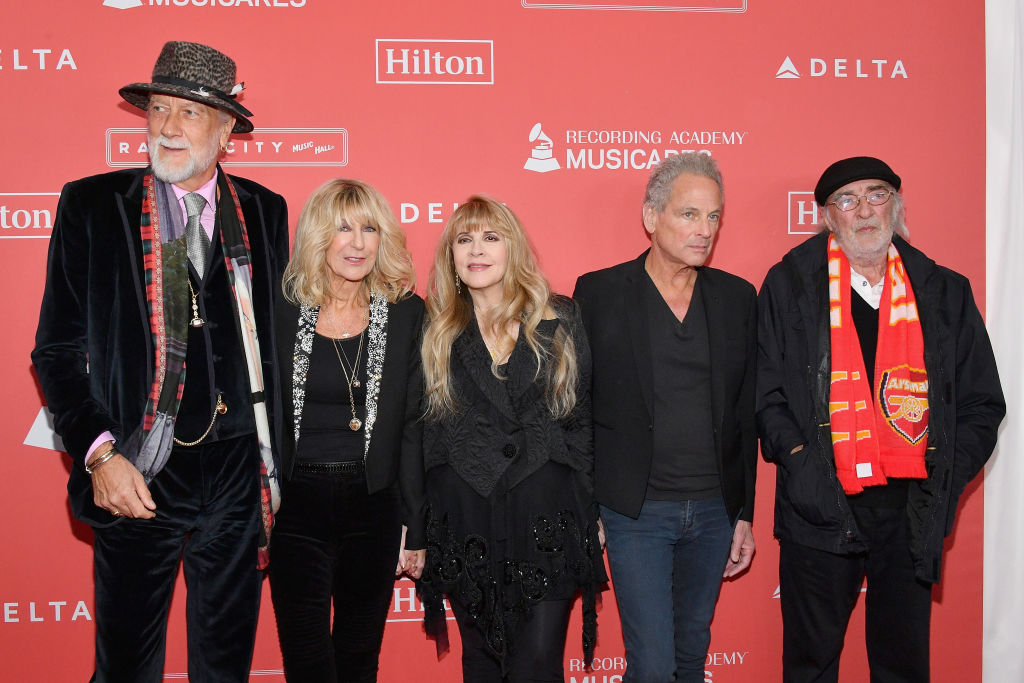
Fleetwood Mac were a British and American rock band formed in London in 1967. They have sold more than 120 million records worldwide, making them one of the world's best-selling musical acts. Their 1977 album, Rumours, is one of the best-selling albums of all time and won the Grammy Award for Album of the Year in 1978. In 1979, they were honoured with a star on the Hollywood Walk of Fame, and in 1998 they were inducted into the Rock and Roll Hall of Fame and received the Brit Award for Outstanding Contribution to Music. In 2018, Fleetwood Mac received the MusiCares Person of the Year award from the Recording Academy in recognition of their artistic achievement in the music industry and dedication to philanthropy.
Primarily a British blues band in their early years, the line-up of singers/guitarists Peter Green, Jeremy Spencer and Danny Kirwan, bassist John McVie, and drummer Mick Fleetwood achieved a UK No. 1 single in 1968 with the instrumental "Albatross", and had other UK Top 10 hits with "Man of the World", "Oh Well" (both 1969), and "The Green Manalishi (With the Two Prong Crown)" (1970). Green, Spencer, and Kirwan left the band in succession during 1970–1972, with McVie's wife, singer/keyboardist Christine McVie, and American singer/guitarist Bob Welch joining during this period. 1974 saw the band's relocation to the United States and Welch's departure. Fleetwood and the McVies recruited singer/guitarist Lindsey Buckingham and singer Stevie Nicks at the end of that year, and the first album with this line-up, Fleetwood Mac (1975), topped the Billboard 200 chart in the US, followed by Rumours.
The line-up remained stable through three more studio albums – Tusk (1979), Mirage (1982), and Tango in the Night (1987) – before Buckingham left in 1987, and was replaced by Billy Burnette and Rick Vito. The sole studio album from this line-up, Behind the Mask (1990), reached No. 1 in the UK, but was less successful in the US. The 1975–1987 line-up reunited for a one-off performance for the first inauguration of President Bill Clinton in 1993, before a full-scale reunion took place four years later, resulting in the band's fourth US No. 1 album, The Dance (1997), a live album marking the 20th anniversary of Rumours and the band's 30th anniversary. Christine McVie left in 1998 but rejoined in 2014. During her departure, Fleetwood, John McVie, Buckingham, and Nicks released the final Fleetwood Mac studio album, Say You Will, in 2003. In 2018, Buckingham was fired and replaced by Mike Campbell (formerly of Tom Petty and the Heartbreakers) and Neil Finn (of Split Enz and Crowded House). In 2024, two years after the death of Christine McVie, Nicks said she believed that the band would not continue.
Contents
History
1967–1970: Formation and early years
Fleetwood Mac were formed in July 1967 in London, England, by Peter Green after he left the British blues band John Mayall & the Bluesbreakers. Green had previously replaced guitarist Eric Clapton in the Bluesbreakers and had received critical acclaim for his work on their album A Hard Road. Green had been in two bands with Mick Fleetwood, Peter B's Looners and the subsequent Shotgun Express (which featured a young Rod Stewart as vocalist), and suggested Fleetwood as a replacement for drummer Aynsley Dunbar when Dunbar left the Bluesbreakers to join the Jeff Beck Group. John Mayall agreed and Fleetwood joined the Bluesbreakers.
The Bluesbreakers then consisted of Green, Fleetwood, bassist John McVie (a member of the Bluesbreakers since their 1963 formation) and Mayall. Mayall gave Green free recording time as a gift, which Fleetwood, McVie and Green used to record five songs. The fifth song was an instrumental that Green named after the rhythm section, "Fleetwood Mac" ("Mac" being short for McVie).
Soon after this, Green suggested to Fleetwood that they form a new band. The pair wanted McVie on bass and named the band "Fleetwood Mac" to entice him, but McVie opted to keep his steady income with Mayall rather than take a risk with a new band. In the meantime, Green and Fleetwood teamed up with slide guitarist Jeremy Spencer and bassist Bob Brunning. Brunning was in the band on the understanding that he would leave if McVie agreed to join. The band made its debut on Sunday 13 August 1967 at the National Jazz and Blues Festival (a forerunner of the Reading Festival), billed as "Peter Green's Fleetwood Mac featuring Jeremy Spencer". Brunning played only a few gigs with Fleetwood Mac, as within a few weeks of their first show, John McVie agreed to join the band as permanent bassist, after growing disenchanted with Mayall's move to a more jazz-influenced style. With management wanting to capitalise on Green's popularity with the Bluesbreakers, the band would continue to use the name Peter Green's Fleetwood Mac until early 1968 when, at Green's own insistence, the name was officially shortened to Fleetwood Mac.
Fleetwood Mac's self-titled debut album was released by the Blue Horizon label in February 1968. The song "Long Grey Mare" was recorded earlier with Brunning on bass, while the rest of the album was recorded with McVie. The album was successful in the UK and reached no. 4, although no tracks were released as singles. Later in the year, the singles "Black Magic Woman" (later a big hit when covered by Santana) and "Need Your Love So Bad" were released, both going top-forty in the UK.
1970–1973: Transitional era
After Green's departure, the four remaining members—Fleetwood, McVie, Spencer and Kirwan—set about working on their next album. In September 1970, Fleetwood Mac released their fourth studio album, Kiln House, to generally positive reviews. Kirwan's songs on the album moved the band in a melodic rock direction, while Spencer's contributions focused on re-creating the country-tinged "Sun Sound" of the late 1950s. Christine Perfect, now Christine McVie following her marriage to John McVie, had retired from the music business after one unsuccessful solo album, though she contributed (uncredited) to Kiln House, singing backup vocals and playing keyboards. She also drew the album cover. After Kiln House, Fleetwood Mac were progressing and developing a new sound, and she was invited to join the band to help fill in the rhythm section. The first time she had played live with the band had been a guest appearance at Bristol University, England, in May 1969, just as she was leaving Chicken Shack, while her first gig as an official member of the band was on 1 August 1970 in New Orleans, Louisiana. In early 1971, the band released a non-album single, Danny Kirwan's "Dragonfly" b/w "The Purple Dancer" in the UK and certain European countries, but despite good notices in the press, it was not a success. In 1971, CBS Records, which now owned Fleetwood Mac's original record company Blue Horizon (except in the US and Canada), released the band's third compilation album, The Original Fleetwood Mac, containing previously unreleased material from 1967 and 1968.
While on a US tour in February 1971, Jeremy Spencer said he was going out to "get a magazine" but never returned. After several days of frantic searching, the band discovered that Spencer had joined a religious group, the Children of God. The band were liable for the remaining shows on the tour and asked Peter Green to step in as a replacement. Green brought along his friend Nigel Watson, who played the congas (twenty-five years later Green and Watson collaborated again to form the Peter Green Splinter Group), and insisted on playing only new material and none he had written. Green and Watson played the last week of the tour, with a show in San Bernardino on 20 February 1971 being recorded. Green did not want to re-join the band permanently, and a search for a guitarist to replace Spencer began after the tour was completed.
In the summer of 1971, the band held auditions for a replacement guitarist at their large country home, "Benifold", which they had jointly bought with their manager Davis for £23,000 (equivalent to £315,500 in 2025) prior to the Kiln House tour. A friend of the band, Judy Wong, recommended her high school friend Bob Welch, who was living in Paris, France, at the time. The band held a few meetings with Welch and decided to hire him, without actually playing with him, after they heard a tape of his songs.
1973–1974: Name dispute and "fake Fleetwood Mac"
In late 1973, after the collapse of the US tour, the band's manager, Clifford Davis, was left with major touring commitments to fulfill and no band. Fleetwood Mac had "temporarily disbanded" in Nebraska and its members had gone their separate ways. Davis was concerned that failing to complete the tour would destroy his reputation with bookers and promoters. He sent the band a letter in which he said he "hadn't slaved for years to be brought down by the whims of irresponsible musicians". Davis claimed that he owned the name 'Fleetwood Mac' and the right to choose the band members. He recruited members of the band Legs, which had recently issued one single under Davis's management, to tour the US in early 1974 under the name "The New Fleetwood Mac" and perform the rescheduled dates. This band—who former vocalist Dave Walker said were "very good"—consisted of Elmer Gantry (Dave Terry, formerly of Velvet Opera: vocals, guitar), Kirby Gregory (formerly of Curved Air: guitar), Paul Martinez (formerly of the Downliners Sect: bass), John Wilkinson (also known as Dave Wilkinson: keyboards) and Australian drummer Craig Collinge (formerly of Manfred Mann Chapter Three, The Librettos, Procession and Third World War). The members of this group were told that Mick Fleetwood would join them on the tour to validate the use of the name. Fleetwood said later that he had not agreed to be part of the tour.
The "New Fleetwood Mac" tour began on 16 January 1974 at the Syria Mosque in Pittsburgh, Pennsylvania, and was initially successful. One of the band members said the first concert "went down a storm". The promoter was dubious at first but said later that the crowd had loved the band and they were "actually really good". More successful gigs followed, but then word got around that this was not the real Fleetwood Mac and audiences became hostile. The band was turned away from several gigs and the next six shows were pulled by promoters. The band struggled on and played further dates in the face of increasing hostility and heckling. More dates were pulled, the keyboard player quit, and after a concert in Edmonton where bottles were thrown at the stage, the tour collapsed. The band dissolved and the remainder of the tour was cancelled.
The lawsuit that followed regarding who owned the rights to the name "Fleetwood Mac" put the real Fleetwood Mac on hiatus for almost a year. Their record company, Warner Bros. Records, when appealed to, said they did not know who owned it. The dispute was eventually settled out of court, four years later, in what was described as "a reasonable settlement not unfair to either party". In later years Fleetwood said that, in the end, he was grateful to Davis because the lawsuit was the reason the band moved to California.
1974: Return of the authentic Fleetwood Mac
While the fake Fleetwood Mac were on tour, Welch stayed in Los Angeles and connected with entertainment attorneys. He realised that Fleetwood Mac was being neglected by Warner Bros and that they would need to change their base of operation from England to America, to which the rest of the band agreed. The presence of a false Fleetwood Mac had also confused matters. Rock promoter Bill Graham wrote a letter to Warner Bros to convince them that the real Fleetwood Mac was Mick Fleetwood, John McVie, Christine McVie, and Bob Welch. This did not end the legal battle, but the band was able to record as Fleetwood Mac again. Instead of hiring another manager, Fleetwood Mac, having re-formed, became the only major rock band managed by the artists themselves.
In September 1974, Fleetwood Mac signed a new recording contract with Warner Bros but remained on the Reprise label. In the same month, the band released their ninth studio album, Heroes Are Hard to Find. This was the first time Fleetwood Mac had only one guitarist. While on tour, they briefly added a second keyboardist, Doug Graves, who had been an engineer on Heroes Are Hard to Find. In 1980, Christine McVie said Graves had been there to back her up, but after the first two or three concerts it was decided that she was better off without him: "The band wanted me to expand my role and have a little more freedom, but he didn't play the same way I did." Keyboard player Robert ("Bobby") Hunt, who had been in the band Head West with Bob Welch in 1970, replaced Graves for the remaining dates on the tour but was not invited to join the band full time. By the time the tour ended (on 5 December 1974 at California State University, Northridge), the Heroes album had reached a higher position on the American charts than any of the band's previous records.
1974–1987: Addition of Buckingham and Nicks, and global success
In Bob Welch's words, following the Heroes are Hard to Find tour, "the buzz that the Mystery to Me band had started to create...[was] gone. I [was] totally exhausted by writing, singing, touring, negotiating, moving, and frankly so [were] Mick, John and Chris. We were all discouraged that Heroes [hadn't] done better. Something needs to change, but what? ... There was also a kind of fatigue, anger and bitterness that all the work we had done hadn't really paid off and we were just all sort of shaking our heads saying 'what do we do now' ... Everybody knew that we had to find some new creative juice." Welch himself had grown tired of the constant struggles to keep Fleetwood Mac functioning and was openly considering leaving the band.
Whilst Fleetwood was checking out Sound City Studios in Los Angeles during the autumn of 1974, the house engineer, Keith Olsen, played him a track he had recorded, "Frozen Love", from the album Buckingham Nicks (1973). Fleetwood liked it and was introduced to the guitarist from the band, Lindsey Buckingham, who was at Sound City that day recording demos. Fleetwood asked him to join Fleetwood Mac, and Buckingham agreed, on the condition that his music partner and girlfriend, Stevie Nicks, be included. Welch considered remaining as part of this extended lineup but opted to depart for a solo career. Buckingham and Nicks joined the band on New Year's Eve 1974.
In 1975, the new line-up released their first album together, the self-titled Fleetwood Mac, the band's tenth studio album overall. The album was a breakthrough for the band and became a huge hit, reaching No. 1 in the US and selling over 7 million copies. Among the hit singles from this album were Christine McVie's "Over My Head" and "Say You Love Me" and Stevie Nicks' "Rhiannon", as well as the much-played album track "Landslide", a live rendition of which became a hit twenty years later on The Dance album.
In 1976, the band was suffering from severe stress. With success came the end of John and Christine McVie's marriage, as well as Buckingham and Nicks's long-term romantic relationship. Fleetwood, meanwhile, was in the midst of divorce proceedings from his wife, Jenny, and had also begun an affair with Nicks. The pressure on Fleetwood Mac to release a successful follow-up album, combined with their new-found wealth, led to creative and personal tensions which were allegedly fuelled by high consumption of drugs and alcohol.
1987–1995: Departures of Buckingham and Nicks
With a ten-week tour scheduled, Buckingham held back at the last minute, saying he felt his creativity was being stifled. A group meeting at Christine McVie's house on 7 August 1987 resulted in turmoil. Tensions were coming to a head. Fleetwood said in his autobiography that there was a physical altercation between Buckingham and Nicks. Buckingham left the band the following day. After Buckingham's departure, Fleetwood Mac added two new guitarists to the band, Billy Burnette and Rick Vito, again without auditions.
Burnette was the son of Dorsey Burnette and nephew of Johnny Burnette, both of The Rock and Roll Trio. He had already worked with Fleetwood in Zoo, with Christine McVie as part of her solo band, had done some session work with Nicks, and backed Buckingham on Saturday Night Live. Fleetwood and Christine McVie had played on his Try Me album in 1985. Vito, a Peter Green admirer, had played with many artists from Bonnie Raitt to John Mayall, to Roger McGuinn in Thunderbyrd and worked with John McVie on two Mayall albums.
The 1987–88 "Shake the Cage" tour was the first outing for this line-up. It was successful enough to warrant the release of a concert video, also titled Tango in the Night, which was filmed at San Francisco's Cow Palace arena in December 1987.
Capitalising on the success of the Tango in the Night album, the band released a Greatest Hits album in 1988. It featured singles from the 1975–1988 era and included two new compositions, "No Questions Asked" written by Nicks and Kelly Johnston, and "As Long as You Follow", written by Christine McVie and Quintela. 'As Long as You Follow' was released as a single in 1988 but only made No. 43 in the US and No. 66 in the UK, although it reached No. 1 on the US Adult Contemporary charts. The Greatest Hits album, which peaked at No. 3 in the UK and No. 14 in the US (though it has since sold over 8 million copies there) was dedicated by the band to Buckingham, with whom they were now reconciled.
In 1990, Fleetwood Mac released their fifteenth studio album, Behind the Mask. With this album, the band veered away from the stylised sound that Buckingham had evolved during his tenure (which was also evident in his solo work) and developed a more adult contemporary style with producer Greg Ladanyi. The album yielded only one Top 40 hit, Christine McVie's "Save Me". Behind the Mask only achieved Gold album status in the US, peaking at No. 18 on the Billboard album chart, though it entered the UK Albums Chart at No. 1. It received mixed reviews and was seen by some music critics as a low point for the band in the absence of Buckingham (who had actually made a guest appearance playing on the title track). But Rolling Stone magazine said that Vito and Burnette were "the best thing to ever happen to Fleetwood Mac". The subsequent "Behind the Mask" tour saw the band play sold-out shows at London's Wembley Stadium. In the final show in Los Angeles, Buckingham joined the band onstage. The two women of the band, McVie and Nicks, had decided that the tour would be their last (McVie's father had died during the tour), although both stated that they would still record with the band. In 1991, however, Nicks and Rick Vito left Fleetwood Mac altogether.
1995–2007: Reformation, reunion, and Christine McVie's departure
Just weeks after disbanding Fleetwood Mac, Mick Fleetwood started working with Lindsey Buckingham again. John McVie was added to the sessions, and later Christine McVie. Stevie Nicks also enlisted Buckingham to produce a song for a soundtrack. In May 1996, Fleetwood, John McVie, Christine McVie, and Nicks performed together at a private party in Louisville, Kentucky, prior to the Kentucky Derby, with Steve Winwood filling in for Buckingham. A week later, the Twister film soundtrack was released, which featured the Nicks-Buckingham duet "Twisted", with Fleetwood on drums. This eventually led to a full reunion of the Rumours line-up, which officially reformed in March 1997.
The regrouped Fleetwood Mac performed a live concert on a soundstage at Warner Bros. Burbank, California, on 22 May 1997. Buckingham said in an interview with Mojo magazine regarding the five of them coming together again that their "chemistry was very present". The concert was recorded and filmed, and from this performance came the 1997 live album and video The Dance, which brought the band back to the top of the US album charts for the first time in ten years. In addition to live performances of their most notable songs, the album also featured new songs including "Bleed to Love Her" and "Temporary One". The album was certified five million units by the RIAA. An arena tour followed the MTV premiere of The Dance video and kept the reunited Fleetwood Mac on the road throughout much of 1997, the 20th anniversary of Rumours. With additional musicians Neale Heywood on guitar, Brett Tuggle on keyboards, Lenny Castro on percussion and Sharon Celani (who had toured with the band in the late 1980s) and Mindy Stein on backing vocals, this would be the final appearance of the classic line-up including Christine McVie for 16 years.
In 1998, Fleetwood Mac were inducted into the Rock and Roll Hall of Fame. Members inducted were the 1968–1970 band—Mick Fleetwood, John McVie, Peter Green, Jeremy Spencer, and Danny Kirwan—and Rumours-era members Christine McVie, Stevie Nicks, and Lindsey Buckingham. Bob Welch was not included, despite his key role in keeping the band alive during the early 1970s. The Rumours-era version of the band performed both at the induction ceremony and at the Grammy Awards programme that year. Peter Green attended the induction ceremony but did not perform with his former bandmates, opting instead to perform his composition "Black Magic Woman" with Santana, who were inducted the same night. Neither Jeremy Spencer nor Danny Kirwan attended. Fleetwood Mac also received the "Outstanding Contribution to Music" award at the Brit Awards (British Phonographic Industry Awards) the same year. Shortly after this, Christine McVie officially left the band.
2008–2013: Touring activity
In March 2008, it was mooted that Sheryl Crow might work with Fleetwood Mac in 2009. Crow and Stevie Nicks had collaborated in the past and Crow had stated that Nicks had been a great teacher and inspiration to her. Later, Buckingham said that the potential collaboration with Crow had "lost its momentum" and the idea was abandoned.
In March 2009, Fleetwood Mac started their "Unleashed" tour, again without Christine McVie. It was a greatest hits show, although album tracks such as "Storms" and "I Know I'm Not Wrong" were also played. During their show on 20 June 2009 in New Orleans, Louisiana, Stevie Nicks premiered part of a new song that she had written about Hurricane Katrina. The song was later released as "New Orleans" on Nicks's 2011 album In Your Dreams with Mick Fleetwood on drums. In October 2009 and November, the band toured Europe, followed by Australia and New Zealand in December. In October, 2002's The Very Best of Fleetwood Mac was re-released in the UK, this time using the US 2-CD track listing, entering at number six on the UK Albums Chart. On 1 November 2009 a one-hour documentary, Fleetwood Mac: Don't Stop, was broadcast in the UK on BBC One, featuring interviews with all four of the band members at the time. During the documentary, Nicks gave a candid summary of the current state of her relationship with Buckingham, saying, "Maybe when we're 75 and Fleetwood Mac is a distant memory, we might be friends."
On 6 November 2009, Fleetwood Mac played the last show of the European leg of their Unleashed tour at London's Wembley Arena. Christine McVie was in the audience. Nicks paid tribute to her from the stage to a standing ovation from the audience, saying that she thought about her former bandmate "every day", and dedicated that night's performance of "Landslide" to her. On 19 December 2009, Fleetwood Mac played the second-to-last show of their Unleashed tour to a sell-out crowd in New Zealand, at what was intended to be a one-off event at the TSB Bowl of Brooklands in New Plymouth. Tickets, after pre-sales, sold out within twelve minutes of public release. Another date, Sunday 20 December, was added and also sold out. The tour grossed $84,900,000 and was ranked No. 13 in the highest grossing worldwide tours of 2009. On 19 October 2010, Fleetwood Mac played a private show at the Phoenician Hotel in Scottsdale, Arizona for TPG (Texas Pacific Group).
On 3 May 2011, the Fox Network broadcast an episode of Glee entitled "Rumours" that featured six songs from the band's 1977 album. The show sparked renewed interest in the band and its most commercially successful album, and Rumours re-entered the Billboard 200 chart at No. 11 in the same week that Nicks's solo album In Your Dreams debuted at No. 6. (She was quoted by Billboard saying that her new album was "my own little Rumours.") The two recordings sold about 30,000 and 52,000 units respectively. Music downloads accounted for 91 per cent of the Rumours sales. The spike in sales for Rumours represented an increase of 1,951%. It was the highest chart entry by a previously issued album since The Rolling Stones' reissue of Exile On Main St. re-entered the chart at No. 2 on 5 June 2010. In an interview in July 2012 Nicks confirmed that the band would reunite for a tour in 2013.
2014–present: Buckingham's departure, death of Christine McVie
On 11 January 2014, Mick Fleetwood confirmed that Christine McVie would be rejoining Fleetwood Mac. The band launched the On with the Show tour in Minneapolis, Minnesota, on 30 September 2014, marking McVie's first full-show appearance with the group since 1997. United Kingdom arena dates scheduled for May–June 2015 sold out within minutes, leading to additional shows, including an Australian leg.
In early 2015, Lindsey Buckingham suggested that the ongoing tour and a planned new album could represent the band's final major phase, while still emphasizing that work on the Fleetwood Mac album would continue and solo projects would become a lower priority for a period. Mick Fleetwood later said the record could take several years to complete, citing Stevie Nicks' ambivalence at the time about committing to a full album.
In August 2016, Fleetwood said the band had recorded a large amount of material, although little of it featured Nicks; he added that Buckingham and Christine McVie had provided many songs for the project. Nicks later said she was reluctant to commit to an extended recording period with the group followed by a major tour cycle.
On 9 June 2017, Buckingham and McVie released the collaborative album Lindsey Buckingham/Christine McVie, which included contributions from Fleetwood and John McVie. A 38-date tour in support of the album ran from 21 June to 16 November 2017. During the same period, Fleetwood Mac headlined the second nights of the Classic West concert (16 July 2017, Dodger Stadium) and the Classic East concert (30 July 2017, Citi Field). Plans for further touring in 2018 were reported, including suggestions from some sources that it could be framed as a farewell run.
In January 2018, Fleetwood Mac received the MusiCares Person of the Year award, reuniting to perform at the Grammy-hosted gala held in their honour. In April 2018, "Dreams" returned to the charts amid renewed attention from a viral meme, which also boosted consumption of Rumours.
In April 2018, Buckingham departed from the group for a second time, with reports describing the split as a dismissal. The departure was linked to disagreements over tour planning and setlist direction. Fleetwood later said Buckingham would not approve the long-planned tour, leading to an impasse, while emphasizing continued respect for Buckingham's work with the band.
Musical style
Fleetwood Mac's musical style has been described as pop rock, soft rock, blues rock, British blues, and art pop. While describing the evolution of their sound, Stephen Thomas Erlewine of AllMusic wrote, "Originally, guitarists Peter Green and Jeremy Spencer provided the group with their gutsy psychedelic blues-rock sound, then the band moved toward pop/rock with the addition of keyboardist/songwriter Christine McVie."
Band members
Final lineup
Mick Fleetwood – drums, percussion (1967–1995, 1997–2022)
John McVie – bass (1967–1995, 1997–2022)
Christine McVie – keyboards, vocals (1970–1995, 1997–1998, 2014–2022; her death)
Stevie Nicks – vocals (1974–1990, 1997–2022)
Mike Campbell – lead guitar, vocals (2018–2022)
Neil Finn – vocals, rhythm guitar (2018–2022)
Discography
Studio albums
Fleetwood Mac (1968, also known as Peter Green's Fleetwood Mac)