
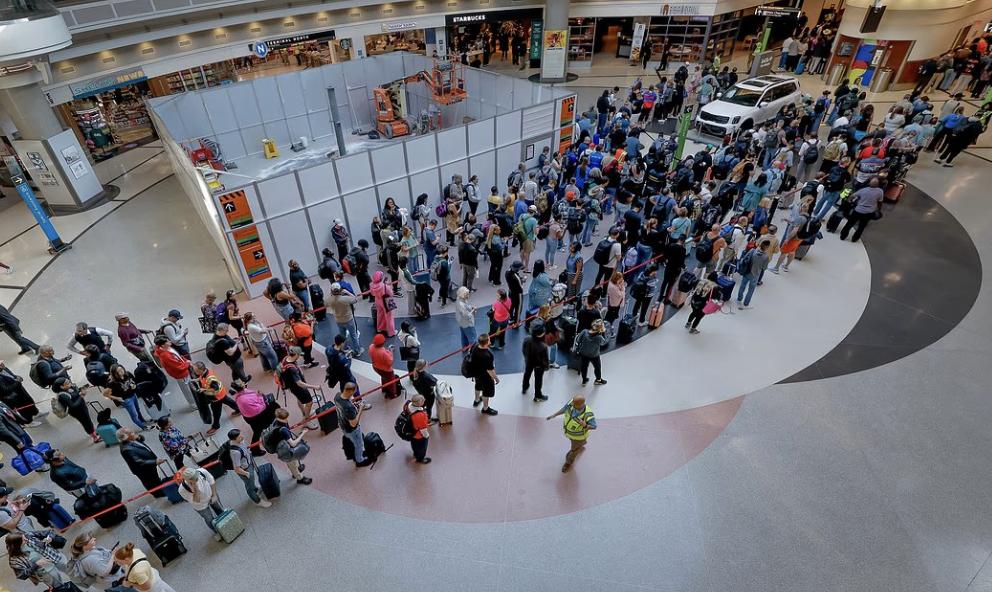
George Bush Intercontinental Airport (IATA: IAH, ICAO: KIAH, FAA LID: IAH) is the main international airport in Houston, Texas, United States, serving the Greater Houston metropolitan area. Initially named Houston Intercontinental Airport upon its opening in 1969, it was renamed in honor of George H. W. Bush, the 41st president of the United States and a resident of Houston, in 1997. It is also commonly called Houston International Airport or George Bush International Airport.
Located about 23 miles (37 km) north of Downtown Houston between Interstate 45 and Interstate 69/U.S. Highway 59 with direct access to the Hardy Toll Road expressway, George Bush Intercontinental Airport has scheduled flights to a large number of domestic and international destinations covering five continents. It is the second busiest airport in Texas for international passenger traffic as of 2025 (behind DFW) and has a number of international destinations, the second-busiest airport in Texas as of 2021 and the 15th busiest in the United States for total passenger traffic as of 2022.
IAH covers 10,000 acres (40 km2) of land and has five runways. Houston Intercontinental is one of the largest passenger hubs for United Airlines and formerly also served as a hub for one of United Airlines' predecessors, Continental Airlines, as well as defunct airlines Eastern Air Lines and Texas International Airlines.
Contents
History
20th century
A group of Houston businessmen purchased the site for Bush Intercontinental Airport in 1957 to preserve it until the city of Houston could formulate a plan for a new airport as a replacement for William P. Hobby Airport (at the time known as Houston International Airport). The holding company for the land was named the Jet Era Ranch Corporation, but a typographical error transformed the words "Jet Era" into "Jetero" and the airport site subsequently became known as the Jetero airport site. Although the name Jetero was no longer used in official planning documents after 1961, the airport's eastern entrance was named Jetero Boulevard. Most of Jetero Boulevard was later renamed Will Clayton Parkway.
The City of Houston annexed the Intercontinental Airport area in 1965. This annexation, along with the 1965 annexations of the Bayport area, the Fondren Road area, and an area west of Sharpstown, resulted in a gain of 51,251 acres (20,741 ha) of land for the city.
Houston Intercontinental Airport, which was the original name for the airport, opened in June 1969. The airport's IATA code of IAH derived from the stylization of the airport's name as "Intercontinental Airport of Houston." All scheduled passenger airline service formerly operated from William P. Hobby Airport moved to Intercontinental upon the airport's completion. Hobby remained open as a general aviation airport and was once again used for scheduled passenger airline jet service two years later when Southwest Airlines initiated intrastate airline service nonstop between Hobby and Dallas Love Field in 1971.
In the late 1980s, Houston City Council considered a plan to rename the airport after Mickey Leland—an African-American U.S. Congressman who died in an aviation accident in Ethiopia. Instead of renaming the whole airport, the city named Mickey Leland International Arrivals Building, which would later become Mickey Leland Terminal D, after the congressman. In April 1997, Houston City Council unanimously voted to rename the airport George Bush Intercontinental Airport/Houston, after George H. W. Bush, the 41st president of the United States. The name change took effect on May 2, 1997.
On August 28, 1990, Continental Airlines agreed to build its maintenance center at George Bush Intercontinental Airport; Continental agreed to do so because the city of Houston agreed to provide city-owned land near the airport.
21st century
In 2002, runway 15R-33L was extended from 6,308 ft. to 10,000 ft. and widened. It holds the distinction as the world's first lime/cement/fly ash crushed concrete stabilized base (LCF) used under a portland cement concrete (PCC) surface.
Since Houston was not an approved gateway for U.S. to London Heathrow flights under the Bermuda II Agreement, Continental Airlines, and British Airways flew their London services to London Gatwick. British Airways, keen to allow its passengers access to connections at its larger Heathrow Airport hub, subsequently flew various routings from Houston to Heathrow, via a gateway approved technical stop, allowing its Houston originating flights to land at Heathrow. While keeping a daily Houston–Gatwick flight, British Airways operated a flight from Houston to Heathrow via Washington-Dulles, with the technical stop being later changed to Chicago-O'Hare and finally to Detroit. In March 2008, the Bermuda II agreement was replaced with the EU–US Open Skies Agreement, allowing Continental Airlines and British Airways to switch its London services from Houston to Heathrow Airport that summer. Gate BA presently operates double-daily flights to London's Heathrow Airport with Boeing 777 and Boeing 787 service.
As of 2007, Terminal B remained from the airport's original design. Lewis W. Cutrer Terminal C opened in 1981, the Mickey Leland International Arrivals Building (now called Terminal D) opened in May 1990, and the new Terminal E partially opened on June 3, 2003. The rest of Terminal E opened on January 7, 2004. Terminal D is the arrival point for all international flights except for United flights, which use Terminal E. Flights from Canada on Air Canada and WestJet arrive in terminal A. Terminal D also held customs and INS until the opening of the new Federal Inspection Service (FIS) building, completed on January 25, 2005.
On January 7, 2009, a Continental Airlines Boeing 737-800 departing Bush Intercontinental was the first U.S. commercial jet to fly on a mix of conventional jet fuel and biofuel.
In December 2009, the Houston City Council approved a plan to allow Midway Cos. to develop 10 acres (4.0 ha) of land owned by Houston Airport System (HAS) on the grounds of Bush Airport. Midway planned to develop a travel center for the airport's rental car facility. The city dictated the developer needed to place a convenience store and gas station facility, a flight information board, a fast casual restaurant, and a sit-down restaurant in the development. Beyond the required buildings, the developer planned to add an office facility of between 20,000 and 40,000 square feet (1,900 and 3,700 m2) and additional retail space.
Facilities
Terminals
George Bush Intercontinental Airport has five terminals and 116 total gates. The Skyway automated people mover system provides airside connections between all five terminals. The Subway is an automated people mover system that provides landside connections between the five terminals and the airport hotel. Terminals D & E have access to an international arrivals facility, and Terminal D has gates to support super jumbo jets including the Airbus A380 and Boeing 747-8.
Terminal A is primarily used by non-United domestic carriers and occasionally United Express. The original Terminal A was opened in 1969 coinciding with the opening of IAH, and contained four "banjo" air stations. The original configuration was scrapped in the 1990s. The current terminal spans across two concourses: South (1999) and North (2002), and contains 21 gates.
Terminal B is used for United Express flights. The original terminal opened in 1969 and was identical to Terminal A. Currently, the south concourse (2013) contains 26 gates across three ground-level piers. Departing passengers wait at a centralized location on the second floor and then head downstairs to one of three piers shortly before their flight. There are no dining or shopping establishments at any of the south concourse piers, nor are passengers permitted to enter the downstairs piers without a valid boarding pass. The 22-gate north expansion is slated to open in fall 2026 as aformentioned, and the current south concourse will receive a gate reduction as part of a revampment effort.
Terminal C (1981) is used for United domestic flights. It contains 30 gates.
Terminal D (1990) is primarily used for non-United international flights. It contains 16 gates.
Terminal E (2003) is used for United international flights and international arrivals. It contains 23 gates.
Ground transportation
From Downtown Houston one can travel to George Bush Intercontinental by taking I-69/US 59 (Eastex Freeway) to Beltway 8 or to Will Clayton Parkway, and access the airport from either road. From Downtown one could also take I-45 (North Freeway), connect to Beltway 8, and enter the airport from the Beltway. The Hardy Toll Road has an exit from the north or south to the airport.
The Metropolitan Transit Authority of Harris County, Texas, or METRO, offers bus services available at the south side of Terminal C. The 102 Bush IAH Express serves the airport. Previously, METRO also operated an express bus service known as Airport Direct, launched in the summer of 2008, which traveled from Downtown Houston to Terminal C via the HOV lane of the Eastex Freeway (I-69)/(US 59). In 2010, in an effort to increase ridership and maximize revenue, METRO reduced the fare of Airport Direct and closed a dedicated passenger plaza for the service in Downtown Houston; instead, the bus stopped at several downtown hotels. The fare each way was reduced from $15 to $4.50. The fare change increased ridership levels but reduced cash flow. METRO consistently provided the service at an operational loss. However, in the summer of 2011, METRO announced it was discontinuing the Airport Direct service, while the Route 102 local service (which serves the greater Greenspoint business and residential district before traveling on I-45 to access downtown) continued to operate.
As of 2025, Route 102 continues operating between Downtown Houston and the airport, via Greater Greenspoint, with up to 15 minute headway during weekdays. In April of 2025, Houston Metro also re-introduced nonstop bus service between Downtown Houston and the airport, operating as Route 500 IAH Downtown Direct. Route 500 operates non-stop between the George R. Brown Convention Center and Terminal E at the airport. The route travels via US-59 with a 30 minute headway. On February of 2026, METRO extended the service of the 500 Downtown Direct to operate via Downtown Transit Center and William P. Hobby Airport (HOU) with the same 30 minute headways, in addition, the bus stop at Intercontinental Airport (IAH) was moved to Terminal E - International Terminal, enabling transfer free public transit service between the 2 of Houston's major airports.
Fares for Route 102 is priced at the local bus fare for $1.25 and Route 500 is $4.50.
As of 2016 the Taiwanese airline EVA Air operates a shuttle bus service from Bush IAH to Richardson in the Dallas–Fort Worth area so DFW based customers may fly on its services to and from Houston. Previously China Airlines, also a Taiwanese carrier, provided a shuttle bus service to Sugar Land and the Southwest Houston Chinatown. It ended in 2008 when China Airlines ended its Houston passenger service.
Artwork
The airport houses over 130 works of art. In July 2024, Andrew Dansby of the Houston Chronicle described IAH as "like the world’s most inefficient art gallery", with 135 public works spread across the facility.
61st Mayor of Houston, Texas Annise Parker led policies to mandate art funding.
Ed Carpenter's "Light Wings", a multicolored glass sculpture suspended below a skylight, adorns the Terminal A North Concourse. In Terminal A, South Concourse stands Terry Allen's "Countree Music." Allen's piece is a cast bronze tree that plays instrumental music by Joe Ely and David Byrne, though the music is normally turned off. The corridor leading to Terminal A displays Leamon Green's "Passing Through," a 200-foot (61 m) etched glass wall depicting airport travelers.
The elevators in Terminal B are cased in stainless steel accordion shaped structures designed by Rachel Hecker. The corridor leading to Terminal B has Dixie Friend Gay's "Houston Bayou." This work is composed of an 8 ft × 75 ft (2.4 m × 22.9 m) Byzantine glass mosaic mural depicting scenes from Houston's bayous and wetlands, several bronze animals embedded in the floor, and five mosaic columns.
"Lights Spikes," designed by Jay Baker, was created for the 1990 G7 Summit when it was hosted by President George H. W. Bush in Houston. The sculpture was relocated to the airport outside E Terminal after the meetings, from its original location in front of the George R. Brown Convention Center. The columns lean at a ten-degree angle toward a central point that represents Houston. The distance between each "spike" and this point is relative to the distance between Houston and the capitals of the countries the flags represent. The countries represented are the United States, the United Kingdom, France, Japan, Canada, Italy and Germany, as well as the European community. The airport has a display of lighted modern sculptures between terminals C and D.
Radiant Fountains, LED-illuminated towers on JFK Boulevard, is the most prominent sculpture around the airport.
Janavi Mahimtura Folmsbee's The Aquarius Art Tunnel, which is decorated like an aquarium, links Terminals D and E. The exhibit won the 2023 CODAawards People's Choice.
Exhibitions
2003-2005 "Skywall", 60 foot long sculpture with LED lights
2019 Apollo 11 Anniversary exhibition (digital art) gallery hosting vivid photography, United Airlines
2024 Art Cars - Tribute to Freddie Mercury
Other facilities
The airport houses an on-site hotel, a Marriott, between Terminals B and C and is accessible via the landside inter-terminal train which runs every 3 minutes from 3:30 am to 12:30 am every day. The hotel has 573 rooms, one restaurant and bar, a concierge lounge, a coffee shop, health club, sundry shop and a conference center.
A VOR station, identified as IAH, is located on the airport property, south of runway 33L.
Minute Suites are available at Terminal C North, offering private relaxation suites and showers past security.
Airlines and destinations
Statistics
Accidents and incidents
February 1, 1975: a Douglas DC-3 N15HC of Horizon Properties crashed on approach when the port wing collided with an electricity pylon. The aircraft was on a domestic non-scheduled passenger flight from Lawton Municipal Airport, Oklahoma, to Huntsville Regional Airport, Texas. The flight was diverted to Houston for weather. Of the 16 occupants, two crew and three passengers were killed.
August 23, 1990: a Grumman Gulfstream I operated by Rowan Drilling Company; power loss in an engine after take-off resulted in a failed attempt to regain altitude en route to New Orleans International Airport. The aircraft crashed on departure from Runway 15L and came to rest midfield along a parallel taxiway. There were three fatalities.
On September 11, 1991, Continental Express Flight 2574 was on descent to the airport when it suffered a structural failure because of improper maintenance, killing all 14 people on board.
February 19, 1996: a Continental Airlines McDonnell Douglas DC-9-32 operating as Continental Airlines Flight 1943 from Ronald Reagan Washington National Airport, arriving in Houston, landed with its landing gear in the stowed position on Runway 27. The aircraft slid for 6,915 feet (2,108 m) on its belly before stopping on the runway 140 feet (43 m) left of the runway centerline approximately at the departure end of the runway. There were no fatalities and only minor injuries. The aircraft was written off.
January 13, 1998, a Learjet 25 operated by American Corporate Aviation crashed 2 miles (3.2 km) east of IAH descending below the glideslope. Both occupants were killed.
February 23, 2019: Atlas Air Flight 3591, a Boeing 767-300ERF operated for Amazon Air crashed into Trinity Bay while on approach, 30 miles (48 km) southeast of the airport. All three crewmembers were killed.