
Hanover (German: Hannover [haˈnoːfɐ] ) is the capital and largest city of the German state of Lower Saxony. Its population of 535,932 (2021) makes it the 13th-largest city in Germany as well as the fourth-largest in northern Germany after Berlin, Hamburg and Bremen. Hanover's urban area comprises the towns of Garbsen, Langenhagen and Laatzen and has a population of about 791,000 (2018). The Hanover Region has some 1.16 million inhabitants (2019) and is the largest in the Hanover–Braunschweig–Göttingen–Wolfsburg Metropolitan Region, the 17th biggest metropolitan area by GDP in the European Union.
Before it became the capital of Lower Saxony in 1946, Hanover was the capital of the Principality of Calenberg (1636–1692), the Electorate of Hanover (1692–1814), the Kingdom of Hanover (1814–1866), the Province of Hanover of the Kingdom of Prussia (1868–1918), the Province of Hanover of the Free State of Prussia (1918–1947) and of the State of Hanover (1946). From 1714 to 1837 Hanover was by personal union the family seat of the Hanoverian Kings of the United Kingdom of Great Britain and Ireland, under their title of the dukes of Brunswick-Lüneburg (later described as the Elector of Hanover).
The city lies at the confluence of the River Leine and its tributary the Ihme, in the south of the North German Plain. The city is a major crossing point of railway lines and motorways (Autobahnen), connecting European main lines in both the east–west (Berlin–Ruhr area/Düsseldorf/Cologne) and north–south (Hamburg–Frankfurt/Stuttgart/Munich) directions. Hanover Airport lies north of the city, in Langenhagen, and is Germany's ninth-busiest airport. The city's most notable institutes of higher education are the Hanover Medical School (Medizinische Hochschule Hannover), one of Germany's leading medical schools, with its university hospital Klinikum der Medizinischen Hochschule Hannover, and the Leibniz University Hanover. The city is also home to International Neuroscience Institute.
The Hanover Fairground, owing to numerous extensions, especially for the Expo 2000, is the largest in the world. Hanover hosts annual commercial trade fairs such as the Hanover Fair and up to 2018 the CeBIT. It also hosts the biannual IAA Commercial Vehicles show, the world's leading trade show for transport, logistics and mobility. Every year Hanover hosts the Schützenfest Hanover, the world's largest marksmen's festival, and the Oktoberfest Hanover. In 2014, Hanover was named a UNESCO City of Music, joining UNESCO's Creative Cities Network.
Contents
Etymology
The name of the city may derive from the German (am) hohen Ufer, literally 'on the high (river) bank'.
Traditionally, the English spelling is ⟨Hanover⟩. However, ⟨Hannover⟩, the German spelling with a double-⟨n⟩, has become more popular in English. Recent editions of Encyclopædia Britannica prefer the German spelling, and the local government uses the German spelling on their English webpages. The English pronunciation, with stress on the first syllable, is applied to both the German and English spellings, which is different from German pronunciation, with stress on the second syllable and a long second vowel. The traditional English spelling is still used in historical contexts, especially when referring to the British House of Hanover.
History
Early history
Hanover was founded in medieval times on the east bank of the Leine River. Its original name Honovere may mean 'high river bank', but that is debated. Hanover was a small village of ferrymen and fishermen that became a comparatively large town in the 13th century and received town privileges in 1241 because of its position at a natural crossroads. As overland travel was relatively difficult, its position on the upper navigable reaches of the river helped it grow from increasing trade. It was connected to the Hanseatic League city of Bremen by the Leine River and was situated near the southern edge of the wide North German Plain and northwest of the Harz mountains, so east–west traffic such as mule trains passed through it. Hanover was thus a gateway to the Rhine, Ruhr and Saar river valleys, and their industrial areas which grew up to the southwest and the plains regions to the east and north for overland traffic skirting the Harz between the Low Countries and Saxony or Thuringia.
In the 14th century, the main churches of Hanover were built, as well as a city wall with three city gates. The beginning of industrialization in Germany led to trade in iron and silver from the northern Harz Mountains, which increased the city's importance.
In 1636 George, Duke of Brunswick-Lüneburg, ruler of the Brunswick-Lüneburg principality of Calenberg, moved his residence to Hanover. The Dukes of Brunswick-Lüneburg were elevated by the Holy Roman Emperor to the rank of Prince-Elector in 1692, which was confirmed by the Imperial Diet in 1708. Thus, the principality was upgraded to the Electorate of Brunswick-Lüneburg, colloquially known as the Electorate of Hanover after Calenberg's capital (see also House of Hanover). Its electors later became monarchs of Great Britain (and from 1801 of the United Kingdom of Great Britain and Ireland). The first of them was George I Louis, who acceded to the British throne in 1714. The last British monarch who reigned in Hanover was William IV. Semi-Salic law, which required succession by the male line if possible, forbade the accession of Queen Victoria in Hanover. As a male-line descendant of George I, Queen Victoria was herself a member of the House of Hanover. Her descendants, however, bore her husband's titular name of Saxe-Coburg-Gotha. Three kings of Great Britain, or the United Kingdom, were concurrently also Electoral Princes of Hanover.
During the time of the personal union of the crowns of the United Kingdom and Hanover (1714–1837), the monarchs rarely visited the city. In fact during the reigns of the last three joint rulers (1760–1837), there was only one short visit, by George IV in 1821. From 1816 to 1837, Viceroy Adolphus represented the monarch in Hanover.
19th century
After Napoleon imposed the Convention of Artlenburg (treaty of the Elbe) on 5 July 1803, about 35,000 French soldiers occupied Hanover. The convention also required disbanding the Hanoverian Army. However, George III did not recognise the Convention of the Elbe, which resulted in a great number of soldiers from Hanover eventually emigrating to Great Britain, where the King's German Legion was formed. It was only troops from Hanover and Brunswick who consistently opposed France throughout the Napoleonic Wars. The Legion later played an important role in the Peninsular War and the Battle of Waterloo in 1815. In 1814 the electorate became the Kingdom of Hanover.
In 1837, the personal union of the United Kingdom and Hanover ended because William IV's heir in the United Kingdom was female (Queen Victoria). Hanover could be inherited only by male heirs. Thus, Hanover passed to William IV's brother, Ernest Augustus, and remained a kingdom until 1866, when it was annexed by the Prussia during the Austro-Prussian war. Though Hanover was expected to defeat Prussia at the Battle of Langensalza in 1866, Prussia employed Moltke the Elder's Kesselschlacht order of battle to destroy the Hanoverian Army. Thereafter the city of Hanover became the capital of the Prussian Province of Hanover.
In 1872, the first horse railway was inaugurated, and in 1893, an electric tram was installed.
A local newspaper, the Hannoverscher Kurier, was published in Hanover at this time.
Nazi era
After 1937 the lord mayor and the state commissioners of Hanover were members of the NSDAP (Nazi party). A large Jewish population then existed in Hanover. In October 1938, 484 Hanoverian Jews of Polish origin were expelled to Poland, including the Grynszpan family. However, Poland refused to accept them, leaving them stranded at the border with thousands of other Polish-Jewish deportees, fed only intermittently by the Polish Red Cross and Jewish welfare organisations. The Grynszpans' son Herschel Grynszpan was in Paris at the time. When he learned of what was happening, he drove to the German embassy in Paris and shot the German diplomat Eduard Ernst vom Rath, who died shortly afterwards.
The Nazis took this act as a pretext to stage a nationwide pogrom known as Kristallnacht (9 November 1938). On that day, the synagogue of Hanover, designed in 1870 by Edwin Oppler in neo-romantic style, was burnt by the Nazis.
In September 1941, through the "Action Lauterbacher" plan, a ghettoisation of the remaining Hanoverian Jewish families began. Even before the Wannsee Conference, on 15 December 1941, the first Jews from Hanover were deported to Riga. A total of 2,400 people were deported, and very few survived. During the war seven concentration camps were constructed in Hanover, in which many Jews were confined, but also Polish, French and Russian women. Of the approximately 2271 Jews who had lived in Hanover in 1939, fewer than 100 were still in the city when troops of the United States Army arrived on 10 April 1945 to occupy Hanover at the end of the war. Today, a memorial at the Opera Square is a reminder of the persecution of the Jews in Hanover.
After the war a large group of Orthodox Jewish survivors of the nearby Bergen-Belsen concentration camp settled in Hanover.
There was also a camp for Sinti and Romani people (see Romani Holocaust), and dozens of forced labour subcamps of the Stalag XI-B prisoner-of-war camp for Allied POWs.
As an important railway and road junction and production centre, Hanover was a major target for strategic bombing during World War II, including the Oil Campaign. Targets included the AFA (Stöcken), the Deurag-Nerag refinery (Misburg), the Continental plants (Vahrenwald and Limmer), the United light metal works (VLW) in Ricklingen and Laatzen (today Hanover fairground), the Hanover/Limmer rubber reclamation plant, the Hanomag factory (Linden) and the tank factory M.N.H. Maschinenfabrik Niedersachsen (Badenstedt). Residential areas were also targeted, and more than 6,000 civilians were killed by the Allied bombing raids. More than 90% of the city centre was destroyed in a total of 88 bombing raids. After the war, the Aegidienkirche was not rebuilt and its ruins were left as a war memorial. Today around 25% of the city consists of buildings from before 1950.
Post-war
Hanover was in the British zone of occupation of Germany and became part of the new state (Land) of Lower Saxony in 1946. In 1947, Hanover established its relationship with Bristol, England in exchanges of goods, students and music. This would link the two cities as models for establishing programs and organizations like Sister Cities International.
Today Hanover is a vice-president city of Mayors for Peace, an international mayoral organisation mobilising cities and citizens worldwide to abolish and eliminate nuclear weapons by 2020.
Geography
Climate
Hanover has an oceanic climate (Köppen: Cfb) independent of the isotherm. Although the city is not on a coastal location, the predominant air masses are still from the ocean, unlike other places further east or south-central Germany.
The Hanover weather station has recorded the following extreme values:
Its highest temperature was 39.2 °C (102.6 °F) on 20 July 2022.
Its lowest temperature was −24.8 °C (−12.6 °F) on 22 January 1940.
Its greatest annual precipitation was 935.4 mm (36.83 in) in 1981.
Its least annual precipitation was 337.4 mm (13.28 in) in 1959.
The longest annual sunshine was 1,971.6 hours in 1959.
The shortest annual sunshine was 1,274.3 hours in 1998.
Subdivisions
The city of Hanover is divided into 13 boroughs (Stadtbezirke) and 53 quarters (Stadtteile).
Mitte
Vahrenwald-List
Bothfeld-Vahrenheide
Buchholz-Kleefeld
Misburg-Anderten
Kirchrode-Bemerode-Wülferode
Südstadt-Bult
Döhren-Wülfel
Ricklingen
Linden-Limmer
Ahlem-Badenstedt-Davenstedt
Herrenhausen-Stöcken
Nord
A selection of the 53 quarters:
Nordstadt
Südstadt
Oststadt
Zoo (for the zoo itself, see Hanover Zoo)
Herrenhausen
Waldheim
Politics
Mayor
The current mayor of Hanover is Belit Onay of Alliance 90/The Greens, elected in 2019. The most recent mayoral election was held on 17 October 2019, with a runoff held on 10 November, and the results were as follows:
City council
The Hanover city council governs the city alongside the mayor. The most recent city council election was held on 12 September 2021, and the results were as follows:
Main sights
There are around 5,500 buildings of major historic value within city limits. One of Hanover's most grandiose sights is the Royal Gardens of Herrenhausen. Its Great Garden is an important European Baroque garden. The palace itself was largely destroyed by Allied bombing, but was reconstructed and reopened in 2013. Among its points of interest is the Grotto, with the interior designed by French artist Niki de Saint Phalle. The Great Garden consists of several parts and features Europe's tallest garden fountain. The historic Garden Theatre has hosted the musicals of the German rock musician Heinz Rudolf Kunze.
Also at Herrenhausen, the Berggarten is a botanical garden with the most varied collection of orchids in Europe. Some points of interest are the Tropical House, the Cactus House, the Canary House and the Orchid House, and free-flying birds and butterflies. Near the entrance to the Berggarten is the historic Library Pavillon. The Mausoleum of the Guelphs is also in the Berggarten. Like the Great Garden, the Berggarten also consists of several parts, for example the Paradies and the Prairie Garden. The Georgengarten is an English landscape garden. The Leibniz Temple and the Georgen Palace are two points of interest there.The landmark of Hanover is the New Town Hall (Neues Rathaus). Inside the building are four scale models of the city. An elevator ascends to the observation deck at the top of the large dome along a variable angle of up to 17 degrees, thought to be unique in the world.
The Hanover Zoo received the Park Scout Award for the fourth year running in 2009–10, placing it among the best zoos in Germany. The zoo consists of several theme areas: Sambesi, Meyers Farm, Gorilla-Mountain, Jungle-Palace, and Mullewapp. Some smaller areas are Australia, the wooded area for wolves, and the so-called swimming area with many seabirds. There is also a tropical house, a jungle house, and a show arena. The new Canadian-themed area, Yukon Bay, opened in 2010. In 2010 the Hanover Zoo had over 1.6 million visitors. There is also the Sea Life Centre Hanover, which is the first tropical aquarium in Germany.
Another point of interest is the Old Town. In the centre are the large Marktkirche (Church St. Georgii et Jacobi, preaching venue of the bishop of the Lutheran Landeskirche Hanovers), and the 15th century Old Town Hall, heavily damaged by Allied bombing in 1943, and reconstructed after World War II. Nearby are the Leibniz House, the Nolte House, and the Beguine Tower. The Kreuz-Church-Quarter around the Kreuz Church contains many little lanes. Nearby is the old royal sports hall, now called the Ballhof theatre. On the edge of the Old Town are the Market Hall, the Leine Palace, and the ruin of the Aegidien Church which is now a monument to the victims of war and violence. Through the Marstall Gate the bank of the river Leine can be reached; the Nanas of Niki de Saint Phalle are there. They are part of the Sculpture Mile, which starts at Trammplatz, runs along the river bank, crosses Königsworther Square, and ends at the entrance of the Georgengarten. Near the Old Town is the district of Calenberger Neustadt where the Catholic St. Clement's Basilica, the Reformed Church and the Lutheran Neustädter Hof- und Stadtkirche St. Johannis stand.
Population
Hanover has a population of about 540,000. It is the largest city in Lower Saxony and is the 13th largest city in Germany. The Hanover Region, a district that surrounds the city of Hanover and cities like Langenhagen, Garbsen and Laatzen has a population of about 1,160,000 and is the largest District (Landkreis) in Germany. Hanover metropolitan region, which includes also cities like Braunschweig, Hildesheim and Göttingen, has a population of about 3,850,000 and is the 8th largest metropolitan area in Germany. Hanover passed a population of 100,000 in 1875, and Hanover's population has grown since 1946, when Hanover became the capital of Lower Saxony state and it grew rapidly in 1950s and 60s due to West German Wirtschaftswunder. This also saw the growth of a large migrant population, drawn largely from Turkey, Greece and Italy. Hanover has also one of the largest Vietnamese communities in former West Germany due to its proximity to former East Germany. The Viên Giác pagoda in Mittelfeld, southern district of Hanover is the largest Vietnamese pagoda in Germany and one of the largest in Europe. Hanover is one of the liveable cities due to its good location and good population size.
It is the fifth-largest city in the Low German dialect area after Hamburg, Dortmund, Essen and Bremen.
Society and culture
Religious life
Hanover is headquarters for several Protestant organizations, including the World Communion of Reformed Churches, the Protestant Church in Germany, the Reformed Alliance, the United Evangelical Lutheran Church of Germany, and the Independent Evangelical-Lutheran Church.
In 2015, 31.1% of the population were Protestant and 13.4% were Roman Catholic. The majority 55.5% were irreligious or other religion.
Museums and galleries
The Historisches Museum Hanover (Historic museum) describes the history of Hanover, from the medieval settlement "Honovere" to the city of today. The museum focuses on the period from 1714 to 1834 when Hanover had a strong relationship with the British royal family of that period.
With more than 4,000 members, the Kestnergesellschaft is the largest art society in Germany. The museum hosts exhibitions from classical modernist art to contemporary art. Emphasis is placed on film, video, contemporary music and architecture, room installments and presentations of contemporary paintings, sculptures and video art.
The Kestner-Museum is located in the House of 5,000 windows. The museum is named after August Kestner and exhibits 6,000 years of applied art in four areas: Ancient cultures, ancient Egypt, applied art and a valuable collection of historic coins.
The KUBUS is a forum for contemporary art. It features mostly exhibitions and projects of artists from Hanover.
The Kunstverein Hannover (Art Society Hanover) shows contemporary art and was established in 1832 as one of the first art societies in Germany. It is located in the Künstlerhaus (House of artists). There are around seven international exhibitions each year.
The Landesmuseum Hanover is the largest museum in Hanover. The art gallery shows European art from the 11th to the 20th century, the nature department shows the zoology, geology, botanic, geology and a vivarium with fish, insects, reptiles and amphibians. The primeval department shows the primeval history of Lower Saxony, and the folklore department shows cultures from all over the world.
The Sprengel Museum shows the art of the 20th century. It is one of the most notable art museums in Germany. The focus is put on the classical modernist art with the collection of Kurt Schwitters, works of German expressionism, and French cubism, the cabinet of abstracts, the graphics and the department of photography and media. Furthermore, the museum shows the works of the French artist Niki de Saint-Phalle.
Theatre, cabaret and musical
Around 40 theatres are located in Hanover. The Opera House, the Schauspielhaus (Play House), the Ballhof eins, the Ballhof zwei and the Cumberlandsche Galerie belong to the Lower Saxony State Theatre. The Theater am Aegi is Hanover's principal theatre for musicals, shows and guest performances. The Neues Theater (New Theatre) is the boulevard theatre of Hanover. The Theater für Niedersachsen is another large theatre in Hanover, which also has an own musical company. Some of the most important musical productions are the rock musicals of the German rock musician Heinz Rudolph Kunze, which take place at the Garden-Theatre in the Great Garden.
Some important theatre events are the Tanztheater International, the Long Night of the Theatres, the Festival Theaterformen and the International Competition for Choreographers.
Hanover's leading cabaret stage is the GOP Variety theatre which is located in the Georgs Palace. Some other cabaret-stages are the Variety Marlene, the Uhu-Theatre. the theatre Die Hinterbühne, the Rampenlich Variety and the revue-stage TAK. The most important cabaret event is the Kleines Fest im Großen Garten (Little Festival in the Great Garden) which is the most successful cabaret festival in Germany. It features artists from around the world. Some other important events are the Calenberger Cabaret Weeks, the Hanover Cabaret Festival and the Wintervariety.
Music
Hanover has two symphony orchestras: The Lower Saxon State Orchestra Hanover and the NDR Radiophilharmonie (North German Radio Philharmonic Orchestra). Two notable choirs have their homes in Hanover: the Mädchenchor Hanover (girls' choir) and the Knabenchor Hanover (boys' choir).
There are two major international competitions for classical music in Hanover:
Hanover International Violin Competition (since 1991)
Classica Nova International Music Competition (since 1997); the non-profit association Classica Nova exists in Hanover with the aim of continuing the Classica Nova competition
The rock bands Scorpions and Fury in the Slaughterhouse are originally from Hanover. Acclaimed DJ Mousse T also has his main recording studio in the area. Rick J. Jordan, member of the band Scooter was born here in 1968. Lena, winner of the 2010 Eurovision Song Contest, is also from Hanover.
Sport
Hanover 96 (nicknamed Die Roten, literally 'the Reds') is the top local football team that currently plays in the 2. Bundesliga. Home games are played at the Niedersachsenstadion (Lower Saxony Stadium), which hosted matches in the 1974 and 2006 World Cups and the Euro 1988. Their reserve team Hanover 96 II plays in the 3rd division of German Football. Their home games were played in the traditional Eilenriedestadion until they moved to the HDI Arena due to DFL directives. Arminia Hanover is another traditional football team in Hanover that has played in the second division (then 2. Liga Nord) for years and plays now in the Niedersachsen-West Liga (Lower Saxony League West). Home matches are played in the Rudolf-Kalweit-Stadium.
The Hanover Indians are the local ice hockey team. They play in the third tier. Their home games are played at the traditional Eisstadion am Pferdeturm. The Hanover Scorpions played in Hanover in Germany's top league until 2013 when they sold their license and moved to Langenhagen.
Hanover was one of the rugby union capitals in Germany. The first German rugby team was founded in Hanover in 1878. Hanover-based teams dominated the German rugby scene for a long time. DSV 78 Hanover, SC Germania List, and SV Odin Hanover plays in the first division, and DRC Hanover as well as SG 78/08 Hanover play in the second division.
Hanover has traditionally been one of Germany's hubs in Water sports and especially in Water polo. The SG Waspo'98 Hanover won the Deutsche Wasserball-Liga in 2020 and 2021. In total, clubs from Hanover have won the German championship 11 times. Thanks to the Maschsee lake, the rivers Ihme and Leine and to the Mittellandkanal canal, Hanover hosts sailing schools, yacht schools, waterski clubs, rowing clubs, canoe clubs and paddle clubs.
The first German fencing club was founded in Hanover in 1862. Today there are three additional fencing clubs in Hanover.
The Hanover Korbjäger are the city's top basketball team. They play their home games at the IGS Linden.
The Hanover Regents play in the third Bundesliga (baseball) division. The Hanover Grizzlies, Armina Spartans and Hanover Stampeders are the local American football teams.
Regular events
Hanover is one of the leading exhibition cities in the world. It hosts more than 60 international and national exhibitions every year. The most popular ones are the CeBIT, the Hanover Fair, the Domotex, the Ligna, the IAA Nutzfahrzeuge and the Agritechnica. Hanover also hosts a huge number of congresses and symposiums like the International Symposium on Society and Resource Management.
Hanover is also host to the Schützenfest Hannover, the largest marksmen's fun fair in the world which takes place once a year from late June to early July. Founded in 1529, it consists of more than 260 rides and inns, five large beer tents and a large entertainment programme. The highlight of this fun fair is the 12-kilometre-long (7 mi) Parade of the Marksmen with more than 12,000 participants from all over the world, including around 5,000 marksmen, 128 bands, and more than 70 wagons, carriages, and other festival vehicles. This makes it the longest procession in Europe. Around 2 million people visit this fun fair every year. The landmark of this event is one of the largest transportable Ferris wheels in the world, with a height of about 60 metres (197 ft).
Hanover also hosts one of the two largest spring festivals in Europe, with around 180 rides and inns, 2 large beer tents, and around 1.5 million visitors each year. The Oktoberfest Hanover is the second largest Oktoberfest in the world with around 160 rides and inns, two large beer tents and around 1 million visitors each year.
The Maschsee Festival takes place around the Maschsee Lake. Each year around 2 million visitors come to enjoy live music, comedy, cabaret, and much more. It is the largest Volksfest of its kind in Northern Germany. The Great Garden hosts every year the International Fireworks Competition, and the International Festival Weeks Herrenhausen, with music and cabaret performances. The Carnival Procession is around 3 kilometres (2 mi) long and consists of 3,000 participants, around 30 festival vehicles and around 20 bands and takes place every year.
Other festivals include the Festival Feuer und Flamme (Fire and Flames), the Gartenfestival (Garden Festival), the Herbstfestival (Autumn Festival), the Harley Days, the Steintor Festival (Steintor is a party area in the city centre) and the Lister-Meile-Festival (Lister Meile is a large pedestrian area).
Tourism
Hanover is an attractive tourist place due to its many sights and famous events. Hanover had about 580,000 visitors in 2021, predominantly from the Netherlands and the United Kingdom. Famous sights in Hanover are New Town Hall, Herrenhausen Gardens and Hanover Zoo, which is one of the largest zoos in Germany.
The annual trade fair "Hannover Messe" usually attracts between 100,000 and 200,000 visitors. First held in 1947, it is dedicated to the topic of industry development and is one of the world's largest trade fairs.
Transport
Rail
The city's central station, Hanover Hauptbahnhof, is a hub of the German high-speed ICE network. It is the starting point of the Hanover-Würzburg high-speed rail line and also the central hub for the Hanover S-Bahn. It offers many international and national connections.
Air
Hanover and its area is served by Hanover Airport (IATA code: HAJ; ICAO code: EDDV) in Langenhagen.
Road
Hanover is also an important hub of Germany's autobahn network; the junction of two major autobahns, the A 2 and A 7 is at Kreuz Hanover-Ost, at the northeastern edge of the city.
Local autobahns are A 352 (a shortcut between A 7 and A 2, also known as the Airport autobahn because it passes Hanover Airport), and the A 37.
The expressway (Schnellweg) system, a number of Bundesstraße roads, forms a structure loosely resembling a large ring road together with A 2 and A 7. The roads are B 3, B 6 and B 65, called Westschnellweg (B 6 on the northern part, B 3 on the southern part), Messeschnellweg (B 3, becomes A 37 near Burgdorf, crosses A 2, becomes B 3 again, changes to B 6 at Seelhorster Kreuz, then passes the Hanover fairground as B 6 and becomes A 37 again before merging into A 7) and Südschnellweg (starts out as B 65, becomes B 3/B 6/B 65 upon crossing Westschnellweg, then becomes B 65 again at Seelhorster Kreuz).
Bus and light rail
Hanover has an extensive Stadtbahn and bus system, operated by üstra. The city uses designer buses and tramways, the TW 6000 and TW 2000 trams being examples.
Bicycle
Bicycle paths are very common in the city centre. At off-peak hours bikes can be taken on a tram or bus.
Economy
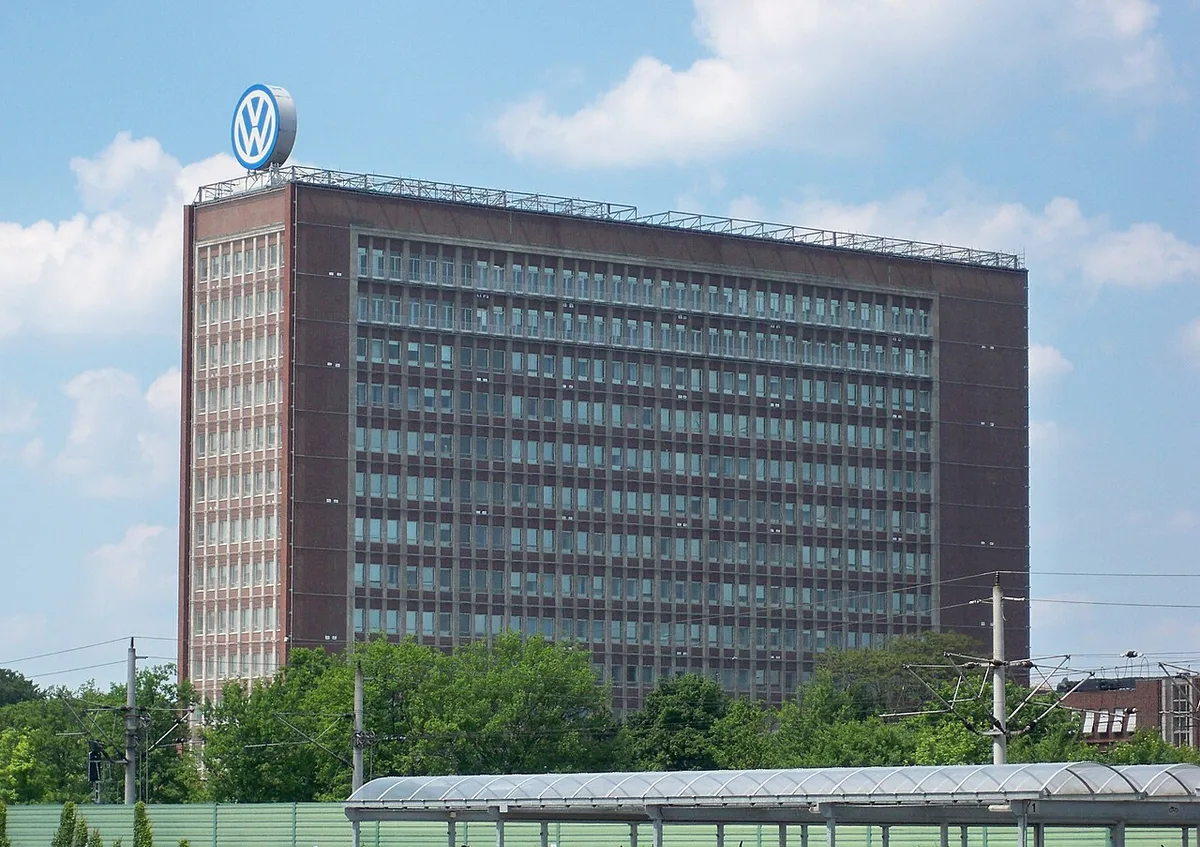
Various industrial businesses are located in Hanover. The Volkswagen Commercial Vehicles Transporter (VWN) factory at Hanover-Stöcken is the biggest employer in the region and operates a large plant at the northern edge of town adjoining the canal Mittellandkanal and the autobahn A 2. Volkswagen shares a coal-burning power plant with a factory of German tire and automobile parts manufacturer Continental AG. Continental, founded in Hanover in 1871, is one of the city's major companies. Since 2008 a take-over has been in progress: the Schaeffler Group from Herzogenaurach (Bavaria) holds the majority of Continental's stock but were required due to the financial crisis to deposit the options as securities at banks.
The audio equipment company Sennheiser and the travel group TUI AG are both based in Hanover. Hanover is home to many insurance companies including Talanx, VHV Group, and Concordia Insurance. The major global reinsurance company Hannover Re also has its headquarters east of the city centre.
Key figures
In 2012, the city generated a GDP of €29.5 billion, which is equivalent to €74,822 per employee. The gross value of production in 2012 was €26.4 billion, which is equivalent to €66,822 per employee.
Around 300,000 employees were counted in 2014. Of these, 189,000 had their primary residence in Hanover, while 164,892 commute into the city every day.
In 2014 the city was home to 34,198 businesses, of which 9,342 were registered in the German Trade Register and 24,856 counted as small businesses. Hence, more than half of the metropolitan area's businesses in the German Trade Register are located in Hanover (17,485 total).
Business development
Hannoverimpuls GMBH is a joint business development company from the city and region of Hanover. The company was founded in 2003 and supports the start-up, growth and relocation of businesses in the Hanover Region. The focus is on thirteen sectors, which stand for sustainable economic growth: Automotive, Energy Solutions, Information and Communications Technology, Life Sciences, Optical Technologies, Creative Industries and Production Engineering.
A range of programmes supports companies from the key industries in their expansion plans in Hanover or abroad. Three regional centres specifically promote international economic relations with Russia, India and Turkey.
The Institut für Integrierte Produktion Hannover is a spin-off from Leibniz University Hanover in the field of production technology that promotes transfer of scientific knowledge to business.
Education
The Leibniz University Hanover is the largest funded institution in Hanover for providing higher education to students from around the world. Below are the names of the universities and some of the important schools, including newly opened Hannover Medical Research School in 2003 for attracting the students from biology background from around the world.
There are several universities in Hanover:
Leibniz University Hannover, host institution to the Max Planck Institute for Gravitational Physics
Hochschule für Musik, Theater und Medien Hannover
Hannover Medical School
School of Veterinary Medicine Hanover (Tierärztliche Hochschule Hannover)
GISMA Business School, part of the for-profit education company Global University Systems.
There is one University of Applied Science and Arts in Hanover:
Hochschule Hannover (the former Fachhochschule)
The Schulbiologiezentrum Hannover maintains practical biology schools in four locations (Botanischer Schulgarten Burg, Freiluftschule Burg, Zooschule Hannover, and Botanischer Schulgarten Linden). The University of Veterinary Medicine Hanover also maintains its own botanical garden specializing in medicinal and poisonous plants, the Heil- und Giftpflanzengarten der Tierärztlichen Hochschule Hannover.
Hannover has several vocational schools like Berufsbildende Schulen (BBS) ME - Metalltechnik und Elektrotechnik, which specializes in metal and electrical engineering, and BBS Cora Berliner, which specializes in business administration as well as the leisure and trading industries.
In popular culture
In the "Problem Dog" episode of American crime drama Breaking Bad, viewers learn that Madrigall Electromotive GmbH, the parent company of Los Pollos Hermanos, is located in Hanover.
Notable people
Hannah Arendt (1906–1975), American political theorist
Erdoğan Atalay (born 1966), actor
Rudolf Augstein (1923–2002), journalist, founder of the weekly journal Der Spiegel
Moritz Baier-Lentz (born 1986), German-American venture capitalist
Hermann Bahlsen (1859–1919), businessman, founder of the biscuit company Bahlsen and inventor of the Leibniz-Keks
Marc Bator (born 1972), journalist
Rudolf von Bennigsen (1824–1902), liberal politician
Klaus Bernbacher (born 1931), conductor, music event manager, broadcasting manager and academic teacher
Count Johann Hartwig Ernst von Bernstorff (1712–1772) a German-Danish statesman
Andreas Peter Bernstorff (1735–1797), Danish diplomat and Foreign Minister
Gero von Boehm (born 1954), director, journalist and television presenter
Emil Berliner (1851–1929), inventor of the phonograph
Anke Blume (born 1969), engineering technology professor, works on silica and silane chemistry.
Herbert Bötticher (1928-2008), actor
Walter Bruch (1908–1990), inventor of the PAL color television system
Sport
Husseyn Chakroun (born 2004), footballer
Johannes Dietwald (born 1985), footballer
Hilal El-Helwe (born 1994), German-Lebanese football player
Niclas Füllkrug (born 1993), footballer
Stina Johannes (born 2000), footballer, goalkeeper for the Germany women's national football team
Niklas Mackschin (born 1994), racing driver
Jan Martín (born 1984), German-Israeli-Spanish basketball player
Arnd Meier (born 1973), racing driver
Per Mertesacker (born 1984), footballer
Jennifer Plass (born 1985), field hockey player
Daniel Reiss (born 1982), ice hockey player
Andreas Toba (born 1990), artistic gymnast
Günter Twiesselmann (1925–2025), rower
Dirk Werner (born 1981), racing driver
Twin towns – sister cities
Hanover is twinned with:
Hanover also cooperates with:
Mykolaiv, Ukraine (2022)