



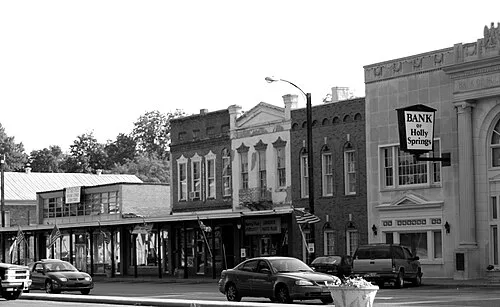
Holly Springs is a city in and the county seat of Marshall County, Mississippi, United States, near the border with Tennessee to the north. As of the 2020 census, the population was 6,968, down from 7,699 in 2010. Along with the Mississippi Delta, in the 19th century, the area was developed for cotton plantations. After the Civil War, many freedmen continued to work in agriculture as sharecroppers and tenant farmers.
As the county seat, Holly Springs is a center of trade and court sessions. The city has several National Register of Historic Places-listed properties and historic districts, including the Southwest Holly Springs Historic District, Holly Springs Courthouse Square Historic District, Depot-Compress Historic District, and East Holly Springs Historic District. Hillcrest Cemetery contains the graves of five Confederate generals and has been called "Little Arlington of the South".
Contents
History
European Americans founded Holly Springs in 1836 on territory occupied by the Chickasaw people for centuries before Indian Removal. Most of their land was ceded under the Treaty of Pontotoc Creek of 1832. Many early U.S. migrants were from Virginia, supplemented by migrants from Georgia and the Carolinas.
In 1836, the city had 4,000 European-American residents. A year later, records show that 40 residents were lawyers, and there were six physicians by 1838. By 1837, the town already had "twenty dry goods stores, two drugstores, three banks, several hotels, and over ten saloons." Hillcrest Cemetery was built on land settler William S. Randolph gave the city in 1837.
Newcomers established the Chalmers Institute, later known as the University of Holly Springs, Mississippi's oldest university.
The area was developed with extensive cotton plantations dependent on the labor of enslaved African Americans. Many had been transported from the Upper South in the domestic slave trade, breaking up families. Holly Springs served as a trading center for the neighboring cotton plantations. In 1837, it was made seat of the newly created Marshall County, named for John Marshall, the Supreme Court justice. The town developed a variety of merchants and businesses to support the plantations. Its population into the early twentieth century included a community of Jewish merchants, whose ancestors were immigrants from eastern Europe in the 19th century. The cotton industry suffered in the crisis of 1840, but soon recovered.
By 1855 Holly Springs was connected to Grand Junction, Tennessee, by the Mississippi Central Railway. In ensuing years, the line was completed to the south of Hill Springs. Toward the end of the 19th century, the Kansas City, Memphis and Birmingham Railroad was constructed to intersect this line in Holly Springs.
During the Civil War, Union general Ulysses S. Grant temporarily used Holly Springs as a supply depot and headquarters while mounting an effort to take the city of Vicksburg. Confederate general Earl Van Dorn led the successful Holly Springs Raid on the town in December 1862, destroying most of the Union supplies at the Confederate Armory Site. The campus of the Holly Springs Female Institute, which had been open since 1836, was also burned, forcing it to permanently close. Grant eventually succeeded in ending the siege of Vicksburg with a Union victory.
Geography
Holly Springs is located slightly east of the geographic center of Marshall County. Interstate 22 runs along the southwest border of the city, with access from exits 26 and 30. I-22 leads northwest toward Memphis, Tennessee, 46 miles (74 km) distant, and southeast 60 miles (97 km) to Tupelo. State highways 4 and 7 pass through the center of Holly Springs on South Craft Street and North Memphis Street. Highway 4 leads east 18 miles (29 km) to Ashland and southwest 34 miles (55 km) to Senatobia, while Highway 7 leads south 30 miles (48 km) to Oxford and northeast toward Bolivar, Tennessee, 45 miles (72 km) distant.
According to the U.S. Census Bureau, Holly Springs has an area of 12.8 square miles (33 km2), of which 0.02 square miles (0.05 km2), or 0.15%, are water. The city sits on high ground that drains to the north and the west toward tributaries of the Coldwater River, and to the southeast toward Big Spring Creek, a tributary of the Little Tallahatchie River.
Climate
Holly Spring's climate is characterized by hot, humid summers and generally mild to cool winters. According to the Köppen Climate Classification system, Holly Springs has a humid subtropical climate. On December 23, 2015, a massive EF4 tornado struck the town around 6:00 pm, causing significant damage. James Richard Anderson, the Marshall County coroner, confirmed the boy's death. Nearly 200 Marshall County structures were damaged during the tornado, some totally.
Demographics
2020 census
As of the 2020 census, Holly Springs had a population of 6,968. The median age was 37.2 years. 18.0% of residents were under the age of 18 and 15.1% of residents were 65 years of age or older. For every 100 females there were 105.5 males, and for every 100 females age 18 and over there were 108.5 males age 18 and over.
79.8% of residents lived in urban areas, while 20.2% lived in rural areas.
There were 2,202 households and 1,259 families in Holly Springs, of which 29.7% had children under the age of 18 living in them. Of all households, 24.4% were married-couple households, 18.2% were households with a male householder and no spouse or partner present, and 51.8% were households with a female householder and no spouse or partner present. About 34.3% of all households were made up of individuals and 14.9% had someone living alone who was 65 years of age or older.
There were 2,710 housing units, of which 18.7% were vacant. The homeowner vacancy rate was 1.7% and the rental vacancy rate was 26.7%.
2010 census
As of the 2010 United States census, there were 7,699 people living in the city, making it a minority-majority city: 79.2% of the residents were African American, 19.3% White, 0.2% Native American, 0.2% Asian, 0.6% from some other race, and 0.5% from two or more races. 1.2% were Hispanic or Latino of any race.
2000 census
As of the census of 2000, there were 7,957 people, 2,407 households, and 1,699 families living in the city. The population density was 626.3 inhabitants per square mile (241.8/km2). There were 2,582 housing units at an average density of 203.2 per square mile (78.5/km2). The racial makeup of the city was 22.81% White, 76.18% African American, 0.06% Native American, 0.16% Asian, 0.03% Pacific Islander, 0.06% from other races, and 0.69% from two or more races. Hispanic or Latino of any race were 0.59% of the population.
There were 2,407 households, out of which 36.4% had children under the age of 18 living with them, 34.3% were married couples living together, 31.9% had a female householder with no husband present, and 29.4% were non-families. 27.2% of all households were made up of individuals, and 10.0% had someone living alone who was 65 years of age or older. The average household size was 2.66 and the average family size was 3.22.
In the city, the population was spread out, with 25.1% under the age of 18, 19.1% from 18 to 24, 27.6% from 25 to 44, 17.2% from 45 to 64, and 11.1% who were 65 years of age or older. The median age was 29 years. For every 100 females, there were 101.7 males. For every 100 females age 18 and over, there were 101.6 males.
The median income for a household in the city was $23,408, and the median income for a family was $25,808. Males had a median income of $29,159 versus $20,777 for females. The per capita income for the city was $12,924. About 27.5% of families and 32.0% of the population were below the poverty line, including 44.6% of those under age 18 and 21.2% of those age 65 or over.
Education
The city is served by the Holly Springs School District. Marshall Academy is a private institution for the MPSA, offering K-4 through 12th grade.
Rust College was established in 1866 by the Freedman's Aid Society of the Methodist Episcopal Church to serve freedmen and is a historically black college.
The now defunct Mississippi Industrial College, intended as a vocational training school, was in Holly Springs, as was the Holly Springs Female Institute.