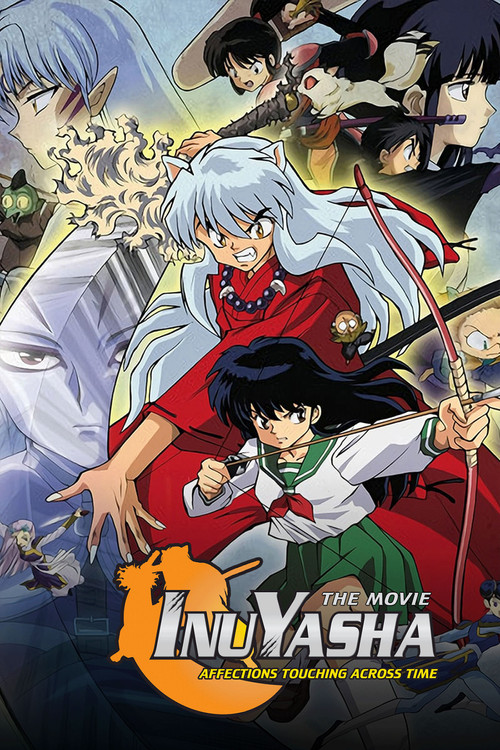
Inuyasha the Movie: Affections Touching Across Time is a 2001 Japanese animated fantasy adventure film based on the Inuyasha manga series written and illustrated by Rumiko Takahashi. The film is directed by Toshiya Shinohara, written by Katsuyuki Sumisawa, and produced by Sunrise. It was released in Japan on December 22, 2001.
The film follows Inuyasha and his friends, confronting a demonic moth warrior named Menomaru, who was resurrected by one of the shards of the Shikon Jewel.
Affections Touching Across Time is the first film of the Inuyasha series, which is followed up by The Castle Beyond the Looking Glass.
Contents
Plot
Half-demon Inuyasha's late demon father Toga defeated a powerful Chinese moth yōkai, Hyōga, two centuries ago, but a Shikon Jewel fragment has freed his son, Menōmaru, who seeks to avenge his father's death and free the tremendously infinite power and strength of his father sealed away with him.
In the present of Feudal-era Japan, Inuyasha and his friends, Kagome, monk Miroku, demon slayer Sango and fox demon Shippo, defeat a scorpion demon. Miroku and Sango split up from the group after Sango's faithful nekomata companion Kirara mysteriously runs off, leading them to Menōmaru's cave. Menōmaru and his female minions, Ruri and Hari, face off against Miroku and Sango. Ruri copies Miroku's Wind Tunnel, and Hari curses Kirara to follow Hari as her leader. Menōmaru mind-controls Kagome to turn against Inuyasha.
After the heroes are pushed away by a blast from Menōmaru and split up, Menōmaru succeeds in accessing the demonic power of his predecessors, sealed away by Inuyasha's father. He becomes a new, more powerful Hyōga, and begins to change the essence of time and space by absorbing the souls of countless people to fully merge himself with his family's demonic energy.
Menōmaru's mind-control curse on Kagome possesses her, and she is forced to pursue and kill Inuyasha, who recognizes her wearing the same style of clothing as Kikyo, his former lover. After realizing what Menōmaru did to her and choosing to face the controlled Kagome at the Sacred Tree, she shoots him with a sacred arrow. Kagome regains control of herself in anguish over Inuyasha, during which Kikyo appears and forces Kagome to return to her own time.
Back in the present, Kagome finds her family shrine and the rest of Tokyo covered in snow caused by Menōmaru's curse. She goes to the tree that Inuyasha was sealed to, realizing that without a way back to Feudal Japan, that she can never see him again. She places her hand on the tree and discovers that she and Inuyasha are emotionally connected to each other through the tree and can talk to each other through thoughts. After Inuyasha pleads with her to return to the Feudal era, Kagome retrieves a piece of Kikyo's sacred arrow from the tree and shoots it into the well. She returns to the Feudal era to find Inuyasha reawakened, thanks to Shippo, Myoga and Kaede.
Deciding to face off Menōmaru and his minions alone, Miroku defeats Ruri in a duel with their wind tunnels, and Sango brings Kirara back to her senses, allowing them to defeat Hari. They join Inuyasha, Kagome and Shippo in a last stand against Menōmaru. Inuyasha combines the Backlash Wave with Kagome's sacred arrow to kill Hyōga.
Production
The film was directed by Toshiya Shinohara, with a screenplay by Katsuyuki Sumisawa and music composed by Kaoru Wada, both of whom also worked on the Inuyasha television series. Hideyuki Motohashi and Yoshihito Hishinuma were credited as character designers, with Motohashi also serving as chief animation director. Hishinuma was also the character designer of the television series.
The film's theme song, "No More Words", was performed by Ayumi Hamasaki.
Release
Affections Touching Across Time was released theatrically in Japan by Toho on December 15, 2001. The film debuted at number 11 at the Japanese box office. Eiga.com, reporting nationwide admissions figures supplied by Kōgyō Tsūshinsha, noted that the opening was below expectations, as the film had been regarded as a potential sleeper hit for the New Year release period.
The film ultimately grossed ¥1.54 billion in Japan.
The film was released on home video in Japan in August 2002 by Shogakukan, with distribution by Toho. The DVD included 42 minutes of bonus material, including a television special, trailers, production artwork and a bonus audio drama CD.
In North America, Viz Media released the film on DVD in 2004. Viz subsequently partnered with Borders Group to promote the film alongside the first-season Inuyasha DVD set and related manga releases at Borders and Waldenbooks stores. On 26 March 2013, Viz Media released all four Inuyasha films together on Blu-ray in North America as Inuyasha the Movie: The Complete Collection.
Reception
Reviewing the four-film collection for DVD Talk, Todd Douglass Jr. praised Affections Touching Across Time for its fast pace and balance between its principal characters and story elements. Although he did not consider it among the strongest anime films generally, he regarded it as one of the better entries among the four Inuyasha films.