1930–1935: Warner Bros.
Playing opposite Cagney in Maggie the Magnificent was Joan Blondell, who starred again with him a few months later in Marie Baumer's new play, Penny Arcade. While the critics panned Penny Arcade, they praised Cagney and Blondell. Al Jolson, sensing film potential, bought the rights for $20,000. He then sold the play to Warner Bros., with the stipulation that they cast Cagney and Blondell in the film version. Retitled Sinners' Holiday, the film was released in 1930, starring Grant Withers and Evalyn Knapp. Joan Blondell recalled that when they were casting the film, studio head Jack Warner believed that she and Cagney had no future, and that Withers and Knapp were destined for stardom. Cagney was given a $500-a-week, three-week contract with Warner Bros.
In the film, he portrayed Harry Delano, a tough guy who becomes a killer but generates sympathy because of his unfortunate upbringing. This role of the sympathetic "bad" guy was to become a recurring character type for Cagney throughout his career. During filming of Sinners' Holiday, he also demonstrated the stubbornness that characterized his attitude toward the work. He later recalled an argument he had with director John Adolfi about a line: "There was a line in the show where I was supposed to be crying on my mother's breast... [The line] was 'I'm your baby, ain't I?' I refused to say it. Adolfi said 'I'm going to tell Zanuck.' I said 'I don't give a shit what you tell him, I'm not going to say that line.'" They took the line out.
Despite this outburst, the studio liked him, and before his three-week contract was up—while the film was still shooting—they gave Cagney a three-week extension, which was followed by a full seven-year contract at $400 a week. However, the contract allowed Warners to drop him at the end of any 40-week period, effectively guaranteeing him only 40 weeks' income at a time. As he did when he was growing up, Cagney shared his income with his family. Cagney received good reviews, and immediately played another colorful gangster supporting role in The Doorway to Hell (1930) starring Lew Ayres. The film was a financial hit, and helped to cement Cagney's growing reputation. He made four more movies before his breakthrough role.
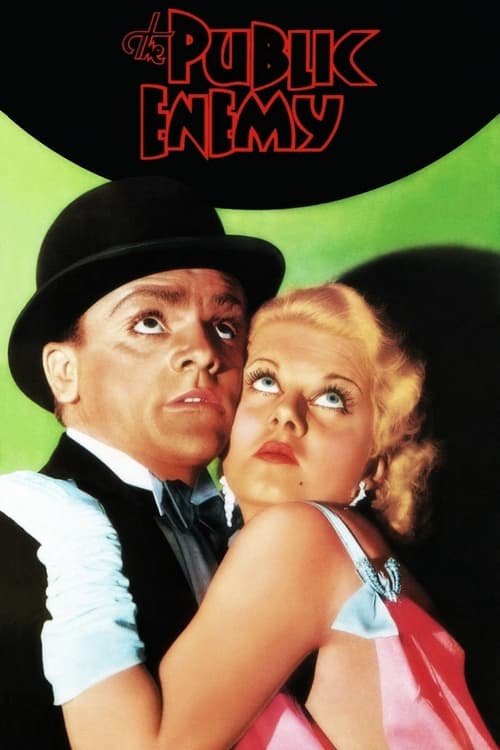
Warner Brothers' succession of gangster movie hits, in particular Little Caesar with Edward G. Robinson, culminated in the 1931 film The Public Enemy. Due to the strong reviews he had received in his short film career, Cagney was cast as nice-guy Matt Doyle, opposite Edward Woods as Tom Powers. However, after the initial rushes, the actors switched roles. Years later, Joan Blondell recalled that a few days into the filming, director William Wellman turned to Cagney and said "Now you're the lead, kid!" "Jimmy's charisma was so outstanding", she added. The film cost only $151,000 to make, but it became one of the first low-budget films to gross $1 million.
Cagney received widespread praise for his performance. The New York Herald Tribune described his interpretation as "...the most ruthless, unsentimental appraisal of the meanness of a petty killer the cinema has yet devised." He received top billing after the film, but while he acknowledged the importance of the role to his career, he always disputed the suggestion that it changed the way heroes and leading men were portrayed. He cited Clark Gable's slapping of Barbara Stanwyck six months earlier (in Night Nurse) as more important. Night Nurse was actually released three months after The Public Enemy. Gable's character punched Stanwyck's, knocking the nurse unconscious.
Many critics view the scene in which Cagney pushes half a grapefruit into Mae Clarke's face as one of the most famous moments in movie history. The scene itself was a late addition, and the origin of the idea is a matter of debate: producer Darryl Zanuck claimed he thought of it in a script conference, Wellman said the idea came to him when he saw the grapefruit on the table during the shoot, and writers Glasmon and Bright claimed it was based on the real life of gangster Hymie Weiss, who threw an omelet into his girlfriend's face. Joan Blondell recalled that the change was made when Cagney decided the omelet wouldn't work. Cagney himself usually cited the writers' version, but the fruit's victim, Clarke, agreed that it was Wellman's idea, saying, "I'm sorry I ever agreed to do the grapefruit bit. I never dreamed it would be shown in the movie. Director Bill Wellman thought of the idea suddenly. It wasn't even written into the script." However, according to Turner Classic Movies (TCM), the grapefruit scene was a practical joke that Cagney and costar Mae Clarke decided to play on the crew while the cameras were rolling. Wellman liked it so much that he left it in. TCM also notes that the scene made Clarke's ex-husband, Lew Brice, very happy. "He saw the film repeatedly just to see that scene, and was often shushed by angry patrons when his delighted laughter got too loud."
Cagney's stubbornness became well known behind the scenes, especially after he refused to join in a 100% participation-free charity drive pushed by Douglas Fairbanks Jr. Cagney did not object to donating money to charity, but he did object to being forced to give. Already he had acquired the nickname "The Professional Againster".
Warner Bros. was quick to team its two rising gangster stars, Edward G. Robinson and Cagney, for the 1931 film Smart Money. Eager to follow the success of Robinson's Little Caesar, the studio filmed Smart Money concurrently with The Public Enemy.
With the introduction of the Motion Picture Production Code of 1930 that placed limits upon on-screen violence, Warner Bros. allowed Cagney a change of pace, casting him in the comedy Blonde Crazy, again opposite Blondell.
The Public Enemy was an enormous box-office success, and Cagney began to compare his pay with that of his peers, believing that his contract allowed for salary adjustments based on the success of his films. However, Warner Bros. refused to allow him a pay raise. The studio heads also insisted that Cagney continue promoting their films, even those in which he did not appear, despite his opposition. Cagney returned to New York, leaving his brother Bill to look after his apartment.
While Cagney was in New York, his brother, who had effectively become his agent, sought a substantial pay raise and more personal freedom for him. Following the success of The Public Enemy and Blonde Crazy, Warner Bros. offered Cagney a contract for $1,000 per week. Cagney's first film upon returning from New York was Taxi! (1932), a critical success in which Cagney danced for the first time on screen. It also marked the last time that he permitted live ammunition to be shot at him, a relatively common occurrence at the time, as blank cartridges and squibs were rare and expensive. During filming for Taxi!, he was almost hit by gunfire. In the film's opening scene, Cagney speaks fluent Yiddish, a language that he had learned during childhood in New York City.
Blonde Crazy and Taxi! contain lines that became the basis of many misquoted celebrity impersonations of Cagney. He never said "Mmm, you dirty rat!" on film; in Blonde Crazy, he says: "That dirty, double-crossin' rat!" and in Taxi!, he says: "Come out and take it, you dirty, yellow-bellied rat, or I'll give it to you through the door!" The quote from Blonde Crazy was nominated for the American Film Institute's 2005 AFI's 100 Years...100 Movie Quotes list.
The film was swiftly followed by The Crowd Roars and Winner Take All.
Despite his success, Cagney remained dissatisfied with his contract. He wanted more money for his successful films, but he also offered to take a smaller salary should his star wane. Warner Bros. refused, so Cagney once again walked out. He held out for $4000 a week, the same salary as Edward G. Robinson, Douglas Fairbanks Jr., and Kay Francis. Warner Bros. refused to cave in this time, and suspended him. Cagney announced that he would do his next three pictures for free if they canceled the five years remaining on his contract. He also threatened to quit Hollywood and go back to Columbia University to follow his brothers into medicine. After six months of suspension, Frank Capra brokered a deal that increased Cagney's salary to around $3000 a week, and guaranteed top billing and no more than four films a year.
Having learned about the block-booking studio system that virtually guaranteed the studios huge profits, Cagney was determined to spread the wealth. He regularly sent money and goods to old friends from his neighborhood, though he did not generally make this known. His insistence on no more than four films a year was based on his having witnessed actors—even teenagers—regularly being worked 100 hours a week to turn out more films. This experience was an integral reason for his involvement in forming the Screen Actors Guild in 1933.
Cagney returned to the studio and made Hard to Handle (1933). This was followed by a steady stream of crowd-pleasing films, including the highly regarded Footlight Parade, which gave Cagney the chance to return to his song-and-dance roots. The film includes show-stopping scenes with Busby Berkeley-choreographed routines. In 1934, Here Comes the Navy paired him with Pat O'Brien for the first of nine films together. The two would have an enduring friendship. Also in 1934, Cagney made his first of two raucous comedies with Bette Davis, Jimmy the Gent, for which he had himself heavily made up with thick eyebrows and procured an odd haircut for the period without the studio's permission, shaved on the back and sides. Cagney initially had the make-up department put prominent scars on the back of his head for a close-up but the studio demanded that he remove them. Cagney's and Davis's fast-paced scenes together were particularly energetic.
In 1935 Cagney was listed as one of the Top Ten Moneymakers in Hollywood for the first time, and was cast more frequently in non-gangster roles; he played a lawyer who joins the FBI in G-Men, and he also took on his first, and only, Shakespearean role, as top-billed Nick Bottom in A Midsummer Night's Dream alongside Joe E. Brown as Francis Flute and Mickey Rooney as Puck.
Cagney's last movie in 1935 was Ceiling Zero, his third film with Pat O'Brien. O'Brien received top billing, which was a clear breach of Cagney's contract. This, combined with the fact that Cagney had made five movies in 1934, again against his contract terms, caused him to bring legal proceedings against Warner Bros. for breach of contract. The dispute dragged on for several months. Cagney received calls from David Selznick and Sam Goldwyn, but neither felt in a position to offer him work while the dispute went on. Meanwhile, while being represented by his brother William in court, Cagney went back to New York to search for a country property where he could indulge his passion for farming.