Overview
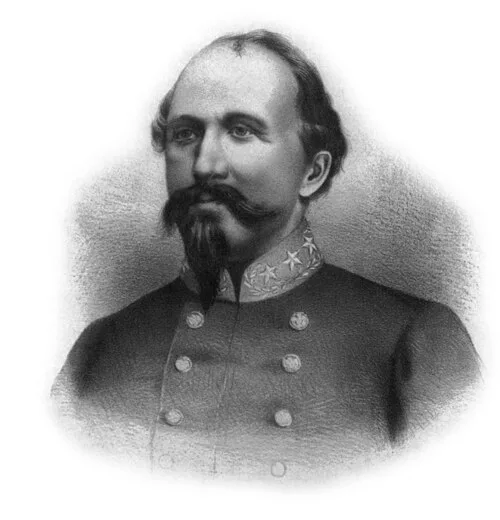
John Hunt Morgan (June 1, 1825 – September 4, 1864) was a Confederate general in the American Civil War. In April 1862, he raised the 2nd Kentucky Cavalry Regiment, fought at Shiloh, and then launched a costly raid in Kentucky, which encouraged Braxton Bragg's invasion of that state. He also attacked the supply-lines of General William Rosecrans. In July 1863, he set out on a 1,000-mile raid into Indiana and Ohio, taking hundreds of prisoners. But after most of his men had been intercepted by Union gunboats, Morgan surrendered at Salineville, Ohio, the northernmost point ever reached by uniformed Confederates. The legendary "Morgan's Raid", which had been carried out against orders, gained no tactical advantage for the Confederacy, while the loss of his regiment proved a serious setback. Morgan escaped from Union prison but his credibility was low, and he was restricted to minor operations. He was killed at Greeneville, Tennessee, in September 1864. Morgan was the brother-in-law of Confederate general A. P. Hill. Various schools and a memorial are dedicated to him.
Early life and career
John H. Morgan was born in Huntsville, Alabama, the eldest of ten children of Calvin and Henrietta (Hunt) Morgan. He was an uncle of geneticist Thomas Hunt Morgan and a maternal grandson of John Wesley Hunt, an early founder of Lexington, Kentucky, and one of the first millionaires west of the Allegheny Mountains. He was also the brother-in-law of A. P. Hill and of Basil W. Duke. Morgan never used his middle name of Hunt during the war — it is a post war appellation.
John Wesley Hunt, Morgan's grandfather, was a leading landowner and businessman in Kentucky and was the first millionaire west of the Allegheny Mountains. "His business empire included interest in banking, horse breeding, agriculture and hemp manufacturing. Among his business associates were Henry Clay and John Jacob Astor." He was a slave owner and an investor in the Lexington slave-trading business of Lewis C. Robards.
Morgan's paternal grandparents were Luther and Anna (Cameron) Morgan. Luther Morgan had settled in Huntsville, but a downturn in the cotton economy forced him to mortgage his holdings. His father, Calvin Morgan, lost his Huntsville home in 1831 when he was unable to pay the property taxes following the failure of his pharmacy. The family then moved to Lexington, where he would manage one of his father-in-law's sprawling farms.
From Wikipedia (CC BY-SA 4.0).