
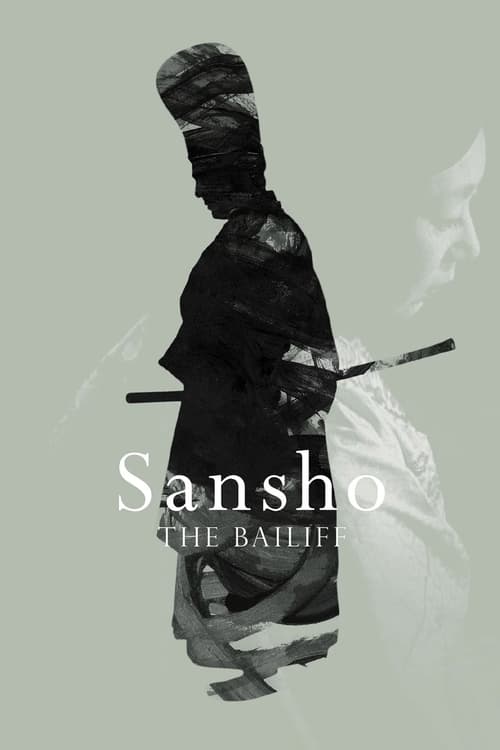
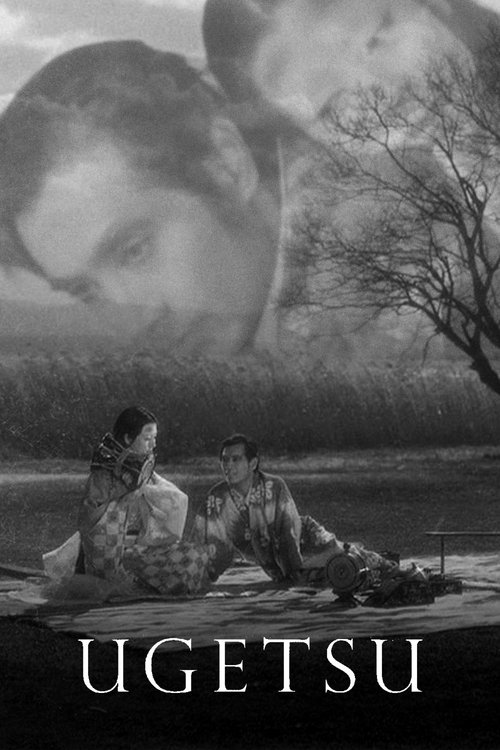
Kenji Mizoguchi (溝口 健二, Mizoguchi Kenji; 16 May 1898 – 24 August 1956) was a Japanese filmmaker who directed roughly one hundred films during his career between 1923 and 1956. His most acclaimed works include The Story of the Last Chrysanthemums (1939), The Life of Oharu (1952), Ugetsu (1953), and Sansho the Bailiff (1954), with the latter three all being awarded at the Venice International Film Festival. A recurring theme of his films was the oppression of women in historical and contemporary Japan. Together with Akira Kurosawa and Yasujirō Ozu, Mizoguchi is seen as a representative of the "golden age" of Japanese cinema.
Contents
Biography
Early life (1898–1920)
Mizoguchi was born in Hongō, Tokyo, as the second of three children, to Zentaro Miguchi, a roofing carpenter, and his wife Masa. The family's background was relatively humble until the father's failed business venture of selling raincoats to the Japanese troops during the Russo-Japanese War. The family was forced to move to the downtown district of Asakusa and gave Mizoguchi's older sister Suzu up for adoption, which in effect meant selling her into the geisha profession.
In 1911, Mizoguchi's parents, too poor to continue paying for their son's primary school training, sent him to stay with an uncle in Morioka in northern Japan for a year, where he finished primary school. His return coincided with an onset of crippling rheumatoid arthritis, which left him with a limp for the rest of his life. In 1913, his sister Suzu secured him an apprenticeship as a designer for a yukata manufacturer, and in 1915, after the mother's death, she brought both her younger brothers into her own house. Mizoguchi enrolled for a course at the Aoibashi Yoga Kenkyuko art school in Tokyo, which taught Western painting techniques, and developed an interest in opera, particularly at the Royal Theatre at Akasaka where he helped the set decorators with set design and construction.
In 1917, his sister again helped him to find work, this time as an advertisement designer with the Yuishin Nippon newspaper in Kobe. The film critic Tadao Sato has pointed out a coincidence between Mizoguchi's life in his early years and the plots of shinpa dramas, which characteristically documented the sacrifices made by geisha on behalf of the young men they were involved with. Probably because of his familial circumstances, "the subject of women's suffering is fundamental in all his work; while sacrifice – in particular, the sacrifice a sister makes for a brother – makes a key showing in a number of his films, including some of the greatest ones (Sansho the Bailiff/Sansho Dayu [1954], for example)." After less than a year in Kobe, however, Mizoguchi returned "to the bohemian delights of Tokyo" (Mark Le Fanu).
Film career (1920–1945)
In 1920, Mizoguchi spoke with his friend Tadashi Tomioka, an actor at the Nikkatsu film studio in Mukojima, Tokyo, who suggested that Mizoguchi try to become an actor. After speaking with one of Nikkatsu's directors, Osamu Wakayama, Mizoguchi found that Nikkatsu was not in need of actors, but that there was an opening for an assistant director. Mizoguchi accepted the offer, and made his start within the film industry. As an assistant director, Mizoguchi worked under the likes of Tadashi Oguchi and Eizō Tanaka. After a little over a year at Nikkatsu, Mizoguchi wanted to quit the film industry, but was persuaded to remain by his sister Suzu.
In 1922, Mizoguchi was promoted to director, and his directorial debut was released the following year, The Resurrection of Love. His early works included remakes of German Expressionist cinema and adaptations of Eugene O'Neill and Leo Tolstoy. In 1923, the Nikkatsu studios in Mukojima was destroyed in the Great Kantō Earthquake, so Mizoguchi moved to Nikkatsu's studios in Kyoto. While working in Kyoto, he studied kabuki and noh theatre, and traditional Japanese dance and music. He was also a frequent visitor of the tea houses, dance halls and brothels in Kyoto and Osaka, which at one time resulted in a widely covered incident of him being attacked by a jealous prostitute and then-lover with a razor. His 1926 Passion of a Woman Teacher (Kyōren no onna shishō) was one of a handful of Japanese films shown in France and Germany at the time and received considerate praise, but is nowadays lost like most of his 1920s and early 1930s films. By the end of the decade, Mizoguchi directed a series of left-leaning "tendency films", including Tokyo March and Metropolitan Symphony (Tokai kokyōkyoku).
In 1927, Mizoguchi met and quickly fell in love with Chieko Saga, a dancer from Osaka. Chieko was married to a yakuza at the time, and her husband confronted Mizoguchi. With the help of Masakazu Nagata, a member of Nikkatsu's general affairs division, Mizoguchi convinced Chieko's husband that Mizoguchi and Chieko had not committed adultery but were in love. Mizoguchi and Chieko married in the summer of 1927. Their love for each other was strong, but their marriage was tumultuous. Mizoguchi and Chieko were both adulterous and frequently fought, with some of the fights getting violent. Chieko helped Mizoguchi with his work, often offering comments about his films during production.
In 1932, Mizoguchi left Nikkatsu and worked for a variety of studios and production companies. The Water Magician (1933) and Orizuru Osen (1935) were melodramas based on stories by Kyōka Izumi, depicting women who sacrifice themselves to secure a poor young man's education. Both have been cited as early examples of his recurring theme of female concerns and "one-scene-one-shot" camera technique, which would become his trademark. The 1936 diptych of Osaka Elegy and Sisters of the Gion, about modern young women (moga) rebelling against their surroundings, is considered to be his early masterpiece. Mizoguchi himself named these two films as the works with which he achieved artistic maturity. Osaka Elegy was also his first full sound film, and marked the beginning of his long collaboration with screenwriter Yoshikata Yoda.
Filmography
Silent films
All of Mizoguchi's silent films are lost, except where stated.
Legacy
In 1975, Kaneto Shindō, a set designer, chief assistant director and scenarist for Mizoguchi in the late 1930s and 1940s, released a documentary about his former mentor, Kenji Mizoguchi: The Life of a Film Director, as well as publishing a book on him in 1976. Already with his autobiographical debut film Story of a Beloved Wife (1951), Shindō had paid reference to Mizoguchi in the shape of the character "Sakaguchi", a director who nurtures a young aspiring screenwriter.
Mizoguchi's films have regularly appeared in "best film" polls, such as Sight & Sound's "The 100 Greatest Films of All Time" (Ugetsu and Sansho the Bailiff) and Kinema Junpo's "Kinema Junpo Critics' Top 200" (The Life of Oharu, Ugetsu and The Crucified Lovers). A retrospective of his 30 extant films, presented by the Museum of the Moving Image and the Japan Foundation, toured several American cities in 2014. Among the directors who have admired Mizoguchi's work are Akira Kurosawa, Orson Welles, Andrei Tarkovsky, Martin Scorsese, Werner Herzog, Theo Angelopoulos and many others. Film historian David Thomson wrote, "The use of camera to convey emotional ideas or intelligent feelings is the definition of cinema derived from Mizoguchi's films. He is supreme in the realization of internal states in external views."
International appreciation
When Mizoguchi died, many film directors and film critics gave comments about Mizoguchi's skill and influence.
‘On 24 August 1956, Japan's greatest film-maker died in Kyoto. And one of the greatest filmmakers of all time. Kenji Mizoguchi was the equal of a Murnau or a Rossellini... If poetry appears at every second, in every shot that Mizoguchi makes, it is because, as with Murnau, it is the instinctive reflection of the inventive nobility of its author’. Jean-Luc Godard, Arts, 5 February 1958.
‘There is no doubt that Kenji Mizoguchi, who died three years ago, was his country's greatest filmmaker. He knew how to discipline for his own use an art born in other climes and from which his compatriots had not always made the most of. And yet there is no slavish desire on his part to copy the West. His conception of setting, acting, rhythm, composition, time and space is entirely national. But he touches us in the same way as Murnau, Ophüls or Rossellini’. Éric Rohmer, Arts, 25 September 1959.
‘Comparisons are as inevitable as they are unfashionable: Mizoguchi is the Shakespeare of cinema, its Bach or Beethoven, its Rembrandt, Titian or Picasso’, James Quandt, Mizoguchi the Master, (retrospective of Mizoguchi centenary films), Cinematheque Ontario and The Japan Foundation, 1996.