Foreign relations
Relations with China initially deteriorated under Kim due to his nuclear weapons program. On 30 November 2012, Kim met with Li Jianguo, member of the Politburo of the ruling Chinese Communist Party (CCP) and first-ranking vice chairman of the National People's Congress Standing Committee, who "briefed Kim on the 18th CCP National Congress", according to the KCNA. A letter from General Secretary of the Chinese Communist Party Xi Jinping was hand-delivered during the discussion.
China condemned North Korea's nuclear tests in 2013, 2016, and 2017 China also banned imports of North Korean coal in February 2017, while enforcing UN Security Council sanctions on North Korea put in 2017. In response, the Korean Central News Agency published an unprecedented criticism of China, accusing it of "big-power chauvinism"; KCNA later published articles criticizing Chinese state media.
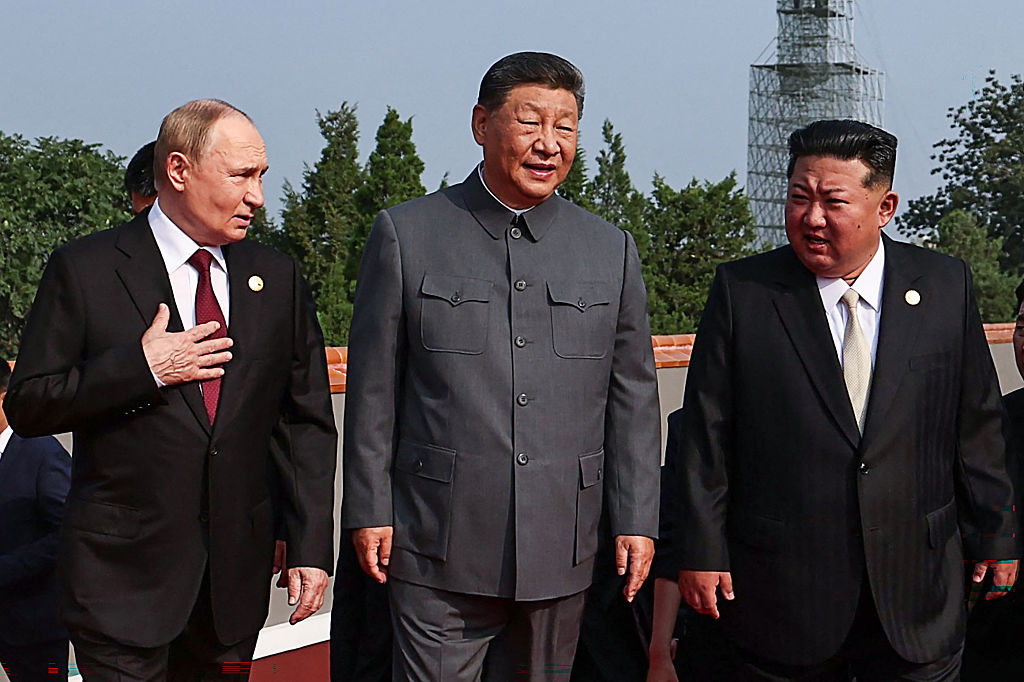
The relationship started improving in March 2018, when Kim visited Beijing, meeting with CCP General Secretary Xi Jinping, marking his first foreign trip since assuming power. From 7–8 May, Kim made a second visit to China, meeting with Xi in Dalian. A further third meeting happened on 19–20 June, when Kim travelled to Beijing to meet Xi. Kim again met Xi in Beijing on 7–10 January 2019. On 20–21 June 2019, Xi travelled to Pyongyang, the first visit by a Chinese leader to North Korea since CCP General Secretary Hu Jintao visited in 2005. On 2 September 2025, North Korean leader Kim Jong Un, accompanied by many other North Korean dignitaries, traveled to Beijing by special train to attend the 80th anniversary of the China Victory Day Parade, marking his first visit to China since 2019, as well as the first time he attended a multilateral event. In June 2026, Xi visited North Korea, marking his first visit since 2019.
In his 2018 New Year Speech, Kim announced that he was open to dialogue with South Korea with a view to take part in the upcoming Winter Olympics in the South. The Seoul–Pyongyang hotline was reopened after almost two years. North and South Korea marched together in the Olympics opening ceremony, and fielded a united women's ice hockey team. In addition to the athletes, Kim sent an unprecedented high-level delegation including his sister, Kim Yo Jong, and President of the Presidium, Kim Yong Nam, and performers such as the Samjiyon Orchestra. On 5 March, he had a meeting with South Korea's Chief of the National Security Office, Chung Eui Yong, in Pyongyang.
At the April 2018 inter-Korean summit, Kim and South Korean President Moon Jae-in signed the Panmunjom Declaration, pledging to convert the Korean Armistice Agreement into a full peace treaty, formally ending the Korean War, by the end of the year. On 26 May, Kim had a second and unannounced meeting in the North Korean side of Panmunjom, meeting with Moon to discuss his proposed summit with US President Donald Trump in Singapore.
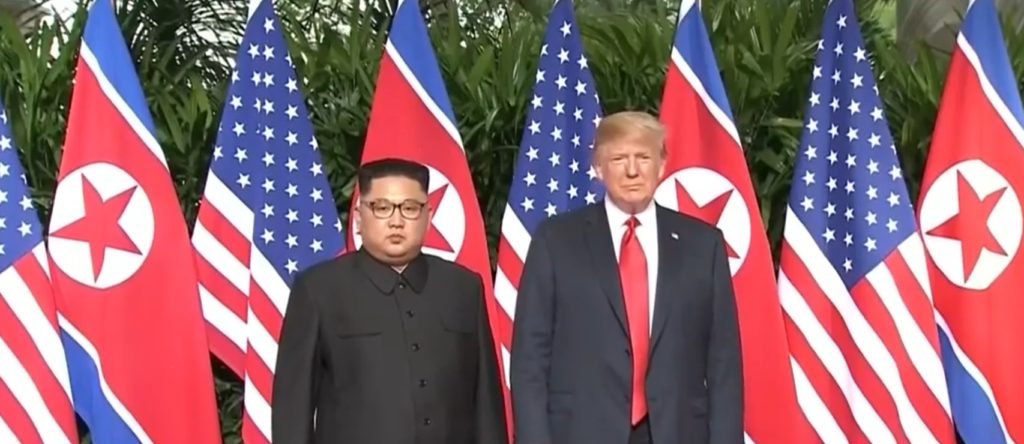
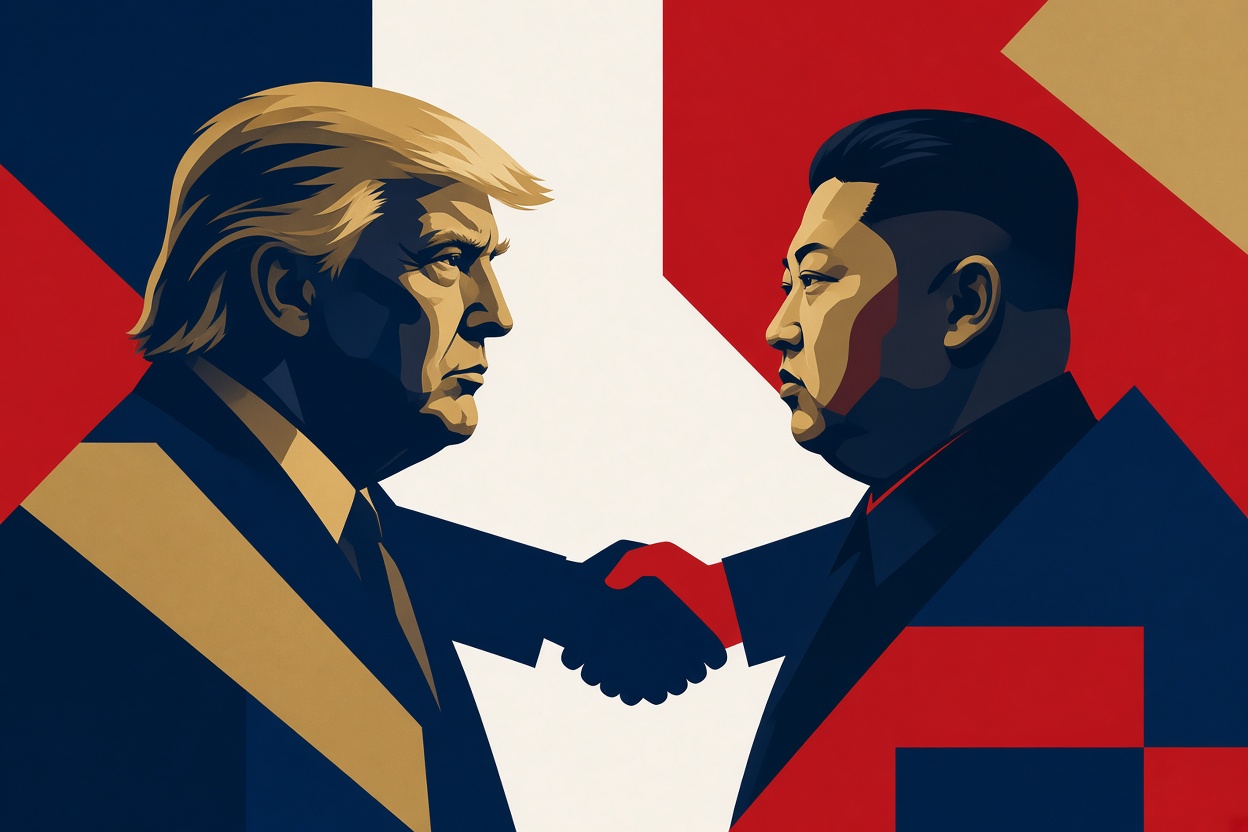
On 10 June, Kim arrived in Singapore and met with Prime Minister Lee Hsien Loong. On 12 June, Kim held his first summit with Trump and signed a declaration, affirming a commitment to peace, nuclear disarmament, and the repatriation of the remains of U.S. war dead. This marked the first-ever meeting between leaders of North Korea and the United States.
In September, Kim held another summit with Moon Jae-in in Pyongyang. Kim agreed to dismantle North Korea's nuclear weapons facilities if the United States took reciprocal action. The two governments also announced that they would establish buffer zones on their borders to prevent clashes.
In February 2019, Kim held another summit with Trump in Hanoi, Vietnam, which Trump cut short on the second day without an agreement. The Trump administration said that the North Koreans wanted complete sanctions relief, while the North Koreans said that they were only asking for partial sanctions relief. On 30 June 2019, in the Korean DMZ, Kim again met with Trump, shaking hands warmly and expressing hope for peace. Kim and Trump then joined Moon Jae-in for a brief chat. Talks in Stockholm began on 5 October 2019 between US and North Korean negotiating teams but broke down after one day. During this period, Trump and Kim established a personal relationship and exchanged at least 27 letters in which the two men described a warm personal friendship.
By 2020, however, negotiations almost completely stalled without progress on denuclearization, with both Trump and Kim focusing on domestic issues. North Korean foreign ministry further criticized the Trump administration that year for "empty promise[s]", and further took action by demolishing the four-story joint-liaison office building it shared with South Korea on 17 June. North Korea further ignored attempts at outreach by the administration of president Joe Biden, and Kim said in October 2021 that the "US has been frequently sending signals that they are not hostile towards our country, but there is no single evidence that they are not hostile", and also criticized South Korea for "destroying the military balance in the Korean peninsula and increasing military instability and danger".
In December 2023, during a speech at the 9th plenum of the 8th Central Committee of the Workers' Party of Korea, Kim called for a "fundamental turnabout" in North Korea's stance towards South Korea, calling the South the "enemy". He stated "the party's comprehensive conclusion after reviewing decades-long inter-Korean relations is that reunification can never be achieved with those ROK riffraffs that defined the 'unification by absorption' and 'unification under liberal democracy' as their state policy", which he said is in "sharp contradiction with what our line of national reunification was: one nation, one state with two systems".
Kim cited South Korean constitution's claims over the entire Korean Peninsula and South Korean President Yoon Suk Yeol's policy towards the north as evidence that South Korea is an unsuitable partner for reunification. He said the relations between the two Koreas currently were "states hostile to each other and the relations between two belligerent states" and no longer ones that are "consanguineous or homogeneous", continuing by saying it is "unsuitable" to discuss the issue of reunification "with this strange clan [ROK], who is no more than a colonial stooge of the U.S. despite the rhetorical word [we used to use]—'the fellow countrymen." Kim also instructed the WPK on reforming organizations related to inter-Korean relations, including the WPK's United Front Department.
On 25 April 2019, Kim held his first meeting with Russian president Vladimir Putin in Vladivostok. Kim Jong Un requested Russian leader Vladimir Putin's help in resolving a nuclear stalemate with the U.S.
North Korea under Kim supported Russia's invasion of Ukraine in 2022, blaming the "hegemonic policy" of the US for the war, recognizing the independence of the breakaway states of Donetsk and Luhansk People's Republics in Eastern Ukraine as well as recognizing Russia's unilateral annexation of Donetsk, Kherson, Luhansk and Zaporizhzhia oblasts on 30 September. In September 2022, US intelligence said that Russia was buying millions of artillery shells and rockets from North Korea due to the sanctions caused by Russia's invasion of Ukraine. A February 2023 report by the Center for Strategic International Studies (CSIS) stated that after dropping to nearly zero during the COVID-19 era, trade between North Korea and Russia rebounded back to pre-pandemic levels.
In July 2023, Russian Minister of Defence Sergei Shoigu and a Chinese delegation led by CCP Politburo member Li Hongzhong arrived in North Korea for the 70th anniversary of the end of the Korean War. Shoigu met with Kim Jong Un and North Korean Defense Minister Kang Sun Nam. In September 2023, Kim Jong Un visited Russia in his first foreign trip since 2019. The meeting lasted over four hours at the Vostochny Cosmodrome in the Amur Oblast, and was described as underpinning how the two countries' interests are aligning. During the meeting, Kim once again gave his support for Russia's "sacred fight" against the west, expressing his "...support for all the measures taken by the Russian government, and [he] takes this opportunity again to affirm that [he] will always be with Russia." When asked if Russia would help North Korea build satellites, presumably in return for ammunition, Putin said "that's why [they] came here."
In November 2023, the NIS reported that North Korea had exported over one million shells to Russia since August 2023, compared to a combined 2 million shells provided by NATO members to Ukraine since the start of the Russian invasion of Ukraine. In February 2024, Kim received a car as a gift from Putin. Four months later Putin arrived in Pyongyang and held talks with Kim. It was Putin's second visit to North Korea, since 2000. Both sides signed the North Korean–Russian Treaty on Comprehensive Strategic Partnership as an agreement of close mutual defence corporation and militant friendship. By the end of 2024, Russia and North Korea had exchanged delegations on AI, cyber-operations, intelligence, science and technology, sports, agriculture, and culture.
In October 2024 North Korea sent military personnel to Russia who fought against Ukraine for Russia in Russian uniforms and under Russian command. According to the United States and its allies, by the end of 2024 North Korea had sent 11,000 troops to fight for Russia, along with munitions including at least six million heavy artillery rounds and 100 ballistic missiles. Although North Korea initially denied that it was involved in the Russo-Ukrainian war, in April 2025 Kim publicly acknowledged that North Korean troops were fighting alongside Russian forces to "annihilate and wipe out the Ukrainian neo-Nazi occupiers." According to US historian and former diplomat Jung H. Pak, in addition to payments for arms and soldiers Russia likely provided North Korea with various commodities and assisted it in accessing the global financial system to pay its workers, circumventing UN sanctions.