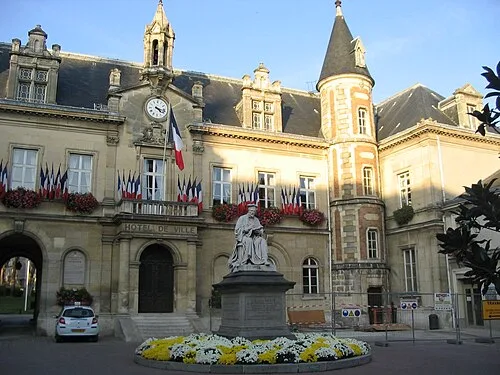
Overview
Melun is a commune in the Seine-et-Marne department in the Île-de-France region, north-central France. It is located on the southeastern outskirts of Paris, about from the centre of the capital. Melun is the prefecture of the Seine-et-Marne, and the seat of one of its arrondissements. Its inhabitants are called Melunais.
History
Meledunum began as a Gaulish town; Caesar noted Melun as "a town of the Senones, situated on an island in the Seine"; at the island there was a wooden bridge, which his men repaired. Roman Meledunum was a mutatio where fresh horses were kept available for official couriers on the Roman road south-southeast of Paris, where it forded the Seine. Around 500 A.D, Clovis I granted Melun to a Gallo-Roman magnate, Aurelianus, who had fought for Clovis several times and apparently influenced his conversion to Christianity.
The Normans sacked it in 845. The castle of Melun became a royal residence of the Capetian kings. Hugh Capet (See also: House of Capet) gave Melun to Bouchard, his favorite. In the reign of Hugh's son, Robert II of France, Eudes, the count of Champagne, bought the city, but the king took it back for Bouchard in 999. The chatelain Gautier and his wife, who had sold the city, were hanged; Eudes escaped. Robert died there in July 1031.
Robert of Melun (c. 1100 – 27 February 1167) was an English scholastic Christian theologian who taught in France, and later became Bishop of Hereford in England. He studied under Peter Abelard in Paris before teaching there and at Melun, which gave him his surname.
From Wikipedia (CC BY-SA 4.0).