
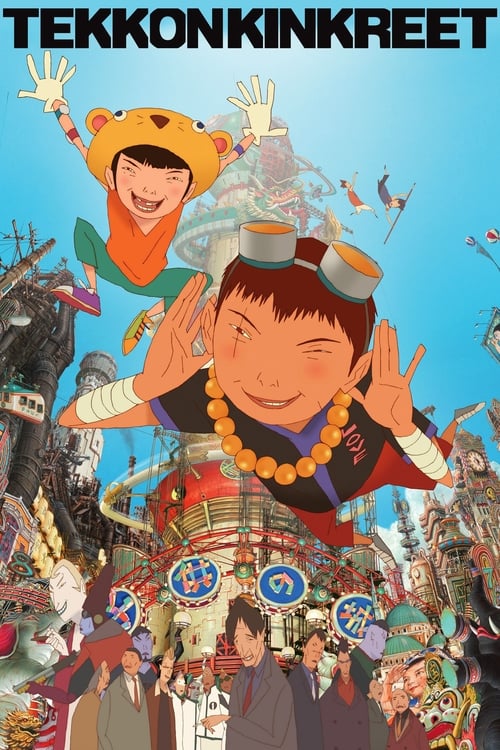
Michael Arias (born 1968) is an American visual effects artist, producer, and director. He is best known for his directorial debut, the anime feature Tekkonkinkreet, which established him as the first non-Japanese director of a major anime film.
Contents
Early life
Michael Arias was born in Los Angeles, California. His father, Ron Arias (born 1941) is a former senior writer and correspondent for People magazine and a highly regarded Chicano writer. Michael Arias' mother, Dr. Joan Arias, was a professor of Spanish and IBM Software Sales Specialist.
When still a young boy, Arias often watched movies in the theater with his parents and borrowed 16mm prints from a local public library for screening at home; it was at this stage in his life that he developed his passion for cinema.
Arias graduated from the Webb School of California at the age of 16. He then attended Wesleyan University in Connecticut, majoring in linguistics for two years, before dropping out to pursue a career as a musician. Michael's early musical associates include Moby and Margaret Fiedler McGinnis.
Soon after quitting Wesleyan, Arias moved to Los Angeles, abandoned his musical ambitions and, through the efforts of a family friend, began working in the film industry.
Career
Early filmmaking career
Michael Arias' early filmmaking career is marked by stints in both the U.S. and Japan, working in VFX, CG production and software development, and as a producer of animated films.
Michael Arias began his film career in 1987 at nascent visual effects powerhouse Dream Quest Images (DQ), first as an unpaid intern and then as a full-time employee and IATSE member. The bulk of his time at DQ was spent as a camera assistant on the motion control stages, working on such effects-heavy Hollywood films as The Abyss, Total Recall, and Fat Man and Little Boy.
At the time, the visual effects industry had only just begun adopting digital technologies, and analog techniques such as motion control and stop motion photography, miniatures, optical compositing, matte painting, and pyrotechnics still dominated. Arias, by his own account, flourished in the hands-on environment of DQ ("a big tinkertoy factory run by car nuts and mad bikers").
After two years of working at Dream Quest, Arias returned to the East Coast with the intention of finishing his studies, this time at NYU's Music Technology program. Soon after enrolling though, Arias was contacted by visual effects veteran and fellow Abyss alumnus Susan Sitnek, who invited Arias to join the crew of Universal Studios' immersive attraction Back To The Future: The Ride (BTTFTR), helmed by visual effects legend Douglas Trumbull. Once relocated to the Berkshires, where pre-production was underway, Arias was drafted by Trumbull to animate the attraction's flight-simulator-style ride vehicles. Of his time working under Trumbull, Arias recalls, "Doug was – IS – such an inspiring figure. For me and the other younger crew, including John Gaeta, now VFX Supervisor on the Matrix films, Doug was so generous with his knowledge; such a very warm and receptive and articulate and creative guy."
Arias' association with Trumbull proved fortuitous, not only for the experience of working daily with Trumbull himself, but also because it resulted in what would be Arias' first trip to Japan, with Trumbull, with whom he toured the Osaka Expo and visited post-production monolith Imagica and video game giant Sega Enterprises. That first visit, combined with Arias' friendship with key members of BTTFTR's largely Japanese modelmaking crew, set the stage for Arias' subsequent long-term stay in Japan.
Recent filmmaking career
Michael Arias' recent career has been focused primarily on directing.
In 2003, while working on The Animatrix, Arias picked up Tekkonkinkreet again. Armed with an English-language screenplay penned by screenwriter Anthony Weintraub, and encouraged by mentor Morimoto, Arias moved forward with plans to revive Tekkon at Studio 4°C, with Animatrix collaborator and 4 °C president Eiko Tanaka producing and Arias directing.
The film was completed in August 2006 and premiered at the Tokyo International Film Festival soon thereafter.
Museum of Modern Art (MoMA) curator Barbara London named Tekkonkinkreet "Best Film of 2006" in her Art Forum roundup, and subsequently arranged for the film's North American premiere to be held at MoMA.
With his adaptation of Tekkonkinkreet, Arias, with Production Designer Shinji Kimura, had re-imagined the manga's Treasure Town as a chaotic pan-Asian hybrid, part Hong Kong, part Bombay, with futuristic and industrial elements densely layered over a foundation that borrowed much from images of Shōwa-era Tokyo. New York Times critic Manohla Dargis, in her review of Tekkonkinkreet, describes Treasure Town as "a surreal explosion of skewed angles, leaning towers, hanging wires, narrow alleys and gaudily cute flourishes that bring to mind a yakuza cityscape by way of a Hello Kitty theme park." Indeed, Tekkon's sumptuous art direction was widely praised, with Production Designer Kimura receiving the Best Art Direction award at the 2008 Tokyo International Anime Fair. Tekkon was further lauded, not only for Arias' innovative use of computer graphics techniques and seamless integration of digital and traditional animation, but also for the film's handmade, documentary-style approach to storytelling. After an early Tekkon screening at the Los Angeles Asian Pacific Film Festival, filmjourney.org editor Doug Cummings elaborated:
Arias' angles and compositions are uniformally [sic] inventive and striking, and most impressively, he incorporates a bevy of live action camera techniques: handheld framing, long tracking shots through corridors, rack focusing and shifting depths of field–that generate considerable immediacy and environmental realism (despite the obvious hand-drawn artifice). More than simple technological advances, these elements have long been untapped by feature animation due to their inability to be storyboarded – they're traditional luxuries of live action spontaneity. For all the accolades bestowed upon Alfonso Cuarón's digitally-composited tracking shots in Children of Men, Arias' techniques here are arguably greater achievements.
Translator of works by Taiyō Matsumoto
Michael Arias has translated and adapted to English some of Tekkonkinkreet author Taiyō Matsumoto's manga.
Arias' English translation of Taiyō Matsumoto's quasi-autobiographical manga Sunny was included in the Young Adult Library Services Association's Great Graphic Novels list for 2014, and awarded the Best Graphic Novel prize by the Slate Book Review and the Center for Cartoon Studies.
Arias is also credited with the 2019 English translation and adaptation of Matsumoto's surreal tale of anthropomorphized stray cats Cats of the Louvre for publisher Viz's Signature collection, recipient of the Eisner Award for Best U.S. Edition of International Material – Asia.
In 2020 Viz published Arias' English translation of the full two-volume edition of Ping Pong, Matsumoto's popular high school table tennis epic.
In 2021 Viz announced a forthcoming English-language edition of No. 5, Matsumoto's surreal sci-fi saga, also translated by Arias.
In 2024 Viz began publishing Arias' English translation of Matsumoto's slice-of-life meditation on the struggle between art and commerce. The series went on to win the 2025 Eisner Award for Best U.S. Edition of International Material—Asia.
Personal life
Arias has lived in Tokyo, Japan since he was 23 and speaks and writes Japanese fluently.
In 2011 Arias documented his experiences providing relief to relatives in Miyagi Prefecture during the days immediately following the Tōhoku earthquake and tsunami.
Achievements and recognitions
At SIGGRAPH 1996 Arias presented the technical sketch "Toon Shaders for Simulating Cel Animation" detailing his work on rendering software for use in simulating the appearance of cel animation.
Arias was Guest Editor of the SIGGRAPH Computer Graphics journal, Volume 32, Number 1, published February 1999. The issue focused on non-photorealistic rendering (NPR).
On October 12, 1999, the United States Patent and Trademark Office awarded Arias U.S. Patent 5,966,134 for invention of a technique for simulating cel animation and shading.
Arias was a contributor to the Animation and Special Effects program of SIGGRAPH 2000. As a member of the panel "Digital Cel Animation in Japan", Arias presented his work on the Tekkonkinkreet pilot and, with moderator Ken Anjyo and co-panelists Youichi Horry and Yoshiyuki Momose, discussed historical developments, cultural influences, and technical innovations particular to Japanese animation.
Arias is a member of the Academy of Motion Picture Arts and Sciences Short Film and Feature Animation Branch and the Visual Effects Society.
Arias has served on the juries for the SIGGRAPH (2013) and SIGGRAPH Asia (2015 and 2016) computer animation festivals.