

Michael Jeffrey Jordan (born February 17, 1963), also known by his initials MJ, is an American businessman, former professional basketball player, and former baseball player. He played 15 seasons in the National Basketball Association (NBA) between 1984 and 2003, winning six NBA championships with the Chicago Bulls. Jordan is regarded as one of the most influential sports figures in history and is considered by many to be the greatest basketball player of all time; he was integral in popularizing the sport and the NBA around the world in the 1980s and 1990s.
Jordan played college basketball with the North Carolina Tar Heels. As a freshman, he was a member of the Tar Heels' national championship team in 1982. As a junior in 1984, he was named the national college player of the year and was selected by the Bulls with the third overall pick of the 1984 NBA draft. With the Bulls, he emerged as a league star known for prolific scoring, defensive prowess and vehement competitiveness. His leaping ability, demonstrated by performing slam dunks from the free-throw line in Slam Dunk Contests, earned him the nicknames "Air Jordan" and "His Airness". Jordan won his first NBA title with the Bulls in 1991 and followed that with titles in 1992 and 1993, securing a three-peat.
Citing physical and mental exhaustion from basketball and superstardom, Jordan abruptly retired before the 1993–94 NBA season to play Minor League Baseball in the Chicago White Sox organization. He returned to the Bulls in 1995 and led them to three more championships in 1996, 1997, and 1998, as well as a then-record 72 regular season wins in the 1995–96 NBA season. Jordan retired for the second time in 1999, then returned for two NBA seasons from 2001 to 2003 as a member of the Washington Wizards. He was selected to play for the United States national team during his college and NBA careers, winning four gold medals—at the 1983 Pan American Games, 1984 Summer Olympics, 1992 Tournament of the Americas and 1992 Summer Olympics—while also being undefeated.
Jordan's individual accolades include six NBA Finals Most Valuable Player (MVP) awards, 10 NBA scoring titles (both all-time records), five NBA MVP awards, an NBA Defensive Player of the Year award, 10 All-NBA First Team designations, nine All-Defensive First Team honors, 14 NBA All-Star Game selections, and three NBA All-Star Game MVP awards. He holds the NBA records for career regular season scoring average (30.1 points per game) and career playoff scoring average (33.4 points per game). He is one of only eight players to achieve the basketball Triple Crown. In 1999, Jordan was named the 20th century's greatest North American athlete by ESPN and was second to Babe Ruth on the Associated Press' list of athletes of the century. Jordan was twice inducted into the Naismith Basketball Hall of Fame, once in 2009 for his individual career, and in 2010 as part of the 1992 United States men's Olympic basketball team ("The Dream Team"). The trophy for the NBA Most Valuable Player Award is named in his honor.
One of the most effectively marketed athletes ever, Jordan made many product endorsements. He fueled the success of Nike's Air Jordan sneakers, which were introduced in 1984 and remain popular. Jordan starred as himself in the live-action animated film Space Jam (1996) and was the focus of the Emmy-winning documentary series The Last Dance (2020). He became part-owner and head of basketball operations for the Charlotte Hornets (then named the Bobcats) in 2006 and bought a controlling interest in 2010, before selling his majority stake in 2023. Jordan is a co-owner of 23XI Racing in the NASCAR Cup Series. He is the wealthiest athlete of all time with official records, and one of the world's richest celebrities, with a $4.3 billion net worth as of 2026. In 2016, President Barack Obama awarded Jordan the Presidential Medal of Freedom.
Contents
Early life
Michael Jeffrey Jordan was born on February 17, 1963, at Cumberland Hospital in the Fort Greene neighborhood of Brooklyn, New York City, to bank employee Deloris (née Peoples) and equipment supervisor James R. Jordan Sr. He has two older brothers, James Jr. and Larry, as well as an older sister named Deloris and a younger sister named Roslyn. Jordan and his siblings were raised Methodist.
In 1968, the family moved to Wilmington, North Carolina. Jordan attended Emsley A. Laney High School, where he played basketball, baseball, and football. He tried out for the basketball varsity team during his sophomore year, but at a height of 5 feet 11 inches (1.80 m), he was deemed too short. Motivated to prove his worth, Jordan became the star of Laney's junior varsity team and tallied some 40-point games. The following summer, he grew four inches (10 cm) and trained rigorously. Upon earning a spot on the varsity roster, Jordan averaged more than 25 points per game (ppg) over his final two seasons of high school play. He also adopted his signature jersey number, 23. As a senior, he was selected for the 1981 McDonald's All-American Game and scored 30 points, after averaging 26.8 ppg, 11.6 rebounds (rpg), and 10.1 assists per game (apg) for the season.
Jordan was recruited by numerous college basketball programs, including Duke, North Carolina, South Carolina, Syracuse, Virginia, and Clemson. He reportedly most strongly considered recruiting efforts from North Carolina, NC State, and Maryland before, in 1980, he accepted a basketball scholarship to the University of North Carolina at Chapel Hill, where he majored in cultural geography. He chose this field of study because of its relationship to meteorology, as Jordan was interested in a career as a meteorologist.
College career
As a freshman under coach Dean Smith's team-oriented system, Jordan was named ACC Freshman of the Year after averaging 13.4 points per game on 53.4% shooting—ranking 10th in scoring and sixth in field goal percentage in the conference. He made the game-winning jump shot in the 1982 NCAA Championship game against Georgetown, which was led by future NBA rival Patrick Ewing. Jordan later described this shot as the major turning point in his basketball career. During his sophomore and junior seasons, Jordan consistently ranked among the ACC's elite, finishing either 1st or 2nd in both total points and points per game, while also placing in the top 10 in field goal percentage and free throw percentage. In his three seasons with the Tar Heels, Jordan averaged 17.7 ppg on 54.0% shooting and added 5.0 rpg and 1.8 apg.
Jordan was selected by consensus to the NCAA All-American First Team in both his sophomore (1983) and junior (1984) seasons. After winning the Naismith and the Wooden College Player of the Year awards in 1984, Jordan left North Carolina a year before his scheduled graduation to enter the 1984 NBA draft. Jordan returned to North Carolina to complete his degree in 1986, when he graduated with a Bachelor of Arts degree in geography. In 2002, Jordan was selected to the ACC 50th Anniversary men's basketball team and named the greatest athlete in ACC history.
Professional career
Chicago Bulls (1984–1993; 1995–1998)
The Chicago Bulls selected Jordan with the third overall pick of the 1984 NBA draft after Hakeem Olajuwon (Houston Rockets) and Sam Bowie (Portland Trail Blazers). One of the primary reasons why Jordan was not drafted sooner was because the first two teams were in need of a center. Trail Blazers general manager Stu Inman contended that it was not a matter of drafting a center but more a matter of taking Bowie over Jordan, in part because Portland already had Clyde Drexler, who was a guard with similar skills to Jordan. Citing Bowie's injury-laden college career, ESPN named the Blazers' choice of Bowie as the worst draft pick in North American professional sports history.
Jordan made his NBA debut at Chicago Stadium on October 26, 1984, and scored 16 points. In 2021, a ticket stub from the game sold at auction for $264,000, setting a record for a collectible ticket stub. During his rookie 1984–85 season with the Bulls, Jordan averaged 28.2 ppg on 51.5% shooting. He helped the Bulls improve from 27–55 to 38–44 and qualify for the postseason for the first time since the 1980–81 season. Jordan quickly became a fan favorite even in opposing arenas. Roy S. Johnson of The New York Times described Jordan as "the phenomenal rookie of the Bulls" in November, and he appeared on the cover of Sports Illustrated with the heading "A Star Is Born" in December. The fans voted in Jordan as an All-Star starter during his rookie season. Controversy arose before the 1985 NBA All-Star Game when word surfaced that several veteran players, led by Isiah Thomas, were upset by the amount of attention Jordan was receiving. This led to a so-called "freeze-out" on Jordan, where players refused to pass the ball to him. The controversy left Jordan relatively unaffected when he returned to regular season play, and he would go on to be voted the NBA Rookie of the Year. The Bulls lost to the Milwaukee Bucks in four games in the first round of the playoffs.
An often-cited moment was on August 26, 1985, when Jordan shook the arena during a Nike exhibition game in Trieste, Italy, by shattering the glass of the backboard with a dunk. The moment was filmed and is often referred to as an important milestone in Jordan's rise. The shoes Jordan wore during the game were auctioned in August 2020 for $615,000, a record for a pair of sneakers. Jordan's 1985–86 season was cut short when he broke his foot in the third game of the year, causing him to miss 64 games. The Bulls made the playoffs despite Jordan's injury and a 30–52 record, at the time the fifth-worst record of any team to qualify for the playoffs in NBA history. Jordan recovered in time to participate in the postseason and performed well upon his return. On April 20 at the Boston Garden, in Game 2 of the First Round, a 135–131 double overtime loss to the Boston Celtics, Jordan scored a playoff career-high 63 points, breaking Elgin Baylor's single-game playoff scoring record. The Celtics team swept the series in three games.
Washington Wizards (2001–2003)
On September 25, 2001, Jordan announced his return to the NBA to play for the Washington Wizards, indicating his intention to donate his salary as a player to a relief effort for the victims of the September 11 attacks. In an injury-plagued 2001–02 season, Jordan led the team in scoring (22.9 ppg), assists (5.2 apg), and steals (1.4 spg), and was an MVP candidate, as he led the Wizards to a winning record and playoff contention; Jordan would eventually finish 13th in the MVP ballot. After he suffered torn cartilage in his right knee, and subsequent knee soreness, the Wizards missed the playoffs, and Jordan's season ended after only 60 games, the fewest he had played in a regular season since playing 17 games after returning from his first retirement during the 1994–95 season. Jordan started 53 of his 60 games for the season, averaging 24.3 ppg, 5.4 apg, and 6.0 rpg, and shooting 41.9% from the field in his 53 starts. His last seven appearances were in a reserve role, in which he averaged just over 20 minutes per game. The Wizards finished the season with a 37–45 record, an 18-game improvement.
Playing in his 14th and final NBA All-Star Game in 2003, Jordan passed Kareem Abdul-Jabbar as the all-time leading scorer in All-Star Game history, a record since broken by Kobe Bryant and LeBron James. That year, Jordan was the only Washington player to play in all 82 games, starting in 67 of them as he came off the bench in 15. Jordan averaged 20.0 ppg, 6.1 rpg, 3.8 assists, and 1.5 spg per game. He also shot 45% from the field, and 82% from the free-throw line. Although Jordan turned 40 during the season, he scored 20 or more points 42 times, 30 or more points nine times, and 40 or more points three times. On February 21, 2003, Jordan became the first 40-year-old to tally 43 points in an NBA game. During his stint with the Wizards, all of Jordan's home games at the MCI Center were sold out and the Wizards were the second most-watched team in the NBA, averaging 20,172 fans a game at home and 19,311 on the road. Jordan's final two seasons did not result in a playoff appearance for the Wizards, and he was often unsatisfied with the play of those around him. At several points, Jordan openly criticized his teammates to the media, citing their lack of focus and intensity, notably that of Kwame Brown, the number-one draft pick in the 2001 NBA draft.
With the recognition that 2002–03 would be Jordan's final season, tributes were paid to him throughout the NBA. In his final game at the United Center in Chicago, which was his old home court, Jordan received a four-minute standing ovation. The Miami Heat retired the No. 23 jersey on April 11, 2003, even though Jordan never played for the team. At the 2003 All-Star Game, Jordan was offered a starting spot from Tracy McGrady and Allen Iverson but refused both; he accepted the spot of Vince Carter. Jordan played in his final NBA game on April 16, 2003, in Philadelphia. After scoring 13 points in the game, Jordan went to the bench with 4 minutes and 13 seconds left in the third quarter and his team trailing the Philadelphia 76ers 75–56. Just after the start of the fourth quarter, the First Union Center crowd began chanting "We want Mike!" After much encouragement from coach Doug Collins, Jordan finally rose from the bench and re-entered the game, replacing Larry Hughes with 2:35 remaining. At 1:45, Jordan was intentionally fouled by the 76ers' Eric Snow, and stepped to the line to make both free throws. After the second foul shot, the 76ers in-bounded the ball to rookie John Salmons, who in turn was intentionally fouled by Bobby Simmons one second later, stopping time so that Jordan could return to the bench. He received a three-minute standing ovation from his teammates, his opponents, the officials, and the crowd of 21,257 fans.
National team career
Jordan made his debut as a college player for the U.S. national basketball team at the 1983 Pan American Games in Caracas, Venezuela. He led the team in scoring with 17.3 ppg as the U.S., coached by Jack Hartman, won the gold medal. The following year, Jordan won another gold medal in the 1984 Summer Olympics. The 1984 U.S. team was coached by Bob Knight and featured young players such as Patrick Ewing, Sam Perkins, Chris Mullin, Steve Alford, and Wayman Tisdale. Jordan led the team in scoring, averaging 17.1 ppg for the tournament.
In 1992, Jordan, now an NBA player, was a member of the "Dream Team", which included Larry Bird and Magic Johnson. The team won gold in the 1992 Tournament of the Americas, and the 1992 Summer Olympics. Jordan was the only player to start all eight games in the Olympics. He averaged 14.9 ppg on 45% shooting from the field and 68% from the free-throw line, and was second on the team in scoring. He was undefeated in the four tournaments he played for the U.S. national team, and won all 30 games he took part in.
Player profile
Jordan was a shooting guard who could also play as a small forward, the position he would primarily play during his second return to professional basketball with the Washington Wizards. Jordan was known as a strong clutch performer. With the Bulls, he decided 25 games with field goals or free throws in the last 30 seconds, including two NBA Finals games and five other playoff contests. His competitiveness was visible in his prolific trash talk and well-known work ethic. Jordan often used perceived slights to fuel his performances. Sportswriter Wright Thompson described him as "a killer, in the Darwinian sense of the word, immediately sensing and attacking someone's weakest spot". As the Bulls organization built the franchise around Jordan, management had to trade away players who were not "tough enough" to compete with him in practice. To improve his defense, Jordan spent hours studying film of opponents. On offense, he relied more on instinct and improvization. Jordan's fierce competitiveness greatly impacted his teammates, sometimes motivating them but also leading to tension and alienation.
Noted as a durable player, Jordan did not miss four or more games while active for a full season from 1986–87 to 2001–02, when he injured his right knee. Of the 15 seasons Jordan was in the NBA, he played all 82 regular season games nine times, and never missed a single playoff game. Jordan has frequently cited David Thompson, Walter Davis, and Jerry West as influences. Confirmed at the start of his career, and possibly later on, Jordan had a special "Love of the Game" clause written into his contract, which was unusual at the time, and allowed him to play basketball against anyone at any time, anywhere.
Jordan had a versatile offensive game and was capable of aggressively driving to the basket as well as drawing fouls from his opponents at a high rate. His 8,772 free throw attempts are the 12th-highest total in NBA history. Early in Jordan's career, he weighed around 200 pounds (91 kg) and was more athletic in terms of play style. As his career progressed, Jordan developed the ability to post up his opponents and score with his trademark fadeaway jump shot, using his leaping ability to avoid block attempts. According to Hubie Brown, this move alone made Jordan nearly unstoppable. Around this time, he bulked up to 215 pounds (98 kg) to adapt to the increased physicality of NBA defenses during the 1990s, sacrificing some athleticism for added strength in the post. Despite media criticism by some as a selfish player early in his career, Jordan was willing to defer to his teammates, with a career average of 5.3 apg and a season-high of 8.0 apg. For a guard, Jordan was also a good rebounder, finishing with 6.2 rpg. Defensively, he averaged 2.3 spg and 0.8 bpg.
Legacy
Jordan is regarded as one of the most influential sports figures in history and is considered by many to be the greatest basketball player of all time; he was integral in popularizing the sport and the NBA around the world in the 1980s and 1990s.
Jordan's talent was clear from his first NBA season; by October 1984, he was being compared to Julius Erving. Larry Bird said that rookie Jordan was the best player he ever saw, and that Jordan was "one of a kind", and comparable to Wayne Gretzky as an athlete. In his first game in Madison Square Garden against the New York Knicks, Jordan received a near minute-long standing ovation. After Jordan established the single game playoff record of 63 points against the Boston Celtics on April 20, 1986, Bird described him as "God disguised as Michael Jordan".
Jordan led the NBA in scoring in 10 seasons (NBA record) and tied Wilt Chamberlain's record of seven consecutive scoring titles. Jordan was a fixture of the NBA All-Defensive First Team, making the roster nine times (NBA record shared with Gary Payton, Kevin Garnett, and Kobe Bryant). He also holds the records for career regular season scoring average (30.1 points per game) and career playoff scoring average (33.4 points per game). Jordan was the outright leading scorer across both teams in 36 of the 37 playoff series of his career (97.3%). By 1998, the season of his Finals-winning shot against the Jazz, he was well known throughout the league as a clutch performer. In the regular season, Jordan was the Bulls' primary threat in the final seconds of a close game and in the playoffs; he would always ask for the ball at crunch time. Jordan's total of 5,987 points in the playoffs is the second-highest among NBA career playoff scoring leaders. He scored 32,292 points in the regular season, placing him sixth on the NBA all-time scoring list behind LeBron James, Kareem Abdul-Jabbar, Karl Malone, Bryant, and Kevin Durant.
With five regular season MVPs (tied for second place with Bill Russell—only Abdul-Jabbar has won more, with six), six Finals MVPs (NBA record), and three NBA All-Star Game MVPs, Jordan is among the most decorated players in NBA history. He finished among the top three in regular season MVP voting 10 times. Jordan was named one of the 50 Greatest Players in NBA History in 1996, and selected to the NBA 75th Anniversary Team in 2021. He is one of only eight players in history to achieve the basketball Triple Crown—winning an NCAA championship, an NBA championship, and an Olympic gold medal. Since 1976, the year of the ABA–NBA merger, Jordan and Pippen are the only two players to win six NBA Finals playing for one team. In the All-Star Game fan ballot, Jordan received the most votes nine times.
Career statistics
Awards and honors
NBA
Six-time NBA champion – 1991, 1992, 1993, 1996, 1997, 1998
Six-time NBA Finals MVP – 1991, 1992, 1993, 1996, 1997, 1998
Five-time NBA MVP – 1988, 1991, 1992, 1996, 1998
NBA Defensive Player of the Year – 1988
NBA Rookie of the Year – 1985
10-time NBA scoring leader – 1987–1993, 1996–1998
Three-time NBA steals leader – 1988, 1990, 1993
NBA free throw scoring leader – 1987
Two-time NBA minutes played leader – 1988, 1989
14-time NBA All-Star – 1985–1993, 1996–1998, 2002, 2003
Three-time NBA All-Star Game MVP – 1988, 1996, 1998
10-time All-NBA First Team – 1987–1993, 1996–1998
One-time All-NBA Second Team – 1985
Nine-time NBA All-Defensive First Team – 1988–1993, 1996–1998
NBA All-Rookie First Team – 1985
Two-time NBA Slam Dunk Contest champion – 1987, 1988
Two-time IBM Award winner – 1985, 1989
Named one of the 50 Greatest Players in NBA History in 1996
Post-retirement
After his third retirement, Jordan assumed that he would be able to return to his position as Director of Basketball Operations with the Wizards. Jordan's previous tenure had produced mixed results and may have also influenced the trade of Richard Hamilton for Jerry Stackhouse, although Jordan was not technically Director of Basketball Operations in 2002. On May 7, 2003, Wizards owner Abe Pollin fired Jordan from the role. Jordan later stated that he felt betrayed, and that if he had known he would be fired upon retiring, he never would have come back to play for the Wizards.
Over the next few years, Jordan played golf in celebrity charity tournaments and spent time with his family in Chicago. He also promoted his Jordan Brand clothing line and rode motorcycles. Since 2004, Jordan has owned Michael Jordan Motorsports, a professional closed-course motorcycle road racing team that competed with two Suzukis in the premier Superbike championship sanctioned by the American Motorcyclist Association (AMA) until the end of the 2013 season.
Charlotte Bobcats / Hornets
On June 15, 2006, Jordan bought a minority stake in the Charlotte Bobcats (known as the Hornets since 2013), becoming the team's second-largest shareholder behind majority owner Robert L. Johnson. As part of the deal, Jordan took full control over the basketball side of the operation, with the title Managing Member of Basketball Operations. Despite his previous success as an endorser, Jordan made an effort not to be included in Charlotte's marketing campaigns. A decade earlier, he had made a bid to become part-owner of Charlotte's original NBA team, the Charlotte Hornets (now the New Orleans Pelicans), but talks collapsed when owner George Shinn refused to give Jordan complete control of basketball operations.
In February 2010, it was reported that Jordan was seeking majority ownership of the Bobcats. Jordan and former Houston Rockets president George Postolos were the leading contenders for ownership of the team. On February 27, the Bobcats announced that Johnson had reached an agreement with Jordan and his group, MJ Basketball Holdings, to buy the team from Johnson pending NBA approval. On March 17, the NBA Board of Governors unanimously approved Jordan's purchase, making him the first former player to become the majority owner of an NBA team, and the league's only African-American majority owner.
During the 2011 NBA lockout, The New York Times wrote that Jordan led a group of 10 to 14 hardline owners who wanted to cap the players' share of basketball-related income at 50 percent and as low as 47. Journalists observed that, during the labor dispute in 1998, Jordan told Washington Wizards then-owner Abe Pollin: "If you can't make a profit, you should sell your team." Jason Whitlock of FoxSports.com called Jordan "a hypocrite sellout who can easily betray the very people who made him a billionaire global icon" for wanting "current players to pay for his incompetence". He cited Jordan's executive decisions to draft disappointing players Kwame Brown and Adam Morrison.
During the 2011–12 NBA season that was shortened to 66 games by the lockout, the Bobcats posted a 7–59 record. The team closed out the season with a 23-game losing streak; their .106 winning percentage was the worst in NBA history. Before the next season, Jordan said: "I'm not real happy about the record book scenario last year. It's very, very frustrating."
During the 2019 NBA offseason, Jordan sold a minority piece of the Hornets to Gabe Plotkin and Daniel Sundheim, retaining the majority for himself, as well as the role of chairman. In 2023, Jordan finalized the sale of his majority stake to Plotkin and Rick Schnall, ending his 13-year tenure as majority owner, although he kept a minority stake and still served as an alternate governor. The sale was officially completed in August 2023 for approximately $3 billion, more than 10 times the $275 million Jordan had paid for the team.
23XI Racing
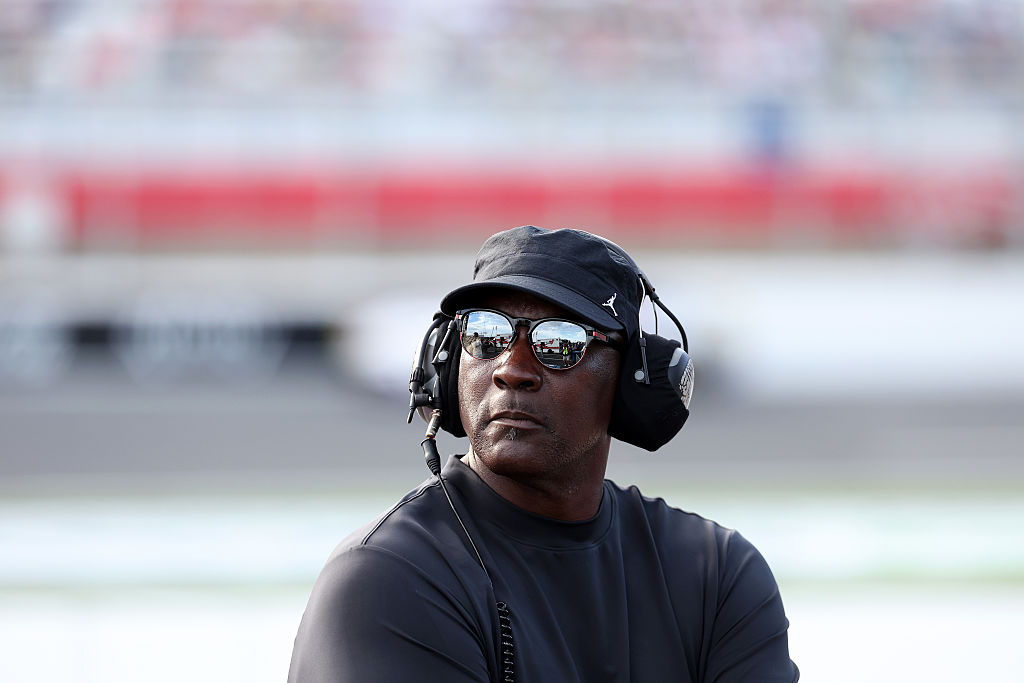
On September 21, 2020, Jordan and NASCAR driver Denny Hamlin announced they would be fielding a NASCAR Cup Series team with Bubba Wallace driving, beginning competition in the 2021 season. On October 22, the team's name was confirmed to be 23XI Racing (pronounced twenty-three eleven) and the team's entry would bear No. 23.
After the team's inaugural season, it added a second car with No. 45, driven by Kurt Busch in 2022. After Busch got severely hurt and Wallace got penalized, Ty Gibbs, John Hunter Nemechek, and Daniel Hemric served for the team as substitutes. For 2023, Busch was replaced by Tyler Reddick. Reddick won the 2024 NASCAR Cup Series regular season championship, the first for the team.
23XI Racing acquired a third charter from the defunct Stewart–Haas Racing, the No. 35 driven by Riley Herbst beginning in 2025.
Front Row Motorsports and Jordan, Hamlin, and his team sued NASCAR in October 2024 over the new charter agreements; the case was later settled on December 11, 2025, after 8 days in court. Reddick became the first driver in Cup Series history to win the first three races in a season, including the 2026 Daytona 500, making Jordan a Daytona 500 champion.
The team fields a part-time car, the Nos. 50 and 67, with past drivers Corey Heim, Kamui Kobayashi, Juan Pablo Montoya, and Travis Pastrana.
Personal life
Relationships
Jordan married Juanita Vanoy at A Little White Wedding Chapel in Las Vegas on September 2, 1989. They had three children, including Jeffrey and Marcus. The Jordans filed for divorce on January 4, 2002, citing irreconcilable differences, but reconciled shortly thereafter. They again filed for divorce and were granted a dissolution of marriage on December 29, 2006, commenting that the decision was made "mutually and amicably". It is reported that Juanita received a $168 million settlement (equivalent to $268 million in 2025), the largest celebrity divorce settlement on public record at the time.
In 1991, Jordan purchased a lot in Highland Park, Illinois, where he planned to build a 56,000-square-foot (5,200 m2) mansion. It was completed in 1995. Jordan listed the mansion for sale in 2012. He also owns homes in North Carolina and Jupiter Island, Florida.
On July 21, 2006, a judge in Cook County, Illinois, determined that Jordan did not owe his alleged former lover Karla Knafel $5 million in a breach of contract claim. Jordan had allegedly paid Knafel $250,000 to keep their relationship secret. Knafel claimed Jordan promised her $5 million for remaining silent and agreeing not to file a paternity suit after Knafel learned she was pregnant in 1991; a DNA test showed that Jordan was not the father of the child.
Jordan proposed to his longtime girlfriend, Cuban-American model Yvette Prieto, on Christmas 2011, and they were married on April 27, 2013, at Bethesda-by-the-Sea Episcopal Church. It was announced on November 30, 2013, that the two were expecting their first child together. On February 11, 2014, Prieto gave birth to identical twin daughters. In 2019, Jordan became a grandfather.
Gambling
During the 1993 NBA playoffs, Jordan was seen gambling in Atlantic City. The previous year, he admitted that he had to cover $57,000 in gambling losses, and author Richard Esquinas wrote a book in 1993 claiming he had won $1.25 million from Jordan on the golf course.
In 2005, Jordan discussed his gambling with Ed Bradley of 60 Minutes: Yeah, I've gotten myself into situations where I would not walk away and I've pushed the envelope. Is that compulsive? Yeah, it depends on how you look at it. If you're willing to jeopardize your livelihood and your family, then yeah. David Stern, the commissioner of the NBA, denied in 1995 and 2006 that Jordan's 1993 retirement was a secret suspension by the league for gambling, but the rumor spread widely. In 2010, Ron Shelton, director of Jordan Rides the Bus, said that he began working on the documentary believing that the NBA had suspended him, but that research "convinced [him it] was nonsense".
Politics
In 1990, Jordan declined to endorse Democratic candidate Harvey Gantt, reportedly remarking, "Republicans buy sneakers, too." In The Last Dance, Jordan confirmed he made the comment on a team bus but clarified it was intended as a joke, adding that he did not view himself as a political activist. In 2000, Jordan endorsed the presidential campaign of Democrat Bill Bradley, the first time that he publicly supported a candidate.
Media figure and business interests
Endorsements
Jordan is one of the most marketed sports figures ever. He has been a major spokesman for such brands as Nike, Coca-Cola, Chevrolet, Gatorade, McDonald's, Ball Park Franks, Rayovac, Wheaties, Hanes, MCI, 2K, and Upper Deck. Early in his career, Jordan appeared in an anti-drug advertisement sponsored by McDonald's. Jordan has appeared in over 20 commercials for Gatorade since 1991, including the "Be Like Mike" commercials in which a song was sung by children wishing to be like Jordan.
Nike created a signature shoe for Jordan, called the Air Jordan, in 1984. One of his more popular commercials for the shoe involved Spike Lee playing the part of Mars Blackmon: Lee, as Blackmon, attempted to find the source of Jordan's abilities and became convinced that "it's gotta be the shoes". The hype and demand for the shoes brought on a spate of "shoe-jackings", in which people were robbed of their sneakers at gunpoint. Subsequently, Nike spun off the Jordan line into its own division named the "Jordan Brand", with athletes and celebrities as endorsers. The brand has also sponsored college sports programs such as those of North Carolina, UCLA, California, Oklahoma, Florida, Georgetown, and Marquette.
Jordan also has been associated with the Looney Tunes cartoons. A Nike commercial shown during 1992's Super Bowl XXVI featured Jordan and Bugs Bunny playing basketball. This commercial inspired the 1996 live-action animated film Space Jam, which starred Jordan and Bugs in a story set during the former's first retirement from basketball. They have subsequently appeared together in several commercials for MCI. Jordan also made an appearance in the music video for Michael Jackson's "Jam" (1992).
In 2008, Jordan's yearly income from endorsements was estimated at over $40 million. When his power at the ticket gates was at its highest point, the Bulls regularly sold out both their home and road games. Due to this, Jordan set records in player salary by signing annual contracts worth in excess of $30 million per season. An academic study found that his first NBA comeback resulted in an increase in the market capitalization of his client firms of more than $1 billion.
Most of Jordan's endorsement deals, including his first deal with Nike, were engineered by his then-agent, David Falk. Jordan has described Falk as "the best at what he does" and that "marketing-wise, he's great. He's the one who came up with the concept of 'Air Jordan'."
Business ventures and wealth
In June 2010, Jordan was ranked by Forbes as the 20th-most-powerful celebrity in the world, with $55 million earned between June 2009 and June 2010. According to Forbes, Jordan Brand generates $1 billion in sales for Nike. In June 2014, Jordan was named the first NBA player to become a billionaire, after he increased his stake in the Charlotte Hornets from 80% to 89.5%. Jordan was honored with the Charlotte Business Journal's Business Person of the Year for 2014. In 2017, he became a part owner of the Miami Marlins of Major League Baseball.
Forbes designated Jordan as the athlete with the highest career earnings in 2017. From his Jordan Brand income and endorsements, Jordan's 2015 income was an estimated $110 million, the most of any retired athlete. As of 2026, his net worth is estimated at $4.3 billion by Forbes, making him the fourth-richest African-American, and one of the richest celebrities. In April 2026, Sportico ranked Jordan as the highest-paid athlete in history (as of December 31, 2025); his earnings were estimated at $4.5 billion when adjusted for inflation. He is the wealthiest athlete of all time with official records.
Jordan co-owns an automotive group which bears his name. The company has a Nissan dealership in Durham, North Carolina, acquired in 1990, and formerly had a Lincoln–Mercury dealership from 1995 until its closure in 2009. The company also owned a Nissan franchise in Glen Burnie, Maryland. The restaurant industry is another business interest of Jordan's. Restaurants he has owned include the former Michael Jordan's Restaurant in Chicago, and steakhouse in New York City's Grand Central Terminal; the latter restaurant closed in 2018. Other locations of the steakhouse are still operating in Chicago, Connecticut, and South Korea. He is also the owner of 1000 North, an upscale waterfront restaurant and private social club in Jupiter and Sarasota, Florida. Jordan is the majority investor in a golf course, Grove XXIII in Hobe Sound, Florida.
In September 2020, Jordan became an investor and advisor for DraftKings. Since September 2021, he occupies the same role at Sportradar.
Philanthropy
From 2001 to 2014, Jordan hosted an annual golf tournament, the Michael Jordan Celebrity Invitational, that raised money for various charities. In 2006, Jordan and his wife Juanita pledged $5 million to Chicago's Hales Franciscan High School. The Jordan Brand has made donations to Habitat for Humanity and a Louisiana branch of the Boys & Girls Clubs of America. Jordan is also a founding donor of the National Museum of African American History and Culture in Washington, D.C.
The Make-A-Wish Foundation named Jordan its Chief Wish Ambassador in 2008. In 2013, he granted his 200th wish for the organization. As of 2019, Jordan has raised more than $5 million for the Make-A-Wish Foundation. In 2023, he donated $10 million to the organization for his 60th birthday.
In 2015, Jordan donated a settlement of undisclosed size from a lawsuit against supermarkets that had used his name without permission to 23 different Chicago charities. In 2017, Jordan gave $7 million to fund two Novant Health Michael Jordan Family Clinics in Charlotte, North Carolina, his biggest donation to that point. The following year, after Hurricane Florence damaged parts of North Carolina, Jordan donated $2 million to relief efforts. He gave $1 million to aid the Bahamas' recovery following Hurricane Dorian in 2019.
In 2016, amidst the public uproar about the police shootings of two African-American men, Alton Sterling and Philando Castile, and two deadly attacks against police officers in Dallas and Baton Rouge, Jordan made $1 million donations to the NAACP Legal Defense Fund and the Institute for Community-Police Relations. Jordan said the goal is to "build trust and respect between communities and law enforcement." He also said: I can no longer stay silent. We need to find solutions that ensure people of color receive fair and equal treatment AND that police officers – who put their lives on the line every day to protect us all – are respected and supported.
On June 5, 2020, in the wake of the protests following the murder of George Floyd, Jordan and his brand announced in a joint statement that they would be donating $100 million over the next 10 years to organizations dedicated to "ensuring racial equality, social justice and greater access to education". In February 2021, Jordan funded two Novant Health Michael Jordan Family Clinics in New Hanover County, North Carolina, by giving $10 million. In 2024, he funded the opening of another Novant Health Clinic, this time in Wilmington.
Film and television
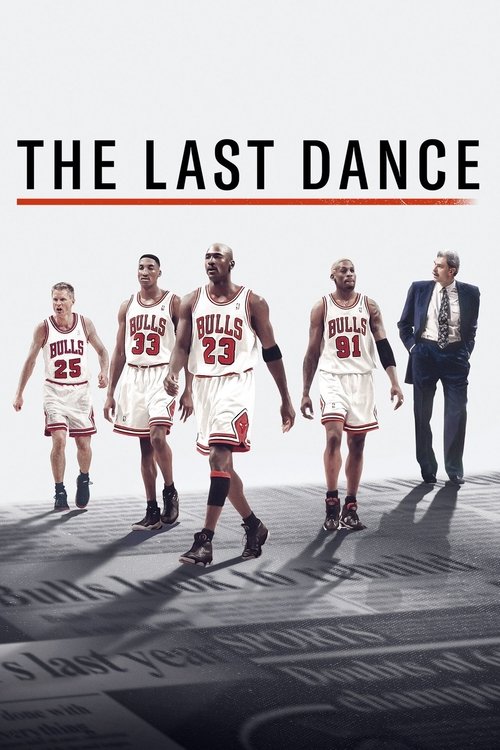
Jordan played himself in the 1996 film Space Jam. In 2000, Jordan was the subject of an IMAX documentary about his career with the Chicago Bulls, especially the 1998 NBA playoffs, titled Michael Jordan to the Max. Two decades later, the same period of Jordan's life was covered in much greater and more personal detail by the Emmy Award-winning The Last Dance, a 10-part TV documentary which debuted on ESPN in 2020. The Last Dance relied heavily on about 500 hours of candid film of Jordan's and his teammates' off-court activities which an NBA Entertainment crew had shot during the 1997–98 NBA season for use in a documentary. The project was delayed for many years because Jordan had not yet given his permission for the footage to be used. Jordan appeared in the 2022 miniseries The Captain, which follows the life and career of Derek Jeter. In 2023, the events about the origin of the Air Jordan brand were dramatized in the film Air.
In May 2025, Jordan was announced as a special contributor for the revived NBA on NBC; his role was later revealed to be MJ: Insights to Excellence, a segment featuring excerpts from an interview he conducted with NBC's Mike Tirico.
Books
Jordan has authored several books:
Rare Air: Michael on Michael, with Mark Vancil and Walter Iooss (Harper San Francisco, 1993).
I Can't Accept Not Trying: Michael Jordan on the Pursuit of Excellence, with Mark Vancil and Sandro Miller (Harper San Francisco, 1994).
For the Love of the Game: My Story, with Mark Vancil (Crown Publishers, 1998).
Driven from Within, with Mark Vancil (Atria Books, 2005).