




.jpg?width=400)




.jpg?width=400)


Monty Python's Life of Brian is a 1979 British surreal satirical biblical black comedy film starring and written by the comedy group Monty Python (Graham Chapman, John Cleese, Terry Gilliam, Eric Idle, Terry Jones, and Michael Palin). It was directed by Jones. The film tells the story of Brian Cohen (played by Chapman), a young Judaean man who is born on the same day as—and next door to—Jesus, and is subsequently mistaken for the Messiah.
Following the withdrawal of funding by EMI Films just days before production was scheduled to begin, musician and former Beatle George Harrison and his business partner Denis O'Brien arranged financing for Life of Brian through the formation of their HandMade Films company.
The film's themes of religious satire were controversial at the time of its release, drawing accusations of blasphemy and protests from some religious groups. In the United Kingdom, the film was given an AA (14) rating by the British Board of Film Classification, though 11 local councils outright banned the film, while a further 28 raised the rating from AA to X across their jurisdictions. (This certificate would later be amended, from AA to 15 in 1988, and from 15 to 12A in 2019.) Some countries, including Ireland and Norway, banned its showing; and, in a few of these, such as Italy, bans lasted over a decade. The filmmakers used the notoriety to promote the film, with posters in Sweden reading, "So funny it was banned in Norway!"
The film was a box office success. It was the fourth highest-grossing film in the United Kingdom in 1979 and the highest-grossing of any British film in the United States that year. It has remained popular and has been named as the greatest comedy film of all time by several magazines and television networks. In a 2006 Channel 4 poll, Life of Brian was ranked first on their list of the 50 Greatest Comedy Films.
Contents
Plot
Brian Cohen is born in a stable next door to Jesus, which initially confuses the three wise men who come to praise the future King of the Jews. He grows up into an idealistic young man who resents the continuing Roman occupation of Judea.
While listening to Jesus' Sermon on the Mount, Brian becomes infatuated with a young rebel named Judith Iscariot. His desire for her and hatred of the Romans, further exacerbated by his scolding mother, Mandy Cohen, revealing that Brian himself is half-Roman, inspire him to join the "People's Front of Judea" (PFJ). This is one of many fractious and bickering independence movements that spend more time fighting each other than the Romans.
PFJ leader Reg tasks Brian to paint slogans overnight on Roman governor Pontius Pilate's palace, but a Roman officer catches him in the act. However, the officer shows more concern with Brian's Latin grammar than the act itself, and after correcting the slogan to "Romani ite domum", orders him to write it on the wall one hundred times. Brian finishes after sunrise and is chased by guards before being rescued by Judith.
Reg gives a revolutionary speech to the PFJ asking, "What have the Romans ever done for us?" At this point the listeners outline all forms of positive aspects of the Roman occupation such as sanitation, medicine, education, wine, public order, irrigation, roads, a fresh water system, public health and peace. He then outlines plans to kidnap Pilate's wife.
However, inside Pilate's palace, the PFJ encounters another revolutionary group, the Campaign for a Free Galilee; an argument ensues over who came up with the plan first and everyone except Brian is knocked unconscious, leading Brian to be captured by the palace guards. The guards bring Brian before Pilate, but his questioning is cut short when the guards laugh uncontrollably after Pilate mentions the name of his friend, Biggus Dickus, and his wife, Incontinentia Buttocks.
After escaping from the Romans, Brian is accidentally scooped up by a passing extraterrestrial spaceship that crash-lands back on Earth. He tries to blend in among prophets who are preaching in a busy plaza, repeating fragments of Jesus' sermons. He stops his sermon mid-sentence when some Roman soldiers depart, leaving his small but intrigued audience demanding to know more. Brian grows frantic when people chase him to the mountains, and there they declare him to be the Messiah.
Cast
Graham Chapman as Brian Cohen (of Nazareth), Biggus Dickus, second wise man
Sue Jones-Davies as Judith Iscariot
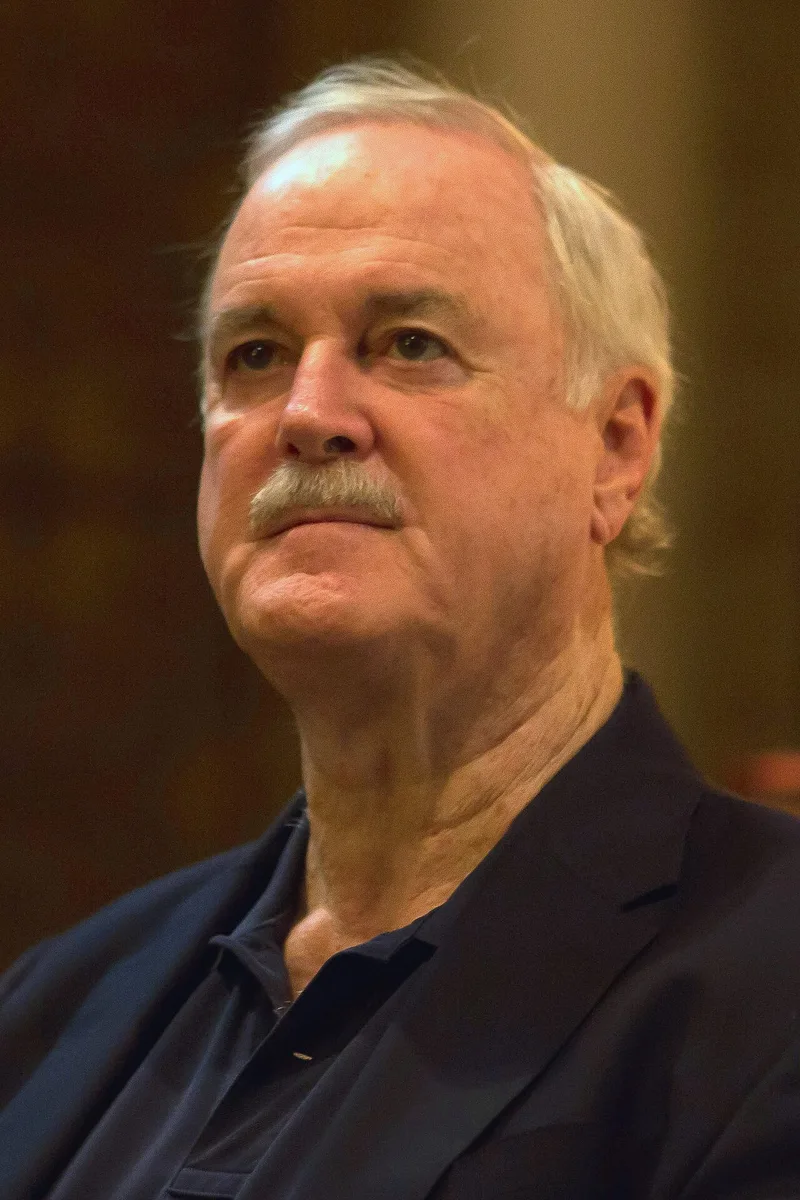
John Cleese as Reg, High priest, Centurion of the Yard, Deadly Dirk, Arthur, first wise man
Terry Gilliam as Another person further forward (at Mount – "Do you hear that? 'Blessed are the Greek'!"), Revolutionary, Blood and Thunder prophet, Geoffrey, Gaoler, Audience Member, Frank, Crucifee
Eric Idle as Mr Cheeky, Stan/Loretta, Harry the Haggler, Culprit woman who casts first stone, Warris, Intensely dull youth, Otto, Gaoler's assistant, Mr Frisbee III
Terry Jones as Mandy Cohen (Brian's mother), Colin, Simon the Holy Man, Bob Hoskins, Saintly passer-by, Alarmed Crucifixion Assistant
Michael Palin as Mr Big-Nose, Francis, Mrs A, Culprit woman who casts second stone, Ex-leper, Announcer, Ben, Pontius Pilate, Boring Prophet, Eddie, Shoe Follower, Nisus Wettus, 3rd wise man
Terence Bayler as Mr Gregory, second Centurion, Dennis
Carol Cleveland as Mrs Gregory, Woman #1, Elsie
Charles McKeown as False Prophet, Blind Man, Giggling Guard, Stig, Man #1
Kenneth Colley as Jesus
Neil Innes as A Weedy Samaritan
John Young as Matthias
Gwen Taylor as Mrs Big-Nose, Woman with ill donkey, Female heckler
Production
Pre-production
There are various stories about the origins of Life of Brian. Shortly after the release of Monty Python and the Holy Grail (1975), Eric Idle flippantly suggested that the title of the Pythons' forthcoming feature would be Jesus Christ: Lust for Glory (a play on the UK title for the 1970 American film Patton, Patton: Ordeal and Triumph). This was after he had become frustrated at repeatedly being asked what it would be called, despite the troupe not having given the matter of a third film any consideration. However, they shared a distrust of organised religion, and, after witnessing the critically acclaimed Holy Grail's enormous financial turnover, confirming an appetite among the fans for more cinematic endeavours, they began to seriously consider a film lampooning the New Testament era in the same way that Holy Grail had lampooned Arthurian legend. All they needed was an idea for a plot. Eric Idle and Terry Gilliam, while promoting Holy Grail in Amsterdam, had come up with a sketch in which Jesus' cross is falling apart because of the idiotic carpenters who built it and he angrily tells them how to do it correctly. However, after an early brainstorming stage, and despite being non-believers, they agreed that Jesus was "definitely a good guy" and found nothing to mock in his actual teachings: "He's not particularly funny, what he's saying isn't mockable, it's very decent stuff", said Idle later. After settling on the name Brian for their new protagonist, one idea considered was that of "the 13th disciple". The focus eventually shifted to a separate individual born at a similar time and location who would be mistaken for the Messiah, but had no desire to be followed as such.
The first draft of the screenplay, provisionally titled The Gospel According to St. Brian, was ready by Christmas 1976. The final pre-production draft was ready in January 1978, following "a concentrated two-week writing and water-skiing period in Barbados".
Finance originally came from EMI Films under Michael Deeley and Barry Spikings - EMI had distributed Holy Grail. However head of EMI, Bernard Delfont, was scared off at the last minute by the subject matter and pulled finance. Python fan and former Beatle George Harrison set up HandMade Films along with Denis O'Brien to help fund the film at a cost of £3 million. Harrison put up the money for it as he "wanted to see the movie"—later described by Terry Jones as the "world's most expensive cinema ticket". The very last words in the film are: "I said to him, 'Bernie, they'll never make their money back on this one'", teasing Delfont for his lack of faith in the project. Terry Gilliam later said, "They pulled out on the Thursday. The crew was supposed to be leaving on the Saturday. Disastrous. It was because they read the script ... finally."
Filming
Terry Jones was solely responsible for directing, having amicably agreed with Gilliam (who co-directed Holy Grail) to do so, with Gilliam concentrating on the look of the film. Holy Grail's production had often been stilted by their differences behind the camera. Gilliam again contributed two animated sequences (one being the opening credits) and took charge of set design. However, this did not put an absolute end to their feuding. On the DVD commentary, Gilliam expresses pride in one set in particular, the main hall of Pilate's fortress, which had been designed so that it looked like an ancient synagogue that the Romans had converted by dumping their structural artefacts (such as marble floors and columns) on top. He reveals his consternation at Jones for not paying enough attention to it in the cinematography. Gilliam also worked on the matte paintings, useful in particular for the very first shot of the three wise men against a star-scape and in giving the illusion of the whole of the outside of the fortress being covered in graffiti. Perhaps the most significant contribution from Gilliam was the scene in which Brian accidentally leaps off a high building and lands inside a starship about to engage in an interstellar war. This was done "in camera" using a hand-built model starship and miniature pyrotechnics. Gilliam recounted in an interview: "Well, we didn't know what to do with Brian. He got himself to the top of the tower and we had to rescue him somehow, so I said, 'OK, spaceship for that.' That was purely it. It was funny, because this was at the time when Star Wars had just come out."
The film was shot on location in Monastir, Tunisia, which allowed the production to reuse sets from Franco Zeffirelli's Jesus of Nazareth (1977). The Tunisian shoot was documented by Iain Johnstone for his BBC film The Pythons. Many locals were employed as extras on Life of Brian. Director Jones noted, "They were all very knowing because they'd all worked for Franco Zeffirelli on Jesus of Nazareth, so I had these elderly Tunisians telling me, 'Well, Mr Zeffirelli wouldn't have done it like that, you know.'" Further location shooting also took place in Tunisia, at Sousse (Jerusalem outer walls and gateway), Carthage (Roman theatre) and Matmata (Sermon on the Mount and Crucifixion).
Graham Chapman, suffering from alcoholism, was so determined to play the lead role—at one point coveted by Cleese—that he sobered up in time for filming, so much so that he also acted as the on-set doctor.
Rough cut and pre-screenings
Following shooting between 16 September and 12 November 1978, a two-hour rough cut of the film was put together for its first private showing in January 1979. Over the next few months Life of Brian was re-edited and re-screened a number of times for different preview audiences, losing a number of entire filmed sequences.
Editing
A number of scenes were cut during the editing process. Five deleted scenes, a total of 13 minutes, including the controversial "Otto", were first made available in 1997 on the Criterion Collection Laserdisc. An unknown amount of raw footage was destroyed in 1998 by the company that bought Handmade Films. However, a number of them (of varying quality) were shown the following year on the Paramount Comedy Channel in the UK. The scenes shown included three shepherds discussing sheep and completely missing the arrival of the angel heralding Jesus's birth, which would have been at the very start of the film; a segment showing the attempted kidnap of Pilate's wife (a large woman played by John Case) whose escape results in a fistfight; a scene introducing hardline Zionist Otto, leader of the Judean People's Front (played by Eric Idle), and his men who practise a suicide run in the courtyard; and a brief scene in which Judith releases some birds into the air in an attempt to summon help. The shepherds' scene has badly distorted sound, and the kidnap scene has poor colour quality. The same scenes that were on the Criterion laserdisc can now be found on the Criterion Collection DVD.
The most controversial cuts were the scenes involving Otto, an extremist Zionist leader, initially a recurring character, who had a thin Adolf Hitler moustache and spoke with a German accent. Otto would shout accusations of "racial impurity" at Judeans who were conceived (as Brian was) when their mothers were raped by Roman centurions, as well as other Nazi phrases. The logo of the Judean People's Front, designed by Terry Gilliam, was a Star of David with a small line added to each point so it resembled a swastika, most familiar in the West as the symbol of the anti-Semitic Nazi movement. The rest of this faction also all had the same thin moustaches, and wore a spike on their helmets, similar to those on Imperial German helmets. The official reason for the cutting was that Otto's dialogue slowed down the narrative. However, Gilliam, writing in The Pythons Autobiography by The Pythons, said he thought it should have stayed, saying "Listen, we've alienated the Christians, let's get the Jews now." Idle himself was said to have been uncomfortable with the character; "It's essentially a pretty savage attack on rabid Zionism, suggesting it's rather akin to Nazism, which is a bit strong to take, but certainly a point of view." Michael Palin's personal journal entries from the period when various edits of Brian were being test-screened consistently reference the Pythons' and filmmakers' concerns that the Otto scenes were slowing the story down and thus were top of the list to be chopped from the final cut of the film. However, Oxford Brookes University historian David Nash says the removal of the scene represented "a form of self-censorship" and the Otto sequence "which involved a character representative of extreme forms of Zionism" was cut "in the interests of smoothing the way for the film's distribution in America."
Soundtrack
An album was also released by Monty Python in 1979 in conjunction with the film. In addition to the "Brian Song" and "Always Look on the Bright Side of Life", it contains scenes from the film with brief linking sections performed by Eric Idle and Graham Chapman. The album opens with a brief rendition of "Hava Nagila" on Scottish bagpipes. A CD version was released in 1997.
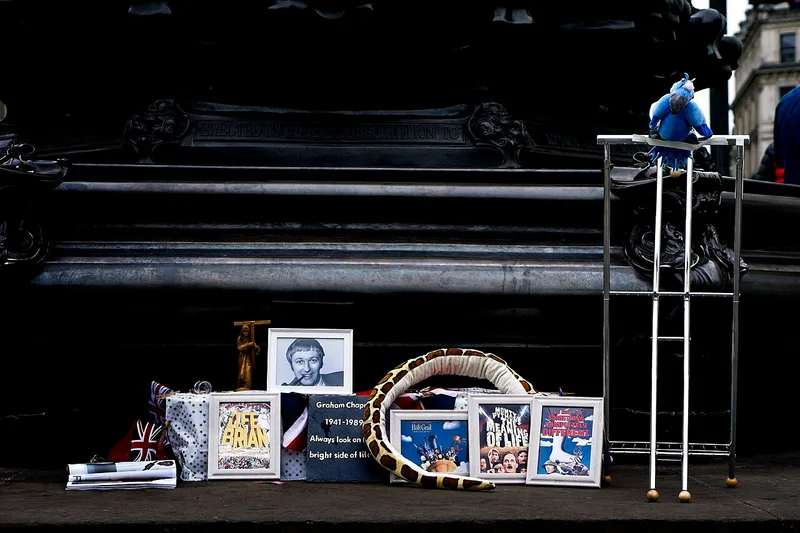
An album of the songs sung in Monty Python's Life of Brian was released on the Disky label. "Always Look on the Bright Side of Life" was later re-released with great success, after being sung by British football fans. Its popularity became truly evident in 1982 during the Falklands War when sailors aboard the destroyer HMS Sheffield, severely damaged in an Argentinean Exocet missile attack on 4 May, started singing it while awaiting rescue. Many people have come to see the song as a life-affirming ode to optimism. One of its more famous renditions was by the dignitaries of Manchester's bid to host the 2000 Olympic Games, just after they were awarded to Sydney. Idle later performed the song as part of the 2012 Summer Olympics closing ceremony. "Always Look on the Bright Side of Life" is also featured in Eric Idle's Spamalot, a Broadway musical based upon Monty Python and the Holy Grail, and was sung by the rest of the Monty Python group at Graham Chapman's memorial service and at the Monty Python Live at Aspen special. The song is a staple at Iron Maiden concerts, where the recording is played after the final encore.
Release
For the original British and Australian releases, a spoof travelogue narrated by John Cleese, Away from It All, was shown before the film itself. It consisted mostly of stock travelogue footage and featured arch comments from Cleese. For instance, a shot of Bulgarian girls in ceremonial dresses was accompanied by the comment "Hard to believe, isn't it, that these simple happy folk are dedicated to the destruction of Western civilisation as we know it!", Communist Bulgaria being a member of the Warsaw Pact at the time. Not only was this a spoof of travelogues per se, it was a protest against the then common practice in Britain of showing cheaply made banal short features before a main feature.
Life of Brian opened on 17 August 1979 in five North American theatres and grossed US$140,034 ($28,007 per screen) in its opening weekend. Its total gross was $19,398,164. It was the highest grossing British film in North America that year.
Released on 8 November 1979 at the Plaza Theatre in London, the film became the fifth highest-grossing film in the United Kingdom in 1979. It opened at number one in London, grossing a house record £40,470 in its opening week, beating the record set by Jaws three years previously by almost £9,000. It remained number one in London for six weeks, grossing £216,355 at the Plaza and expanding to the Ritz in its sixth week, setting a house record £16,991 there, and giving it a higher gross in its sixth week (£46,329) than in its first.
On 30 April 2004, Life of Brian was re-released on five North American screens to "cash in" (as Terry Jones put it) on the box office success of Mel Gibson's The Passion of the Christ. It grossed $26,376 ($5,275 per screen) in its opening weekend. It ran until October 2004, playing at 28 screens at its widest point, eventually grossing $646,124 during its re-release. By comparison, a re-release of Monty Python and the Holy Grail had earned $1.8 million three years earlier. A DVD of the film was also released that year.
Reception
Reviews from critics were mostly positive on the film's release. Movie historian Leonard Maltin reported that "This will probably offend every creed and denomination equally, but it shouldn't. The funniest and most sustained feature from Britain's bad boys." Vincent Canby of The New York Times called the film "the foulest-spoken biblical epic ever made, as well as the best-humored—a nonstop orgy of assaults, not on anyone's virtue, but on the funny bone. It makes no difference that some of the routines fall flat because there are always others coming along immediately after that succeed." Roger Ebert gave the film three stars out of four, writing, "What's endearing about the Pythons is their good cheer, their irreverence, their willingness to allow comic situations to develop through a gradual accumulation of small insanities." Gene Siskel of the Chicago Tribune gave the film three and a half stars, calling it "a gentle but very funny parody of the life of Jesus, as well as of biblical movies." Kevin Thomas of the Los Angeles Times declared, "Even those of us who find Monty Python too hit-and-miss and gory must admit that its latest effort has numerous moments of hilarity." Clyde Jeavons of The Monthly Film Bulletin wrote that the script was "occasionally over-raucous and crude", but found the second half of the film "cumulatively hilarious", with "a splendidly tasteless finale, which even Mel Brooks might envy." Richard Grenier, writing in the neoconservative magazine Commentary, said "Life of Brian contains appreciably more mocking of faddish radicalism and Third World 'national-liberation movements' than it does of religion," citing numerous examples in the film of satire at the expense of "left-wing ideas about imperialism, feminism, and terrorism," reflecting a satirical omnivorousness that Grenier associated with "the tradition of what might be called 'Tory wit,' reaching back to Congreve and Swift and all the way forward to Evelyn Waugh and Kingsley Amis." Gary Arnold of The Washington Post had a negative opinion of the film, writing that it was "a cruel fiction to foster the delusion that 'Brian' is bristling with blasphemous nifties and throbbing with impious wit. If only it were! One might find it easier to keep from nodding off."
Over time, Life of Brian has regularly been cited as a significant contender for the title "greatest comedy film of all time", and has been named as such in polls conducted by Total Film magazine in 2000, the British TV network Channel 4 where it topped the poll in the 50 Greatest Comedy Films, and The Guardian in 2007. Rotten Tomatoes lists it as one of the best reviewed comedies, with a 96% approval rating from 73 published reviews, with an average rating of 8.6/10. Its critical consensus reads, "One of the more cutting-edge films of the 1970s, this religious farce from the classic comedy troupe is as poignant as it is funny and satirical." Metacritic, which uses a weighted average, assigned the film a score of 77 out of 100, based on 15 critics, indicating "generally favorable" reviews.
Controversies
Richard Webster comments in A Brief History of Blasphemy (1990) that "internalised censorship played a significant role in the handling" of Monty Python's Life of Brian. In his view, "As a satire on religion, this film might well be considered a rather slight production. As blasphemy it was, even in its original version, extremely mild. Yet the film was surrounded from its inception by intense anxiety, in some quarters of the Establishment, about the offence it might cause. As a result it gained a certificate for general release only after some cuts had been made. Perhaps more importantly still, the film was shunned by the BBC and ITV, who declined to show it for fear of offending Christians in the UK. Once again a blasphemy was restrained – or its circulation effectively curtailed – not by the force of law but by the internalisation of this law." On its initial release in the UK, the film was banned by several town councils – some of which had no cinemas within their boundaries, or had not even seen the film. A member of Harrogate council, one of those that banned the film, revealed during a television interview that the council had not seen the film, and had based their opinion on what they had been told by the Nationwide Festival of Light, a grouping with an evangelical Christian base, of which they knew nothing.
In New York (the film's release in the US preceded British distribution), screenings were picketed by both rabbis and nuns ("Nuns with banners!" observed Michael Palin). It was also banned for eight years in Ireland and for a year in Norway (it was marketed in Sweden as "The film that is so funny that it was banned in Norway"). During the film's theatrical run in Finland, a text explaining that the film was a parody of Hollywood historical epics was added to the opening credits.
In the UK, Mary Whitehouse, and other traditionalist Christians, pamphleteered and picketed locations where the local cinema was screening the film, a campaign that was felt to have boosted publicity. Leaflets arguing against the film's representation of the New Testament (for example, suggesting that the Wise Men would not have approached the wrong stable as they do in the opening of the film) were documented in Robert Hewison's book Monty Python: The Case Against.
One of the most controversial scenes was the film's ending: Brian's crucifixion. Many Christian protesters said that it was mocking Jesus' suffering by turning it into a "Jolly Boys Outing" (such as when Mr Cheeky turns to Brian and says: "See, not so bad once you're up!"), capped by Brian's fellow sufferers suddenly bursting into song. This is reinforced by the fact that several characters throughout the film claim crucifixion is not as bad as it seems. For example, when Brian asks his cellmate in prison what will happen to him, he replies: "Oh, you'll probably get away with crucifixion". In another example, Matthias, an old man who works with the People's Front of Judea, dismisses crucifixion as "a doddle" and says being stabbed would be worse.
Political satire
The film pokes fun at revolutionary groups and 1970s British left-wing politics. According to Roger Wilmut, "What the film does do is place modern stereotypes in a historical setting, which enables it to indulge in a number of sharp digs, particularly at trade unionists and guerilla organisations". There are several groups in the film which oppose the Roman occupation of Judea, but fall into the familiar pattern of intense competition among factions that appears, to an outsider, to be over ideological distinctions so small as to be invisible, thus portraying the phenomenon of the narcissism of small differences. The comical naming similarities of the groups were also a satire of fractious divisions between contemporary Palestinian liberation groups, all containing the words "front" and "liberation" along with "Palestine": the Palestinian Popular Struggle Front (PPSF) (formed 1967) had broken off from the Popular Front for the Liberation of Palestine (PFLP), which had further divisions which led to the Popular Front for the Liberation of Palestine – General Command (PFLP-GC) (1968), the Democratic Front for the Liberation of Palestine (DFLP) (1969), and the Popular Revolutionary Front for the Liberation of Palestine (PFRLP) (1972).
Such disunity indeed fatally hampered real-life Judean resistance against Roman rule. Michael Palin says that the various separatist movements were modelled on "modern resistance groups, all with obscure acronyms which they can never remember and their conflicting agendas".
The People's Front of Judea, composed of the Pythons' characters, harangue their "rivals" with cries of "splitters" and stand vehemently opposed to the Judean People's Front, the Judean People's Popular Front, the Campaign for a Free Galilee, and the Popular Front of Judea (the last composed of a single old man, mocking the size of real revolutionary Trotskyist factions). The infighting among revolutionary organisations is demonstrated most dramatically when the PFJ attempts to kidnap Pontius Pilate's wife, but encounters agents of the Campaign for a Free Galilee, and the two factions begin a violent brawl over which of them conceived of the plan first. When Brian exhorts them to cease their fighting to struggle "against the common enemy", the revolutionaries stop and cry in unison, "the Judean People's Front!" However, they soon resume their fighting and, with two Roman legionaries watching bemusedly, continue until Brian is left the only survivor, at which point he is captured.
Other scenes have the freedom fighters wasting time in debate, with one of the debated items being that they should not waste their time debating so much. The famous "what have the Romans ever done for us" scene has drawn significant attention, with Python biographer George Perry noting, "The People's Liberation Front of Judea conducts its meetings as though they have been convened by a group of shop stewards". This joke is the reverse of a similar conversation recorded in the Babylonian Talmud; some authors have even suggested the joke is based on the Talmudic text.
Film analysis
Themes and motifs
The depictions of Jesus in two short scenes at the start of the film are strongly based on Christian iconography. The resistance fighters leave the Sermon on the Mount, which was a literal recital, angry because Jesus was too pacifistic for them. ("Well, blessed is just about everyone with a vested interest in the status quo…") In addition to the respectful depiction of Jesus, the film does not state that there is no God or that Jesus is not the son of God. The appearance of a leper, who says he was healed by Jesus, is in line with the Gospels and their reports about Jesus performing miracles.
Any direct reference to Jesus disappears after the introductory scenes, yet his life story partially acts as a framework and subtext for the story of Brian. Brian being a bastard of a Roman centurion could refer to the polemic legend that Jesus was the son of the Roman soldier Panthera. Disguised as a prophet, Brian talks about "the lilies on the field" and states more clearly, "Don't pass judgment on other people or else you might get judged yourself": Brian incoherently repeats statements he heard from Jesus.
Another significant figure in the film who is named in the Gospels is Pontius Pilate, the central antagonist. Although the humour largely involves Jews, there is no sinister Jew to compare with Judas or Caiaphas. An anti-Semitic interpretation of the story is therefore excluded, according to scholars. The crucifixion scene, a central part of Christian iconography, is viewed from a historical context within the narrative style of the film. It is a historically accurate enactment of a routinely done mass crucifixion.
The intended subject of the satire was not Jesus and his teachings but religious dogmatism, according to film theorists and statements from Monty Python. This is made clear in the beginning of the film during the Sermon on the Mount. Not only do the poor acoustics make it more difficult to hear what Jesus says, but the audience fails to interpret what was said correctly and sensibly. When Jesus said, "blessed are the peacemakers", the audience understands the phonetically similar word "Cheesemakers" and in turn interpret it as a metaphor and beatification of those who produce dairy products.
Life of Brian satirises, in the words of David Hume, the "strong propensity of mankind to [believe in] the extraordinary and the marvellous". When Brian cuts his sermon short and turns away from the crowd, they mistake his behaviour as not wanting to share the secret to eternal life and follow him everywhere. In their need to submit to an authority, the crowd declares him first a prophet and eventually a messiah. Even when Brian explicitly denies he is the Messiah, they still follow him, rationalizing that only the true Messiah would have the humility to deny his own divine status. The faithful gather beneath Brian's window en masse to receive God's blessing. This is when Brian utters the main message of the film "you don't need to follow anybody! You've got to think for yourselves!" Monty Python saw this central message of the satire confirmed with the protests of practising Christians after the film was released.
Legacy
Literature
Spin-offs include a script-book The Life of Brian of Nazareth, which was printed back-to-back with MONTYPYTHONSCRAPBOOK as a single book. The printing of this book also caused problems, due to rarely used laws in the United Kingdom against blasphemy, dictating what can and cannot be written about religion. The publisher refused to print both halves of the book, and original prints were by two companies.
Julian Doyle, the film's editor, wrote The Life of Brian/Jesus, a book which not only describes the filmmaking and editing process but argues that it is the most accurate Biblical film ever made. In October 2008, a memoir by Kim "Howard" Johnson titled Monty Python's Tunisian Holiday: My Life with Brian was released. Johnson became friendly with the Pythons during the filming of Life of Brian and the book is based on his notes and memories of the behind-the-scenes filming and make-up.
Music
With the success of Eric Idle's musical retelling of Monty Python and the Holy Grail, called Spamalot, Idle announced that he would be giving Life of Brian a similar treatment. The oratorio, called Not the Messiah (He's a Very Naughty Boy), was commissioned to be part of the festival called Luminato in Toronto in June 2007, and was written/scored by Idle and John Du Prez, who also worked with Idle on Spamalot. Not the Messiah is a spoof of Handel's Messiah. It runs approximately 50 minutes, and was conducted at its world premiere by Toronto Symphony Orchestra music director Peter Oundjian, who is Idle's cousin. Not the Messiah received its US premiere at the Caramoor International Music Festival in Katonah, New York. Oundjian and Idle joined forces once again for a double performance of the oratorio in July 2007.
Other media
In October 2011, BBC Four premiered the made-for-television comedy film Holy Flying Circus, written by Tony Roche and directed by Owen Harris. The "Pythonesque" film explores the events surrounding the 1979 television debate on talk show Friday Night, Saturday Morning between John Cleese and Michael Palin and Malcolm Muggeridge and Mervyn Stockwood, then Bishop of Southwark.
In a Not the Nine O'Clock News sketch, a bishop who has directed a scandalous film called The Life of Christ is hauled over the coals by a representative of the "Church of Python", claiming that the film is an attack on "Our Lord, John Cleese" and on the members of Python, who, in the sketch, are the objects of Britain's true religious faith. This was a parody of the infamous Friday Night, Saturday Morning programme, broadcast a week previously. The bishop (played by Rowan Atkinson) claims that the reaction to the film has surprised him, as he "didn't expect the Spanish Inquisition."
Radio host John Williams of Chicago's WGN 720 AM has used "Always Look on the Bright Side of Life" in a segment of his Friday shows. The segment is used to highlight good events from the past week in listeners' lives and what has made them smile. In the 1997 film As Good as It Gets, the misanthropic character played by Jack Nicholson sings "Always Look on the Bright Side of Life" as evidence of the character's change in attitude.
A BBC history series What the Romans Did for Us, written and presented by Adam Hart-Davis and broadcast in 2000, takes its title from Cleese's rhetorical question "What have the Romans ever done for us?" in one of the film's scenes. (Cleese himself parodied this line in a 1986 BBC advert defending the Television Licence Fee: "What has the BBC ever given us?", and in 2026 an updated version was produced, this time fronted by Romesh Ranganathan).
Former British Prime Minister Tony Blair in his Prime Minister's Questions of 3 May 2006 made a shorthand reference to the types of political groups, "Judean People's Front" or "People's Front of Judea", lampooned in Life of Brian. This was in response to a question from the Labour MP David Clelland, asking "What has the Labour government ever done for us?" – itself a parody of John Cleese's "What have the Romans ever done for us?"


