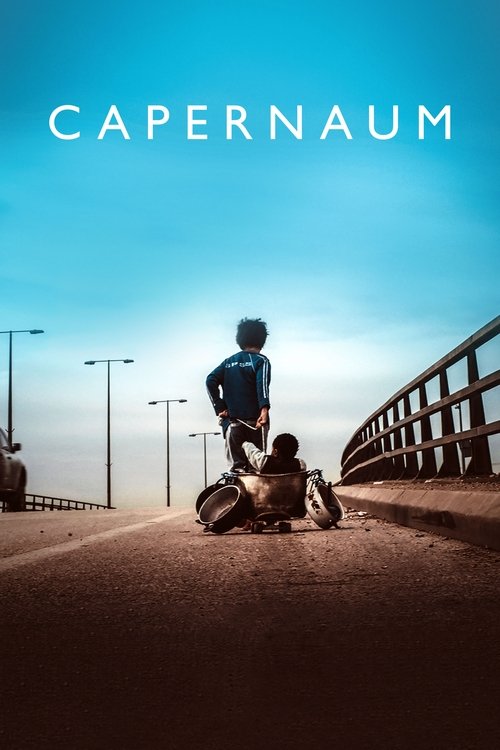
Nadine Labaki (Arabic: نادين لبكي, romanized: Nādīn Labikī; born February 18, 1974) is a Lebanese actress, director, and activist. Labaki first came into the spotlight as an actress in the early 2000s. Her filmmaking career began in 2007 after the release of her debut film, Caramel, which premiered at the Cannes Film Festival. She is known for demonstrating everyday aspects of Lebanese life and covering a range of political issues such as war, poverty, and feminism. She is the first female Arab director to be nominated for an Oscar in the category for Best Foreign Language Film for her third directorial effort, Capernaum (2018).
Contents
Early life
Labaki was born in Baabdat, Mount Lebanon Governorate, Lebanon, to Maronite parents Antoine and Antoinette Labaki. Her father is an engineer, while her mother is a homemaker. She spent the first seventeen years of her life living in a war-torn environment until the Lebanese Civil War ended. She learned the art of storytelling from her uncle, who was the family hakawati (storyteller). Her grandfather owned a small theatre in Lebanon. She began her career in 1990 with Studio El Fan, the Lebanese talent show that aired from the 1970s until the early 2000s, Labaki won a prize for her direction of music video productions.
Fleeing from the war in 1989, Labaki spent three years in Montreal and obtained Canadian citizenship.
Labaki obtained a degree in audiovisual studies at the Saint Joseph University in Beirut. In 1997, she directed her graduation film, 11 Rue Pasteur, which won her the Best Short Film Award at the Biennale of Arab Cinema at the Arab World Institute in Paris. Labaki is unique among her fellow Lebanese and Arab filmmakers in that she was not educated or trained abroad.
In 1998, she attended a workshop in acting at the Cours Florent in Paris. With her sister Caroline Labaki as executive producer, she went on to direct advertisements and music videos for renowned Middle Eastern singers, for which she won several awards. Striving to portray contemporary Lebanese women, she "created examples of Lebanese women who were very at ease in their bodies."
Career
Director
In 2003, Labaki began to gain popular attention in the Arab media. 2003 was also the year when she began directing music videos for singer Nancy Ajram. The song "Akhasmak ah" (Yes, I'll fight you) sparked controversy due to its scenes of sexually suggestive dancing. Ajram's female character, who serves as a waitress to male customers, was seen as inappropriate and too evocative. Labaki defended her script, stating that Ajram was actually portraying an "assertive and powerful female figure". Labaki and Ajram worked to redefine the image of the current Arab woman as feminine, alluring and in control. Ajram continued to collaborate with Labaki on her music videos "Ya Salam", "Lawn Ouyounak" and "Inta Eih". The three videos were awarded with best music video honors.
In 2005, Labaki took part in the Cannes Film Festival Residence for six months. During that time, she wrote Caramel, her first feature film. In 2006, she directed and played one of the leading roles in Caramel, which showcases a Beirut that most people are not familiar with. Rather than tackle political issues that have plagued Lebanon, she presents a comedy that deals with five Lebanese women in Beirut who gather at a beauty salon and deal with issues related to love, sexuality, tradition, disappointment, and everyday ups and downs. The film premiered at the Directors' Fortnight at the Cannes Film Festival in 2007, which was a commercial success in the summer of that same year. It sold worldwide and collected important prizes at many festivals around the world, garnering Labaki much acclaim both as a director and actress. It also put her on Variety's 10 Directors to Watch list at the Sundance Film Festival. In 2008, the French Ministry of Culture and Communication gave her the Insignia of Chevalier in the Order of Arts and Letters.
In 2010, Labaki directed and starred in her second feature film, Where Do We Go Now? The film humorously tackles a delicate subject about a war-ravaged Middle Eastern village in which Muslim and Christian women try to keep their men from starting a religious war. The idea for this film first came about when Labaki was pregnant with her son in 2008. At that time, Lebanon was at the brink of its most violent turmoil in decades. The inter-religious conflict led to outbursts in the streets of Beirut. Labaki speaks of friends becoming enemies due to religious differences. Preparing for motherhood, she began to ponder what extreme lengths mothers would go to to prevent their sons from obtaining arms and taking to the streets to fight. This one idea sparked the narrative of this film, in which an entire town of women begin a mission to prevent the men from brutally killing each other. The story takes place in Lebanon, although never explicitly stated. Labaki's reasoning for this was that "the film is universal... this conflict does not only happen in Lebanon. I see it everywhere . . . We are scared of each other as human beings." Similar to Caramel, her second feature casts non-professional actors. In effort to heighten the reality, Labaki states that "normal people deserve to be on the big screen."
Actress
Labaki started acting in short films during the early 2000s. She starred in Zeina Durra's The Seventh Dog. The work won the audience award at the Circuito Of Venice International Short Film Festival in 2006.
In 2006, Labaki starred in "Bosta," a Lebanese musical comedy. The film was a box office success, outgrossing "Harry Potter and the Goblet of Fire" in Lebanon.
In the same year, Labaki acted in her first feature film, Caramel.
Labaki starred in Stray Bullet, directed by Georges Hachem in 2010.
She appears in the Moroccan production Rock The Casbah, directed by Laila Marrakchi, alongside actors Hiam Abbas and Lubna Azabal.
She has also performed in her films Where Do We Go Now? and Capernaum.
Labaki often casts herself in her movies. She feels, "When I act with the people I cast, they feel more comfortable. I like to improvise a lot, and when I am in the film, it's like directing the scene from the inside."
Jury
In 2021, she was selected as a jury member at the 11th Beijing International Film Festival for the Tiantan Awards.
Themes and directing style
Themes
Growing up during the Lebanese Civil War, Labaki's films are informed by her experiences of political unrest in her home country, often exploring themes of violence and trauma.
Labaki's films challenge apathy towards important issues, such as the refugee crisis and poverty. Though themes of war and tragedy are prevalent in Labaki's works, so is humor. Her films cover the Lebanese Civil War and the lasting impacts it had on the country. Her experiences impacted Labaki personally, as well as how it shaped her film-making. As a director, she feels that she has to do something good for her country. She then decided that talking about problems such as poverty and the refugee crisis is important. FF2 Media covered a Q&A with Labaki in 2018 about her movie Capernaum, which received an Oscar nomination for Best Foreign Language Film of the Year (as well as 34 other wins and 46 other nominations). While trying to brainstorm concepts for the script, her team came up with ideas that she wanted to include, such as "child labor, migrant labor rights, children's rights, the absurdity of having to have the papers to prove that you exist, the absurdity of borders, and early marriage". She believes that "cinema can be a way to [create] change." She has stated that politics and art are intertwined and that her films are her own "way of revolt". According to Labaki, "Sometimes, a line in a film, or a scene can make you think about yourself, about your decisions. By touching your hearts, films can offer hope more than politics". Labaki's films have no solutions for the issues Lebanon faces, but she hopes that her films will "simply shake audiences out of their chronic lethargy". She has stated that her filmmaking and activism are the same, believing that cinema can effect social change.
Another common theme in her work is feminism and the female narrative. She does this by focusing on the everyday lives of women in the Middle East in her films.
Style
Labaki's films are often cast with non-professional actors. She often finds men, women, and children who live in the real neighborhoods shown on screen where they re-enact scenes from their own experiences, often in some of Beirut's grittiest slums. Labaki does this to make the film as realistic as possible. Labaki is also known for spending long periods to research and pick the cast for her films. She immerses herself in the lives of her subjects and spent four years researching her subject and the mistreated children in Beirut. For her film Capernaum, she gave her actors minimal direction and used hand-held cameras to capture life in the streets of Lebanon. For her film Caramel, she spent almost a year searching for women who resembled her characters. She purposely did not want professional actors, she explained, and the spontaneity of each authenticates the plot of women supporting each other as they cope with their problems. The filmmaker amassed months of raw footage, which she later edited down to just over two hours.
Labaki states that she was inspired by the photo of a 3-year-old Syrian refugee whose lifeless body sparked outrage around the world. Stating, "I remember thinking if this child could talk, what would he say, and how would he address the adults that killed him?" she says. "I wanted to become their voice, their vehicle for them to express themselves."
In a 2012 interview with Jan Lisa Huttner from FF2 Media, Labaki said: "I have a problem with injustice. I have a problem with seeing the wrong things around me and just not saying anything about them". She likes to address relevant issues and portray them through her art, be it acting, directing, or even dance. Her movie Where Do We Go Now? heavily incorporates dance, and in the same interview with FF2 Media, she mentioned that she has a background of being a dancer.
Personal life
Labaki is multilingual, fluent in Arabic, French, English and Italian. In 2007, she married Lebanese musician and composer Khaled Mouzanar. In 2009, Labaki gave birth to her first boy, Walid. Seven years later (2016), Labaki gave birth to a daughter, Mayroun.
In 2016, Labaki received an honorary degree from the American University of Beirut and was the speaker at the 150th Commencement Ceremony.
Politics
Labaki was a candidate on the list of the new political movement Beirut Madinati for the capital's May 2016 local election. Beirut Madinati focuses on social justice and the good of the public using a diverse group of citizens as representatives.
Despite achieving about 40% of the popular vote, the movement lost against its opponent, the Beirutis' List supported by Saad Hariri, in all 6 out of 12 wards, but did not gain a single seat under the election's one-district first-past-the-post system.
Filmography
Short films
Rio, I Love You segment: O Milagre
Homemade, Labaki directed Episode 11 of this Netflix anthology series, which features short films created by filmmakers during the COVID-19 pandemic lockdown.
As an actress
Ramad (Ashes) – a short film by Joanna Hadjithomas and Khalil Joreige (2003)
The Seventh Dog – a short film by Zeina Durra
Non métrage Libanais (2003) – a short film by Wissam Smayra; Role as Nina
Bosta – a long feature by Philippe Aractingi; Role as Alia
Caramel or Sukkar Banat (2007) – Role as Layale
Stray Bullet (2010) – Role as Noha
Al Abb Wal Gharib The Father and the Foreigner (2010) by Ricky Tognazzi
Where Do We Go Now? (2011) – Role as Amale
Rock The Casbah (2013)
Mea Culpa (2014)
Rio, I Love You (2014) – Role as self
La Rançon de la gloire (2014)
The Idol (2015)
Capernaum (2018) – Role as Nadine
1982 (2019) – Yasmine
Costa Brava, Lebanon (2021)
Perfect Strangers (2022)
Swimming Home (2024)
The Sand Castle (2024) Premiered at the Red Sea International Film Festival in December 2024 and directed by Matty Brown, revolves around a family of four stranded on an island.
Other work
In 2014, Labaki was the goodwill ambassador for the bilingual and multimedia campaign produced by The Brave Heart Fund (BHF). Based out of the Children's Heart Center at the American University of Beirut Medical Center, the BHF creates awareness and helps to fund operations and procedures for underprivileged children with Congenital Heart Disease.