
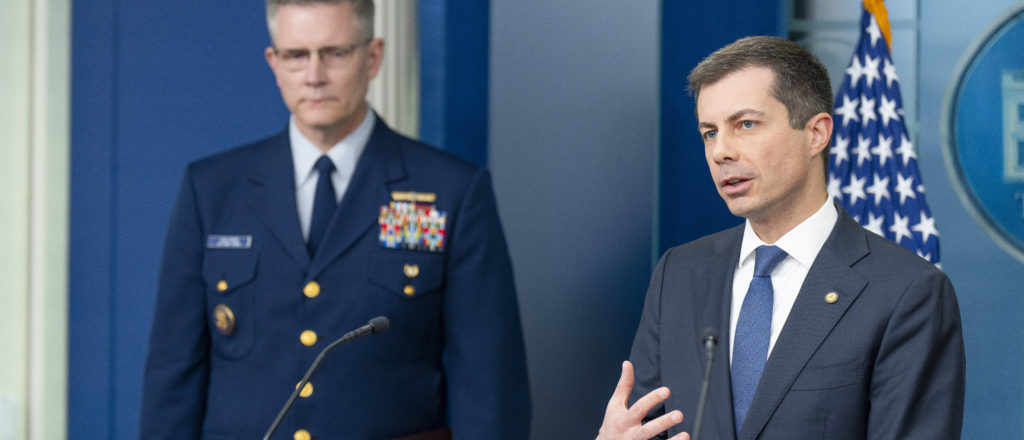
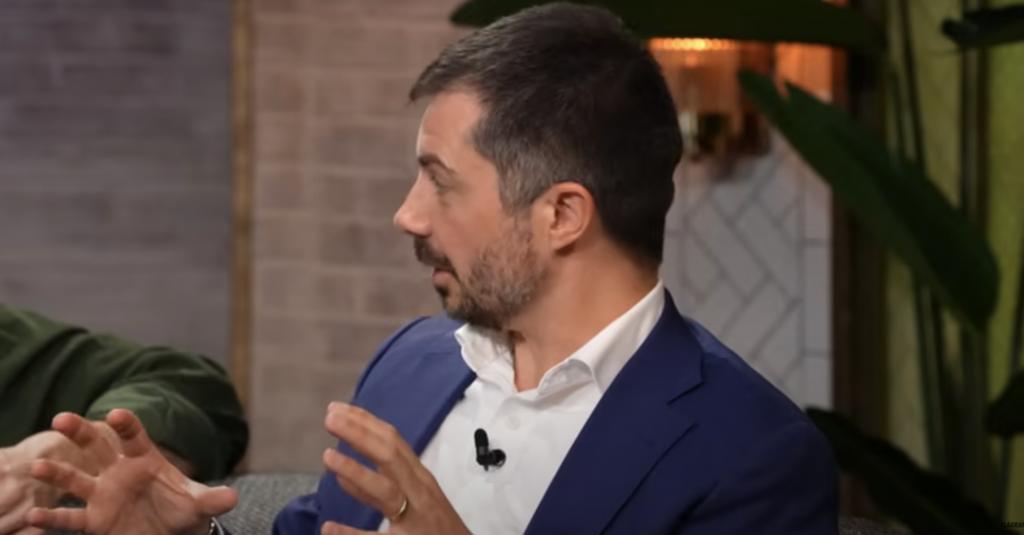
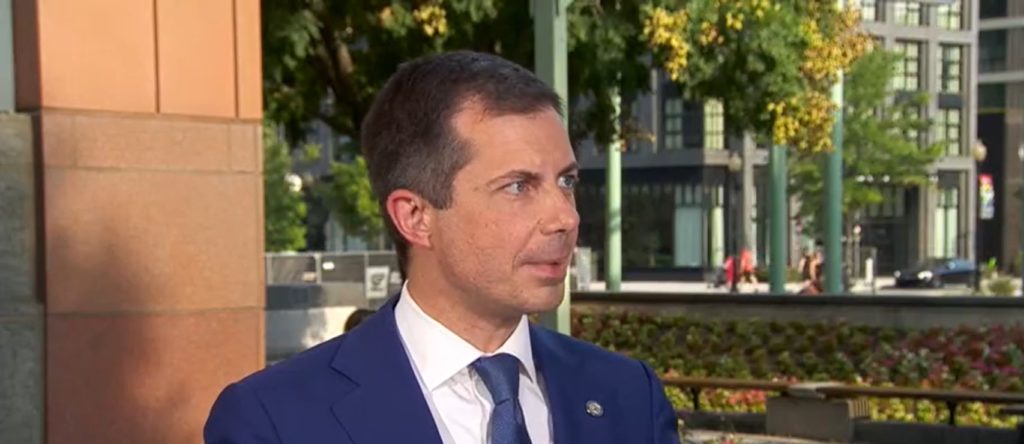

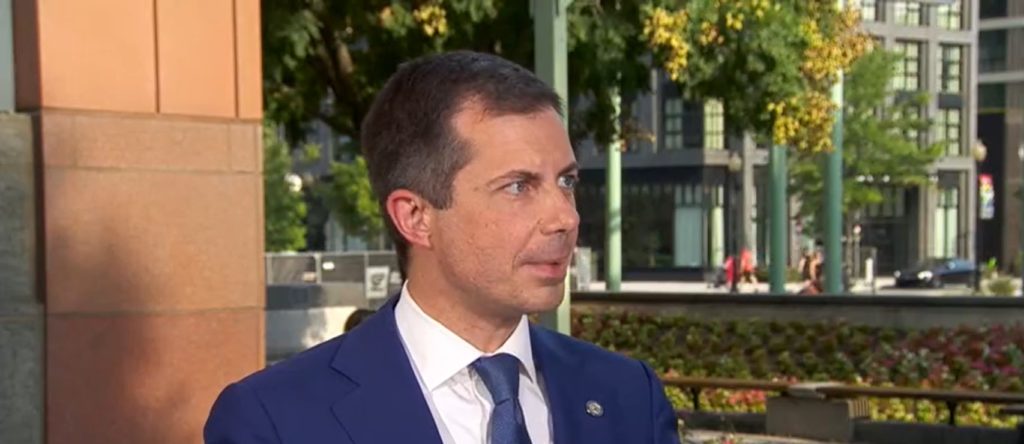
Peter Paul Montgomery Buttigieg ( BOO-tij-əj; born January 19, 1982) is an American politician and former naval officer who served as the 19th United States secretary of transportation from 2021 to 2025. A member of the Democratic Party, he previously served as the 32nd mayor of South Bend, Indiana, from 2012 to 2020.
Buttigieg is a graduate of Harvard College and the University of Oxford, attending the latter on a Rhodes Scholarship. In 2007, he began three years of work at the management consulting firm McKinsey & Company. From 2009 to 2017, he was an intelligence officer in the United States Navy Reserve, attaining the rank of lieutenant. He was mobilized and deployed to the war in Afghanistan for seven months in 2014. Afterwards, he worked on the political campaigns of Democrats Jill Long Thompson, Joe Donnelly, and John Kerry, and was the unsuccessful Democratic nominee for Indiana state treasurer in 2010. In 2011, he was elected mayor of South Bend. In 2015, Buttigieg was re-elected, coming out as gay earlier that year. He married Chasten Glezman, a schoolteacher and writer, in June 2018. Buttigieg declined to seek a third term as mayor.
In April 2019, Buttigieg announced a 2020 presidential campaign, making him the first openly gay man to launch a Democratic presidential campaign. During the Democratic Party primaries, he gained significant momentum in mid-2019 after several town hall meetings and television debates. Buttigieg narrowly won the Iowa caucuses while placing second in the popular vote, and placed a close second in the New Hampshire primary. By winning Iowa, he became the first openly gay candidate to win a presidential primary or caucus. Buttigieg dropped out of the race on March 1, 2020, and endorsed Joe Biden the following day.
After Biden won the 2020 presidential election, he named Buttigieg as his nominee for Secretary of Transportation in December 2020. His nomination was confirmed on February 2, 2021, by a vote of 86–13, making him the first openly gay Cabinet secretary in U.S. history. Nominated at age 38, he was also the youngest Cabinet member in the Biden administration and the youngest person ever to serve as Secretary of Transportation. After Biden withdrew his re-election campaign in 2024, Buttigieg was considered as a potential running mate for Kamala Harris, though he was ultimately not selected.
Contents
Early life and career
Pete Buttigieg was born on January 19, 1982, in South Bend, Indiana, to Jennifer "Anne" Montgomery and Joseph Anthony Buttigieg II. He is an only child. His parents met and married while employed as faculty at New Mexico State University. His father was born in Ħamrun, Malta, and emigrated to the United States to pursue his doctorate. Buttigieg's father embarked on a career as a professor of English at the University of Notre Dame near South Bend. Buttigieg's mother also taught at the University of Notre Dame for 29 years. His father, a translator of Italian Marxist philosopher Antonio Gramsci's Prison Notebooks and the editor of a three-volume English edition, influenced his son's decision to study literature in college.
Education
Buttigieg was valedictorian of the class of 2000 at St. Joseph High School in South Bend. That year, he won first prize in the John F. Kennedy Presidential Library and Museum's Profiles in Courage essay contest. He traveled to Boston where he accepted the award and met Caroline Kennedy and other members of the Kennedy family. The subject of his essay was the integrity and political courage of then U.S. representative Bernie Sanders of Vermont, one of only two independent politicians in Congress.
In 2000, Buttigieg was one of two students chosen to be a delegate from Indiana to the United States Senate Youth Program, an annual scholarship competition sponsored jointly by the U.S. Senate and the Hearst Foundations.
In his last high-school year, Buttigieg was named the school valedictorian, voted senior class president and chosen Most Likely to be U.S. President.
After graduating from high school, Buttigieg attended Harvard College, where he majored in history and literature. He became president of the Student Advisory Committee of the Harvard Institute of Politics and worked on the institute's annual study of youth attitudes on politics. His undergraduate thesis, The Quiet American's Errand into the Wilderness, examined the influence of Puritanism on U.S. foreign policy as reflected in Graham Greene's novel The Quiet American. He graduated magna cum laude from Harvard in 2004, and was elected a member of Phi Beta Kappa.
Buttigieg was awarded a Rhodes Scholarship to study at the University of Oxford. In 2007, he received a Bachelor of Arts degree with first-class honours in philosophy, politics, and economics after studying at Pembroke College, Oxford. At Oxford, he was an editor of the Oxford International Review, and was a co-founder and member of the Democratic Renaissance Project, an informal debate and discussion group of approximately a dozen Oxford students.
Professional career
Before graduating from college, Buttigieg was an investigative intern at WMAQ-TV, Chicago's NBC News affiliate. He also interned for Democrat Jill Long Thompson during her unsuccessful 2002 congressional bid.
After college, Buttigieg worked on John Kerry's 2004 presidential campaign as a policy and research specialist for several months in Arizona and New Mexico. From 2004 to 2005, Buttigieg was conference director of the Cohen Group. In 2006, he lent assistance to Joe Donnelly's successful congressional campaign.
After earning his Oxford degree, in 2007, Buttigieg became a consultant at the Chicago office of McKinsey & Company, where he worked on energy, retail, economic development, and logistics for three years. His clients at McKinsey included the health insurer Blue Cross Blue Shield of Michigan; electronics retailer Best Buy; Canadian supermarket chain Loblaws; two nonprofit environmentalist groups, the Natural Resources Defense Council and Energy Foundation; and several U.S. government agencies, the Environmental Protection Agency (EPA), Energy Department, Defense Department, and Postal Service. He took a leave of absence from McKinsey in 2008 to become research director for Jill Long Thompson's unsuccessful campaign for Indiana governor. His work at McKinsey included trips to Iraq and Afghanistan, which he rarely discusses. Buttigieg left McKinsey in 2010 in order to focus full-time on his campaign for Indiana state treasurer.
Buttigieg has been involved with the Truman National Security Project since 2005 and serves as a fellow with expertise in Afghanistan and Pakistan. He was named to the organization's board of advisors in 2014.
Military service
Buttigieg joined the U.S. Navy Reserve through the direct commission officer (DCO) program and was sworn in as an ensign in naval intelligence in September 2009. He took a seven-month leave during his mayoral term to deploy to Afghanistan in 2014. While there, Buttigieg was part of a unit assigned to identify and disrupt terrorist finance networks. Part of this was done at Bagram Air Base, but he was also an armed driver for his commander on more than 100 trips into Kabul, where he was tasked with watching out for ambushes and explosive devices along the roads and ensuring that the vehicle was guarded. Buttigieg has jokingly referred to this role as "military Uber". Also, while deployed in Afghanistan, Buttigieg was assigned to the Afghan Threat Finance Cell, a counterterrorism unit that targeted Taliban insurgency financing. Buttigieg was awarded the Joint Service Commendation Medal. He left the U.S. Navy Reserve in 2017.
Indiana state treasurer election
Buttigieg was the Democratic nominee for state treasurer of Indiana in 2010. He received 37.5 percent of the vote, losing to Republican incumbent Richard Mourdock. Much of Buttigieg's campaign had focused on criticizing Mourdock for investing state pension funds in Chrysler junk bonds, and for having subsequently filed a lawsuit against Chrysler's bankruptcy restructuring, which Buttigieg argued imperiled Chrysler jobs in the state of Indiana.
Mayor of South Bend
First term
Buttigieg ran for the Democratic nomination for mayor of South Bend in 2011. In a PBS Michiana – WNIT broadcast, he expressed his desire to reinvigorate South Bend, especially with respect to job creation and education. Buttigieg campaigned on other issues, such as pursuing international investment, increasing presence of police and other safety professionals, and improving city services. Buttigieg won his primary election against four opponents on May 3, 2011, receiving 7,663 votes. Buttigieg was elected mayor of South Bend in the November 2011 general election with 10,991 of the 14,883 votes cast, or 74 percent of all votes. He defeated Republican nominee Norris W. Curry Jr. and Libertarian nominee Patrick M. Farrell. Buttigieg took office in January 2012 at the age of 29, becoming the second-youngest mayor in South Bend history and the youngest incumbent mayor, at the time, of a U.S. city with at least 100,000 residents.
After a federal investigation ruled that South Bend police had illegally recorded telephone calls of several officers, Buttigieg demoted police chief Darryl Boykins in 2012. Buttigieg also dismissed the department's communications director, who had discovered the recordings but continued to record the line at Boykins's command. The police communications director alleged that the recordings captured four senior police officers making racist remarks and discussing illegal acts.
Buttigieg has written that his "first serious mistake as mayor" came shortly after taking office in 2012, when he decided to ask for Boykins's resignation. Backed by supporters and legal counsel, Boykins requested reinstatement. When Buttigieg denied his request, Boykins, as the city's first African American police chief, sued the city for racial discrimination, arguing that the taping policy had existed under previous police chiefs, who were white. Buttigieg settled the lawsuits brought by Boykins and the four officers out of court for over $800,000. A federal judge ruled in 2015 that Boykins's recordings violated the Federal Wiretap Act. Buttigieg came under pressure from political opponents to release the eight tapes, but he said that it was not possible to release seven of them, citing the Federal Wiretap Act. It was unclear if releasing the eighth tape would violate any laws. St. Joseph County Superior Court Judge Steve Hostetler heard a case for the release of five cassette tapes. Judge Hostetler ruled that the cassette tapes must be released to the South Bend City Council in May 2021.
As mayor, Buttigieg promoted a number of development and redevelopment projects. Buttigieg was a leading figure behind the creation of a nightly laser-light display along downtown South Bend's St. Joseph River trail as public art. The project cost $700,000, which was raised from private funds. The "River Lights" installation was unveiled in May 2015 as part of the city's 150th anniversary celebrations. He also oversaw the city's launching of a 3-1-1 system in 2013. Buttigieg's administration oversaw the sale of numerous city-owned properties. One of Buttigieg's signature programs was the "Vacant and Abandoned Properties Initiative". Known locally as 1,000 Properties in 1,000 Days, it was a project to repair or demolish blighted properties across South Bend. The program reached its goal two months before its scheduled end date in November 2015. By the thousandth day of the program, before Buttigieg's first term ended, nearly 40 percent of the targeted houses were repaired, and 679 were demolished or under contract for demolition. Buttigieg took note of the fact that many homes within communities of color were the ones demolished, leading to early distrust between the city and these communities.
Second term
Buttigieg announced in 2014 that he would seek a second term in 2015. He won the Democratic primary with approximately 78 percent of the vote, defeating Henry Davis Jr., the city councilman from the second district. In November 2015, he was elected to his second term as mayor with over 80 percent of the vote, defeating Republican Kelly Jones by a margin of 8,515 to 2,074 votes. After winning reelection, Buttigieg signed an executive order helping to establish a recognized city identification card in 2016.
To improve South Bend's downtown area, Buttigieg proposed a Smart Streets urban development program in 2013. In early 2015 – after traffic studies and public hearings – he secured a bond issue for the program backed by tax increment financing. Smart Streets was a complete streets implementation program aimed at improving economic development and urban vibrancy as well as road safety. Elements of the project were finished in 2016, and the project was officially completed in 2017. The project was credited with spurring private development in the city.
In a new phase of the Vacant and Abandoned Properties Initiative, South Bend partnered with the Notre Dame Clinical Law Center to provide free legal assistance to qualifying applicants wishing to acquire vacant lots and, with local nonprofits, to repair or construct homes and provide low-income home ownership assistance using South Bend Housing and Urban Development funds.
The City of South Bend partnered with the State of Indiana and private developers to break ground on a $165-million renovation of the former Studebaker complex in 2016, hoping that the redevelopment would facilitate industrial and housing units. This development is in the Renaissance District which includes nearby Ignition Park. In 2017, it was announced that the long-abandoned Studebaker Building 84, also known as Ivy Tower, would have its exterior renovated with $3.5 million in Regional Cities funds from the State of Indiana and another $3.5 million from South Bend tax increment financing, with plans for the building and other structures in its complex to serve as a technology hub. The website Best Cities later ranked South Bend number 39 on its 2020 list of the 100 best small cities in the United States, citing Buttigieg's efforts to revitalize the Studebaker factory and Downtown South Bend.
Under Buttigieg, the city also began a smart sewer program, the first phase of which was finished in 2017 at a cost of $150 million. The effort used federal funds and by 2019 had reduced the combined sewer overflow by 75 percent. The impetus for the effort was a fine that the EPA had levied against the city in 2011 for Clean Water Act violations. In 2019, Buttigieg asked for the city to be released from an agreement with the EPA brokered under his mayoral predecessor Steve Luecke, in which South Bend had agreed to make hundreds of millions of dollars in further improvements to its sewer system by 2031.
DNC chairmanship campaign
In January 2017, Buttigieg announced his candidacy for chairman of the Democratic National Committee (DNC) in its 2017 chairmanship election. He built a national profile as an emerging dark horse in the race for the chairmanship with the backing of former DNC chairman Howard Dean, former Maryland governor Martin O'Malley, Indiana senator Joe Donnelly, and North Dakota senator Heidi Heitkamp. Buttigieg campaigned on the need for the Democratic Party to empower its millennial members. Buttigieg pledged to resign as mayor if elected DNC chair.
Former U.S. secretary of labor Tom Perez and U.S. representative Keith Ellison quickly emerged as the favored candidates of a majority of DNC members. Buttigieg withdrew from the race on the day of the election without endorsing a candidate, and Perez was elected chairman after two rounds of voting.
2020 presidential campaign
On January 23, 2019, Buttigieg announced that he was forming an exploratory committee to run for President of the United States in the upcoming 2020 election. Buttigieg sought the Democratic Party nomination for president. If he had been elected, he would have been the youngest and first openly gay American president. Amid the start of Buttigieg's presidential effort, on February 12, 2019, he published his debut book, autobiography Shortest Way Home. Two months later, Buttigieg officially launched his campaign on April 14, 2019, in South Bend.
Buttigieg described himself as a progressive and a supporter of democratic capitalism. Historian David Mislin identifies Buttigieg as a pragmatic progressive in the tradition of the Social Gospel movement once strong in the Midwest. Buttigieg identifies regulatory capture as a significant problem in American society.
Initially regarded as a long-shot candidate, Buttigieg rose into the top-tier of candidates in the primary by December 2019. In early February 2020, Buttigieg led the 2020 Iowa Democratic caucuses results with 26.2 percent to Bernie Sanders' 26.1 percent, winning 14 delegates to Sanders's 12. The LGBTQ Victory Fund, Buttigieg's first national endorsement, noted the historical first of an openly gay candidate winning a state presidential primary. Buttigieg finished second behind Sanders in the New Hampshire primary. After placing fourth in the South Carolina primary with 8.2 percent of the vote, behind Joe Biden (48.7 percent), Bernie Sanders (19.8 percent), and Tom Steyer (11.3 percent), Buttigieg dropped out of the race on March 1, 2020, and endorsed Biden.
A 2023 study by political scientists from Loyola Marymount University reported how different aspects of Buttigieg's biography affected voters' views on his electability as a US president. The authors concluded, that "His military background... successfully countered voter discrimination, suggesting that some gay candidates may close the gap once voters learn more about their story."
Post-presidential campaign
In April 2020, Buttigieg launched Win The Era PAC, a new super PAC to raise money and distribute it to down-ballot Democrats. The PAC focused on local elected positions, and its list of endorsements included candidates such as Jaime Harrison, Cal Cunningham, Gina Ortiz Jones, Christine Hunschofsky, and Levar Stoney. On June 8, 2020, the University of Notre Dame announced that it had hired Buttigieg as a teacher and researcher for the 2020–21 academic year. Also, in October 2020, Buttigieg released his second book, Trust: America's Best Chance.
Buttigieg acted as a surrogate for Biden's campaign in the general election. He delivered a speech on the closing night of the 2020 Democratic National Convention, and also announced Indiana's votes during the convention's roll call. On September 5, 2020, Buttigieg was announced to be a member of the advisory council of the Biden-Harris Transition Team that was planning the presidential transition of Joe Biden. Ahead of the vice presidential debate, Buttigieg played the role as a stand-in for Republican vice president Mike Pence to prepare vice-presidential nominee Kamala Harris. Buttigieg was selected to perform this role because of his experience working with Pence during their simultaneous tenures as mayor of South Bend and governor of Indiana, respectively.
Secretary of Transportation (2021–2025)
Nomination and confirmation
Following the end of his presidential campaign, Buttigieg was considered a possible Cabinet appointee in Joe Biden's administration. After Biden was declared the winner of the election on November 7, 2020, Buttigieg was again mentioned as a possible nominee for Secretary of Veterans Affairs, Ambassador to the United Nations, Ambassador to China or Secretary of Transportation. On December 15, 2020, Biden announced that he would nominate Buttigieg as his Secretary of Transportation. The Senate Commerce Committee advanced Buttigieg's nomination to the full Senate with a vote of 21–3. Buttigieg was confirmed on February 2, 2021, with a vote of 86–13, and was sworn in the next morning.
Tenure
As Secretary of Transportation, Buttigieg worked on re-organizing the department's internal policy structure, including carrying out a thorough review process of rules enacted under the Trump administration. For example, Buttigieg reinstated an Obama-era pilot program which ensures local hiring for public works projects on May 19, 2021, with the goal of helping minorities and disadvantaged individuals. This program had been revoked in 2017 during the Trump administration, when the Department of Transportation returned to rules established during the Reagan administration, which banned geographic-based hiring preferences.
Buttigieg addressed the African American Mayors Association in late February 2021 to discuss systemic racism. He argued that misguided investments in the federal transport and infrastructure policy had contributed to racial inequity. In early March 2021, Politico noted that Buttigieg had mentioned racial equity in almost every interview he gave to the press as it related to his work at the department. In late June 2022, Buttigieg launched a $1 billion Reconnecting Communities pilot program to establish racial equity in roads. Using money from the Infrastructure Investment and Jobs Act, the program aims to reconnect cities and neighborhoods divided by roads through projects such as rapid bus lines, pedestrian walkways, and planning studies.
After the 2021 birth of his twins, Buttigieg took a parental leave. This became a point of prominent criticism and ridicule from conservative and Republican figures. Some political analysts have noted homophobic tones to the attacks on Buttigieg's decision to take a parental leave. After conservatives criticized him for taking a paternity leave, Buttigieg declared that he would not apologize for "taking care of my premature newborn infant twins. The work that we are doing is joyful, fulfilling, wonderful work." According to his department, Buttigieg had been on paid leave since mid-August 2021, where for a month he was "mostly offline except for major agency decisions and matters that could not be delegated", and he "has been ramping up activities since then", making many media appearances in early October 2021. The White House had approved Buttigieg's leave.
After passage of the Infrastructure Investment and Jobs Act, Insider called Buttigieg "the most powerful transportation secretary ever", as the department now has $210 billion of discretionary grants to award.
Post-secretary career (2025–present)
In January 2025, news reports emerged that Buttigieg considered a run for U.S. Senate in Michigan, with the announced retirement of U.S. senator Gary Peters. Previously, he had expressed interest in running for the state's gubernatorial election to replace the incumbent governor Gretchen Whitmer, who was term-limited. From February to April 2025, Buttigieg served as a fellow at the University of Chicago Institute of Politics, delivering a seminar on campus every week. In March 2025, Buttigieg opted not to run for the U.S. Senate in Michigan in 2026, with sources saying that he was instead mulling a run for president in 2028.
Kamala Harris, the 2024 Democratic presidential nominee, reported in her 2025 book 107 Days that she wanted to choose Buttigieg as her running mate, but decided against it. She chose to not select him due to concerns about Buttigieg's sexuality (combined with Harris's own background as a woman and racial minority) affecting the ticket's electability.
Political positions
During his 2020 presidential run and after, Buttigieg has been variously described as a moderate or centrist Democrat, a progressive, or a technocratic liberal. In 2019, Buttigieg labeled himself both as a progressive and a democratic capitalist but has simultaneously downplayed this, saying "these labels are becoming less and less useful" and that political ideology has "never been less relevant."
Infrastructure
During his 2020 campaign for the Democratic nomination, Buttigieg proposed spending $1 trillion on U.S. infrastructure projects over the next ten years, estimating that the plan would create at least six million jobs. The plan focused on green energy, protecting tap water from lead, fixing roads and bridges, improving public transportation, repairing schools, guaranteeing broadband internet access, and preparing communities for floods and other natural disasters.
Social issues
Buttigieg supports abortion rights and the repeal of the Hyde Amendment, which blocks federal funding for abortion services except in cases of rape, incest, or if the life of the mother is in danger. He favors amending civil rights legislation, including the Federal Equality Act, so that LGBT Americans receive federal non-discrimination protections.
Buttigieg supports expanding opportunities for national service, including a voluntary year of national service for those turning 18 years old.
In July 2019, Buttigieg shared his "Douglass Plan", named after abolitionist Frederick Douglass, to address systemic racism in America. The initiative would allocate $10 billion to African American entrepreneurship over five years; grant $25 billion to historically black colleges; legalize marijuana; expunge drug convictions; halve the federal prison population; and propose a federal New Voting Rights Act designed to increase voting access.
Buttigieg supports abolishing the death penalty, moving toward reversing criminal sentences for minor drug-related offenses, and eliminating incarceration for drug possession offenses.
In 2019, Buttigieg called for the United States to decriminalize mental illness and addiction via initiatives such as re-entry programs. Also, he aspired to decrease incarceration rates because of mental illnesses or substance use by 75 percent during his first term as President of the United States.
Voting rights
Buttigieg favors the abolition of the Electoral College and has also called for restoring voting rights to felons who have completed their prison sentences.
Campaign finance reform
Buttigieg supports a constitutional amendment on campaign finance to reduce the undue influence of money in politics. During his 2020 presidential run, in response to accusation of campaign finance concerns, Buttigieg's campaign told Newsweek that he did not accept contributions from individuals and organizations such as corporate political action committees. In addition, Buttigieg's campaign emphasized that Buttigieg had included critical campaign finance reforms as part of his campaign platform, including pushing to overturn Citizens United and Buckley v. Valeo.
Statehood advocacy
Buttigieg supports statehood for the District of Columbia, and said that he would support Puerto Rico statehood if desired by the Puerto Rican people.
Climate change
During his campaign for the Democratic presidential nomination, Buttigieg stated that, if elected, he would restore the United States' commitment to the Paris Climate Agreement and double its pledge to the Green Climate Fund. He also supports the Green New Deal proposed by House Democrats, solar panel subsidies, and a carbon tax and dividend policy to reduce greenhouse gas emissions.
Economic beliefs
Buttigieg identifies as a democratic capitalist and has decried crony capitalism. He has entertained the possibility of antitrust actions against large technology companies on the basis of privacy and data security concerns. During the Democratic primary, he supported deficit and debt reduction, arguing that large debt makes it harder to invest in infrastructure, health and safety.
Workers' rights
In July 2019, he released a plan to strengthen union bargaining power, to raise the minimum wage to $15, and to offer national paid family leave.
Education
Buttigieg's education plan includes a $700-billion investment in universal full-day child care and pre-kindergarten for all children from infancy to age five. Buttigieg has also proposed tripling Title I funding for schools serving students predominately from lower socioeconomic backgrounds. Other goals include doubling the number of new teachers of color in the next 10 years; addressing school segregation with a $500-million fund; paying teachers more; expanding mental health services in schools; and creating more after-school programs and summer learning opportunities.
His plan for debt-free college has called for expanding Pell Grants for low-income students, as well as other investments and reversing Trump's tax cuts for the wealthy. Under Buttigieg's college plan, the bottom 80 percent of students with respect to income would have received free education, while the top 20 percent would have paid for at least some portion of their tuition. Buttigieg has opposed free college tuition for all students because he has believed universally free tuition unfairly subsidizes higher-income families at the expense of lower-income individuals who do not attend college. This position distinguished Buttigieg from his competitors in the 2020 presidential election.
Foreign policy
In 2020, Buttigieg called for modifying the structure of defense spending, while suggesting that he might favor an overall increase in defense spending.
Buttigieg has said that he believes the 2001 U.S. invasion of Afghanistan following the September 11 attacks was justified but supported the planned withdrawal of American troops from the region with a maintained intelligence presence.
In 2008, Buttigieg wrote an op-ed in The New York Times calling on the United States to support the de facto independent Republic of Somaliland.
In June 2019, Buttigieg said: "We will remain open to working with a regime like the Kingdom of Saudi Arabia for the benefit of the American people. But we can no longer sell out our deepest values for the sake of fossil fuel access and lucrative business deals." He supports ending U.S. support for Saudi Arabia in Saudi Arabia's war in Yemen.
Buttigieg has condemned China for its mass detention of ethnic Uyghurs in Xinjiang. He criticized Trump's decision to withdraw U.S. troops from Syria, which critics say gave Turkey the green light to launch its military offensive against Syrian Kurds.
Buttigieg is a committed supporter of Israel. He favors a two-state solution to the Israeli–Palestinian conflict. He opposes proposals for Israel to annex the Israeli-occupied West Bank, and disapproves of Israeli prime minister Benjamin Netanyahu's comments in support of applying Israeli law in Jewish settlements in the West Bank.
In an August 2025 interview on Pod Save America, Buttigieg did not give a clear answer on whether he supported limiting arms sales to Israel. He said, "I think that we, as Israel's strongest ally and friend, you put your arm around your friend when there's something like this going on, and talk about what we're prepared to do together." Following widespread criticism for his comments, Buttigieg said he would support limiting arms sales to Israel, as well as U.S. recognition of Palestine. In 2026, Buttigieg did not respond when asked by Politico if he would reject support from AIPAC, a pro-Israel lobby group.
Healthcare
Buttigieg opposed Republican efforts to repeal the Affordable Care Act.
In 2018, Buttigieg said he favored Medicare for All. During his presidential campaign, Buttigieg has promoted Medicare for All Who Want It, which includes a public option for health insurance. He has spoken favorably of Maryland's all-payer rate setting. Buttigieg has described Medicare for All Who Want It as inclusive, more efficient than the current system, and a possible precursor or "glide path" to single-payer health insurance. He also favors a partial expansion of Medicare that would allow Americans ages 50 to 64 to buy into Medicare, and supports proposed legislation, the Family and Medical Insurance Leave Act, that would "create a fund to guarantee up to 12 weeks of partial income for workers to care for newborn children or family members with serious illnesses."
In August 2019, Buttigieg released a $300 billion plan to expand mental health care services and fight addiction.
Immigration
Buttigieg supports Deferred Action for Childhood Arrivals (DACA) and repeatedly criticized the first Trump administration's aggressive deportation policies. In March 2017, he wrote an article for the HuffPost defending a resident of Granger, Indiana, who was deported after living in the U.S. for 17 years despite regularly checking in with ICE and applying for a green card.
In January 2019, Buttigieg told CBS News that Trump had been "reckless" in sending American troops to the Southern border, calling the decision "a measure of last resort".
Personal life
Buttigieg is a Christian, and he has said his faith has had a strong influence in his life. He was baptized in the Catholic Church as an infant and attended Catholic schools. While at the University of Oxford, Buttigieg attended Christ Church Cathedral, saying he felt "more-or-less Anglican" by the time he returned to South Bend. Augustine of Hippo, Catholic priest James Martin, and Garry Wills are among his religious influences. A member of the Episcopal Church, Buttigieg attended the Cathedral of St. James while living in South Bend.
Besides his native English, Buttigieg has some knowledge of Norwegian, Spanish, Italian, Maltese, Arabic, Dari Persian, and French. Buttigieg plays guitar and piano, and in 2013 performed with the South Bend Symphony Orchestra as a guest piano soloist with Ben Folds. Buttigieg was a 2014 Aspen Institute Rodel Fellow.
Buttigieg came out as gay in a June 2015 piece in the South Bend Tribune, becoming Indiana's first openly gay elected executive. He was the first elected official in Indiana to come out while in office and the highest elected official in Indiana to come out.
Buttigieg announced his engagement to Chasten Glezman, a junior high school teacher, in a December 14, 2017, Facebook post. They had been dating since August 2015 after meeting on the dating app Hinge. They were married on June 16, 2018, in a private ceremony at the Cathedral of St. James. This made Buttigieg the first mayor of South Bend to get married while in office. Chasten uses the surname Buttigieg.
Buttigieg announced on August 17, 2021, that he and his husband had become parents. He elaborated on September 4, 2021, that they had adopted two newborn fraternal twins. In June 2026, he was separated from his children overnight after an anonymous report, which the police determined to be meritless, accused him of abusing them.
In July 2022, Buttigieg established his permanent residence in Traverse City, Michigan, which is Chasten's hometown, and registered to vote in Michigan.
Awards and honors
Buttigieg was a 2015 recipient of the Fenn Award, given by the John F. Kennedy Presidential Library in recognition of his work as mayor. To mark the 50th anniversary of the Stonewall riots in June 2019, Queerty named him one of its "Pride50" people—"trailblazing individuals who actively ensure society remains moving towards equality, acceptance and dignity for all queer people". At the Golden Heart Awards, run by God's Love We Deliver, Buttigieg was awarded the "Golden Heart Award for Outstanding Leadership and Public Service" in October 2019. Equality California, an LGBT-rights organization, gave Buttigieg and his husband Chasten their Equality Trailblazer Award in August 2020. Attitude, a British gay lifestyle magazine, named Buttigieg their 2020 Person of the Year to recognize his groundbreaking run for the presidency. In August 2024, Buttgieg was inducted by the LGBTQ Victory Fund into the LGBTQ+ Political Hall of Fame.
Books
Shortest Way Home: One Mayor's Challenge and a Model for America's Future. New York: Liveright. 2019. ISBN 978-1-63149-437-6.
Trust: America's Best Chance. New York: Liveright. 2020. ISBN 978-1-63149-877-0.

