Career
All of his films were either documentary or drama presented with documentary techniques, sometimes portraying historical occurrences and sometimes possible near future events as if contemporary reporters and filmmakers were there to interview the participants. Watkins pioneered this technique in his first full-length television film, Culloden, which portrayed the Jacobite uprising of 1745 in a style similar to the Vietnam War reporting of the time. In 1965, he won a Jacob's Award for Culloden at the annual presentation ceremony in Dublin.
The scope and formal innovation of Culloden drew immediate critical acclaim for the previously unknown director, and the BBC commissioned him for another ambitious production, the nuclear-war docudrama The War Game, for The Wednesday Play series. The production was subsequently released to cinemas and won the 1966 Academy Award for Documentary Feature, but was banned for almost two decades, eventually being screened by the BBC on 31 July 1985.
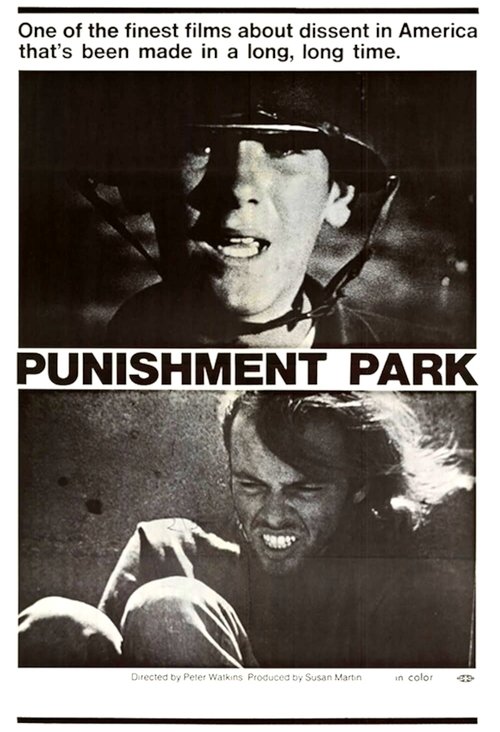
His reputation as a political provocateur was amplified by Punishment Park, a story of violent political conflict in the United States that coincided with the Kent State Massacre. Opposition to war is a common theme of his work, but the films' political messages are often ambiguous, usually allowing the main characters to present violently opposing viewpoints which in many cases are improvised by the cast: in Punishment Park, the soldiers and dissidents were played by nonprofessional actors whose political opinions matched those of their characters so well that the director said he feared actual violence would break out on set. He took a similar approach in his Paris Commune re-enactment La Commune, using newspaper advertisements to recruit conservative actors who would have a genuine antipathy to the commune rebels. Watkins is also known for political statements about the film and television media, writing extensively about flaws in television news and the dominance of the Hollywood-derived narrative style that he refers to as "the monoform".
After the banning of The War Game and the poor reception of his first non-television feature, Privilege, Watkins left England and made all of his subsequent films abroad: The Gladiators in Sweden, Punishment Park in the United States, Edvard Munch in Norway, Evening Land in Denmark, Resan (a 14-hour film cycle about the threat of nuclear war) in 10 different countries, and La Commune in France. Freethinker: The Life and Work of Peter Watkins, is a forthcoming biography by Patrick Murphy, a senior lecturer in film and television at York St John University, and John Cook. It was compiled with Watkins's active help and participation.
Following Privilege, Watkins planned a Western film following a fictional American Indian tribe, to which Universal Studios showed interest and Marlon Brando agreed to star as a cavalry scout. However, Watkins conceived a new script in the style of Culloden, titled Proper in the Circumstances, which covered the Washita Massacre and battles in the Great Sioux War. The new script was rejected by Universal on the grounds that American audiences would not be interested in another film about George Custer.
In 2004, he wrote the book Media Crisis, which discusses his ideas of media hegemony which he called, the monoform, and the lack of debate around the construction of new forms of audiovisual media.