Film
Trouble in Molopolis (1970), Mora's first feature-length film (the title a homage to Fritz Lang's Metropolis), was financed by the partnership of Arthur Boyd and Eric Clapton. Shot in Robert Hughes' apartment and at the Pheasantry, the film features Germaine Greer as a cabaret singer, Jenny Kee as 'Shanghai Lil', Laurence Hope as a gangster, Martin Sharp as a mime and Richard Neville as a PR man. Tony Cahill from The Easybeats collaborated with Jamie Boyd for the score before the film premiered at the Paris Pullman Cinema in Chelsea, as an Oz benefit. Introduced by George Melly, star John Ivor Golding also made a memorable appearance at the premiere, defecating in the front row and then passing out in an alcoholic coma. Shown in May 1970 at the Festival of British independent Films in London, it was eventually screened in Australia at the Adelaide Film Festival in 1980.
At age 23, Mora directed Swastika, a two-hour compilation selected from 250 hours of captured Nazi documentaries, anti-Semitic propaganda, the Berlin Olympics including an interview with a polite Jesse Owens, and sequences from home movies made by Eva Braun discovered in the United States Marine and Signal Corps files in Washington by German-born University of London academic and specialist in German film, Lutz Becker, who pointed out that it included the first piece of film ever to show Hitler, in Munich in 1919, and colour film of the Storm Troopers' victory parade in Berlin, 1933, remarking that "Even the Nazis didn't know about the 1919 piece of film with Hitler in it." In the same year Mora became editor and American correspondent of the newly launched Cinema Papers alongside Peter Beilby and Scott Murray.
In 1975, and newly married, Mora wrote and directed, Brother, Can You Spare a Dime?, a documentary about the 1930s Depression consisting of a series of film clips from newsreels and photographs, Hollywood films reflecting historical events, and those about making movies as well as outtakes, trailers, and home movies. It was screened at the Cannes Film Festival during 'Critics Week,' and at the 1975 Melbourne Film Festival, at which he announced that he had left Australia "because I wanted to get into films, and there was no industry here."
In 1976, after eight years working in London and New York, Mora's first feature film was Mad Dog Morgan, about the bushranger Daniel Morgan, which he also wrote and directed, explaining to Rita Erlich that while he was moving away from the documentary, in all films "one is telling a story, just using different means. Film is a narrative art." Starring Dennis Hopper, Jack Thompson, David Gulpilil, Bill Hunter and Frank Thring, produced by David Puttnam with A$175,666 investment and a A$8,500 loan from the Australian Film Corporation and private backers, Mad Dog Morgan was the first Australian movie to get a 40-cinema release in the United States and worldwide rights purchased for A$300,000 (worth nearly A$2 million in 2021). Though reviewer Michael Rowberry considered its "bid for realism has led the director to overdo the blood," and that the "simplistic morality of the film which ultimately robs it of depth," it went on to receive the John Ford Award at the Cannes Film Festival in 1976 as part of US Bicentennial celebrations, and in 1977 Mora was nominated by the Australian Film Institute for 'Best Director' for the film.
In early 1980, Mora and Ron Mallory took an option on Errol Flynn: The Untold Story by Charles Higham, raising hopes of an Australian film being produced in Hollywood, but abandoned after controversy over Higham's research; members of Flynn's family unsuccessfully sued the author and the book's publisher for libel. After making The Beast Within, his first film in America, Mora's next project on one of his periodic returns to Australia in 1981, was the parodic superhero musical, The Return of Captain Invincible, released in Hoyts cinemas for Christmas 1982 by Seven Keys, and starring Alan Arkin, Christopher Lee, Kate Fitzpatrick and an all-star Australian cast, with songs by The Rocky Horror Show creator Richard O'Brien. When Mora fell out with producer Andrew Gaty following Gaty re-cutting the film, the Department of Home Affairs pulled its certification as an Australian film asserting that it was then a different film, prompting a February 1983 court case, which was still not settled in July.
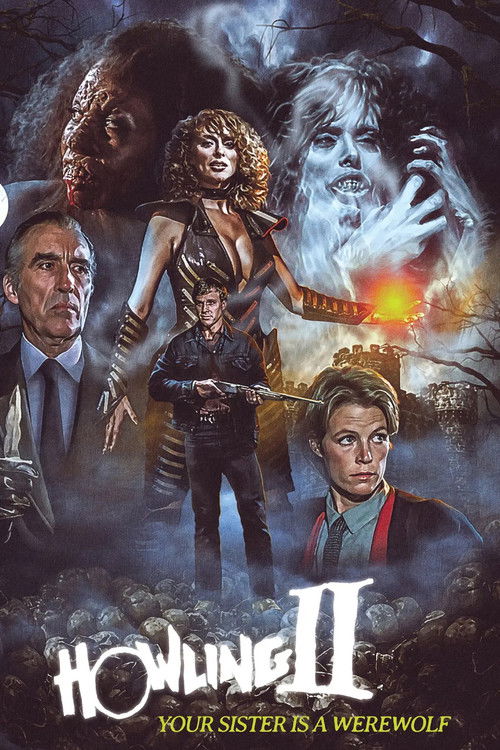
Mora's next productions were A Breed Apart with Rutger Hauer and Kathleen Turner, the werewolf horror films Howling II: Your Sister Is a Werewolf and Howling III, the latter shown at the Melbourne Comedy Festival in 1991, and the political drama Death of a Soldier, starring James Coburn, which was based on the infamous Melbourne wartime Eddie Leonski murder case. While in Australia to make the latter, Mora conducted a seminar in June 1985 at the Australian Screen Directors Association. Mora's next film used the plot of the book Communion, by his old friend from his London days in the late 1960s, artist, author and broadcaster Whitley Strieber. Released in 1989, and to video, the film starred Christopher Walken and was based on Strieber's own alleged encounters with aliens.
Film credits as director as well as occasional writer and actor during the 1990s included the horror spoof Pterodactyl Woman from Beverly Hills (1994) with Beverly D'Angelo, Barry Humphries (in three roles), Moon Unit Zappa and Philippe's children Georges and Madeleine; Art Deco Detective (1994); and Precious Find (1996), a sci-fi version of The Treasure of the Sierra Madre. For television, Mora directed Mercenary II: Thick & Thin (1997), and the films Back in Business (1997), Snide and Prejudice (1998) and Burning Down the House (1998).