




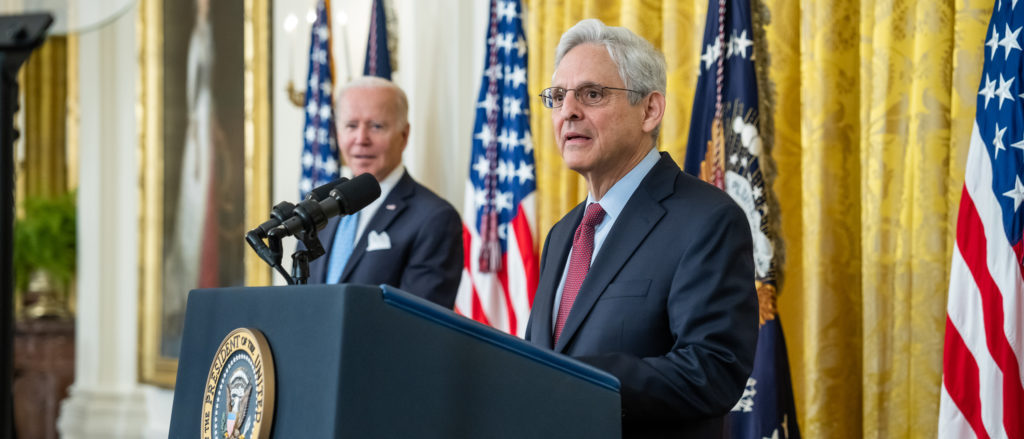
Joe Biden's tenure as the 46th president of the United States began with his inauguration on January 20, 2021, and ended on January 20, 2025. Biden, a member of the Democratic Party, had previously served as the 47th vice president from 2009 to 2017 under President Barack Obama, took office after defeating the Republican incumbent president Donald Trump in the 2020 presidential election. Upon his inauguration, he became the oldest president in American history, breaking the record set by Ronald Reagan. Alongside Biden's presidency, the Democratic Party also held their majorities in the House of Representatives and the Senate during the 117th U.S. Congress following the 2020 elections, thereby attained an overall federal government trifecta. Biden entered office amid the COVID-19 pandemic, an economic crisis, and increased political polarization.
Day one actions of his presidency included restoring U.S. participation in the Paris Agreement, revoking the permit for the Keystone XL pipeline and halting funding for the Mexico–United States border wall. On his second day, he issued a series of executive orders to reduce the impact of COVID-19, including invoking the Defense Production Act of 1950, and set an early goal of achieving one hundred million COVID-19 vaccinations in the United States in his first 100 days. The first major legislation signed into law by Biden was the American Rescue Plan Act of 2021, a $1.9 trillion stimulus bill that temporarily established expanded unemployment insurance and sent $1,400 stimulus checks to most Americans in response to continued economic pressure from COVID-19. He signed the bipartisan Infrastructure Investment and Jobs Act, a ten-year plan brokered by Biden alongside Democrats and Republicans in Congress to invest in American roads, bridges, public transit, ports and broadband access.
Biden proposed a significant expansion of the U.S. social safety net through the Build Back Better Act, but those efforts, along with voting rights legislation, failed in Congress. In August 2022, Biden signed the Inflation Reduction Act of 2022, a domestic appropriations bill that included some of the provisions of the Build Back Better Act after the entire bill failed to pass. It included significant federal investment in climate and domestic clean energy production, tax credits for solar panels, electric cars and other home energy programs as well as a three-year extension of Affordable Care Act subsidies, an insulin price cap, and a provision allowing Medicare to negotiate drug prices. In late 2022, Biden signed the Respect for Marriage Act, which repealed the Defense of Marriage Act and codified same-sex and interracial marriage in the United States. Other domestic legislation signed during his term included the Bipartisan Safer Communities Act, the first major federal gun control law in nearly three decades; the CHIPS and Science Act, bolstering the semiconductor and manufacturing industry; the Honoring our PACT Act, expanding health care for US veterans; the Electoral Count Reform and Presidential Transition Improvement Act; and the Juneteenth National Independence Day Act, making Juneteenth a federal holiday in the United States. Biden also unsuccessfully pushed for legislation protecting the right to abortion in response to the U.S. Supreme Court's decision in Dobbs v. Jackson Women's Health Organization overturning Roe v. Wade.
Biden appointed Ketanji Brown Jackson to the U.S. Supreme Court—the first Black woman to serve on the court. In response to the debt-ceiling crisis of 2023, he negotiated and signed the Fiscal Responsibility Act of 2023, which restrains federal spending for fiscal years 2024 and 2025, implements minor changes to SNAP and TANF, includes energy permitting reform, claws back some IRS funding and unspent money for COVID-19, and suspended the debt ceiling to January 1, 2025. He established the American Climate Corps and created the first ever White House Office of Gun Violence Prevention. On September 26, 2023, Biden visited a United Auto Workers picket line during the 2023 United Auto Workers strike, making him the first US president to visit one. Biden also rigorously enforced antitrust laws by appointing Lina Khan to head the FTC. Biden issued more individual pardons and commutations than any other president, including controversial sweeping pardons of members of his family and high-profile political figures that he claimed were either presently or expected to be the subject of "baseless and politically motivated investigations." The first sitting U.S. president to oppose the death penalty, Biden commuted the sentences of nearly all inmates on federal death row to life imprisonment weeks before leaving office.
The foreign policy goal of the Biden administration was to restore the U.S. to a "position of trusted leadership" among global democracies in order to address the challenges posed by Russia and China. Biden signed AUKUS, an international security alliance together with Australia and the United Kingdom. He supported the expansion of NATO with the additions of Finland and Sweden. Biden approved a raid which led to the death of Abu Ibrahim al-Hashimi al-Qurashi, the leader of the Islamic State, and approved a drone strike which killed Ayman Al Zawahiri, leader of Al-Qaeda. He completed the withdrawal of U.S. military forces from Afghanistan, declaring an end to nation-building efforts and shifting U.S. foreign policy toward strategic competition with China and, to a lesser extent, Russia. During the withdrawal, the Afghan government collapsed and the Taliban seized control, leading to Biden receiving bipartisan criticism. He responded to the Russian invasion of Ukraine by imposing sanctions on Russia and providing Ukraine with over $100 billion in combined military, economic, and humanitarian aid. During the Gaza war, Biden condemned the actions of Hamas and other Palestinian militants as terrorism, and announced American military support for Israel; he also sent humanitarian aid to the Gaza Strip and brokered a four-day temporary pause and hostage exchange in 2023 followed by a three-phase ceasefire in January 2025. In 2023, Biden negotiated the Camp David Principles, a security pact between Japan, South Korea, and the United States. He also oversaw the 2024 Ankara prisoner exchange, the largest prisoner exchange since the end of the Cold War, involving the release of 26 individuals, including American journalist Evan Gershkovich and former U.S. Marine Paul Whelan.
Biden began his term with over 50% approval ratings; these fell significantly after the withdrawal from Afghanistan, and remained low as the country experienced high inflation and rising gas prices, even as they later decreased during his presidency. His age and mental fitness were a frequent subject of discussion throughout his presidency, ultimately culminating in his decision to withdraw his bid for re-election in the 2024 presidential election. Trump won the election against Biden's preferred successor, Kamala Harris, making him the second U.S. president to be succeeded in office by his predecessor. Biden oversaw the strongest economic recovery of any G7 nation post COVID-19 and one of the strongest economic recoveries in United States history, breaking a 70-year record for low unemployment, and the creation of over 16 million new jobs, the most of any single term president. During Biden's time in office, median wages stagnated, and the share of wealth of the wealthiest 0.1% of Americans continued to increase.
Although some political scientists and historians have rated Biden's presidency favorably, his political legacy is interwoven with the re-election of Trump in 2024.
Contents
Milestones
2020 election
Biden, who unsuccessfully sought the Democratic nomination in 1988 and 2008, and later served as the 47th vice president of the United States under President Barack Obama from 2009 to 2017, announced his candidacy for the nomination of the Democratic Party in the 2020 presidential election on April 25, 2019. In June 2020, Biden secured the Democratic nomination. Biden selected Senator Kamala Harris of California as his running mate, and the two were officially nominated at the 2020 Democratic National Convention.
On November 7, four days after the election, Biden was projected to have secured the presidency. Biden won the presidential election with 306 electoral votes and 51.3% of the popular vote, while Donald Trump received 232 electoral votes and 46.8% of the popular vote. The Trump campaign launched at least 63 lawsuits against the results, especially in the battleground states of Arizona, Georgia, Michigan, Nevada, Pennsylvania, and Wisconsin, raising unsubstantiated claims of widespread voter fraud that were subsequently dismissed by courts. The electoral votes were certified on January 6–7, 2021. In the concurrent congressional elections, Democrats secured a government trifecta after retaining their majority in the House of Representatives and winning back control of the Senate, leaving the partisan balance in the Senate at 50 Democrats and 50 Republicans, with vice president Kamala Harris' tie-breaking vote giving Democrats control of the chamber.
Transition period and inauguration
Though Biden was generally acknowledged as the winner, General Services Administration head Emily W. Murphy initially refused to begin the transition to the president-elect, thereby denying funds and office space to his team. On November 23, after Michigan certified its results, Murphy issued the letter of ascertainment, granting the Biden transition team access to federal funds and resources for an orderly transition.
Two days after becoming the projected winner of the 2020 election, Biden announced the formation of a task force to advise him on the COVID-19 pandemic during the transition, co-chaired by former Surgeon General Vivek Murthy, former FDA commissioner David A. Kessler, and Yale University's Marcella Nunez-Smith.
On January 5, 2021, the Democratic Party won control of the United States Senate, effective January 20, as a result of electoral victories in Georgia by Jon Ossoff in a runoff election for a six-year term and Raphael Warnock in a special runoff election for a two-year term. President-elect Biden had supported and campaigned for both candidates prior to the runoff elections on January 5.
On January 6, a mob of thousands of Trump supporters violently stormed the Capitol in the hope of overturning Biden's election, forcing Congress to evacuate during the counting of the Electoral College votes. More than 26,000 National Guard members were deployed to the capital for the inauguration, with thousands remaining into the spring.
On January 20, 2021, Biden was sworn in by U.S. Chief Justice John Roberts as the 46th president of the United States, completing the oath of office at 11:49 am EST, 11 minutes before the legal start of his term at 12:00 pm, EST.
Biden's inaugural speech laid out his vision to unite the nation, prefaced by the various impacts of the COVID-19 pandemic, economic strife, climate change, political polarization, and racial injustice. Biden called for an end to the "uncivil war" of political, demographic, and ideological American cultures through a greater embrace of diversity. He cited the American Civil War, Great Depression, world wars, and September 11 attacks as moments in American history where citizens' "better angels" prevailed, saying that the unity, the solution, must again be invoked to rise from the "cascading" crises of the present; this unity, he proclaimed, exists in the "common objects" that define America: "opportunity, liberty, dignity, respect, honor, and ... truth." He explicitly decried white supremacy and nativism, calling them an "ugly reality" of American life he vows to defeat that clouds the "American ideal" set out in the U.S. Declaration of Independence — that all Americans are equal. Biden pledged that the U.S. would "engage with the world once again", "repair our alliances", and act as a "trusted partner for peace and security". Near the conclusion of his speech, Biden held a moment of silence for those who died in the COVID-19 pandemic. Quoting the Gene Scheer composition "American Anthem", he implored Americans to consider their legacy in answering the "call of history" to protect "democracy, hope, truth, and justice", "secure liberty", and make America a "beacon to the world", insisting that generations of their descendants would judge them on their actions.
First 100 days
The first hundred days of a President's term have been historically significant since the first term of Franklin D. Roosevelt who, in his first 100 days, worked on both legislative and executive actions to combat the great depression. In Biden's first hundred days, he signed 42 executive orders, more than any of his predecessors since Harry S. Truman. Many of these executive orders were reversals to Donald Trump's policies and to resume where Barack Obama—under whom Biden served as vice president—left off after his two terms in office. On March 11, he signed the American Rescue Plan, a $1.9 trillion bill to help relieve economic strain due to the COVID-19 pandemic.
Administration
Biden was inaugurated alongside Kamala Harris, the first woman, first African American, and first Asian American vice president.
On November 11, 2020, Biden selected Ron Klain, who served as his vice presidential chief of staff, to serve as his White House chief of staff. Biden chose Jen Psaki, deputy White House press secretary and U.S. Department of State spokesperson during the presidency of Barack Obama, as his White House press secretary. Psaki announced, and has held, daily press briefings for White House reporters. On March 25, 2021, Biden held his first solo press conference after 64 days in office, unlike his most recent predecessors (back to Herbert Hoover in 1929), who all held their first solo press conferences within 33 days of taking office.
On November 17, 2020, Biden announced that he had selected Mike Donilon as senior advisor and Steve Ricchetti as counselor. Jen O'Malley Dillon, who had served as campaign manager for Biden's successful presidential campaign, was named as deputy chief of staff.
Cabinet
Biden selected Antony Blinken to be secretary of state, Linda Thomas-Greenfield as ambassador to the United Nations, and Jake Sullivan as national security advisor.
On November 23, 2020, Biden announced Alejandro Mayorkas to be his choice for Secretary of Homeland Security and Avril Haines as Director of National Intelligence. Throughout December and January, Biden continued to select cabinet members, including Marty Walsh, the then current mayor of Boston, as his Secretary of Labor.
Biden altered his cabinet structure, elevating the chair of the Council of Economic Advisers, director of the Office of Science and Technology Policy, and ambassador to the United Nations as cabinet-level positions. Biden removed the director of the Central Intelligence Agency from his official cabinet at the onset of his presidency, but he restored it to the cabinet in 2023.
While administering the oath of office to hundreds of White House officials through video conferencing, Biden called for more civility in politics, saying: "If you ever work with me and I hear you treat another colleague with disrespect, talk down to someone, I promise you I will fire you on the spot. ... No ifs, ands, or buts."
Judicial appointments
Of the Article III judges nominated by Biden, 235 of them were confirmed by the United States Senate, including: one associate justice of the Supreme Court of the United States, 45 judges for the United States courts of appeals, 187 judges for the United States district courts and two judges for the United States Court of International Trade. Biden appointed the most federal judges during the first two years of any presidency since John F. Kennedy.
Notably, President Biden declined to select a nominee for a judicial vacancy on the Third Circuit in his home state of Delaware even though the vacancy was announced eight months before his term ended. Biden's decision not to fill the vacancy in his home state of Delaware on the Third Circuit and unsuccessful nomination of Adeel A. Mangi to another Third Circuit vacancy allowed President Trump to fill both seats in 2025 and flip the Third Circuit to a conservative majority.
Domestic affairs
Health care
Biden strongly campaigned for the presidency on the public option, a policy that, if enacted into law, would have offered Americans a choice between maintaining their private healthcare insurance or buying into Medicare. The idea was viewed as a compromise between the progressive and moderate flanks of the Democratic Party. The Biden campaign described the public option as a "plan to protect and build on ObamaCare".
However, shortly before taking office in January 2021, Biden's team abruptly dropped the proposal, frustrating many online progressives who already viewed the public option healthcare proposal as a failure to fight the status quo.
The Biden administration rescinded work requirements for Medicaid recipients. The administration opened a special enrollment period for the Affordable Care Act as well as extending the normal enrollment period, citing the COVID-19 pandemic. The administration provided larger premium subsidies.
In August 2022, President Biden signed into law the Inflation Reduction Act of 2022. The law allocates $64 billion for a three-year expansion of Affordable Care Act subsidies originally expanded under the American Rescue Plan Act of 2021 and $265 billion for prescription drug price reform to lower prices, including providing Medicare the authority to negotiate the prices for certain drugs with pharmaceutical companies.
That same month, Biden signed into law the Honoring our PACT Act of 2022, which expands federal health care access, services, and funding for veterans who were exposed to toxic substances during their service, including toxic smoke from burn pits.
Drug overdoses killed 106,699 in the United States in 2021. Opioids were involved in 80,411 overdose deaths in 2021, up from around 10,000 in 1999.
In June 2023, U.S. federal prosecutors announced criminal indictments of fentanyl precursor producers in China. In October 2023, OFAC sanctioned a China-based network of fentanyl manufacturers and distributors. In 2023, the Biden administration announced a crackdown on Mexican drug cartels smuggling fentanyl into the United States.
Economy
The New Republic praised Biden's economic record in July 2024, highlighting record low unemployment leading to a growth in wages at the lower end of the wage distribution as workers had more bargaining power. However, overall real median full-time wages stagnated throughout his time in office. The wealthiest 0.1% of Americans further expanded their share of household wealth from 13.2% to 13.8%, continuing the trend of the previous decades. While inflation was painful, it has returned near its pre-pandemic rate and was similar to peer countries, though the U.S. economy has grown faster than its peers. The expansion of the Affordable Care Act, the child tax credit, $1400 stimulus checks, and the expansion of SNAP benefits boosted balance sheets for low and middle-income Americans. New business formation rose 30% from pre-pandemic levels, and was notably strong among women. Biden also signed three major pieces of longer-term economic legislation to repair infrastructure like roads, bridges and water pipes, boost semiconductor investment, and expand green energy.
In February 2024, the total federal government debt grew to $34.4 trillion after having grown by approximately $1 trillion in both of two separate 100-day periods since the previous June.
The Build Back Better Plan was a proposed framework of public investment in social, infrastructural, and environmental programs. It was eventually divided into three parts. The American Rescue Plan was focused on COVID-19 pandemic relief, and was passed and signed into law in March 2021 as the American Rescue Plan Act of 2021. The second part called for investment in infrastructure and addressing climate change, and was called the American Jobs Plan. Elements of the American Jobs Plan were the basis for the Infrastructure Investment and Jobs Act, signed into law in November 2021. The third part, the American Families Plan, proposed investment in social policies, such as paid parental leave. The American Families Plan was merged with elements of the American Jobs Plan to form the Build Back Better Act, introduced in September 2021. This passed the House of Representatives, but failed to pass the Senate. Continued negotiations led to a new proposal, the Inflation Reduction Act of 2022 which included proposals addressing climate change, healthcare, and tax reform proposals while excluding Build Back Better's social safety net proposals. This was passed and signed into law in August 2022.
The administration also pursued lower drug prices by allowing Medicare to negotiate the prices it pays and capping the price of insulin.
Energy, environment, and climate
During his first week in office, Biden established the position of White House National Climate Advisor, appointing environmental health and air quality expert Gina McCarthy to the role. Biden also created the position of U.S. Special Presidential Envoy for Climate, appointing former secretary of state John Kerry.
On January 20, 2021, Biden signed an executive order rejoining the U.S. to the Paris Agreement. With the U.S. rejoining the agreement, countries responsible for two-thirds of the global greenhouse gas emissions would make pledges of becoming carbon neutral, while without United States it is only half. On the same day, Biden also issued an executive order that cancelled the construction of the Keystone XL pipeline, an extension of the Keystone Pipeline. The pipeline was heavily criticized by environmental and Native American activists and groups. This order also directed agencies to review and reverse more than 100 actions made by Trump on the environment.
On March 27, 2021, Biden invited more than forty world leaders for a climate summit.
In August 2022, Biden signed the Inflation Reduction Act of 2022 into law, a domestic spending bill born out of continued negotiations on the Build Back Better Act after its collapse that fulfilled some of its initial provisions. The bill included significant federal investment in domestic clean energy production, combating climate change, and healthcare; it aims to reduce U.S. carbon emissions by 40% from peak 2005 levels by 2030, included a three-year extension of Affordable Care Act subsidies, and empowered Medicare to begin negotiating lower prescription drug costs for the first time.
In May 2022, the White House Council on Environmental Quality released a report in which it describes how Biden's administration followed the around 200 recommendations of the White House Environmental Justice Advisory Council. The full report has around 150 pages. The report summarizes many of the steps taken by the administration on environmental issues. Among others, it mentions significant achievements in the domains of energy efficiency, weatherization, transit-oriented development, walking, cycling, mixed-use development, cooperation with Indigenous peoples of the Americas.
Electoral and ethical reform
In response to what Biden describes as the growing influence of special interests and gerrymandering in elections, he has pledged to seek electoral and government ethics reforms. Biden supported the For the People Act and the John Lewis Voting Rights Act. In January 2022, he endorsed a change to senate filibuster rules after they both failed to invoke cloture. However, the rules change failed when two Democratic senators joined Senate Republicans in opposing it.
Known for his generally bipartisan tone, Biden avoided directly referring to his predecessor during his first year in office. Beginning in 2022, Biden condemned Trump and Trumpism in stronger terms; he likened the "MAGA philosophy" to "semi-fascism" and, in a 2022 speech outside Independence Hall in Philadelphia, said the "extreme ideology" of Trump, and a Republican Party dominated by him, "threatens the very foundation of our republic." Biden specifically condemned Trump and "MAGA Republicans" for promoting authoritarian leaders, using violent rhetoric, refusing to disavow political violence, and refusing to acknowledge election losses. Biden suggested that the 2022 United States elections could be illegitimate if federal laws are not passed to combat enacted voter-suppression legislation from state legislatures.
After the attempts to overturn the 2020 United States presidential election, Biden called for reforms to the 1887 Electoral Count Act to clarify the roles of Congress and the vice president in certifying electoral votes. The Electoral Count Reform and Presidential Transition Improvement Act of 2022 raised the threshold for objections to electoral votes, clarified that the vice president cannot decertify electoral votes, and modified the process for which electors are certified. It was included as part of the 2023 Consolidated Appropriations Act.
Housing
Due to ongoing decreases in housing affordability exacerbated by the pandemic, inflation, and snarls in the global supply chain, Biden launched the Housing Supply Action Plan on May 16, 2022, to increase housing supply and construction through executive initiatives, administrative deregulation and funding from the Infrastructure Investment and Jobs Act. Due to the statutory limits upon federal intervention in housing policy, the plan relied heavily upon partnerships with willing municipal governments and the private sector to reform zoning and permitting laws and secure construction supply, issuing financial incentives to municipal governments for cooperation with the plan, issuing financial support to renters, landlords and first-time homeowners, and disincentivizing large institutional investors from acquiring government-owned or funded home properties. Biden also called upon Congress to pass an Unlocking Possibilities Program to allow HUD to issue grants to states and localities to help reform permitting for affordable housing, as well as further mortgage assistance for first-time homebuyers.
Through the Inflation Reduction Act, the Biden administration secured over $25 billion to invest in a variety of programs and tax credits that incentivize renovations and energy efficiency in housing through five federal agencies (HUD, IRS, DOE, DOT, EPA).
Immigration
On January 20, 2021, the day Biden was inaugurated, he halted the construction of the U.S.–Mexico barrier and ended a related national emergency declared by Trump in February 2018. Biden issued a proclamation that ended the Trump travel ban imposed on predominantly Muslim countries in January 2017. Biden also reaffirmed protections to recipients of Deferred Action for Childhood Arrivals (DACA). The same day, Biden sent a memorandum to the U.S. Department of State reinstating Deferred Enforced Departure for Liberians.
On January 20, Biden proposed the U.S. Citizenship Act of 2021 which would enact broad changes to the immigration system. It would provide an eight-year potential pathway for citizenship to eleven million immigrants living in the U.S. without a permanent legal status. The bill would also make it easier for certain foreign workers to stay in the U.S. In addition, it would deliver record budget allocations for the Department of Homeland Security to secure the border and $4 billion to El Salvador, Guatemala and Honduras to combat the root causes of their emigration. If passed, it would also replace the word "alien" with "noncitizen" in U.S. immigration law. Senate Majority Whip Dick Durbin called the bill "aspirational" and it was widely expected not to pass both houses of Congress without significant revision.
Also on January 20, 2021, the Biden administration issued a moratorium on deportations from the U.S. Department of Homeland Security (DHS) for the first 100 days of his presidency. On January 22, Texas Attorney General Ken Paxton sued the Biden administration for violating Biden's written pledge to cooperatively work with the state of Texas. A federal judge in Texas subsequently issued a temporary restraining order barring the Biden administration from enforcing its moratorium, citing the lack of "any concrete, reasonable justification for a 100-day pause on deportations."
On January 22, 2021, Biden had a call with Mexican president Andrés Manuel López Obrador. On the call, Biden and López Obrador spoke about immigration, where Biden spoke of reducing immigration from Mexico to the U.S. by targeting what Biden deemed as root causes. According to an Associated Press report, López Obrador noted that Biden pledged $4 billion to "help development in Honduras, El Salvador and Guatemala — nations whose hardships have spawned tides of migration through Mexico toward the United States."
According to a 2021 Politico report, Republicans expected prior to Biden taking office that there would be a border surge at the start of 2021 (due to seasonal patterns and regional crises) and coordinated to make it a central issue in the lead-up to the 2022 mid-term elections. The number of migrants arriving in the U.S. from Central America had been rising since April 2020 due to ongoing violence, natural disasters, food insecurity, and poverty in the region. In February 2021, the U.S. Border Patrol reported a 61% increase in encounters with unaccompanied children from the month before, the largest one-month percentage increase in encounters with unaccompanied children since U.S. Customs and Border Protection began recording data in 2010.
Separation of church and state
Biden, a practicing Catholic, has taken a public position of dissent against the Church's position opposing free-choice in the abortion issue. This has raised the question of whether his public office might allow him to influence the outcomes of current debates with the Church concerning abortion. The Vatican has taken a mediating position concerning Biden's dissent by allowing him to take Communion in Rome while visiting the Pope.
Social issues
During his early days in office, Biden focused on "advancing equity, civil rights, racial justice and equal opportunity." According to The New York Times, Biden's early actions in office focused on racial equality more than any president since Lyndon B. Johnson, who passed the Civil Rights Act of 1964. On January 25, 2021, Biden signed an executive order that lifted the ban on transgender military service members. This reversed a memorandum imposed by Trump.
The Biden administration sought to put Harriet Tubman on the twenty-dollar bill. This effort followed that of the Obama administration, which was blocked by Steven Mnuchin. Press secretary Psaki said it was important that U.S. money and notes reflect the "history and diversity" of the country and that putting Tubman on the twenty-dollar bill would do so.
On January 20, 2021, the Biden administration issued an Executive Order entitled Advancing Racial Equity and Support for Underserved Communities Through the Federal Government increasing the federal government's anti-bias enforcement against government contractors. The intent is heightened investigations and audits by the Department of Justice as well as more detailed follow-up inquiries with government contractors, with an emphasis on combatting pay discrimination. Also in January, Biden directed the U.S. Department of Justice to reduce their usage of private prisons and ordered the attorney general to not renew contracts with private prisons, citing the need to "reduce profit-based incentives" for the incarceration of racial minorities.
Three days after the Atlanta spa shootings that killed 8 people, including 6 Asian women, Biden and Vice President Harris travelled to Atlanta. They spoke to Asian American and Pacific Islander advocates and leaders and condemned sexism, and racism against Asian Americans.
Biden made Juneteenth (June 19) a federal holiday in 2021, celebrating the end of slavery in the U.S. In March 2022, Biden signed the Emmett Till Antilynching Act into law. With the enactment of that legislation, lynching was made a federal hate crime for the first time in American history.
In October 2022, Biden pardoned all past federal marijuana possession charges and announced an inquiry into whether cannabis should be removed from Schedule I of the Controlled Substances Act. In December 2022, Biden signed the Medical Marijuana and Cannabidiol Research Expansion Act which was the first standalone cannabis-related bill ever passed by the United States Congress.
Space policy
The Biden administration reversed the Trump administration's method of using the National Space Council to coordinate commercial, civil, and military space policies, instead using the National Security Council to issue national security memoranda instead of the Space Council's space policy directives. The Biden administration renewed the National Space Council, chaired by Vice President Harris, "to assist the president in generating national space policies, strategies, and synchronizing America's space activities." Harris held meetings with the leaders of five countries to discuss international cooperation on space issues.
The Biden administration continued the Artemis program to send people back to the Moon. The administration also emphasized the role of NASA in studying climate change.
Biden appointed Bill Nelson, an astronaut and former U.S. senator, to the post of NASA administrator. Nelson was confirmed unanimously by the Senate in April 2021.
In April 2021, as part of his first annual budget request, Biden proposed a $24.8 billion budget for NASA in 2022, a $1.5 billion increase on what Congress allocated to 2021. The proposal includes funding for the Artemis program for a new crewed Moon landing mission. The proposal also included a 12.5% increase for NASA's Earth Science Division, as well as a 22% increase for the National Oceanic and Atmospheric Administration, which operates a fleet of weather satellites; both measures aimed to use space tools to study and mitigate climate change.
On December 1, 2021, Biden announced his new framework for US space policy, the United States Space Priorities Framework, which explains Biden's approach for commercial, civil, and military space activity. There is a new emphasis on combating climate change and investing in STEM education.
Surveillance
In 2024, Biden reauthorized Section 702.
Foreign affairs
Defense
On January 22, 2021, Biden signed his first bill, H.R. 335 into law, providing a waiver to the law preventing appointment of a Secretary of Defense who had been on active duty in the armed forces within the past seven years; this was the third time such a waiver was granted by Congress. Retired army four-star general Lloyd Austin was confirmed by the Senate in a 93–2 vote that same day, making Austin the first African-American Defense Secretary.
Austin said his number one priority was to assist COVID-19 relief efforts, pledging he would "quickly review the Department's contributions to COVID-19 relief efforts, ensuring that we're doing everything that we can to help distribute vaccines across the country and to vaccinate our troops and preserve readiness."
On February 10, 2021, Biden visited the Pentagon for the first time as president. In remarks to service members alongside Vice President Kamala Harris and Defense Secretary Lloyd Austin, Biden announced a U.S. Department of Defense-led China task force "to provide a baseline assessment of department policies, programs and processes in regard to the challenge China poses."
On June 18, 2021, the administration removed eight MIM-104 Patriot anti-missile batteries from Saudi Arabia, Jordan, Kuwait, and Iraq, removed the THAAD anti-missile defense system from Saudi Arabia, and announced that most jet squadrons and hundreds of American troops would be withdrawn from the region. The changes come in light of both de-escalating tensions with Iran and the administration changing its focus on countering China.
After taking office, Biden heavily restricted the use of armed drones and drone strikes. After Biden's first year in office, drone strikes had hit a 20-year low and were heavily limited by the administration.
In October 2023, President Biden asked Congress for nearly $106 billion in funding for Israel, Ukraine, countering China in the Indo-Pacific, and operations on the southern U.S. border. Biden signed a record $886 billion defense spending bill into law on December 22, 2023.
Indo-Pacific strategy
In 2021, Biden held a virtual meeting with leaders of Japan, India and Australia, an alliance of countries known as the Quadrilateral Security Dialogue, or the Quad, that work together to address China's expansionism in the Indo-Pacific region. This was followed by high level meetings and sanctions on Chinese officials, and later hosting the first in-person Quad summit at the White House.
On May 23, 2022, Biden launched the Indo-Pacific Economic Framework for Prosperity (IPEF) with 12 regional partners to counter growing Chinese economic and political influence in the Indo-Pacific region, a move China described as a "closed and exclusive club". In November 2023, under pressure from Congressional Democrats, the Biden administration halted plans for the IPEF's trade component.
On August 18, 2023, Biden hosted Japan's Fumio Kishida and South Korea's Yoon Suk Yeol at Camp David, producing the Camp David Principles relating to joint military exercises, supply chain resilience, and united criticism of North Korea, Russia, and China.
China
Biden has said the U.S. needs to "get tough" on China and build "a united front of U.S. allies and partners to confront China's abusive behaviors and human rights violations." He described China as the "most serious competitor" that poses challenges on the "prosperity, security, and democratic values" of the U.S.
Biden nominated Antony Blinken to serve as Secretary of State who took office on January 26, 2021. During his nomination hearing, Blinken said that previous optimistic approaches to China were flawed, and that Biden's predecessor, Donald Trump, "was right in taking a tougher approach to China" but he "disagree[s] very much with the way [Trump] went about it in a number of areas." He endorsed former secretary of state Mike Pompeo's report that China is committing a genocide against Uyghur Muslims.
In March 2021, Secretary of State Antony Blinken, National Security Advisor Jake Sullivan and other administration officials met with the Chinese Communist Party Politburo member Yang Jiechi, Chinese foreign minister Wang Yi, and other Chinese officials in Alaska with heated exchanges on China's human rights abuses, cyberattacks, its threats against Taiwan, its crackdown in Xinjiang and Hong Kong, and other issues of U.S. interest. The Chinese side countered: "The U.S. does not have the qualification to speak to China from a position of strength [and] does not serve as a model to others [and] China's development and strengthening is unstoppable."
On October 20, 2021, Biden said he is concerned about Chinese hypersonic missiles, days after China tested a nuclear-capable hypersonic missile that circled the globe before speeding towards its target.
The U.S. took steps to restrict TikTok over national-security concerns related to its Chinese ownership. In December 2022, Biden signed the No TikTok on Government Devices Act, barring TikTok on federal devices. In April 2024, he signed the Protecting Americans from Foreign Adversary Controlled Applications Act, which set a deadline for apps owned by foreign adversaries, such as TikTok's parent company ByteDance, to either be sold to a non-adversary owner or be banned in the United States. TikTok's U.S. ban was not enforced; service was restored and the enforcement deadline was repeatedly extended.
Taiwan
On September 18, 2022, Biden said that U.S. forces would defend Taiwan if China launched an invasion. China condemned the remark, saying it sent the wrong signal to supporters of Taiwanese independence. The policy was stated in contrast to Biden's previous exclusion of U.S. forces in support for Ukraine in its current conflict with Russia.
Myanmar
On February 1, 2021, Biden condemned the Myanmar coup d'état and called for the release of detained officials. Biden also left open the door to re-imposing sanctions on the country, saying in a statement that "[t]he United States removed sanctions on Burma over the past decade based on progress toward democracy. The reversal of that progress will necessitate an immediate review of our sanction laws and authorities, followed by appropriate action."
On March 5, 2021, Biden imposed sanctions on Myanmar's Ministry of Home Affairs and Ministry of Defence and certain junta conglomerates. On March 22, 2021, Secretary of State Antony Blinken announced sanctions on several military generals in response to a violent crackdown on peaceful protests.
Afghanistan
In February 2020, the Trump administration made a deal with the Taliban to completely withdraw U.S. forces by May 1, 2021. In April 2021, President Biden formally announced that American troops would instead withdraw from Afghanistan by September 11, 2021, which would signal an end to the U.S.'s longest war. According to Princeton professor Julian E. Zelizer, Biden "clearly learned a great deal from his time in the Obama presidency", and demonstrated that "he is a politician capable of learning and evolving, contrary to some of the skeptics in the primaries who thought he didn't understand how politics had changed." According to Washington Post journalist Steven Levingston, "Obama listened to military leaders who advised him that withdrawal would be a mistake. Biden, meanwhile, was the top administration official arguing for a much more limited role for American forces in Afghanistan. Later, Biden would go on to say that he could tell by Obama's 'body language' that he agreed with that assessment — even though he ultimately rejected it."
Soon after the withdrawal of U.S. troops started, the Taliban launched an offensive against the Afghan government, quickly advancing in front of a collapsing Afghan Armed Forces. President Biden defended the withdrawal, saying "I trust the capacity of the Afghan military, who is better trained, better equipped and ... more competent in terms of conducting war."
By early July 2021, most of the American troops in Afghanistan were withdrawn. Biden addressed the withdrawal, stating that: "The likelihood there's going to be the Taliban overrunning everything and owning the whole country is highly unlikely." On August 15, amid an offensive by the Taliban, the Afghan government collapsed, Afghan president Ashraf Ghani fled the country and Kabul fell to the Taliban. Biden reacted by ordering 6,000 American troops to assist in the evacuation of American personnel and Afghan allies. He has been criticized over the manner of the American withdrawal.
On August 16, Biden addressed the "messy" situation, taking responsibility for it ("the buck stops with me"), and admitting that the situation "unfolded more quickly than we had anticipated". He defended his decision to withdraw, saying that Americans should not be "dying in a war that Afghan forces are not willing to fight for themselves", since the "Afghan military collapsed [against the Taliban], sometimes without trying to fight". Biden partly attributed the lack of early evacuation of Afghan civilians to the Afghan government's opposition of a "mass exodus" which they thought would cause a "crisis of confidence".
Iran
Relations with Iran during the Biden administration centered on attempts to revive the 2015 nuclear agreement amid sanctions, cyberattacks, and proxy conflicts. U.S. officials sought a return to the JCPOA, but Vienna talks stalled, as Iran increased uranium enrichment and imposed retaliatory sanctions, while the U.S. imposed new sanctions over missile programs, oil exports, and human rights abuses.
Proxy attacks on U.S. bases continued, intensifying after the Gaza war in late 2023, and were met with American strikes. The period also saw disputes over the assassination of Qasem Soleimani, and military escalations across the Gulf region. In 2023, a breakthrough occurred with a U.S.–Iran prisoner swap and the release of frozen Iranian funds, though indirect diplomacy remained fragile. Later accusations of Iranian cyber interference in the 2024 U.S. election, along with alleged assassination plots in the U.S., further strained relations. By late 2024, relations remained tense and adversarial.
Saudi Arabia and Yemen
Biden ordered a halt in the arms sales to Saudi Arabia and the United Arab Emirates which the Trump administration had previously agreed to. Two years after Jamal Khashoggi's assassination, Avril Haines, the Director of National Intelligence under Biden's administration, announced that the intelligence report into the case against the Saudi government would be declassified. It was reported that Crown Prince Mohammed bin Salman would be blamed for the murder, as was concluded by the CIA.
On February 4, 2021, the Biden administration announced that the U.S. was ending its support for the Saudi-led bombing campaign in Yemen. President Biden in his first visit to the State Department as president said "this war has to end" and that the conflict has created "a humanitarian and strategic catastrophe". However, the details of the end of American involvement in the war have yet to be released as of April 2021.
In September 2021, Biden's national security adviser Jake Sullivan met in Saudi Arabia with Crown Prince Bin Salman to discuss the high oil prices. The record-high energy prices were driven by a global surge in demand as the world quit the economic recession caused by COVID-19. The Biden administration was pressed on potential oil deals with Saudi Arabia, Venezuela, and Iran that would have them increase their oil production. However, so far, Saudi Arabia and the United Arab Emirates have declined requests from the US.
As a presidential candidate, Joe Biden had vowed to make the Saudis "pay the price" and make them a "pariah" state, citing the Kingdom's involvement in the assassination of Jamal Khashoggi. But, in June 2022, the White House confirmed that Biden was to visit Saudi Arabia and meet Crown Prince Mohammed bin Salman, during his Middle East trip in July. The announcement came after inflation in the US rose to a 40-year high. The Russian invasion of Ukraine also had an impact on the oil and gas prices in the US. Biden repeatedly appealed to the Saudis to increase oil production, but the Kingdom turned down such requests. Biden's planned visit was seen as a move to seek Saudi assistance to ease the oil and gas prices at home. However, human rights activists and Democratic lawmakers warned Biden that the visit could send signals to Saudi that their horrific human rights violations could be exempted. Saudi dissidents living in the US said that as Saudi activists who were wronged by Prince Mohammed, they "feel betrayed by Biden". Son of Saad Aljabri, Khalid AlJabri said Biden's meeting with MbS would be "equivalent of a presidential pardon for murder". Democratic representative Adam Schiff also criticized the visit saying, "I wouldn't go. I wouldn't shake his hand. This is someone who butchered an American resident, cut him up into pieces and in the most terrible and premeditated way."
United Arab Emirates
The U.S. authorities indicted Thomas J. Barrack Jr., an outside adviser to Donald Trump during and after the 2016 United States presidential election campaign. They alleged he acted as an unregistered foreign lobbyist for the United Arab Emirates. Barrack was also accused of obstruction of justice by giving false statements to the investigators. He was found not guilty on all charges in November 2022. The DOJ also prosecuted some men for funneling more than $3.5 million to Hillary Clinton from George Nader, the royal adviser of the UAE.
While federal prosecutors accused the Emirates of interfering in American politics from both sides, the relations with the Arab nation during Biden's presidency didn't witness much of the expected changes. The UAE was seen escaping its blunder-filled history of relations with the US, despite Biden's repetitive criticism against the Emirates' human rights violations and its attempts of infiltrating the US politics. Moreover, the Biden administration also permitted the arms sales of $23 billion to the UAE, which was initiated by Donald Trump and involved a transfer of sophisticated weaponry like the F-35 fighter jets. The US Justice Department did not charge any Emirati in the case. However, Barrack's indictment identified three UAE officials who were hosts at his reception in the Gulf nation after Trump's 2016 elections, and two others who were involved. Amongst the hosts was Abu Dhabi Crown Prince Mohamed bin Zayed, the UAE's national security adviser Tahnoun bin Zayed and director of the Emirati intelligence service, Ali Mohammed Hammad Al Shamsi. The fourth Emirati official was Abdullah Khalifa Al Ghafli, who "tasked" Barrack to push Emirati interests with America. Another official was Yousef Al Otaiba, who asked to remain anonymous in discussions over private matters.
On September 23, 2024, the UAE president Mohamed bin Zayed visited the White House to hold meetings with President Biden and Kamala Harris. It marked the first ever meeting of an Emirati President to Washington. Biden and Harris met Mohamed separately, focusing on future bilateral economic and technological relations. Prior to the meeting, Biden received a letter from the lawmakers to raise concerns with the UAE around its military support to the Rapid Support Forces (RSF) in Sudan. Appreciating Biden's efforts towards the Sudan crisis, the lawmakers stated that the Emirati actions could become an obstruction. They urged Biden to address the concerns to Mohammed and press the UAE to cease the support to RSF.
Israel
Early on, the Biden administration addressed Trump's recognition of Jerusalem as the Israeli capital. The White House confirmed that the U.S. Embassy would remain in Jerusalem and it would continue to be recognized as the capital. The administration also expressed support for the Abraham Accords while wanting to expand on them, although it shied away from using that name, instead referring to it simply as "the normalization process".
On May 13, 2021, in the aftermath of the Al-Aqsa mosque conflict, the Biden administration was accused of being indifferent towards the violent conflict between Israeli statehood and the Palestinian minority there. Critics on both sides identified the reaction by the White House as "lame and late".
On May 21, 2021, a ceasefire was brokered between Israel and Hamas after eleven days of clashes. According to Biden, the US will be playing a key role to rebuild damaged infrastructure in the Gaza alongside the Palestinian authority.
After the October 7 attack in Israel, Biden stated, "We stand with Israel" three days later and emphasized the US's role in potentially freeing American hostages in Gaza.
On October 14, Biden condemned the murder of Wadea Al-Fayoume, a six-year-old Muslim boy in Chicago, by the boy's landlord. The murder was an alleged hate crime inspired by the conflict. Biden said, "There is no place in America for hate against anyone."
During a speech at the Human Rights Campaign Dinner on October 15, a protestor chanted "let Gaza live" and "ceasefire now" to which Biden responded that he could not hear the protestor, but then later said "I get it. I'm not sure that's a good thing. No, I'm only joking."
Biden's trip to Jordan to meet King Abdullah II, Abdel Fattah el-Sisi, and Mahmoud Abbas was "mutually" canceled on October 17 and indefinitely postponed.
President Biden traveled to Tel Aviv, Israel on October 18 and met with Prime Minister Benjamin Netanyahu, resulting in humanitarian aid being allowed into Gaza, including food, water, and medicine. During the trip, Biden blamed the al-Ahli Arab Hospital explosion on "an errant rocket fired by a terrorist group in Gaza," citing US intelligence reports. He also promised to ask congress for an "unprecedented support package for Israel's defense," potentially tied to a bill with support for Ukraine, Taiwan, and the Southern Border. Biden called on Congress to pass $14.3 billion in emergency military aid to Israel. Israel already receives $3.8 billion a year in military aid. Biden also announced that the US would send $100 million in humanitarian aid to Gaza and the West Bank.
Palestine
During a July 2022 visit to Israel, Biden stressed the importance of keeping the two-state vision alive. He met with Palestinian National Authority President Mahmoud Abbas and announced a new aid package to the Palestinians. During the administration of his predecessor Donald Trump, U.S. contributions to the United Nations Relief and Works Agency for Palestine Refugees had been defunded. On the Israeli end, Prime Minister Yair Lapid reaffirmed his position on a two-state solution.
Armenian genocide
On April 24, 2021, the Biden administration declared that the Turkish killings of Armenians at the start of the 20th century were a genocide. He is the first U.S. president to ever officially recognize the Armenian genocide.
Russia
On the day of Biden's inauguration, the Russian government urged the new U.S. administration to take a "more constructive" approach in talks over the extension of the 2010 New START treaty, the sole remaining agreement limiting the number of U.S. and Russian long-range nuclear warheads. In Biden's first telephone call as president with Russian President Vladimir Putin, on January 26, 2021, Biden and Putin agreed to extend the New START treaty (which was set to expire in February 2021) by an additional five years.
Biden and his administration condemned human rights violations by the Russian authorities, calling for the release of detained dissident and anti-corruption activist Alexei Navalny, his wife, and the thousands of Russians who had demonstrated in his support; the U.S. called for the unconditional release of Navalny and the protestors and a credible investigation into Navalny's poisoning. On March 2, 2021, the U.S. and European Union imposed coordinated additional sanctions on Russian officials, as well as the FSB and GRU, over Navalny's poisoning and imprisonment. The State Department also expanded existing sanctions from the Chemical and Biological Weapons Control and Warfare Elimination Act that had been imposed after the poisoning of Skripal. The Biden administration also planned to impose sanctions against Russia because of the 2020 SolarWinds cyberespionage campaign, which compromised the computer systems of nine federal agencies. Biden's national security adviser Jake Sullivan said the response "will include a mix of tools seen and unseen, and it will not simply be sanctions."
The Biden administration's comprehensive review into Russian activities has included an examination of reports that the Russian government offered bounties to kill U.S. troops in Afghanistan. The Biden administration said intelligence community has only "low to moderate" confidence in reports due to the fact that the bounty reports originated from "detainee reporting and because of the difficult operating environment in Afghanistan." Biden called Russian president Vladimir Putin a "killer" in an ABC News interview, and said that Russia would pay a price for election meddling.
On May 19, 2021, the Biden administration lifted CAATSA sanctions on the Nord Stream 2 pipeline project between Russia and Germany. Despite Biden's personal opposition to the project, the U.S. State Department says that it concluded that it was in the "U.S. national interest" to waive the sanctions. Russian deputy foreign minister Sergei Ryabkov welcomed the move as "a chance for a gradual transition toward the normalization of our bilateral ties."
Ukraine
In February 2022, amid rising tensions between Ukraine and Russia, the Biden administration faced questions for its year-long failure to nominate an ambassador to Ukraine.
The Russian invasion of Ukraine instigated significant and substantial support to Ukraine during the Biden presidency including two dozen military aid packages to assist them against the invasion. On October 28, 2022 the Pentagon announced the 24th presidential drawdown of materiel worth $275 million; the security assistance has totaled $18.5 billion to Ukraine since January 2021. The aid includes 500 Excalibur precision-guided 155mm artillery rounds, 2000 155mm remote anti-armor mine systems, more than 1,300 anti-armor weapons, more than 2.75 million rounds of small arms ammunition, more HIMARS rockets, 125 Humvees, and four satellite communications antennas for Ukraine's command and control systems, as well as training for operation of the NASAMS units. Two NASAMS units arrived in Ukraine on November 7, 2022.
On February 20, 2023, four days before the one-year anniversary of the start of Russia's invasion of Ukraine, Biden visited Kyiv and met with President Volodymyr Zelenskyy and First Lady of Ukraine Olena Zelenska. While there, Biden affirmed more military aid to Ukraine and denounced the war. The trip was unannounced, and involved major security coordinations to ensure safety.
In 2022, Congress approved more than $112 billion in aid to Ukraine. In October 2023, the Biden administration requested $61.4 billion more in aid for Ukraine for the year ahead.
Europe
President Biden promised to repair "strained" relationships with European allies in contrast to his predecessor Trump. "An attack on one is an attack on all. That is our unshakeable vow," Biden said, referring to Article 5 of the North Atlantic Treaty (the mutual defense clause). Biden pledged support for the European project and for Ukraine's sovereignty as well as the need for global cooperation on fighting the pandemic and climate change.
U.S. relations with France deteriorated in September 2021 due to fallout from the AUKUS security pact between the United States, the United Kingdom, and Australia, which aimed to counter Chinese power in the Indo-Pacific region. As part of the agreement, the U.S. agreed to provide nuclear-powered submarines to Australia. After entering into the agreement, the Australian government canceled an agreement that it had made with France for the provision of French conventionally powered submarines. The deal angered the French government, which recalled its ambassador to the U.S. (Philippe Étienne) as well as the ambassador to Australia. Amid the diplomatic row, the French Foreign Ministry contended that it had been subjected to "duplicity, disdain and lies" and French foreign minister Jean-Yves Le Drian called the deal a "stab in the back". In a conciliatory call a few days later, Biden and French president Emmanuel Macron agreed to reduce bilateral tensions, and the White House acknowledged the crisis could have been averted if there had been open consultations between allies. A month later, Biden met Macron, telling him his administration was "clumsy" and that he was "under the impression that France had been informed long before" that France's deal with Australia was "not going through".
In July 2024, the Biden administration announced its intention to deploy long-range missiles in Germany beginning in 2026. In response, Russian president Putin warned of a Cold War-style missile crisis and threatened to deploy long-range missiles within striking distance of the West. US weapons in Germany would include SM-6 and Tomahawk cruise missiles and hypersonic weapons. The United States' decision to deploy long-range missiles in Germany has been compared to the deployment of Pershing II launchers in Western Europe in 1979. Critics say the move would trigger a new arms race. According to Russian military analysts, it would be extremely difficult to distinguish between a conventionally armed missile and a missile carrying a nuclear warhead, and Russia could respond by deploying longer-range nuclear systems targeting Germany.
Biden has reiterated his commitment to maintaining peace in Northern Ireland by resisting the possibility of a hard border as a result of Brexit.
Cuba
The Biden administration has maintained the sanctions against Cuba that were issued by the first Trump administration, despite one of Biden's campaign promises being to lift restrictions against the country.
In June 2021, the Biden administration continued America's tradition of voting against an annual United Nations General Assembly resolution calling for an end to the U.S. economic embargo against Cuba. The resolution was adopted for the 29th time with 184 votes in favor, three abstentions, and two no votes: the U.S. and Israel.
In July 2021, protesters gathered in front of the White House and demonstrators called on President Joe Biden to take action in Cuba. The Biden administration sanctioned a key Cuban official and a government special forces unit known as the Boinas Negras for human rights abuses in the wake of historic protests on the island. On July 22, 2021, directly before hosting a meeting with Cuban American leaders, President Biden stated "I unequivocally condemn the mass detentions and sham trials that are unjustly sentencing to prison those who dared to speak out in an effort to intimidate and threaten the Cuban people into silence." President Biden has also ordered government specialists to develop ideas for the U.S. to unilaterally extend internet access on the island, and he has promised to enhance backing for Cuban dissidents.
In August 2021, Biden sanctioned three additional Cuban officials who were also reportedly involved in the suppression of anti-government protesters in Cuba.
In December 2021, 114 Democratic House members signed a letter that urged President Biden to lift restrictions and sanctions against Cuba in order to make their access to food and medicine easier.
In January 2022, Biden again sanctioned Cuba officials, this time placing travel restrictions on eight members of the Cuban government.
In May 2022, the Biden administration lifted some of the sanctions, with policy changes such as expansion of flights to Cuba and resumption of a family reunification program. In January 2023, the Biden administration made changes to its immigration policy, to limit the amount of Cuban migrants entering the United States.
Africa
Biden hosted a three-day U.S.-Africa summit in Washington in December 2022, attended by 49 African national leaders. The meeting was the first such summit since 2014. The leaders of every African nation in good standing with the African Union (AU), except Eritrea, were invited to the summit. The leaders of African nations not in good standing with the AU (mostly those who had come to power through military coups) were also not invited.
At the summit, Biden announced U.S. support for the AU joining the G20 group of major economies, a long-sought goal for Africa. The summit was part of a broader effort by the U.S. to rebuild U.S.-African relations and counter Chinese influence on the continent. During the summit, the administration announced $800 million in new deals with Cisco Systems and Cybastion to combat cyberthreats targeting Africa, a bid to blunt the dominance of the Chinese firm Huawei in Africa. The administration also signed a memorandum of understanding in support of the African Continental Free Trade Area to reduce trade barriers in Africa, and committed $55 billion to Africa over the next three years, focused on preexisting U.S. initiatives, such as the trade-focused Prosper Africa and Africa Growth and Opportunity Act, as well as the Power Africa initiative, which aims to increase connections of Africans to the electric grid. The administration also emphasized initiatives in technology and cybersecurity, health, clean energy and the environment, and other areas. Biden committed an additional $2 billion for emergency humanitarian aid and $11 billion for food security programs in Africa. The administration also expanded ties with West Africa, including support for infrastructure improvements at the Benin seaport of Cotonou, a key part of the West African economy. Biden appointed a longtime U.S. diplomat, Johnnie Carson, to coordinate implementation of U.S. actions following up the summit.
During the 2022 summit, Biden and senior administration officials also met privately with six African leaders facing elections in 2023, pushing them to ensure free and fair elections in their nations.
Senator Bob Menendez, the Democratic chairman of the Senate Foreign Relations Committee, has criticized the Biden administration for hesitating to impose sanctions on the governments of Sudan and Ethiopia, where many atrocities and war crimes were committed in the Tigray War.
Americans detained abroad
In July 2022, President Biden signed an executive order aimed at deterring the wrongful detention of Americans abroad. According to an estimate by The James W. Foley Legacy Foundation, there are at least 67 U.S. citizens who are currently imprisoned abroad. The foundation further estimates that 90% of those are wrongly detained by foreign governments hostile to the U.S., including Venezuela, Russia, China, Iran, and others. Dozens of families of Americans who are detained abroad say President Biden has failed to adequately address the crisis. They formed a group called "Bring Our Families Home Campaign" to pressure Biden to do more.
In September 2023, President Biden reached a deal to release five prisoners held by Iran. In exchange, $6 billion of frozen Iranian assets were released. The U.S. said the unfrozen money would be held in restricted accounts so that it could only be spent on humanitarian goods such as food and medicine.
In August 2024, President Biden reached a deal to secure the largest prisoner exchange since the Cold War. The exchange included the release of Americans Evan Gershkovich, Paul Whelan, and Alsu Kurmasheva; thirteen others from Russia and Belarus; and Russians held by the U.S., Slovenia, Norway, Poland, and Germany. Turkey and Estonia were also involved in the deal. Biden stressed the importance of alliances on the world stage by describing the achievement as "a powerful example of why it's vital to have friends in this world."
Worldwide LGBT rights
On February 4, 2021, Biden issued a presidential memorandum for expanding protection of LGBT rights worldwide, which includes the possibility to impose financial sanctions.
The US State Department released a statement on Intersex Awareness Day promoting LGBTQI+ rights around the globe, saying, "Intersex persons often face stigma and discrimination in accessing education, healthcare, and legal recognition, and are subjected to medically unnecessary surgeries. These harmful practices, which can cause lifelong negative physical and emotional consequences, are a medical form of so-called conversion therapy practices in that they seek to physically "convert" Intersex children into non-Intersex children."
Biden announced he would be removing Uganda from the African Growth and Opportunity Act trade deal over the country's anti-LGBT bill that included the death penalty for "aggravated homosexuality" and life-in-prison for identifying as LGBT.
Investigations of Biden
Hur special counsel investigation
Biden's attorneys informed the National Archives Administration in November 2022 that classified documents from before Biden's presidency had been found at the Penn Biden Center. Days later Attorney General Garland tasked U.S. Attorney John R. Lausch Jr. with conducting an initial investigation. On January 5, 2023, Lausch advised Garland that the assignment of a special counsel was warranted. On January 12, Garland announced that he was appointing a special counsel to investigate "possible unauthorized removal and retention of classified documents or other records", and appointed Robert K. Hur as special counsel. Hur released his report on February 8, 2024, stating that the "evidence does not establish Mr. Biden's guilt beyond a reasonable doubt". The report's final conclusion was that "no criminal charges are warranted in this matter" and that it would be "the same even if there was no policy against charging a sitting president".
Congressional investigations
On September 12, 2023, Speaker McCarthy acceded to the right wing of the House Republican Conference and announced the launch of an impeachment inquiry into Biden. McCarthy claimed that earlier findings of House investigations "paint a picture of corruption" involving Biden and his relatives. Prior investigations have failed to find evidence of wrongdoing by the president. The impeachment inquiry fizzled out by April 2024.
Elections during the Biden presidency
2022 midterm elections
Despite Biden's low approvals, a red wave did not occur during the 2022 mid-term elections as many had anticipated. Democrats expanded their narrow Senate majority while Republicans took control of the House by a far smaller margin than expected. This was largely attributed to a backlash against the Supreme Court's decision in Dobbs v. Jackson Women's Health Organization, as well as the perceived extremeness of certain Republican candidates in competitive races.
It was the first midterm election since 1986 in which the party of the incumbent president achieved a net gain in governorships, and the first since 1934 in which the president's party didn't lose any state legislative chambers or incumbent senators.
Many pundits had failed to predict the Democrats' resilient performance; Simon Rosenberg was one exception. Polls for the election cycle were the most accurate since 1998, though Republican-aligned pollsters such as the Trafalgar Group had a notable polling miss.
The results drew praise from the Democratic Party, and Biden celebrated the results as a strong day for democracy.
Democratic overperformance in these elections are considered to have played a factor in the party's defeat in the 2024 elections, with its results misinterpreted as support for Biden's initial bid for re-election.
After the election, Kevin McCarthy replaced Nancy Pelosi as Speaker of the House, while Hakeem Jeffries became the House Minority Leader.
2024 elections and transition period
After speculation Biden would not seek re-election due to his advanced age and poor job approval, Biden officially announced his reelection campaign for the Democratic nomination in the 2024 presidential election on April 25, 2023. Representative Dean Phillips ran against Biden in the primaries but was unsuccessful. Phillips campaigned as a younger alternative to Biden, who would be a stronger opponent to Trump. Biden became the presumptive Democratic party nominee on March 12, 2024, facing no effective challengers in the primaries. Following what was widely viewed as a lackluster performance in the first presidential debate against presumptive Republican nominee Donald Trump and numerous age and health concerns, Biden faced repeated calls to suspend his candidacy. On July 21, 2024, Biden announced in a post on X (formerly known as Twitter) that he was suspending his campaign. He stated that "while it has been my intention to seek re-election, I believe it is in the best interest of my party and the country for me to stand down and to focus solely on fulfilling my duties as President for the remainder of my term", and immediately endorsed Vice President Kamala Harris to replace him in his place as the party's presidential nominee.
Following the attempted assassination of his then-opponent and then-presumptive Republican nominee former president Donald Trump, Biden condemned the shooting and, in an Oval Office address the next day, spoke about the "need for to lower the temperature" of its political rhetoric.
Biden defended his record as president at the Democratic National Convention and advocated for the election of Harris in one of the last speeches of his presidency. The convention was largely portrayed as an honoring of his political legacy. In the general election, Harris was defeated by Trump. Some Democrats attributed Harris' loss to Biden's unpopularity on issues such as the economy and his refusal to withdraw from the race sooner. In the concurrent congressional elections, Republicans also retained a narrow majority in the House of Representatives and took control of the Senate.
On January 15, 2025, Biden gave a farewell address in the Oval Office days before the second inauguration of Donald Trump.
Approval ratings and image
Very early in Biden's presidency, opinion polls found that Biden's approval ratings were steadier than Trump's, with an average approval rating of 55% and an average disapproval rate of 39%. Biden's early approval ratings have been more polarized than Trump's, with 98% of Democrats, 61% of independents and 11% of Republicans approving of Biden's presidency in February 2021, a party gap of 87%. Around the end of his first hundred days in office, Biden's approval rating was higher than Trump's but was the third worst since the presidency of Harry Truman; only Trump and Gerald Ford scored lower.
After the fall of Kabul and the surge of COVID-19 cases due to the Delta variant in July and August 2021, Biden's approval rating began to steadily decline, from a high of 52.7% approval on July 26, 2021, to 45.9% approval by September 3, 2021, according to FiveThirtyEight. While the White House emphasized COVID-19 as causing his low approval rating, inflation, the highest in nearly 40 years, has also been described as a cause. Biden's lowest approval rating on record comes from a Quinnipiac University poll in July 2022, which showed just 31% of respondents approving of his performance as president.
By the one-year anniversary of Biden's presidency on January 20, 2022, Gallup recorded the average approval rating for Biden's first year as 49%, which was the second-lowest first-year average approval rating for any American president since World War II; only Trump's first-year average of 38.4% was lower. Gallup further noted that there was greater political polarization in Biden's approval ratings than any other first-year president in modern history, with 91% of Democrats supporting Biden while just 8% of Republicans supported him, resulting in a party gap of 83%. The only other year of any presidency that saw greater polarization was Trump's final year in office. The July 2022 Gallup survey saw Biden's sixth quarter approval rating of 40%, the lowest sixth quarter rating of any president in modern history dating back to Dwight Eisenhower. Until April 23, according to figures compiled by FiveThirtyEight, Biden's approval rating stood at 42.3 percent, a slight improvement from the sub-40 percent level reached in the summer of 2022, but still well below the peak of 53 percent when he began his presidency in January 2021.
An October 30, 2023, poll by the Arab American Institute, support for Biden among Arab Americans dropped from 59% in 2020 to 17%. The drop in support has been attributed to the administration's handling of the Gaza war.
Media appearances
Biden was interviewed for several news outlets and appeared on several late-night talk shows throughout his presidency.
In December 2021, Biden appeared on The Tonight Show Starring Jimmy Fallon where they discussed "his Build Back Better Plan, the importance of his bipartisan friendship with the late Sen. Bob Dole, rejecting extremism and getting Americans vaccinated against COVID-19."
In June 2022, Biden appeared on Jimmy Kimmel Live! where he discussed "27 school shootings in America in 2022, why he believes nothing has been done so far about gun violence, an overwhelming amount of Americans supporting background checks, meeting with families after the tragic events in Uvalde, Texas, the idea of passing an Executive Order, the strides made in regard to Climate Change, Joe Manchin & Kyrsten Sinema's voting record, housing, food and gas prices being very high and what he intends to do about inflation, the negative impact that the pandemic has had on families and the need for mental health care, being optimistic about this generation of young people, changes in the press, his process for flushing documents down the toilets, what his intentions are if Roe v Wade does in fact get overturned, and his hopes for America."
In July 2022, comedian and host of The Late Late Show, James Corden, visited the White House and spoke with Biden, Jen Psaki, and White House custodian staff. He also gave a fake press briefing in the James S. Brady Press Briefing Room.
Biden has also been interviewed by Drew Barrymore, Jake Tapper, Jonathan Capehart, Yonit Levi, George Stephanopoulos, David Muir, Scott Pelley, Lester Holt, and Norah O'Donnell, for The Drew Barrymore Show, CNN, MSNBC, Channel 12 in Israel, ABC News, 60 Minutes, NBC, and CBS News, as well as a solo interview by Heather Cox Richardson and Brian Tyler Cohen. Notably, Biden has not sat down with Fox News, despite its popularity in the United States.
News outlets have criticized Biden for only doing a limited amount of interviews during his tenure. Biden participated in 23 interviews in his first 100 days, compared to 95 for Donald Trump (first term), 187 for Barack Obama, 60 for George W. Bush, 64 for Bill Clinton, 70 for George H. W. Bush, and 78 for Ronald Reagan.