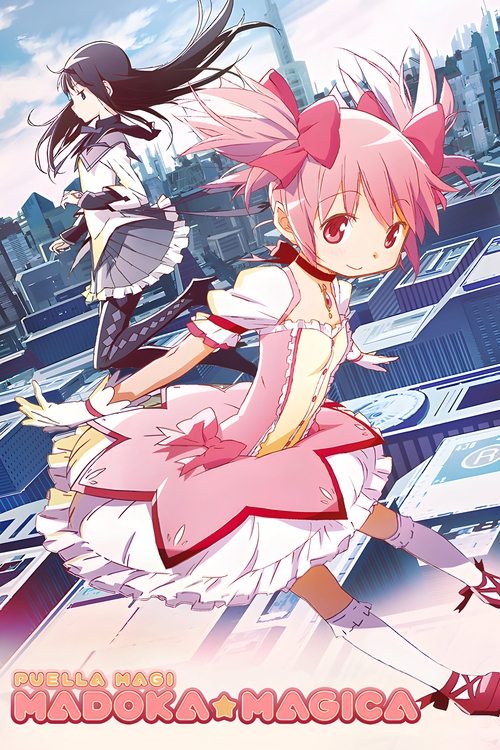







Puella Magi Madoka Magica (Japanese: 魔法少女まどか☆マギカ, Hepburn: Mahō Shōjo Madoka Magika), also known simply as Madoka Magica, is a Japanese anime television series created by Magica Quartet, and animated by Shaft. The story follows a group of middle school girls, led by protagonist Madoka Kaname, who make supernatural contracts to become magical girls. In battling surreal enemies known as "witches", they learn of the anguish and peril associated with their new roles. The first ten episodes of the series aired on TBS, MBS, and their affiliates between January and March 2011, while the final two episodes were delayed until April of the same year due to the Tōhoku earthquake and tsunami.
A manga adaptation of the anime and various spin-off manga have been published by Houbunsha and licensed in North America by Yen Press. A novelization by Nitroplus was released in August 2011, and a dedicated magazine, Manga Time Kirara Magica, was launched by Houbunsha in June 2012. A video game for the PlayStation Portable was released in March 2012 and another for the PlayStation Vita was released in December 2013. A mobile game, Magia Record, launched in August 2017, and a three-season anime adaptation produced by Shaft aired from January 2020 to April 2022. An anime film series, beginning with two films recapping the television series, was released in October 2012. A third film featuring an original story, Rebellion, was released in October 2013. A sequel film to Rebellion, titled Walpurgisnacht: Rising, premiered in August 2026.
Puella Magi Madoka Magica received widespread critical acclaim, with praise for its complex narrative, visuals, themes, and soundtrack, as well as its unconventional approach to the magical girl subgenre. It became a commercial success; each Blu-ray Disc volume sold more than 50,000 copies in Japan. The series garnered a variety of awards, such as the Television Award at the 16th Animation Kobe Award, as well as 12 Newtype Anime Awards and the Grand Prize for the Animation Division at the 15th Japan Media Arts Festival in 2011.
Contents
Plot
In the fictional city of Mitakihara, Japan, middle school student Madoka Kaname and her best friend Sayaka Miki encounter a small, cat-like creature named Kyubey. Kyubey offers them a contract in which a girl may have any wish granted in exchange for obtaining magical powers and being tasked with fighting creatures called witches. Meanwhile, a transfer student and mysterious magical girl named Homura Akemi tries to stop Madoka from making the contract with Kyubey. Madoka and Sayaka meet Mami Tomoe, an upperclassman at their school who is also a magical girl. Noticing their indecisiveness on whether to become magical girls, Mami offers to take Madoka and Sayaka along on her witch hunts so they may learn of the responsibilities of the role.
However, after Mami is unexpectedly killed by a witch, Madoka realizes the life of a magical girl is filled with suffering and pain. This is further enforced by the appearance of Kyoko Sakura, a veteran magical girl whose wish unintentionally caused the death of her family. Madoka also discovers that magical girls give up their souls to form Soul Gems, the source of their magic. When a Soul Gem becomes too tainted with despair it becomes a Grief Seed, irrevocably transforming its owner into a witch.
Sayaka decides to become a magical girl upon learning that a wish could heal her hospitalized friend Kyosuke, a musician on whom she has a crush. However, her friend Hitomi Shizuki confesses her love to him first, causing Sayaka to become disillusioned and fall into an inescapable despair, turning her into a witch. Kyubey reveals to Madoka that they are of an alien race that has been harvesting the emotions of magical girls for centuries to use as energy to counteract the spread of entropy, and thus stave off the heat death of the universe. Madoka also learns that Homura is a magical girl from a different timeline who has repeated the same month countless times via time travel to try to save Madoka from a grisly fate.
Madoka and Kyoko attempt to reverse Sayaka's transformation, but the plan fails and Kyoko is forced to sacrifice herself to allow Madoka to escape, leaving Homura as the only remaining magical girl. Following this, an extremely powerful witch known as Walpurgisnacht approaches the city. Homura attempts to stop it but is defeated. She begins to lose hope and is on the verge of becoming a witch herself when Madoka arrives. With the past month's events in mind, Madoka decides to become a magical girl, despite Homura's efforts to stop her. Madoka makes a wish to stop the creation of all witches in the past, present, and future. The paradoxical nature of the wish causes her to transcend into a psychopomp form, called the "Law of Cycles", which is a new rule of the universe where magical girls are purified and disappear into a higher plane instead of becoming witches. A new reality is formed, and Homura is the only one who remembers Madoka. Homura vows to continue fighting in honor of Madoka and the world she cherished.
Creation
Pre-production
While collaborating on Hidamari Sketch and Bakemonogatari, Akiyuki Shinbo told Aniplex producer Atsuhiro Iwakami he wanted to create a new magical girl series, beginning the development of Puella Magi Madoka Magica. According to Shinbo, while talking with Iwakami, he had mentioned that there was still improvements for him to make to the genre from one of his previous series. During the early planning stage, Iwakami decided not to adapt an existing work to give Shinbo more freedom in his directional style. Another goal of the project was to develop an anime that would appeal to a wider audience than the usual demographic for media within the magical girl subgenre. Iwakami and Shinbo intended their series to be accessible to "the general anime fan". Gen Urobuchi was suggested to be the writer by Iwakami due to his work with the Fate/Zero light novel (which Iwakami gave Shinbo a copy of the first volume to), and Shinbo asked Ume Aoki to be character designer. The series was Urobuchi's first time writing the screenplay for an anime on his own. Takahiro Kishida was arranged to adapt Aoki's character designs for the television series. The series' working title was, at that point, Magical Girl Apocalypse Madoka Magica (魔法少女黙示録 まどかマギカ), and the staff got used to calling it Madoka Magica during production. It was proposed that the "Magical Girl Apocalypse" part of the title be dropped and the series instead be titled simply "Madoka Magica", but Shinbo was adamant in retaining the "Magical Girl" segment of the title, which stuck.
In his role as producer, Iwakami took a mostly hands-off approach to the series. Because Puella Magi Madoka Magica is an original series rather than an adaptation of an existing work, his main goal was "coming up with a high-quality piece of entertainment". After helping to recruit the staff, he allowed them freedom to develop the content of the story, providing minimal guidance. After viewing the character designs that Aoki created, he was sure he could trust the creative talent of the team. In an interview with Anime News Network after the series finished airing in Japan, Iwakami said, "I don't matter much; it's up to those talents to do their work. If something comes to a stand-still I might intervene, but they did an excellent job and I was very happy seeing the results in episode one."
During the planning phase, Iwakami asked Urobuchi to make the storyline "heavy". Shinbo specified it should contain copious amounts of blood and violence, elements that were rare in the magical girl genre. Iwakami also asked for many of the magical girl characters to be killed throughout the series. Initially, Urobuchi was unsure of how to approach the work due to his lack of experience with the "magical girl" genre, as well as the fact that he was under the impression that the team consisting of Shinbo, Shaft, and Aoki was that of the "cuter" Hidamari Sketch franchise despite the fact that he had heard he was recommended through Fate/Zero. He said that he had no trouble with these requirements, referencing his past reputation as a writer of very dark and somber stories, the extent of which Shinbo had not known; but found difficulty in mixing the dark elements with Aoki's particular character designs and the genre itself, adding that it seemed like he was "bullying" the Hidamari Sketch characters. To help with the writing, Urobuchi read Hidamari Sketch and noted its themes of "friendship" and then watched two of Shinbo's previous anime series: Magical Girl Lyrical Nanoha, which was a magical girl series, as well as Le Portrait de Petit Cossette, a gothic horror series. He decided to mix the cute characters of Hidamari Sketch with the "disturbing" and "mysterious" atmosphere of Le Portrait de Petit Cossette together in writing the series. Eventually, when the production design duo Gekidan Inu Curry, who had been working on a variety of Shaft works at the time, were added to the roster, Urobuchi said he believed that he could successfully link the two ideas together.
Production
While the pre-production phase for Madoka Magica was underway, Miyamoto was directing Arakawa Under the Bridge (which Shinbo was also director for) and humorously commented on Madoka Magica looking like a series that would end up stealing all of the resources for the show, as he saw some of its materials (including Gekidan Inu Curry's, who were old classmates and friends of his) around the Shaft office. Ironically, just a few months before broadcast, Miyamoto was also recruited and asked to be the series director. His initial job as director was gathering materials for designs and the show's look alongside Shaft's animation producer Tadao Iwaki. He was also involved in the discussions regarding the action scenes with Urobuchi, Shinbo, and action director Nozumu Abe, such as solidifying the logic behind Kyoko's multi-jointed spear and how it would work in certain settings. One of the aspects that had yet been undefined even as the series started airing was how Homura's shield in episode 8 worked. It wasn't until sometime before broadcast that Urobuchi came up with the idea while riding on a train one day. Due to the workload at Shaft and a lack of production time, it was decided early on that Shaft would only produce episodes 1–3, 10, and 12 in-house, with the rest being outsourced to other studios and Shaft's staff intermittently assisting with them.
Although Takahiro Kishida was responsible for adapting Aoki's designs for animation, he did not continue working on the project extensively into the production phase as a chief animation director (responsible for overseeing and correcting drawings and animation). Instead, animators Junichirou Taniguchi (from studio Doga Kobo) and Mika Takahashi were recruited as chief animation directors. Taniguchi mentioned Genichirou Abe's work on the series as impressionable and that Yoshiaki Itou's work inspired him to push the limits of the character's expressions. Action director Kamitani noted difficulty in understanding Shaft's general style, as well as the "strange" structure that the anime's production had due to the involvement of Gekidan Inu Curry's material. Kamitani and Nozomu Abe often consulted with each other regarding the design work and their interpretations of certain scenes. In one scene, the storyboards for episode 11 had a fighter jet crashing into Walpurgisnacht which they believed to be too difficult to draw, so they consulted with Urobuchi and instead decided to use a Tomahawk missile.
The opening animation was directed by Tomoyuki Itamura. Shinbo did not give him any particular orders but told him to make it catchy, which he thinks Itamura succeeded in doing. For the opening song itself, Shinbo was surprised that the lyrics matched so well with the anime, as they were written without the context of the story, and he considered it to be a fun coincidence. The ending animation was directed and animated by Hirofumi Suzuki, who had worked with Shinbo on Le Portrait de Petit Cossette, which also had a coincidental thematic similarity to the series.
Broadcast and distribution
On January 7, 2011, Puella Magi Madoka Magica debuted on Mainichi Broadcasting System (MBS), Tokyo Broadcasting System (TBS), and Chubu-Nippon Broadcasting (CBC) in Japan. The first ten episodes aired weekly without interruption and were made available for streaming on Nico Nico Douga and BIGLOBE's Anime One service. That March, the planned broadcasts of the last two episodes were halted because of the 2011 Tōhoku earthquake and tsunami; TBS also canceled its scheduled airing of the 10th episode so it could provide more news coverage of the natural disaster.
Urobuchi apologized to viewers for the delays; he also said the postponements could be viewed in a positive light because they alleviated some production pressures on animation studio Shaft because of the tight broadcast schedule. Citing particularly challenging drawings for episodes 11 and 12, Urobuchi and Iwakami planned to have Shaft continue to improve the episodes up until their rescheduled broadcasts. According to Urobuchi, if episode 11 had been aired in its current state as scheduled, the result would likely have been disappointing. On March 23, 2011, the broadcast for the rest of the series was indefinitely delayed, but the production team reported that they were continuing to work on the episodes and announced their intention to finish airing the series by April. On April 10, 2011, the official website for Puella Magi Madoka Magica announced that broadcasts would resume on April 22. Episodes 11 and 12 aired back-to-back on MBS while TBS and CBC ran episode 10 together with episodes 11 and 12.
Iwakami later commented on this unique production experience in an interview with Anime News Network. He said Shaft was always pressed for time during the production process and only just completed each episode before its air time. After the earthquake and tsunami, he stated that many of the company's staff were upset by the incident and were unable to work effectively on episodes 11 and 12. He said, however, "a week went by, and two weeks went by, and the staff started saying that they couldn't stay in shock forever, that they had to keep on going, and then production continued". The series was released on six Blu-ray Disc (BD) and DVD volumes between April 27 and September 21, 2011, having been delayed by the earthquake from the original release date of March 30, 2011. Drama CDs were included with the first, third, and fifth BD/DVD volumes. The sixth and final volume released on September 21, 2011, contains a director's edit of episode 12. The series began streaming on Crunchyroll on February 15, 2012, as well as on Hulu and Crackle.
Related media
Films
In November 2011, it was announced in the December issue of Kadokawa Shoten's Newtype magazine that Shaft was developing a three-part theatrical film project. The first two films, titled Beginnings (始まりの物語, Hajimari no Monogatari) and Eternal (永遠の物語, Eien no Monogatari), are compilations of the anime television series featuring re-recorded voice lines and some new animation. The first film, which covers the first eight episodes of the television series, was released in theaters on October 6, 2012, while the second film, which covers the last four episodes, was released on October 13, 2012. The first two films were screened in selected locations in the United States and seven other countries between October 2012 and February 2013; they were also screened at Anime Festival Asia between November 10 and 11, 2012, in Singapore. The two films were released on Blu-ray Disc and DVD on July 30, 2013, in standard and collector's edition sets and is being made available for import by Aniplex of America. The third film, titled Rebellion (叛逆の物語, Hangyaku no Monogatari), is a sequel to the television series, featuring a new story written by Urobuchi. It was released to Japanese theaters on October 26, 2013. The film received a North American imported release on December 3, 2013. The first and second films were re-released with an English dub on July 15, 2014.
A short concept film for a new story, described as a "movie-based image board", debuted at Shaft's anniversary exhibition Madogatari on November 27, 2015. Shaft representative director and president Mitsutoshi Kubota later confirmed in an interview in Newtype that the concept film will launch a new Puella Magi Madoka Magica project.
At the 10th anniversary event held on April 25, 2021, a sequel movie to Rebellion was announced, titled Walpurgisnacht: Rising (ワルプルギスの廻天, Warupurugisu no Kaiten). It was scheduled to be released in Q1 2024; however, it was later delayed. The film premiered on August 28, 2026.
Print media
Houbunsha has published several manga series based on Puella Magi Madoka Magica. A direct adaptation of the anime series was illustrated by Hanokage and published in three four-chapter tankōbon volumes that were released between February 12 and May 30, 2011. The manga has been licensed in North America by Yen Press. A side story manga titled Puella Magi Kazumi Magica: The Innocent Malice (魔法少女かずみ☆マギカ〜The innocent malice〜, Mahō Shōjo Kazumi Magika: The Innocent Malice), which was written by Masaki Hiramatsu and illustrated by Takashi Tensugi, was serialized in Manga Time Kirara Forward between March 2011 and January 2013. A third manga titled Puella Magi Oriko Magica (魔法少女おりこ☆マギカ, Mahō Shōjo Oriko Magika), which was written by Kuroe Mura, was released in two tankōbon volumes on May 12, 2011, and June 12, 2011. Both Kazumi Magica and Oriko Magica have been licensed by Yen Press in North America. The first volume of Kazumi Magica was released in May 2013. Puella Magi Madoka Magica: Wraith Arc (魔法少女まどか☆マギカ[魔獣編]), which was written and illustrated by Hanokage, began serialization in the 20th issue of Manga Time Kirara Magica released on June 10, 2015. The plot describes the events that happened between Puella Magi Madoka Magica the Movie: Eternal and Puella Magi Madoka Magica the Movie: Rebellion. Yen Press will publish it in English.
The first volume of an official anthology comic featuring illustrations by guest artists was released on September 12, 2011. A dedicated monthly magazine published by Houbunsha and titled Manga Time Kirara Magica (まんがタイムきらら☆マギカ, Manga Taimu Kirara Magika) was launched on June 8, 2012; it features various manga stories, including spin-off stories of Oriko Magica. A film comic adaptation of the series titled Puella Magi Madoka Magica: Film Memories went on sale on May 26, 2012. Puella Magi Madoka Magica: The Different Story, another manga by Hanokage, was published in three tankōbon volumes between October 12 and November 12, 2012, and was licensed by Yen Press in 2014. The first volume of Puella Magi Suzune Magica (魔法少女すずね☆マギカ), which was written and illustrated by Gan, was released on November 12, 2013, before being serialized in Manga Time Kirara Magica on November 22, 2013. Puella Magi Homura Tamura (魔法少女ほむら☆たむら), which was written and illustrated by Afro, is serialized in Manga Time Kirara Magica; its first volume was released in October 2013 and was licensed by Yen Press. Puella Magi Homura's Revenge! (魔法少女まどか☆マギカ ほむらリベンジ!), written by Kawazukuu and illustrated by Masugitsune, was serialized in Manga Time Kirara Magica and released two volumes in December 2013; Yen Press licensed the manga.
Hajime Ninomae wrote a novel adaptation of the series that was illustrated by Yūpon and published by Nitroplus on August 14, 2011. Pre-release copies were available at Comiket 80 on August 12, 2011. A book titled Puella Magi Madoka Magica: The Beginning Story, which is based on Gen Urobuchi's original draft treatment for the anime, was released in November 2011.
Video games
A video game based on the series titled Puella Magi Madoka Magica Portable (魔法少女まどか☆マギカ ポータブル, Mahō Shōjo Madoka Magika Pōtaburu) was released by Namco Bandai Games on PlayStation Portable on March 15, 2012. The game allows players to take many routes and change the ending of the story. Urobuchi returned as the writer and Shaft animated the title, while Yusuke Tomizawa and Yoshinao Doi produced it. The game was released in two editions; a standard box including a bonus DVD, and a limited-edition box containing a Madoka Figma, a bonus Blu-ray Disc, a Kyubey pouch, a 'HomuHomu' handkerchief and a special clear card. An action game for the PlayStation Vita titled Puella Magi Madoka Magica: The Battle Pentagram (魔法少女まどかマギカThe Battle Pentagram) was developed by Artdink and published by Namco Bandai Games, and was released in Japan on December 19, 2013. The game features an original story that was created with guidance from Urobuchi in which all five magical girls team up to defeat a powerful witch called Walpurgis Night. Upon release, a limited-edition version that included codes for additional in-game costumes and merchandise such as a CD copy of the game's soundtrack and an art book, was also on sale.
A free smartphone application called Mami's Heart Pounding Tiro Finale (マミのドキドキティロフィナーレ, Mami no Doki Doki Tiro Fināre) was released on October 14, 2011. A third-person shooter (TPS) titled Puella Magi Madoka Magica TPS featuring Homura Akemi was released for Android devices in December 2011. A second TPS title featuring Mami was released in August 2012 and a third featuring Sayaka and Kyoko was released on October 16, 2012. A puzzle game for iOS devices titled Puella Magi Madoka Magica Puzzle of Memories was released on March 29, 2013. Costumes from Puella Magi Madoka Magica, alongside content based on other anime and games, are available in Japan as downloadable content (DLC) for the PSP game Gods Eater Burst. Costumes and accessories are also available as DLC for Tales of Xillia 2, and were available for Phantasy Star Online 2 in October 2013. Another collaboration with the mobile game Phantom of the Kill took place for an event that ran from August 8, 2015 to September 21, 2015. During that campaign, players had a chance of obtaining playable Madoka characters through in-game lotteries. Puella Magi Madoka Magica-themed missions, weapons and items were also available at that time.
A pachinko game titled Slot Puella Magi Madoka Magica was released in 2013, and a second pachinko game titled Slot Puella Magi Madoka Magica 2 was released in 2016. Slot Puella Magi Madoka Magica 2 features the song "Naturally" by Aoi Yūki and Eri Kitamura. Also in 2016, the smartphone game Girl Friend Beta announced a collaboration with Puella Magi Madoka Magica in which players got a Madoka card as a log-in bonus. A smartphone game called Magia Record: Puella Magi Madoka Magica Side Story, was released in Japan on August 22, 2017. The game features a new protagonist named Iroha Tamaki, who arrives in Kamihama City to search for her missing sister. The game features the theme song "Kakawari" (かかわり, "Connection") by TrySail. An anime adaptation of the game premiered on January 4, 2020.
Reception
Critical reception
Puella Magi Madoka Magica received widespread critical acclaim. Masaki Tsuji lauded the series' world-building and narrative as well as the character development, and called the series groundbreaking. Masaki went on to say that Madoka Magica had reached a "level of perfection", and noted that the series was worthy of people's admiration. UK Anime Network's Andy Hanley rated the anime 10 out of 10, lauding it for its deeply emotional content and described it as immersive and filled with grandiose visuals along with an evocative soundtrack. He recommended watching it several times to fully comprehend the complex and multi-layered plot. Hanley called it the greatest television anime series of the 21st century thus far. Scott Green of Ain't It Cool News called the series "hugely admirable"; he praised the animation team's attention to detail, stating that the series "would not work nearly as well if the characters in general and as magical girls specifically weren't presented so spectacularly winningly by the production". Green also said he would highly recommend Puella Magi Madoka Magica to anyone with an interest in anime.
Michael Pementel of Bloody Disgusting called Madoka Magica a "fascinating work" and lauded its dark atmosphere and horror elements. Pementel highly praised the show's aesthetics and wrote that the "pacing in revealing twists" is one of the "show's most exceptional qualities" and also commended the characters' tragic arcs, particularly those of Sayaka and Homura. He further praised the series for offering a "unique, grim twist that not only seeps the show in despair, but subverts the subgenre", concluding that Madoka Magica "stands as one of the best works of anime horror, presenting characters that must strive to find hope through profound darkness." THEM Anime Reviews reviewer Tim Jones called it "beautiful, well-written, and surprisingly dark", and gave it four out of five stars. Jones also commended the unique animation and design of the backdrops shown during witch fights, which he described as "surreal, beautiful, [and] trippy". In his review of the three Blu-ray volumes of the anime series, Zac Bertschy of Anime News Network characterized the story as very emotionally dark and one of the most ambitious and beautiful anime series in recent memory. He awarded each of the volumes ratings of A or A+ overall, and stated, "Time will tell us whether or not this show will be remembered as fondly as it is regarded by the fan community now, but it feels like a masterpiece, something to be appreciated again and again. It is a must-see for anyone remotely interested in what anime can accomplish as an art form".
Awarding the series five stars out of five, Common Sense Media wrote that the "animation style is full of fluid motion and attention to detail that makes it a uniquely pleasurable experience to watch" and "the main characters [are] well developed and its hard not to get attached to them as the story progresses". Reviewers highly praised the series' darker approach to the magical girl subgenre. In its review of the series, the staff at Japanator said this trope "added a level of depth and complexity to the genre that we haven't ever seen, and I don't think we will see again ... [a]dding on that dressing gave the show a more perverse and cruel feeling to it, making it all the more compelling to watch". Liz Ohanesian of LA Weekly attributed the series' popularity with older, male audiences—an otherwise unusual demographic to the genre—to the genre deconstruction of Puella Magi Madoka Magica. She also commented on the series' cultural impact, writing that there was incredible fan interest for the series in Japan and the US. She credited the all-star crew including writer Urobuchi, director Shinbo, and the Shaft animation studio as "hitmakers" and described the anime as "a series designed for acclaim". TechnologyTell's Jenni Lada wrote that the show's external appearance belied its true "darker and more twisted" essence. She recommended viewers watch at least three episodes to discover the series' true nature.
Sales
The first Blu-ray volume of the series sold 53,000 copies in its first week, 22,000 of which were sold on its first day, breaking the record held by the sixth BD volume of Bakemonogatari. The second volume sold 54,000 copies, breaking the first volume's record. Each subsequent volume sold over 50,000 copies in their first week. As of October 2012, the total sales of BD and DVDs of the series exceeded 600,000 copies, which was unusual for a late-night program at that time. This was despite controversy over the pricing of the volumes, which some considered to be unfairly high. The staff at Japanator stated they could not recommend the volume to their readers due to the prohibitive cost. Bertschy concurred, writing that the "limited episode count and high price of entry make the show inaccessible to an audience unwilling to shell out". The 2017 compilation album Puella Magi Madoka Magica Ultimate Best ranked at No. 4 on Oricon's weekly albums chart, having sold over 13,500 copies. By the end of 2017, Ultimate Best was the 29th best-selling anime CD album of the year.
Japanese newspaper Nihon Keizai Shimbun reported that Puella Magi Madoka Magica had grossed over ¥40 billion ($400 million) from the sales of related goods within two years of its release. A live broadcast of the entire series was streamed on Nico Nico Douga on June 18, 2011, garnering around a million viewers and surpassing the previous streaming audience record of 570,000 held by Lucky Star. According to Google Zeitgeist, Madoka Magica was the most-searched and fastest-rising search query in the anime category of 2011.
Accolades
Puella Magi Madoka Magica won the Television Award at the 16th Animation Kobe Awards, as well as 12 Newtype Anime Awards, and the Grand Prize for animation in the 15th Japan Media Arts Festival awards, making it the first and only original anime television to win the award, with the jury describing the series in their justification as "an outstanding animation with an ingenious magical scenario" and commended the "ambitious" show for "skillfully setting critical traps that shook the very foundations of the genre". It was nominated for the 32nd Nihon SF Taisho Award and won the 2011 Bronze Prize for Kyubey's catchphrase. It also won three 11th Tokyo Anime Awards in the categories of Television Category, Best Director and Best Screenplay, and the Selection Committee Special Prize award at the 2012 Licensing of the Year awards. Madoka Magica was awarded a 43rd Seiun Award for "Best Media" at the 2012 Japan Science Fiction Convention, and was also awarded a Sisterhood Prize at the 11th Sense of Gender Awards. In 2015, the show was awarded the inaugural 1st Sugoi Japan Award Grand Prix, Japan's nationwide vote for manga, anime, and novels considered as cultural assets that have the potential to be beloved all over the world, among all of the works published since 2005. In 2017, Madoka Magica was selected as the best anime of 2011 by the Tokyo Anime Award Festival.
Multiple media publications have hailed Puella Magi Madoka Magica as one of the best anime series of the 2010s, including Polygon, Thrillist, Looper, IGN, Crunchyroll, and Anime UK News. The Brazilian website Legiao Dos Herois listed the series as one of "10 most successful anime" of the 2010s.
Legacy
The radio station Tokyo FM reported that Puella Magi Madoka Magica had developed into a social phenomenon in Japan. Toussaint Egan of Paste magazine stated that the series was "widely celebrated by fans and critics alike" upon its release and that the show is "a postmodern reconfiguration of genre tropes rife with plot twists and existential malaise on a cosmic horror level". The Spanish film director Carlos Vermut has cited Madoka Magica as a large influence on his 2014 film Magical Girl. The series was referenced in the HBO series Euphoria. Anime director Hiroyuki Imaishi said that darker-toned series like Madoka Magica are an "industry trend". The series also inspired a Nigerian magical girl franchise, Adorned by Chi.