Catholicism
Bresson was a Catholic, although he disagreed with some points of Catholic theology, explaining that he was not sure of the resurrection of the body and "would rather be a Jansenist than Jesuit" due to his belief in predestination. In his later life he stopped attending church services due to his dissatisfaction with the Second Vatican Council's transition to the Mass of Paul VI, explaining that while he still felt a sense of transcendence sitting in a cathedral, Vatican II's changes to the Mass made it harder for him to feel the presence of God. Although several writers claim that Bresson described himself as a "Christian atheist", it is not known in what context he made that statement (if he ever did).
In 1973, Bresson explained:
There is the feeling that God is everywhere, and the more I live, the more I see that in nature, in the country. When I see a tree, I see that God exists. I try to catch and to convey the idea that we have a soul and that the soul is in contact with God. That's the first thing I want to get in my films.
In a 1976 interview with Paul Schrader, Bresson said that he was concerned by what he saw as "the collapse of the Catholic religion" in France. He did not believe the post-Vatican II Church was capable of responding to this challenge. The Devil Probably incorporates some of his criticisms of the post-Vatican II Church. Bresson explained that his youthful protagonist "is looking for something on top of life, but he doesn't find it. He goes to Church to seek it, and he doesn't find it." In addition, an early scene in the film shows a young Catholic complaining that the post-Vatican II Church "run[s] after Protestants."
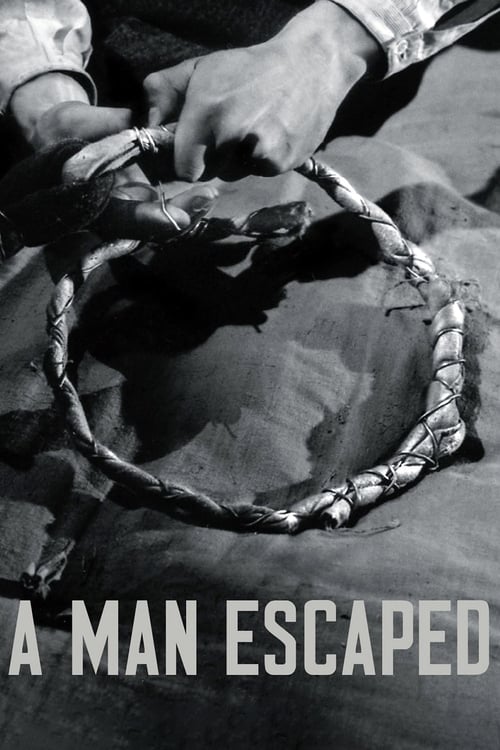
Some feel that Bresson's Catholic upbringing and belief system lie behind the thematic structures of most of his films. Recurring themes under this interpretation include salvation, redemption, defining and revealing the human soul, and metaphysical transcendence of a limiting and materialistic world. An example is A Man Escaped (1956), where a seemingly simple plot of a prisoner of war's escape can be read as a metaphor for the mysterious process of salvation. However, Bresson's films are also critiques of French society and the wider world, with each revealing the director's sympathetic, if unsentimental, view of society's victims. That the main characters of Bresson's most contemporary films, The Devil, Probably (1977) and L'Argent (1983), reach similarly unsettling conclusions about life indicates the director's feelings towards the culpability of modern society in the dissolution of individuals. Of an earlier protagonist, he said, "Mouchette offers evidence of misery and cruelty. She is found everywhere: wars, concentration camps, tortures, assassinations." Film historian Mark Cousins argues that "If Bergman and Fellini filmed life as if it was a theatre and a circus, respectively, Bresson's microcosm was that of a prison", describing Bresson's characters as "psychologically imprisoned".
Bresson explained that his films often address secular themes because he believed that a secular film with religious undercurrents was more likely to resonate with modern filmgoers than an explicitly religious theme. Susan Sontag wrote that in his films, while a "religious vocation supplies one setting for ideas about gravity, lucidity, and martyrdom, ... the drastically secular subjects of crime, the revenge of betrayed love, and solitary imprisonment also yield the same themes." Bresson worried that the new French generation was too materialistic to harbor true religious belief, saying that "every religion is poverty and poverty is the way of having contact with mystery and with God. When Catholicism wants to be materialistic, God is not there." He tried to reach modern audiences indirectly, explaining, "the more life is what it is—ordinary, simple—without pronouncing the word 'God,' the more I see the presence of God in that. ... I don't want to shoot something in which God would be too transparent." In his work, "there is a presence of something which I call God, but I don't want to show it too much. I prefer to make people feel it."
In a 1983 interview for TSR's Spécial Cinéma, Bresson declared that he had been interested in making a film based on the Book of Genesis, although he believed such a production would be too costly and time-consuming. He first began developing ideas for the project in the 1960s and got backing from Dino de Laurentiis, but his attempt to start production in the 1980s ran out of funds.