


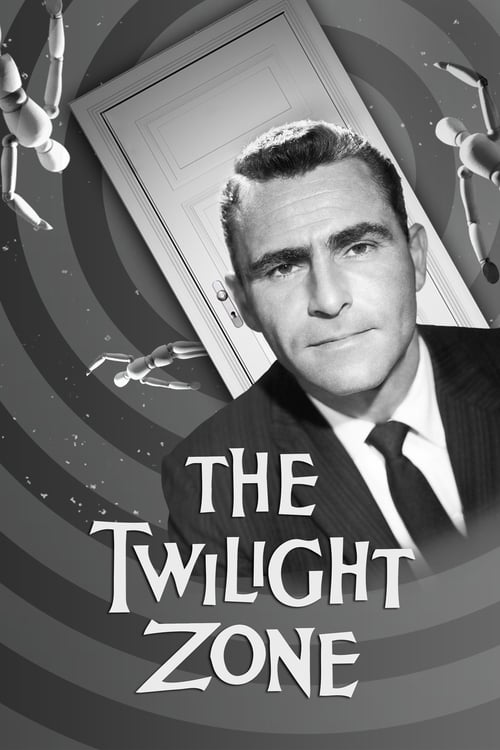
Rodman Edward Serling (December 25, 1924 – June 28, 1975) was an American screenwriter and television producer, widely known for his live television dramas of the 1950s and his anthology television series The Twilight Zone. Serling was active in politics, both on and off the screen, and helped form television industry standards. He was known as the "angry young man" of Hollywood, clashing with television executives and sponsors over a wide range of issues, including censorship, racism, and war. He was nominated for nine Primetime Emmy Awards, winning six times.
Contents
Early life
Serling was born on December 25, 1924, in Syracuse, New York, to a Jewish family. He was the second of two sons born to Esther (née Cooper, 1893–1958), a homemaker, and Samuel Lawrence Serling (1892–1945). Serling's father had worked as a secretary and amateur inventor before his children were born but took on his father-in-law's profession as a grocer to earn a steady income. Sam Serling later became a butcher after the Great Depression forced the store to close. Rod had an older brother, novelist and aviation writer Robert J. Serling.
Serling spent most of his youth 70 miles (110 km) south of Syracuse in Binghamton, New York, after his family moved there in 1926. His parents encouraged his talents as a performer. Sam Serling built a small stage in the basement, where Rod often put on plays, with or without neighborhood children.
His older brother, writer Robert, recalled that, at the age of six or seven, Rod entertained himself for hours by acting out dialogue from pulp magazines or movies he had seen. Rod would often ask questions without waiting for their answers. On an hour trip from Binghamton to Syracuse, the rest of the family remained silent to see if Rod would notice their lack of participation. He did not, and he talked nonstop through the entire car ride.
In elementary school, Serling was seen as the class clown and dismissed by many of his teachers as a lost cause. His seventh-grade English teacher, Helen Foley, encouraged him to enter the school's public speaking extracurriculars. He joined the debate team and was a speaker at his high school graduation. He began writing for the school newspaper, in which, according to the journalist Gordon Sander, he "established a reputation as a social activist".
Serling was interested in sports, and excelled at tennis and table tennis. When he attempted to join the varsity football team, he was told he was too small at 5 ft 4 in (163 cm) tall.
Serling was interested in radio and writing at an early age. He was an avid radio listener, especially interested in thrillers, fantasy, and horror shows. Arch Oboler and Norman Corwin were two of his favorite writers. He also "did some staff work at a Binghamton radio station ... tried to write ... but never had anything published." He was accepted into college during his senior year of high school. However, the United States was involved in World War II at the time, and Serling decided to enlist rather than start college immediately after he graduated from Binghamton Central High School in 1943.
American military service
Serling enlisted in the United States Army the morning after high school graduation, following his brother Robert. He began his military career in 1943 at Camp Toccoa, Georgia, under General Joseph M. Swing and Colonel Orin D. Haugen and served in the 511th Parachute Infantry Regiment of the 11th Airborne Division. He eventually reached the rank of Technician Fourth Grade (T/4). Over the next year of paratrooper training, Serling and others began boxing to vent aggression. He competed as a flyweight and had 17 bouts, rising to the second round of the division finals before being knocked out. He was remembered for his Berserker style, and for "getting his nose broken in his first bout and again in the last bout". He tried his hand at the Golden Gloves, with little success.
On April 25, 1944, Serling received his orders and saw that he was being sent west to California. He knew that he would be fighting against the Empire of Japan rather than Nazi Germany. This disappointed him because he had hoped to fight against Adolf Hitler in the European Theatre. In May, he was assigned to the Pacific Theater in New Guinea and the Philippine Islands. In November 1944, his division first saw combat, landing in the Philippines. The 11th Airborne was not initially used as paratroopers, however, but as light infantry during the Battle of Leyte. The division helped secure the area after the five divisions that had gone ashore earlier.
For a variety of reasons, Serling was transferred to the 511th's demolition platoon, nicknamed "The Death Squad" for its high casualty rate. According to Sergeant Frank Lewis, leader of the demolitions squad, "He screwed up somewhere along the line. Apparently he got on someone's nerves." Lewis also judged that Serling was not suited to be a field soldier: "he didn't have the wits or aggressiveness required for combat."
At one point, Lewis, Serling, and others were in a firefight, trapped in a foxhole. As they waited for darkness, Lewis noticed that Serling had not reloaded any of his extra magazines. Serling sometimes went exploring on his own, against orders, and got lost.
Serling's time in Leyte shaped his writing and political views for the rest of his life. He saw death every day while in the Philippines, at the hands of his enemies and his allies, and through freak accidents such as that which killed another Jewish private, Melvin Levy. Levy was delivering a comic monologue for the platoon as they rested under a palm tree when a food crate was dropped from a plane above, decapitating him. Serling led the funeral services for Levy and placed a Star of David over his grave.
Postwar life, education, and family
After being discharged from the Army in 1946, Serling worked at a rehabilitation hospital while recovering from his wounds. His knee troubled him for years. Later, his wife, Carol, became accustomed to the sound of him falling on the stairs when his knee would buckle.
When he was fit enough, he used the federal G.I. bill's educational benefits and disability payments to enroll in the physical education program at Antioch College in Yellow Springs, Ohio. He had been accepted to Antioch (his brother's alma mater) while in high school. His interests led him to the theater department and then to broadcasting. He changed his major to literature and earned his Bachelor of Arts degree in 1950. "I was kind of mixed up and restless, and I kind of liked their work-for-a-term, go-to-school-for-a-term set-up," he recounted.
As part of his studies, Serling became active in the campus radio station, an experience that proved useful in his future career. He wrote, directed, and acted in many radio programs on campus, then around the state, as part of his work study. Here he met Carolyn Louise "Carol" Kramer (February 3, 1929 — January 9, 2020), a fellow student, who later became his wife.
At first, she refused to date him because of his promiscuous campus reputation, but she eventually changed her mind. In college he joined the Unitarian church, which married him and Kramer on July 31, 1948. They had two daughters, Jodi (born 1952) and Anne (born 1955).
Carol Serling's maternal grandmother, Louise Taft Orton Caldwell, had a summer home on Cayuga Lake in Interlaken, New York, which was the honeymoon destination for the newlyweds. The Serling family continued to use this house annually throughout Rod's life, missing only two summers in the years when his daughters were born.
For extra money in his college years, Serling worked part-time testing parachutes for the United States Army Air Forces. According to his radio station coworkers, he received $50 for each successful jump and had once been paid $500, half before and half if he survived, for a hazardous test. His last test jump was a few weeks before his wedding. In one instance, he earned $1,000 for testing a jet ejection seat that had killed the previous three testers.
Career
Radio
Serling volunteered at WNYC in New York as an actor and writer in the summer of 1946. The next year, he worked at that station as a paid intern in his Antioch work-study program. He then took odd jobs in other radio stations in New York and Ohio. "I learned 'time', writing for a medium that is measured in seconds," Serling later said of his early experiences.
While attending college, Serling worked at the Antioch Broadcasting System's radio workshop and was managing the station within a couple of years. He then took charge of full-scale radio productions at Antioch which were broadcast on WJEM, in Springfield. He wrote and directed the programs and acted in them when needed. He created the entire output for the 1948–1949 school year. With one exception, an adaptation, all the writing that year was his original work.
While in college, Serling won his first accolade as a writer. The radio program, Dr. Christian, had started an annual scriptwriting contest eight years earlier. Thousands of scripts were sent in annually, but very few could be produced. Serling won a trip to New York City and $500 for his radio script "To Live a Dream". He and his new wife, Carol, attended the awards broadcast on May 18, 1949, where he and the other winners were interviewed by the star of Dr. Christian, Jean Hersholt. One of the other winners that day was Earl Hamner, Jr., who had also earned prizes in previous years.
Serling's first job out of college was with WLW radio as copy writer. The position had just been vacated by Hamner who left to concentrate on his writing.
Hamner later wrote scripts for Serling's The Twilight Zone.
In addition to earning $45 to $50 a week at the college radio station, Serling attempted to make a living selling freelance scripts of radio programs, but the industry at that time was involved in many lawsuits, which affected willingness to take on new writers. Some whose scripts were rejected would often hear a similar plot produced, claim their work had been stolen, and sue for recompense. Serling was rejected for reasons such as "heavy competition", "this script lacks professional quality", and "not what our audience prefers to listen to".
Television
Serling moved from radio to television, as a writer for WKRC-TV in Cincinnati. His duties included writing testimonial advertisements for dubious medical remedies and scripts for a comedy duo. He continued at WKRC after graduation and, amidst the mostly dreary day-to-day work, also created a series of scripts for a live television program, The Storm, as well as for other anthology dramas, a format which was in demand by networks based in New York. Following a full day of classes, or, in later years, work, he spent evenings on his own, writing. He sent manuscripts to publishers and received forty rejection slips during these early years.
In 1950, Serling hired Blanche Gaines as an agent. His radio scripts received more rejections, so he began rewriting them for television. Whenever a script was rejected by one program, he would resubmit it to another, eventually finding a home for many in either radio or television.
As Serling's college years ended, his scripts began to sell. He continued to write for television and eventually left WKRC to become a full-time freelance writer. He recalled, "Writing is a demanding profession and a selfish one. And because it is selfish and demanding, because it is compulsive and exacting, I didn't embrace it. I succumbed to it."
According to his wife, Serling "just up and quit one day, during the winter of 1952, about six months before our first daughter Jody was born—though he was also doing some freelancing and working on a weekly dramatic show for another Cincinnati station." He and his family moved to Connecticut in early 1953. Here he made a living by writing for the live dramatic anthology shows that were prevalent at the time, including Kraft Television Theatre, Appointment with Adventure and Hallmark Hall of Fame. By the end of 1954, his agent convinced him he needed to move to New York, "where the action is."
The writer Marc Scott Zicree, who spent years researching his book The Twilight Zone Companion, noted, "Sometimes the situations were clichéd, the characters two-dimensional, but always there was at least some search for an emotional truth, some attempt to make a statement on the human condition."
In 1955, the nationwide Kraft Television Theatre televised a program based on Serling's 72nd script. To Serling, it was just another script, and he missed the first live broadcast. He and his wife hired a babysitter for the night and told her, "no one would call because we had just moved to town. And the phone just started ringing and didn't stop for years!" The title of this episode was "Patterns", and it soon changed his life.
Other radio
Serling returned to radio late in his career with The Zero Hour (also known as Hollywood Radio Theater) in 1973. The drama anthology series featured tales of mystery, adventure, and suspense, airing in stereo for two seasons. Serling hosted the program but did not write any of the scripts. The series ended on July 26, 1974.
Serling's final radio performance was even more unusual: Fantasy Park was a 48-hour-long rock concert aired by nearly 200 stations in 1974 and 1975. The program, written and produced by McLendon National Productions Director Steve Blackson, featured performances by dozens of rock stars of the day, and even reunited the Beatles. It was also completely imaginary—as KNUS Program Director Beau Weaver put it, a "theatre-of-the-mind for the '70s". The concert used record albums, many recorded live in concert, plus crowd noise, interviews, schedule updates by host Fred Kennedy, and other sound effects. (Stations that aired the special were reportedly inundated by callers demanding to know how to get to the nonexistent concert.) KNUS general manager Bart McLendon recruited Serling to record the host segments, bumpers, custom promos, and television spots.
Serling wrote the disclaimers, which aired each hour: "Hello, this is Rod Serling and welcome back to Fantasy Park—the crowds here today are unreal." "This is Fantasy Park—the greatest live concert—never held."
Teaching
Serling kept his schedule full. When he was not writing, promoting, or producing his work, he often spoke on college campuses around the country. He taught week-long seminars in which students would watch and critique films. In the political climate of the 1960s, he often felt a stronger connection to the older students in his evening classes. Serling's critique of high school student writing was a pivotal experience for writer J. Michael Straczynski.
By the fourth season of Twilight Zone, Serling was exhausted and turned much of the writing over to a trusted stable of screenwriters, authoring only seven episodes. Desiring to take a break and clear his mind, he took a one-year teaching job as writer in residence at Antioch College, Ohio. He taught classes in the 1962–63 school year on writing and drama and a survey course covering the "social and historical implications of the media." He used this time to teach as well as work on a new screenplay, Seven Days in May, which he also co-produced through Cayuga Productions.
Later he taught at Ithaca College, from the late 1960s until his death in 1975. He was one of the first guest teachers at the Sherwood Oaks Experimental College in Hollywood, California. Audio recordings of his lectures there are included as bonus features on some Twilight Zone home video editions.
Themes
According to his wife, Carol, Serling often said that "the ultimate obscenity is not caring, not doing something about what you feel, not feeling! Just drawing back and drawing in, becoming narcissistic." This philosophy can be seen in his writing. Some themes appear again and again in his writing, many of which are concerned with war and politics. Another common theme is equality among all people.
Antiwar activism
Serling's experiences as a soldier left him with strong opinions about the use of military force. He was an outspoken antiwar activist, especially during the Vietnam War. He supported antiwar politicians, notably U.S. senator Eugene McCarthy in his presidential campaign in 1968.
"The Rack" is an example of Serling's use of television to speak his mind on political issues. This script for The United States Steel Hour tells the story of an army captain charged with collaborating with the North Koreans. The New York Times reviewer J. P. Shanley called it "controversial and compelling". Serling tackled a question that was much in the media at the time: should veterans be charged with a crime if they cooperated with the enemy while under duress? In this courtroom drama, the accused is put on trial for helping the enemy by urging fellow prisoners of war to cooperate with their captors. Serling offers many valid arguments on behalf of both the defense and the prosecution. Each has a strong case, but in the end, the captain is found guilty. There is no Serling narration to conclude the drama, as he had become famous for in The Twilight Zone—instead, the audience is left to make their own conclusions after the verdict has been rendered.
"No Christmas This Year" was a script written early in Serling's career, around 1950, but was never produced. It told of a place that no longer celebrated Christmas, although none of the residents know why it has been canceled. Meanwhile, at the North Pole, the audience sees Santa Claus dealing with striking elves. Rather than creating toys and candy, the North Pole manufactures a diversity of bombs and offensive gases. Santa has been shot at on his route, and an elf was hit by shrapnel.
"24 Men to a Plane" recounts Serling's first combat jump into the area around Manila in 1945. The combat jump became a fiasco after the jumpmaster in the first plane dropped his men too early, causing every subsequent plane to drop in synchronization with the mistake.
Racial equality
A Town Has Turned to Dust received a positive review from the critic Jack Gould, who was known for being straightforward to the point of being harsh in his reviews. He called A Town Has Turned to Dust "a raw, tough and at the same time deeply moving outcry against prejudice." Set in a Southwestern town in a deep drought, it sees poverty and despair turn racial tensions deadly when the ineffectual sheriff is unable to stand against the town. A young Mexican boy is lynched, and the town as a whole is to blame. A second lynching is in the works after a series of events leads again to the town turning against the Mexicans. This time, the sheriff stands strong, and the first boy's brother is saved, even as the town is not. "Mr. Serling incorporated his protest against prejudice in vivid dialogue and sound situations. He made his point that hate for a fellow being leads only to the ultimate destruction of the bigoted."
Serling took his 1972 screenplay for the film The Man from the Irving Wallace novel of the same title. The black senator from New Hampshire and president pro tempore of the Senate, played by James Earl Jones, assumes the U.S. presidency by succession.
Death
Serling was said to smoke three to four packs of cigarettes a day. On May 3, 1975, he had a heart attack and was hospitalized. He spent two weeks at Tompkins County Community Hospital before being released. A second heart attack two weeks later forced doctors to agree that open-heart surgery, although considered risky at the time, was required. The ten-hour-long procedure was performed on June 26, but Serling had a third heart attack on the operating table and died two days later at Strong Memorial Hospital in Rochester, New York. He was 50 years old.
His funeral and burial took place on July 2 at Lake View Cemetery, Interlaken, (Seneca County), New York. A memorial was held at Cornell University's Sage Chapel on July 7, 1975. Speakers at the memorial included his daughter Anne and the Reverend John F. Hayward.
Legacy
Television
Serling began his career when television was a new medium. The first public viewing of an all-electronic television was presented by inventor Philo Farnsworth at the Franklin Institute in Philadelphia on August 25, 1934, when Serling was nine years old. Commercial television officially started on July 1, 1941. At the time, there were fewer than seven thousand television sets in the United States, and very few of those were in private homes. Only five months later, the U.S. entered World War II, and the television business was put on hold until the war's end, as many of the unsold sets were obtained by the government and repurposed to train air-raid wardens. After World War II ended, money began flowing toward the new medium of television, coinciding with the beginning of Serling's writing career. Early programming consisted of newsreels, sporting events and what would be called public-access television today. It was not until 1948 that filmed dramas were first shown, beginning with a show called Public Prosecutor. Serling began having serious dramas produced in 1950 and is given credit as one of the first to write scripts specifically for television. As such, he is said to have helped legitimize television drama.
Serling worried that television was on the verge of suffering the same decline as radio. He encouraged sponsors to see television as a platform for the kind of dramatic entertainment that could address important social matters through subtle meanings, instead of being "an animated billboard".
The format of writing for television was changing rapidly in the early years, but eventually, it settled into a pattern of commercial breaks on each quarter-hour. Writers were forced to work these breaks into their scripts. Serling's response to this convention was, "How can you put out a meaningful drama when every fifteen minutes proceedings are interrupted by twelve dancing rabbits with toilet paper? No dramatic art form should be dictated and controlled by men whose training and instincts are cut of an entirely different cloth. The fact remains that these gentlemen sell consumer goods, not an art form." Throughout his career, Serling helped to mold the future of television.
As early as 1955, Jack Gould, of the New York Times, commented on the close ties that were then being created between television and movies. Serling was among the first to use both forms, turning his early television successes, "Patterns" and "The Rack", into full-length movies. Up to that time, many established writers were unwilling to write for television because the programs were viewed only once and then stored in a vault, never to be seen again.
Effects on popular culture
During his lifetime
In December 1966, the made-for-television movie, The Doomsday Flight, aired. The fictional plot concerned an airplane with a bomb aboard. If the plane landed without the ransom money being paid, the aircraft would explode. The bomb was set with an altitude trigger that would detonate it if the plane dropped below four thousand feet. The show was one of the highest-rated of the television season, but both Serling and his brother Robert, a technical advisor on the project (a specialist in aviation), regretted making the film. After the film was aired, a rash of copycats telephoned in ransom demands to most of the largest airlines. Serling was truly devastated by what his script had encouraged. He told reporters who flocked to interview him, "I wish to Christ that I had written a stagecoach drama starring John Wayne instead."
In the 1962 Perry Mason episode, "The Case of the Promoter's Pillbox", the titular promoter falsely claims that a teleplay for a TV pilot, "Mr. Nobody", is being rewritten by Serling as a personal favor to him. Later, Mason, who does know Serling, shows the original teleplay to him, saying that Serling wants to help the young man who wrote the teleplay to get a start in his writing career. The man's mother then expresses to Serling her desire to tell her stories from years of running a drug store.
Legacy
Serling is indelibly woven into modern popular culture because of the enduring popularity of The Twilight Zone. Serling's widow, Carol, maintained that the cult status that surrounded both her husband and his shows continues to be a surprise, "as I'm sure it would have been to him." "It won't go away. It keeps bobbing up. ... Each year, I think, well, that's it—and then something else turns up." She survived him to the age of 90, dying on January 9, 2020, and participated in the continuing interest in Rod's work, sometimes preparing them for a new format and editing a publication about Rod that she founded, The Twilight Zone Magazine, as well as many activities to promote his legacy.
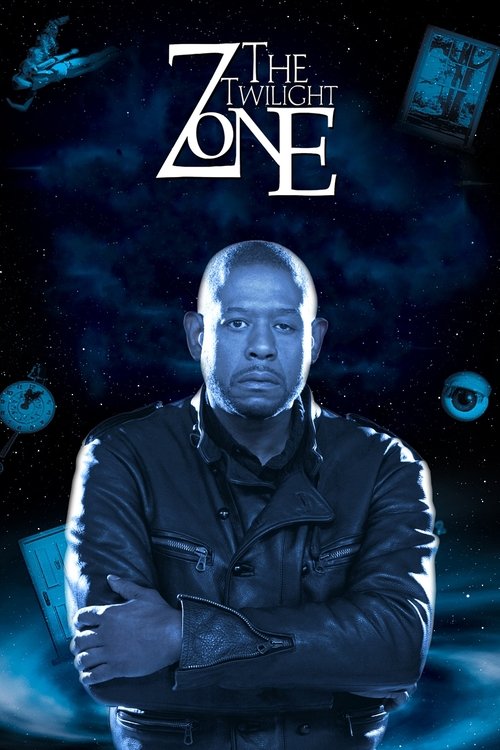
The Twilight Zone has been rerun, re-created and re-imagined since going off the air in 1964. It has been released in comic book form, as a magazine, a film, and three additional television series from 1985 to 1989, from 2002 to 2003, and from 2019 to 2020. In 1988, J. Michael Straczynski scripted Serling's outline "Our Selena Is Dying" for the 1980s Twilight Zone series.
Some of Serling's works are now available in graphic novels. Rod Serling's The Twilight Zone is a series of adaptations by Mark Kneece and Rich Ellis based on original scripts written by Serling. Several episodes were adapted into novel form for pulp fiction books by Serling himself.
The Twilight Zone is not the only Serling work to reappear. In 1994, Rod Serling's Lost Classics released two never-before-seen works that Carol Serling found in her garage. The first was an outline called, "The Theatre", which Richard Matheson expanded. The second was a complete script written by Serling, "Where the Dead Are".
Serling and his work on The Twilight Zone inspired the Disney theme park attraction The Twilight Zone Tower of Terror, which debuted at Disney's Hollywood Studios at the Walt Disney World Resort in Florida in 1994. Serling appears in the attraction through the use of repurposed archival footage, and voice actor Mark Silverman provides the dubbing of Serling's dialogue for the attraction at both Hollywood Studios and the defunct version at Disney California Adventure in Anaheim. The ride takes place in the once-elegant Hollywood Tower Hotel that was struck by lightning, which caused the mysterious disappearance of five guests. Riders enter an abandoned elevator shaft as they become part of a "lost episode" of The Twilight Zone, with the attraction taking guests up 13 stories and dropping them multiple times.
Filmography
Books
Patterns: Four Television Plays, Bantam, 1957 (Includes scripts for the title teleplay, as well as The Rack, Old MacDonald Had a Curve, and Requiem for a Heavyweight)
Stories from the Twilight Zone, Bantam (New York City), 1960
More Stories from the Twilight Zone, Bantam, 1961
New Stories from the Twilight Zone, Bantam, 1962
From the Twilight Zone, Doubleday (Garden City, NJ), 1962
Requiem for a Heavyweight: A Reading Version of the Dramatic Script, Bantam, 1962
Rod Serling's Triple W: Witches, Warlocks and Werewolves, Bantam, 1963. Edited by Gordon R. Dickson and with an introduction by Serling.
The Season to Be Wary (3 novellas, "Escape Route", "Color Scheme", and "Eyes"), Little, Brown (Boston, MA), 1967
Rod Serling's Devils and Demons, Bantam, 1967. Edited by Gordon R. Dickson and with an introduction by Serling.
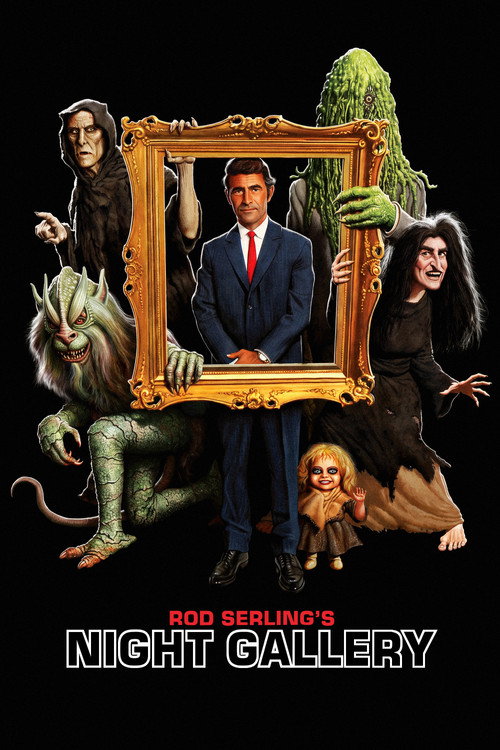
Night Gallery, Bantam, 1971
Night Gallery 2, Bantam, 1972
Rod Serling's Other Worlds,(editor) Bantam, 1978
Accolades
Posthumous honors
1985: Inducted into the Television Hall of Fame
1985: A star honoring Serling can be found at 6840 Hollywood Blvd. on the Hollywood Walk of Fame
2001: Nominated for a Daytime Emmy Award and Winner of a Writer Guild Award for the reusing of his script for the re-make of "A Storm in Century".
2007: Ranked No. 1 on TV Guide's "25 Greatest Sci-Fi Legends" list (the only non-fictitious person on the list)
2008: Inducted into the Science Fiction Hall of Fame