


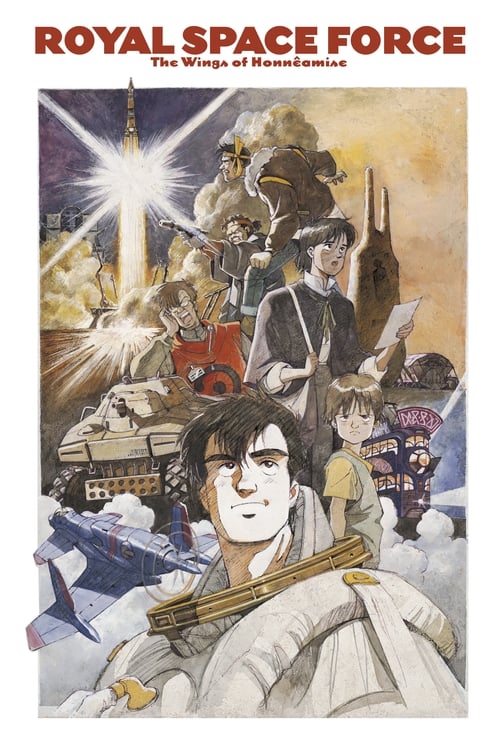
Royal Space Force: The Wings of Honnêamise (Japanese: 王立宇宙軍~オネアミスの翼, Hepburn: Ōritsu Uchūgun: Oneamisu no Tsubasa) is a 1987 Japanese animated science fiction film written and directed by Hiroyuki Yamaga, co-produced by Hiroaki Inoue and Hiroyuki Sueyoshi, and planned by Toshio Okada and Shigeru Watanabe, with music by Ryuichi Sakamoto. The story takes place in an alternate world where a disengaged young man, Shirotsugh, inspired by an idealistic woman, Riquinni, volunteers to become the first astronaut. The film was the debut by the studio Gainax, and the first anime produced by Bandai.
Royal Space Force was produced over four years and involved many creators, including some from outside the anime industry, to construct a detailed alternate world. Its collective approach to filmmaking, rejection of anime motifs, visual complexity, and inexperienced staff were all factors in its chaotic production. Its investors changed the name The Wings of Honnêamise and created lavish but deceptive marketing, with a premiere at Mann's Chinese Theatre.
Royal Space Force was released in Japan on March 14, 1987, by the Toho subsidiary Toho-Towa. It received some support from domestic anime fans and industry figures including Hayao Miyazaki, and Mamoru Oshii. The science fiction writer Ted Chiang described Royal Space Force as the most impressive example of worldbuilding in fiction. It failed to make back its costs at the box office, but eventually became profitable through home video sales. The anime director Hideaki Anno said the response had a major impact on him personally and professionally.
Royal Space Force did not receive an English-language release until 1994, when Bandai licensed it to Manga Entertainment. A dubbed 35 mm version toured theaters in North America and the United Kingdom, and received coverage in major newspapers but mixed reviews. It was released several times in English on home video. Various surveys of anime have regarded the film more positively; Yamaga said in retrospect that the elements which made Royal Space Force unsuccessful made possible the later successes of Studio Gainax.
Contents
Plot
In the Kingdom of Honnêamise, on an alternate version of Earth, Shirotsugh Lhadatt is an unmotivated young man who once aspired to be a fighter pilot. He instead joined the Royal Space Force, his nation's fledgling space program, which has been demoralised by numerous failures. After a fellow astronaut dies in training, Lhadatt befriends a young religious woman named Riquinni Nonderaiko, who spends her days street preaching and lives with a sullen child named Manna. Seeing the groundbreaking nature of his work, Riquinni inspires Lhadatt to volunteer for the Space Force's last attempt to send the world's first astronaut into orbit.
Lhadatt's training as an astronaut parallels his coming of age, as he and the rest of the space project members overcome technological difficulties, doubt, overwhelming public attention, and the machinations of their corrupt government. Lhadatt frequently visits Riquinni, who sees the world has succumbed to selfishness and sin, and becomes destitute when her house is foreclosed by a power company, forcing Riquinni and Manna to live in a small shack provided by a local church. Lhadatt studies a holy book Riquinni gifts to him, which asserts that humanity is eternally cursed for having stolen the "fire" of knowledge.
General Khaidenn, commander of the Royal Space Force, rallies public support for the project by lying that they are building a "space warship". The project’s chief engineer, Dr. Gnomm, is killed during an engine test accident, and controversy sparks regarding the project's expense and how it exacerbates the Kingdom's poverty epidemic. Disenchanted and depressed, Lhadatt suddenly goes AWOL and stays with Riquinni for a while. One night, Lhadatt sexually assaults Riquinni while catching her undressing, but he stops himself just before Riquinni knocks him unconscious. Lhadatt begs forgiveness the next day, but Riquinni blames herself before running off. Returning to the city, Lhadatt barely survives an assassination attempt by the Republic, a neighboring nation that is at war with the Kingdom. Before departing for the launch site, Lhadatt finally befriends Manna and says farewell to Riquinni.
The launch site is in a demilitarized zone, where the government hopes that the rocket will provoke the Republic into attacking. Though Khaidenn pushes the launch time forward, the Republic launches an invasion. Lhadatt — already in the space capsule and determined to finish what he started — refuses to abort the launch, and convinces the vulnerable ground crew to complete it. The spectacular launch stuns both sides into inaction.
Production
The film had a budget of ¥800 million, at the time equivalent to $5,531,000 (equivalent to $16,000,000 in 2025), making it the most expensive anime film up until then. It surpassed the budget records of Hayao Miyazaki's Castle of Cagliostro (1979) and Castle in the Sky (1986).
Development
Royal Space Force developed out of an anime proposal presented to Shigeru Watanabe of Bandai in September 1984 by Hiroyuki Yamaga and Toshio Okada from Daicon Film, an amateur film studio active in the early 1980s associated with students at the Osaka University of Arts and science fiction fandom in the Kansai region. Okada had first met Watanabe in August 1983 at a convention for tokusatsu fans in Tokyo at which Daicon Film screened their live-action short The Return of Ultraman and ran a sales booth for Daicon's related fan merchandise company, General Products. In a 1998 interview, Yamaga asserted that the success of the company was an impetus that led to the creation of Gainax and the Royal Space Force proposal, as Okada had co-founded General Products with Yasuhiro Takeda but Takeda was now managing it well on his own, leaving Okada to feel he had nothing to do. "I approached Okada, who was feeling a bit down. I was thinking every day about how [Daicon Film's] Sadamoto and Maeda are great geniuses. Of course, Anno is a genius, as is Akai. To have one genius in your group is incredible enough, but here we have four of them. I told [Okada] that he would be a fool not to take action. I said that we should do something. We had sacrificed quite a lot for the sake of our independent films as students—we had dropped out of school, we'd lost jobs. So there had always been a desire within us all to see those sacrifices pay off at some point."
Watanabe had been involved with product planning for Bandai's "Real Hobby Series" figurines. The position had also led Watanabe into Bandai's then-new home video label Emotion, where he helped to develop Mamoru Oshii's Dallos. Released at the end of 1983, Dallos would become the first anime original video animation (OVA), an industry event later described as the beginning of a new "third medium" for anime beyond film or television, offering the prospect of "a medium in which [anime] could 'grow up,' allowing the more mature thematic experiments of creators". Okada and Yamaga's pitch to Watanabe had followed the recognition Daicon Film received earlier that year in Animage magazine through a special secondary Anime Grand Prix award given to their 8 mm short Daicon IV Opening Animation. Their September 1984 proposal gave the outline for an anime to be entitled Royal Space Force, to be produced under the heading of a new, professional studio to be named Gainax. The proposal listed five initial core staff for the anime. Four had been previously associated with Daicon Film: Yamaga was to be the anime's concept creator and director and Okada its producer,
Yoshiyuki Sadamoto its chief character designer, and Hideaki Anno its chief mechanical designer. The fifth, Kenichi Sonoda, listed as responsible for the anime's settei (model sheets, drawn up to give the key animators their guides as to how the objects and people to be animated should look) had previously assisted with product development at General Products.
Writing
The Royal Space Force proposal, subheaded "Project Intentions: A New Wave in a Time of Lost Collaborative Illusions," began with a self-analysis of "recent animation culture from the perspective of young people". At the time of the proposal, Yamaga was 22 years old and had directed the opening anime films for Japan's 1981 and 1983 national science fiction conventions, Daicon III and IV, which through their sale to fans on home video through General Products were themselves regarded as informal precursors of the OVA concept. At age 20 and while still in college, Yamaga had been chosen by the series director of the original Macross TV series, Noboru Ishiguro, to direct episode 9 of the show, "Miss Macross," as Ishiguro wished "to aim for a work that doesn't fit the conventional sense of anime." Yamaga commented in a contemporary Animage article that it had taken him two months to create the storyboards for "Miss Macross" and wryly remarked he had thus already used himself up doing so; the magazine noted however that the episode was well received, and judged the creative experiment a success.
Okada and Yamaga argued in their proposal for Royal Space Force that what prevented the anime industry from advancing beyond its current level was that it had fallen into a feedback loop with its audience, producing for them a "cul-de-sac" of cute and cool-looking anime content that had the effect of only further reinforcing the more negative and introverted tendencies of many fans, without making a real attempt to connect with them in a more fundamental and personal way:
"In modern society, which is so information-oriented, it becomes more and more difficult even for sensational works to really connect with people, and even so, those works get forgotten quickly. Moreover, this flood of superficial information has dissolved those values and dreams people could stand upon, especially among the young, who are left frustrated and anxious. It could be said that this is the root cause of the Peter Pan syndrome, that says, 'I don't want to be an adult' ... If you look at the psychology of anime fans today, they do interact with society, and they're trying to get along well in that society, but unfortunately, they don't have the ability. So as compensatory behavior, they relinquish themselves to mecha and cute young girls. However, because these are things that don't really exist—meaning, there's no interaction in reality happening between those things and the anime fans—they soon get frustrated, and then seek out the next [anime] that will stimulate them ... If you look into this situation, what these people really want, deep down, is to get along well with reality. And what we propose is to deliver the kind of project that will make people look again at the society around them and reassess it for themselves; where they will think, 'I shouldn't give up yet on reality.'"
Pilot film
Royal Space Force was initially planned as a 40-minute long OVA project; however, resistance within Bandai to entering the filmmaking business resulted in the requirement that Gainax first submit a short "pilot film" version of Royal Space Force as a demo to determine if the project would be saleable. Work on the pilot film began in December 1984; in addition to the principal staff listed in the initial proposal, Mahiro Maeda worked on the pilot's layouts and settei and was one of its key animators together with Sadamoto, Anno, Hiroyuki Kitakubo, Yuji Moriyama, Fumio Iida, and Masayuki. A further addition to the staff was co-producer Hiroaki Inoue, recruited as a founding member of Gainax by Okada. Inoue had already been in the anime industry for several years, beginning at Tezuka Productions. Takeda noted that while a number of the other Royal Space Force personnel had worked on professional anime projects, none possessed Inoue's supervisory experience, or the contacts he had built in the process. Inoue would leave Gainax after their 1988–1989 Gunbuster, but continued in the industry and would later co-produce Satoshi Kon's 1997 debut film Perfect Blue.
In an effort to get the project green-lit by Bandai's executive board, Shigeru Watanabe of Bandai would show the pilot film to established anime directors Mamoru Oshii and Hayao Miyazaki, both of whom expressed support. In April 1985, Gainax formally presented the finished pilot film to a board meeting at Bandai, together with a new set of concept paintings by Sadamoto. The four-minute pilot film began with a 40-second prelude sequence of still shots of Shirotsugh's early life accompanied by audio in Russian depicting a troubled Soviet space mission, leading into the main portion of the pilot, depicting the story's basic narrative through a progression of animated scenes without dialogue or sound effects, set to the overture of Wagner's Die Meistersinger von Nürnberg.
Okada addressed the board with a speech described as impassioned, speaking for an hour on Gainax's analysis of the anime industry, future market trends, and the desire of the young for "a work called Royal Space Force". Bandai gave interim approval to Royal Space Force as their company's first independent video production; however, the decision to make the project as a theatrical film would be subject to review at the end of 1985, once Gainax had produced a complete storyboard and settei. Yamaga would later acknowledge the pilot film to have been "very Ghiblish," asserting that it had been made by Gainax with a subconscious "consensus" at first to use Hayao Miyazaki's films as a model for success. Yamaga felt that had the actual feature-length version of Royal Space Force been like the pilot, "it would have been easier to grasp and express," yet argued his decision to change course after the pilot film and not attempt to emulate Miyazaki laid the groundwork for Gainax's creative independence that would, in their later works, lead to success on their own terms.
Screenplay
Following the presentation of the pilot film, Yamaga returned to his hometown of Niigata to begin to write the screenplay and draw up storyboards. Yamaga envisioned the fictional Honnêamise kingdom where most of the events of Royal Space Force took place to have the scientific level of the 1950s combined with the atmosphere of America and Europe in the 1930s, but with characters who moved to a modern rhythm. The inspiration he sought to express in anime from Niigata was not its literal look, but rather a sense of the size and feel of the city and its envrions, including its urban geography; the relationships between its old and new parts, and between its denser core and more open spaces. In August 1985, six members of the crew, Yamaga, Okada, Inoue, Sadamoto, and Anno from Gainax, accompanied by Shigeru Watanabe from Bandai, traveled to the United States for a research trip, studying postmodern architecture, aerospace history, and witnessing a launch of the Space Shuttle Discovery. Documentary footage of the trip was shot by Watanabe and incorporated into a promotional film released two weeks before the Japanese premiere of Royal Space Force. Yamaga made revisions to the script during the American research tour.
Noriaki Ikeda, winner of the 1986 Seiun Award for nonfiction, began a series of articles on the film's production that year for Animage. After watching a rough edit of the film, Ikeda wrote that Royal Space Force was an anime that reminded him of what the works of the American New Wave had achieved in the 1960s; perceiving in the film an effort by Gainax to create a work with their own sense of words and rhythm, employing natural body language, raw expressions, and timing, and an overall "texture" that made a closer approach to human realities. Reviewing the completed film five months later, Ikeda made extensive comment on its use of dialogue, including its nuance as opposed to "the anime we're used to seeing these days, that scream their message at you," spoken lines that were independent of the main narrative, or even lines spoken inaudibly behind a music track, which gave a sense the characters existed as real human beings rather than only as roles to advance a plot.
In a roundtable discussion following the film's theatrical release, Yamaga commented, "I wanted to taste the sense of liberation I could get if I recognized everything [about human nature] and included it," a view with which Okada had concurred, saying, "this is a film that acknowledges people in their every aspect". Yamaga remarked, "A critic once said that none of the characters in this film understand each other. That there's no communication between the characters. He was exactly right. The characters don't understand each other at all. But throughout the film, there are moments where there are glimpses of understandings between [Shirotsugh] and the other characters ... In reality, it's okay not to understand each other. People all live their individual lives—it's not necessary to feel the same way another feels. And in fact you will never understand anybody anyway. This is how I feel about the relationships I have with the people in my life."
Design
In May 1985, Gainax transferred their operations to a larger studio in Takadanobaba, where the existing staff gathered in friends and acquaintances to help visualize the setting of Royal Space Force. Among those joining the crew at this time were two of the film's most prolific world designers: Takashi Watabe, whose designs would include the train station, rocket factory, and Royal Space Force lecture hall and Yoichi Takizawa, whose contributions included the rocket launch gantry, space capsule simulator, and rocket engine test facility. Yamaga decided the alternate world depicted in the pilot film did not have the kind of different realism he was hoping to achieve in the completed work and started over again, creating a new series of "image board" paintings to visualize the look of Royal Space Force. The total worldbuilding process went on for roughly a year, and was described as a converse process between Yamaga and the team of designers; expressing his ideas into concrete terms, but also bringing their concrete skills to bear toward the expression of abstract ideas. This reciprocal process influenced Yamaga's writing on the film: "My style is not 'I have a story I created, so you help me make it.' Creators come first, and this is a story I created thinking what story those creators would shine at the most."
In the decade following Royal Space Force, the Sadamoto-designed Nadia La Arwall and Rei Ayanami would each twice win the Anime Grand Prix fan poll for favorite female character; Sadamoto's Shinji Ikari would also win twice for favorite male character. By contrast, his male and female leads designed for Royal Space Force, Shirotsugh and Riquinni, ranked ninth and twentieth respectively for their categories in the Grand Prix poll of 1987 releases. In a roundtable discussion on the film, it was pointed out that neither Shirotsugh nor Riquinni look like typical anime lead characters. Yamaga remarked that one of the design changes made from the pilot film was Shirotsugh, who "used to look like a boy", but in the full-length movie "has become like a middle-aged man." Sadamoto used for the final version of Shirotsugh a model reference significantly older than the 21-year old character's age, the American actor Treat Williams. For Manna, Yamaga referred Sadamoto to actress Tatum O'Neal as she appeared in the first half of the film Paper Moon. Regarding Riquinni herself, Sadamoto commented that there seemed to be a model for her, but Yamaga did not tell him who it was. In a 2018 interview session with Niigata University, Yamaga remarked, "What I see now is surprisingly the character Riquinni is nothing but me. At any rate, Shirotsugh is not me. If you ask me where I would position myself in the film, I would identify myself as Riquinni in many aspects, in terms of the way I think. I was probably someone weird [and] religious, ever since my childhood."
Art direction
Although later noted for creating much of the aesthetic behind the influential 1995 film Ghost in the Shell, Hiromasa Ogura in a 2012 interview named his first project as an art director, Royal Space Force, as the top work of his career. Ogura had entered the anime industry in 1977 as a background painter at Kobayashi Production, where he contributed art to such films as Lupin III: The Castle of Cagliostro; at the time work began on Royal Space Force, Ogura was at Studio Fuga, a backgrounds company he had co-founded in 1983. On temporary transfer to Gainax after he was recruited for the project by Okada and Inoue, Ogura recalled he did not at first realize he was working with the same amateur filmmakers who had made the Daicon opening animations. Ogura oversaw a team of 16 background painters on Royal Space Force, including the future art director of Spirited Away, Yōji Takeshige, then still a student attending Tama Art University. A majority of the film's background paintings were created in Gainax's studio rather than outsourced, as Ogura felt the film's worldview was easier for him to communicate to artists in person; as the color scheme in Royal Space Force was subdued; if a painting needed more of a bluish cast to it, he could not simply instruct the artist to "add more blue."
Toshio Okada described the aesthetics of the world in which Royal Space Force takes place as having been shaped by three main artists: first, its major color elements (blue and brown) were determined by Sadamoto; then its architectural styles and artistic outlook were designed by [Takashi] Watabe, and finally Ogura gave it "a sense of life" through depicting its light, shadow, and air. It was noted also that the film's world displays different layers of time in its designs; the main motifs being Art Deco, but with older Art Nouveau and newer postmodern elements also present. Ogura commented that although the film depicted a different world, "there's nothing that you'd call sci-fi stuff, it's everyday, normal life like our own surroundings. I wanted to express that messy impression." He laid particular emphasis on attempting to suggest the visual texture of the world's architecture and interior design; following Watabe's detailed notes, Ogura worked to convey in his paintings such aspects as the woodwork motifs prominent in the Space Force headquarters, or by contrast the metallic elements in the room where the Republic minister Nereddon tastes wine. Watabe and Ogura would collaborate again in 1995 on Ghost in the Shell.
Critiquing his own work on Royal Space Force, Ogura expressed a wish that he had been able to convey more emphasis on the effects of light and shadow in addition to color, but joked that it was hard to say exactly how things would turn out until he actually painted them, something he said was true of the entire film. Ogura remarked that many of his team were veterans of Sanrio's theatrical films unit, which gave him confidence in their abilities; mentioning the role of former Sanrio artist, future Gankutsuou art director Hiroshi Sasaki, in the visionary sequence occurring after Shirotsugh's orbiting spacecraft crosses from the world's nightside to its dayside, referred to in production as its "image scene." Akai discusses the involvement as well in this sequence of the future director of Gankutsuou, Mahiro Maeda. Okada judged that the image scene was the only place in the film appropriate to the talent of Maeda, whom he called a "true artist." Anime, Okada argued, was like a reactor that harnessed Maeda, whose artistic talent Okada compared to that of a nuclear blast, for the mundane purpose of boiling water; he asserted that when Maeda had worked before Royal Space Force on Castle in the Sky, not even Hayao Miyazaki had been able to employ his talent properly.
Animation
After the completion in December 1985 of Daicon Film's final project, Orochi Strikes Again, its director Takami Akai and special effects director Shinji Higuchi moved to Tokyo to join the production of Royal Space Force as two of its three assistant directors, alongside Shoichi Masuo. At age 20, Higuchi was the very youngest of the main crew; his previous creative experience had been in live-action special effects films rather than anime. As someone who did not "think like an animator," he would bring unorthodox and interesting ideas and techniques to the project. Shoichi Masuo was an associate of Hideaki Anno, whom he had met when the two worked together on the 1984 Macross film. Having more experience than Akai or Higuchi in anime, Masuo would explain Yamaga's abstract directives to animators in concrete terms. Higuchi had overall charge regarding the design aspects of the settei, Masuo was in charge over the color aspects of the settei, including backgrounds, whereas Akai monitored the work as a whole as general assistant to Yamaga. These roles were not fixed, and the three did not confer on a daily basis, but rather would have meetings on how to shift their approach whenever changes in the production situation called for it.
Masuo remarked that the animation style of Royal Space Force was generally straightforward, without the characteristic quirky techniques to create visual interest or amusement often associated with anime, but that "there's nothing else [in anime] like this where you can do proper acting and realistic mechanical movements. That's why its impression is quite cinematic...In animation, it's very difficult to do something normal. When you consider [the film], there are many scenes where the characters are just drinking tea or walking around. You don't take notice of [such actions], yet they're very difficult to draw, and I think it required a lot of challenging work for the key animators." Anno, who served as the film's special effects artist, likewise remarked that two frequent criticisms of Royal Space Force were that "it could have looked more like a [typical] anime" but also contrariwise that it would have been more appropriate for it to be made in live-action. Anno felt these views failed to apprehend the advantage of using animation for filmmaking as a precise transmission of directorial intent, and the film's aim to convey a sense of reality rather than a look of live-action as such: "All I can say to people who want to see something more anime-like on their screen is that they should watch other anime."
Although Royal Space Force was essentially a pre-digital animated work using layers of physical cels and backgrounds painted by hand, computer-assisted animation was used for certain difficult motion shots, including the contra-rotating propellers of the Honnêamise air force plane, the rotation of the space capsule while in orbit, the tilted wheel turn of the street sweeper, and the swing of the instrument needle in the launch control bunker. The motions themselves were rendered using ASCII 3D software, and then traced onto cels. By contrast, Ryusuke Hikawa noted that the flakes of frost falling from the rocket at liftoff, which might be assumed to be a CG effect, were done entirely by hand under the supervision of Hideaki Anno.
Cinematography
As a pre-digital anime, the scenes in Royal Space Force were created by using a camera to photograph the animation cels and backgrounds onto movie film. A scene would typically consist of a series of separate individual shots known as "cuts," with each cut being prepared for the photographer by collecting into a bag all animation cels and background elements to be used in that particular cut. Many of the scenes in the film would be realized through special techniques applied to the underlying animation; an example was the analog television screen in the Space Force barracks, created by photographing the animation cels through a clear acrylic panel cover from a fluorescent lamp. Besides the technical necessity to photograph the animation, Gainax's experience in filming amateur live-action works had an influence on the construction of the animated scenes themselves. Akai and Yamaga remarked that it had not been their intent to "emulate" live-action films, but to make animation with a realism based on their experience of "look(ing) through the camera lens to see what it sees ... It's difficult to express animated films realistically. The camera doesn't really exist." Another reflection of their live-action experience involved building scale models of vehicles and buildings appearing in the film as models for the animators, but also to choose which angles and viewpoints to use in scenes where the modelled objects would appear; in the figurative sense, to "decide where the cameras should be."
The director of photography on Royal Space Force was Hiroshi Isakawa of Mushi Production, where the animation for the pilot film had been shot. Isakawa remarked that he was originally assured photography could begin in April 1986, but received no cuts to film until August, and then "only the easy work," with Gainax putting off more difficult scenes until later. The most intense work period occurred in January 1987, with the filming completed at the end of that month; with the off-and-on nature of the task, the photography had taken three months of actual time. Isakawa described the technical challenges he faced in filming Royal Space Force, with some individual cuts created by using as many as 12 photographic levels consisting of cels, superimposition layers, and sheets of paper masks designed to capture isolated areas of different colored light. Another challenging aspect involved motion, such as conveying the heavy vibrations of Marty's motorcycle, or the air force plane cockpit; whereas ordinarily such scenes would be filmed while shaking the cels and the backgrounds as a unit, Gainax insisted that the elements be shaken separately.
Yamaga and Shinji Higuchi, who also served as assistant director of photography on the film, had Isakawa watch The Right Stuff and showed him NASA photos as a reference for the look they wished to achieve in certain shots. To convey a sense of the visual mystery of the film's world from space, Isakawa photographed the art through masks with such tiny holes that he felt the images were hardly lit at all; he was unable to judge the light levels in advance, having to make adjustments afterwards based on examining the developed film. Isakawa mentioned that he would get tired and angry after being asked to shoot five or six different takes of a cut, not seeing the necessity for it, but gave up resisting when he realized it was a work "in pursuit of perfection," and felt that the final achievement was "realistic without using the imagery of live action, a work that made full use of anime's best merits."
Voice acting
The voice performances in Royal Space Force were supervised by Atsumi Tashiro of the anime studio Group TAC, who had been sound director for the highly influential 1974 TV series Space Battleship Yamato. Gainax had been enthusiastic in pursuing Tashiro's involvement, even though Tashiro had not worked outside his own company in over 20 years, sending him the film's script, followed by a personal visit from Yamaga and Okada. Despite his initial difficulty in grasping the project, Tashiro was struck by the passion and youth of the filmmakers, and felt that working with them on Royal Space Force would represent an opportunity to "revitalize" himself professionally.
Yamaga remarked that he "wanted the dialogue to be natural," which he maintained was "a first in Japanese animation." Akai felt a tone had been set for Royal Space Force by the decision to cast Leo Morimoto in the lead role as Shirotsugh: "The other actors [then] knew that this was going to be a different kind of animated film." Morimoto was a 43-year old veteran actor of live-action films and TV but had very limited experience in anime, whereas Mitsuki Yayoi, cast as Riquinni after Gainax had heard her on the radio, was a stage actor and member of the Seinenza Theater Company with some voice-over experience, but who had never before played an anime role. Tashiro saw the casting as a great opportunity for him, asserting that the apprehension Morimoto and Yayoi felt due to their mutual unfamiliarity with the field meant that they approached their roles as an actual encounter, with genuine emotion and reactions that were honest and fresh, a spirit that Tashiro said he had forgotten within the world of anime.
Morimoto remarked during a recording session for the film in late November 1986 that Tashiro directed him not to play the role of Shirotsugh as if it were an anime, but rather to attempt the flavor of a live performance, and that Yamaga had given him the same instructions. He commented that it was a difficult role for him, as unlike a live-action drama, "you can't fake the mood, you have to express yourself correctly with just your voice," and viewed his work on Royal Space Force as "scary" but "fulfilling." Although evaluating the character himself as "not a great hero," at the same time he found much that was convincing in Shirotsugh's growth, feeling that it somehow came to assume the role of history's own progression: "What is to be found at the end of that maturation is gradually revealed, arriving at a magnificent place." He added he was "shocked that a 24-year old could make such a film ... I'm glad to know that [creators] like this are making their debut, and I hope that more of them do."
Music
In April 1986, Ryuichi Sakamoto was selected as the musical director of Royal Space Force. Sakamoto was already regarded for his work in the pioneering electronic band Yellow Magic Orchestra and his soundtrack for the 1983 Nagisa Oshima film Merry Christmas, Mr. Lawrence; the year following the release of Royal Space Force, Sakamoto would share the Academy Award for Best Original Score for the soundtrack to The Last Emperor. In 1986 Sakamoto was prominent also in the Japanese domestic film market for his soundtrack to its top-grossing movie of that year, Koneko Monogatari. Ryusuke Hikawa commented that in fact the musical director was the only member of Royal Space Force's main staff known to the general public at the time of the film's production; Yamaga recalled that asking Sakamoto to do the music for Royal Space Force required a special increase of 40 million yen above its previous 360 million yen budget. Sakamoto's first commercial release of music for the project occurred three months before the Japanese debut of the film itself, in the form of a 12" maxi single entitled The Wings of Honnêamise: Image Sketch, containing early mixes of four key initial pieces he had composed for the film's soundtrack, referred to on Image Sketch only under the names "Prototype A", "Prototype B", "Prototype C", and "Prototype D". In its liner notes Sakamoto commented that one of the main reasons he accepted the job was that he saw a resemblance between the meticulous care he put into his music and the efforts the filmmakers were taking with Royal Space Force. Yamaga wrote in Image Sketch that he saw Sakamoto as a composer who, like the other creators working on the film, rejected "fill-in-the-blank" styles and instead expressed a deep personal sensibility.
Sakamoto brought into the Royal Space Force project his prior collaborators on Koneko Monogatari, musicians Koji Ueno, Yuji Nomi, and Haruo Kubota. Ueno, Kubota, and Nomi took as their starting points Sakamoto's four prototypes as well as a set of "keywords" that Yamaga had given them for guidance. The team worked from a
"chart table" prepared by Sakamoto and sound director Atsumi Tashiro listing each scene in the film requiring music, with notes on length, the kind of music to be used, and which of the four prototypes to use as a basis for their arrangements. Ueno, Kubota, and Nomi then decided which scenes in the film they would each arrange, and then made their pieces separately, neither working on them in the studio together, or with Sakamoto. After arranging a piece, they would reassemble as a group and listen to each other's work, and then go their separate ways once again to continue the process. 47 musical arrangements were made for the film based on the chart, of which 15 were later selected to be featured on The Wings of Honnêamise~Royal Space Force Original Soundtrack album released in March 1987, most were developed as variations on one of Sakamoto's original four prototypes; for example, "Prototype A" would become the basis of the film's opening credits theme. A few were created based on arrangements combining two of the four prototypes; 13 of the 47 pieces, however, were not based on any of the four, but were instead new original compositions created later in the soundtrack process by Ueno, Kubota, Nomi, or Sakamoto himself; several of these were featured on the Original Soundtrack. The background music pieces not included on the Original Soundtrack would eventually be collected as a bonus feature on the 1990 Royal Space Force~The Wings of Honnêamise Memorial Box LaserDisc edition; this bonus feature would also be included as an extra on the 2000 Manga Entertainment DVD.
Marketing and release
Marketing
By late 1986, signs of nervousness had appeared among sponsors and investors in the film, as "the footage of Royal Space Force neared completion … and was found to be inconveniently free of many merchandising spin-off opportunities," prompting what Jonathan Clements describes as "outrageous attempts" by its financial backers to "fix" the film that began with "prolonged arguments over a sudden perceived need to rename it." The project had been pitched, developed, and approved for production under the name Royal Space Force; Okada remarked that, to Gainax, it was "its one and only title". All Nippon Airways, one of the film's sponsors, however desired that the title include the word "wings", while Bandai favored that the title should use the form "Something of Something," on the reasoning that the last big anime hit had been called Nausicaä of the Valley of the Wind. As Royal Space Force "was 'not sexy enough'" and Riquinni was "conveniently female," the initial push was to use the title (The) Wings of Riquinni.
Although the plan to make Royal Space Force had been known around the anime industry since mid-1985, the official announcement of the film was not made until June 4, 1986, in a press conference held at the prestigious Imperial Hotel in Tokyo. The announcement used Royal Space Force as the main title of the film, with (The) Wings of Riquinni as a smaller subtitle; privately, Yamaga objected strongly to the subtitle, pointing out the purpose of the film was to expand the audience's view of the world, and that he did not want a title that focused on one character; therefore, if a second title was absolutely required, he suggested it use Honnêamise after the name of the kingdom in which most of the film's events takes place. As 1986 drew to a close, publicity for the film gradually relegated Royal Space Force to the status of a smaller subtitle beneath The Wings of Honnêamise.
In a 2010 memoir, Okada reflected that the conflict had involved not only the film's title, but also its length. Okada acknowledged a shorter movie could have potentially increased ticket sales by allowing the film to be shown more times per day; at the time, however, Okada had refused, arguing that the box office was not part of his job, saying in a meeting that if they wanted to cut the film by even 20 minutes, they might as well cut off Okada's arm. In retrospect, Okada felt that he had acted like a child, but that "creators are all children." Bandai company president Makoto Yamashina affirmed shortly before the film's release that during a three week period he and distributor Toho-Towa had thought of cutting 20 minutes from the film: "but the process of deciding what [scenes] to cut began with conversations about why they shouldn't be cut. And afterwards, I thought, 'Ah, I get it now' and felt that I couldn't ... For the sake of the box office, it could have worked at around 100 minutes, but if we cut the film at this stage, the whole objective of the movie flies out the window, and the hundreds of millions of yen spent on it have no meaning." Yamashina told Toho he would accept responsibility if his decision meant the film was not a hit.
Release
Shortly before the release of the film, Makoto Yamashina stated his considerable uncertainty over how the film would be received, with the fear that "the theaters will be deserted." He also however expressed anxiety over the implications for the industry if it succeeded: "If it turns out that young people today are thinking along Yamaga's lines, at that level of sophistication, it's going to be very difficult [for other filmmakers] ... It's hard for me to talk about the film like this, but regardless of whether or not it succeeds, it's a movie that I don't understand." In an attempt to build publicity for the film's March 1987 release in Japan, a world premiere event was held on February 19, 1987, at Mann's Chinese Theatre in Hollywood. The one-night showing was arranged for the Japanese media, with all Tokyo TV news shows covering the premiere; Bandai paid for 200 anime industry notables to attend as well. Footage from the Hollywood event was incorporated into a half-hour promotional special that aired March 8 on Nippon TV, six days before the film's release in Japan. Americans invited to the showing included anime fans and several figures associated with U.S. science fiction cinema including The Terminator and Aliens actor Michael Biehn, as well as Blade Runner designer Syd Mead. Although referred to in Japanese publicity materials as The Wings of Honnêamise~Royal Space Force's "American prescreening," the film was shown under the name Star Quest, and presented in an English dub remarked upon by both U.S. and Japanese anime magazines covering the event for its significant differences from the original film; in 2021 Bandai's Ken Iyadomi recalled, "it was localized in a totally American way, and everyone hated it."
The Wings of Honnêamise~Royal Space Force was released nationwide in Japan on March 14, 1987. In a late spring discussion following the film's release, co-producer Hiroaki Inoue asserted that the film "put up a good fight," arguing that the average theater stay for original anime films was four weeks; in one theater, Royal Space Force had managed a seven-week engagement. Takeda recalled, "Not a single theater cancelled its run, and in some locations, it actually had a longer run than initially planned ... The budget scale meant that reclaiming all the production costs at the box office simply wasn't feasible." Clements however presents an argument that the film was overinvested in as part of the "goldrush tensions" of Japan's bubble economy, and that the original plan to release it as an OVA might have been more financially sensible. Beginning with its 1990 Japanese laserdisc box set release, the film's main title was changed back to Royal Space Force, with The Wings of Honnêamise as a smaller subtitle. Although Gainax itself was nearly bankrupted by the project, Bandai recouped its investment in September 1994, seven and a half years after its Japanese theatrical release; the film has continued to generate profit for them since.
Reception
Critical response in Japan
The Yomiuri Shimbun, Japan's largest daily newspaper, published a mixed review of the film the day before its Japanese premiere, characterizing the film as scattered and boring at times, and stating a certain "resentment at its lack of excitement," but concluded by expressing its admiration for the film on the grounds of its effort and expense, honest and personal vision, and for not clinging to the patterns of previous anime works. A contemporary review in Kinema Junpo, Japan's oldest film journal, saw the film as not truly about the "well-worn subject" of space travel, but rather about reaching a point where "the whole Earth can be seen ... taking full advantage of the unique medium of animation," the creators "observe civilization objectively first and then disassemble it to eventually restructure it ... Stories that feature cool machines, robots, and attractive characters, with the plot unfolding while drifting through space, already reached their peak in a sense with the [1984] Macross movie. Rather than trying to go beyond Macross, I think the creators of this film believed that they could find a new horizon for anime by creating a different world in a way that draws the story closer to Earth again."
Royal Space Force ranked high in major annual retrospectives awarded by the Japanese anime press. The film won the Japan Anime Award for best anime release of 1987, while making two of the top ten lists in the Anime Grand Prix fan poll, as #4 anime release of the year, with Shirotsugh Lhadatt as #9 male character. In 1988, Royal Space Force won the Seiun Award, Japan's oldest prize for science fiction, for Best Dramatic Presentation of the previous year. At the beginning of 1989, an Animage retrospective on the first 70 years of anime film compared Royal Space Force to Isao Takahata's 1968 directorial debut The Great Adventure of Horus, Prince of the Sun as a work that, like Horus, seemed to have emerged onto the scene unrelated to any previous commercial release: "an anime movie with a different methodology and message ... It's uncertain what influence it will have on anime in the future, but what is certain is that this was a work filled with the tremendous passion of its young staff."
Hayao Miyazaki praised Royal Space Force, calling it "an honest work, without any bluff or pretension ... I thought the movie is going to be a great inspiration to the young people working in this industry. They may be intensely divided over whether they like it or not, but either way it's going to serve as a stimulus." Miyazaki expressed two criticisms of the film: the design of the rocket, which he saw as too conventional and reminiscent of "big science like NASA," and the fact Shirotsugh was positioned as having to rally the older members of the Space Force into not giving up on the launch, which Miyazaki found unconvincing given that they had dreamed of space travel far longer than he. Yamaga did not deny that he wrote the script in a way he thought would appeal to young people, but felt it very important to note the contributions of the older and younger generation to both the launch of the rocket, and to the making of the film itself. Miyazaki felt that since it was young people like Yamaga who had "actively sown the seeds of improvement [in anime]" with Royal Space Force, it would have been better in the movie if the young told the old, "'Stand back, old men.'" Yamaga remarked in response that the film showed a reality where neither generation of the Space Force saw their personal visions prevail, as the construction of the rocket and its launch only happened because of support from a government that had a different agenda from their own. "It's not about making a leap, even though from the beginning it seems that way. More than going somewhere new in a physical sense, my aim was to show something worthy in the process."
Critical response internationally
Critical response to the English-dubbed version of the film during its 1994–1995 theatrical release was greatly divided, with reviews differing widely on the film's plot, themes, direction, and designs. The San Jose Mercury News gave a one-star review, writing that the film was misogynistic, lacked originality, conflict, and resolution; also perceiving in its character designs "self-loathing stereotypes" of Japanese people, a view advanced as well in a negative review of the film by LA Village View. The Salt Lake Tribune described it as "plodding" and "a dull piece of Japanese animation ... The filmmakers create precisely drawn images, but there's no life or passion behind them." The Dallas Morning News felt that Hiroyuki Yamaga's "trying to appeal to a broader audience" was by itself a fundamentally mistaken approach to making anime, comparing it to trying to "commercialize punk music"; the review instead recommended that audiences see "a far more representative anime, Fist of the North Star ... Fist has few of the pretensions of Wings and it's driven along with an energy its better-dressed cousin never attains."
More favorable reviews tended to regard the film as unconventional while nevertheless recommending the film to audiences. The Fort Worth Star-Telegram wrote it "blends provocative ideas and visual beauty", comparing its worldbuilding to that of Blade Runner. LA Weekly commented, "These strange, outsize pieces fuse and add a feeling of depth that cartoon narratives often don't obtain ... Technical brilliance aside, what gives [the film] its slow-building power is the love story—a mysterious and credible one." The Washington Post viewed its two-hour length as "a bit windy" but also asserted, "Hiroyuki Yamaga's The Wings of Honnêamise is a spectacular example of Japanimation, ambitious and daring in its seamless melding of color, depth and detail." Roger Ebert of the Chicago Sun-Times gave the film three stars out of four, praising Yamaga's visual imagination and remarked on the director's "offbeat dramatic style," recommending "If you're curious about anime, The Wings of Honnêamise ... is a good place to start." In the United Kingdom, The Guardian regarded it as the standout of an anime festival at London's National Film Theatre: "One film in the season, though, proves that anime can be complex and lyrical as well as exciting. Hiroyuki Yamaga's Wings of Honnêamise ... " In Australia, Max Autohead of Hyper magazine rated it 10 out of 10, calling it "a cinematic masterpiece that will pave the way for more" anime of its kind.
Following its initial English-language release in the mid-'90s, later retrospectives on anime have had a positive view of Royal Space Force: The Wings of Honnêamise. In a 1999 issue of Time, former Film Comment editor-in-chief Richard Corliss wrote an outline on the history of anime, listing under the year 1987 the remark, "The Wings of Honnêamise is released, making anime officially an art form." In the 2006 edition of The Anime Encyclopedia, Jonathan Clements and Helen McCarthy characterized the film as "one of the shining examples of how cerebral and intelligent anime can be". Simon Richmond, in 2009's The Rough Guide to Anime, wrote that the film's "reputation has grown over time to the point where it is justly heralded as a classic of the medium". whereas in 2014's Anime, Colin Odell and Michelle Le Blanc described the film as "an example of science-fantasy anime as art-film narrative, combined with a coming-of-age drama that is intelligent and thought-provoking". Jason DeMarco, current senior vice president at Warner Discovery and co-creator of Toonami, ranked it as the #11 anime movie of all time, stating "If The Wings of Honnêamise is a 'noble failure,' it's the sort of failure many filmmakers would kill to have on their résumé." During a 2021 interview with the New York Times, science fiction author Ted Chiang, whose Nebula Award-winning "Story of Your Life" was the basis for the Denis Villeneuve movie Arrival, cited Royal Space Force as the single most impressive example of worldbuilding in book or film. On the review aggregator website Rotten Tomatoes, 100% of 8 critics' reviews are positive, with an average rating of 6.9/10.
Academic analysis
Royal Space Force attracted a broader academic analysis as early as 1992, when Takashi Murakami referenced the film through Sea Breeze, an installation created during his doctoral studies in nihonga at Tokyo University of the Arts. The installation piece was described as "a ring of enormous, 1000-watt mercury spotlights that emitted a powerful blast of heat and blinding light when a roller shutter was raised ... the circular of lights was based on a close-up of rocket engines firing during a space launch in the anime Royal Space Force: [The] Wings of Honneamise." Hiroyuki Yamaga's remark, "We wanted to create a world, and we wanted to look at it from space" would be quoted as an epigram in My Reality—Contemporary Art and the Culture of Japanese Animation, where Murakami was described as a "pivotal figure" among contemporary artists "inundated with manga and anime—and with concepts of the new Japan, which was wrestling with a sense of self-identity as an increasingly strong part of the modern capitalistic world, yet was tied to a long and distinguished past." In a discussion with the Japanese arts magazine Bijutsu Techō, Murakami "... found it commendable that otaku were dedicated to 'the invention of a new technique, especially through the use of overlooked elements, finding an "empty space".' He maintained that art must find the same 'empty space' to revolutionize itself." "Gainax represented, for Murakami, a model of marginalized yet cutting-edge cultural production ... At the same time, the fact that the burning wheel was contained inside a box signified passion confined within a conventional frame, evoking the failure of Honneamise to present a uniquely Japanese expression as it remained under the influence of Western science-fiction films."
Murakami would express a specific historical conception of otaku during a discussion with Toshio Okada conducted for the 2005 exhibition Little Boy: The Arts of Japan's Exploding Subculture: "After Japan experienced defeat in World War II, it gave birth to a distinctive phenomenon, which has gradually degenerated into a uniquely Japanese culture ... [you] are at the very center of this otaku culture", further asserting in an essay for the exhibit catalog that therefore "otaku ... all are ultimately defined by their relentless references to a humiliated self". This historical positioning of otaku culture would itself be challenged through an analysis of Royal Space Force by Viktor Eikman, who cites Murakami's statement that the studio that made the film occupied "a central place in the current anime world... [they were] professionally incorporated as Gainax in 1984 upon production of the feature-length anime The Wings of Honneamise (released in 1987)" but that the two Gainax works discussed by Murakami in his theory of otaku were the Daicon IV Opening Animation and Neon Genesis Evangelion. Eikman argues that the theory should be tested also against "other works by the same studio, made by the same people for the same audience, but not analysed [in the essay] by Murakami". Of Royal Space Force, Eikman contended, "At most we may view the humiliated Shiro's mission as symbolic of Japan's desire to join the Space Race in particular and the 'big boy' struggles of the Cold War in general, a desire which plays into the sense of childish impotence described by Murakami, but even that is a very speculative hypothesis," arguing that "it is remarkably hard to find parallels to World War II" in the film.
Sequel
During 1992–93, Gainax developed plans for a sequel to Royal Space Force to be entitled Aoki Uru (also known under the titles Uru in Blue and Blue Uru); an anime film project to be directed by Hideaki Anno and scripted by Hiroyuki Yamaga, with Yoshiyuki Sadamoto serving as its chief animation director and character designer. Although a full storyboard, partial script, and an extensive collection of design illustrations were produced for Aoki Uru, the project had been initiated without a secured budget, and its development occurred within a period of personal, financial, and managerial crises at Gainax that contributed to the indefinite suspension of work on Aoki Uru in July 1993; the studio instead shifted to producing as their next anime project the TV series Neon Genesis Evangelion. In the years following 1993, Gainax has made occasional announcements regarding a revival of the Aoki Uru concept, including a multimedia proposal in the late 1990s, and the formal announcement of an English name for the film, Uru in Blue, at the 2013 Tokyo Anime Fair. In 2018, the Uru in Blue project was transferred from Gainax to Gaina, a different corporate entity and subsidiary of the Kinoshita Group, which aimed for a worldwide release of the film in 2022. However, in an essay about civilization made by Yamaga in the December 22, 2022, issue of Niigata Keizai Shimbun, it was stated that he was still "currently working" on the project.