
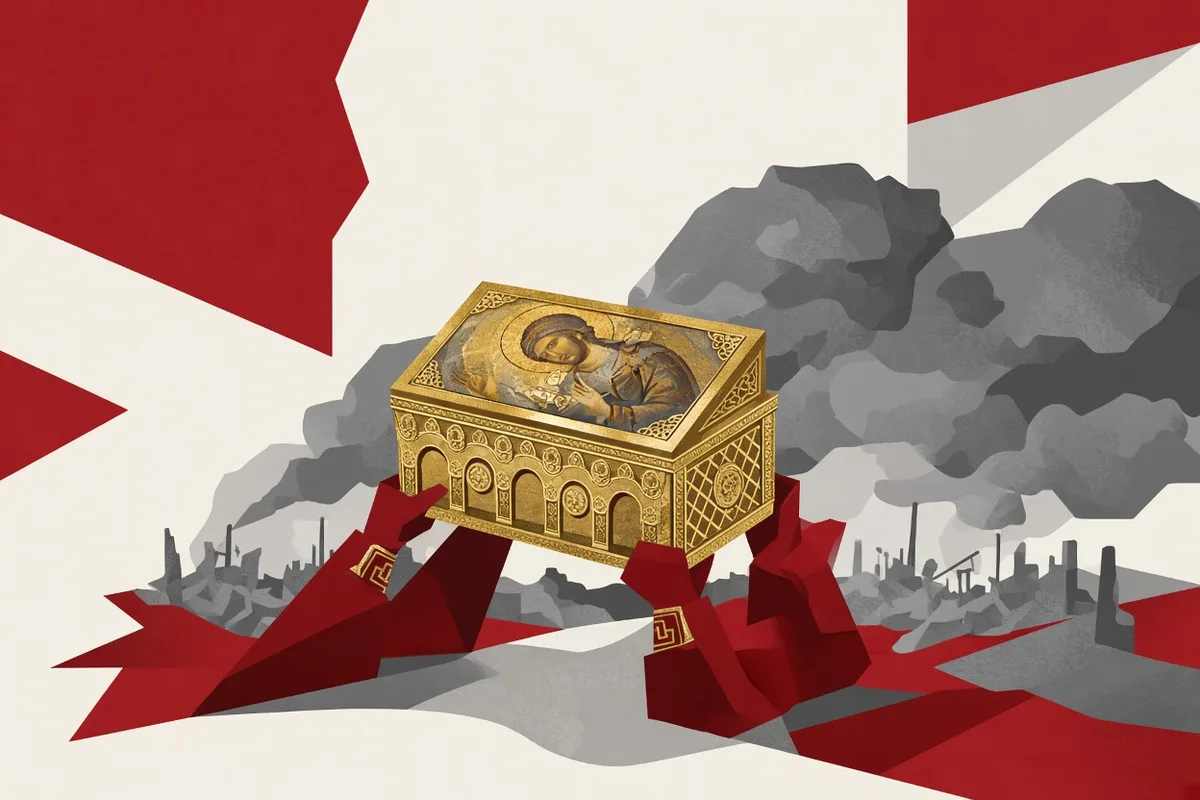
The Russian Orthodox Church (ROC; Russian: Русская православная церковь, РПЦ, romanized: Russkaya pravoslavnaya tserkov', RPTs;), also officially known as the Moscow Patriarchate (Russian: Московский патриархат, romanized: Moskovskiy patriarkhat), is an autocephalous Eastern Orthodox Christian church. It has 194 dioceses inside Russia. The primate of the ROC is the Patriarch of Moscow and all Rus'.
The history of the ROC begins with the Christianization of Kievan Rus', which commenced in 988 with the baptism of Vladimir the Great and his subjects by the clergy of the ecumenical patriarch of Constantinople. Starting in the 14th century, Moscow served as the primary residence of the Russian metropolitan. The ROC declared autocephaly in 1448 when it elected its own metropolitan. In 1589, the metropolitan was elevated to the position of patriarch with the consent of Constantinople. In the mid-17th century, a series of reforms led to a schism in the Russian Church, as the Old Believers opposed the changes.
The ROC currently claims exclusive jurisdiction over the Eastern Orthodox Christians, irrespective of their ethnic background, who reside in the former member republics of the Soviet Union, excluding Georgia. The ROC also created the autonomous Church of Japan and Chinese Orthodox Church. The ROC eparchies in Belarus and Latvia, since the fall of the Soviet Union in the 1990s, enjoy various degrees of self-government, albeit short of the status of formal ecclesiastical autonomy.
The ROC should also not be confused with the Russian Orthodox Church Outside of Russia (or ROCOR, also known as the Russian Orthodox Church Abroad), headquartered in the United States. The ROCOR was instituted in the 1920s by Russian communities outside the Soviet Union, which had refused to recognise the authority of the Moscow Patriarchate that was de facto headed by Metropolitan Sergius Stragorodsky. The two churches reconciled on 17 May 2007; the ROCOR is now a self-governing part of the Russian Orthodox Church.
Contents
History
Apostle Andrew
One of the foundational narratives associated with the history of Orthodoxy in Russia is found in the 12th-century Primary Chronicle, which says that the Apostle Andrew visited Scythia and Greek colonies along the northern coast of the Black Sea before making his way to Chersonesus in Crimea. According to the legend, Andrew reached the future location of Kiev and foretold the foundation of a great Christian city with many churches. Then, "he came to the [land of the] Slovenians where Novgorod now [stands]" and observed the locals, before eventually arriving in Rome. Despite the lack of historical evidence supporting this narrative, modern church historians in Russia have often incorporated this tale into their studies.
Kievan Rus'
In the 10th century, Christianity began to take root in Kievan Rus'. Towards the end of the reign of Igor, Christians are mentioned among the Varangians. In the text about the treaty with the Byzantine Empire in 944–945, the chronicler also records the oath-taking ceremony that took place in Constantinople for Igor's envoys as well as the equivalent ceremony that took place in Kiev. Igor's wife Olga was baptized sometime in the mid-10th century; however, scholars have disputed the exact year and place of her conversion, with dates ranging from 946 to 960. Most scholars tend to agree that she was baptized in Constantinople, though some argue that her conversion took place in Kiev. Olga's son Sviatoslav opposed conversion, despite persuasion from his mother, and there is little information about Christianity in sources in the period between 969 and 988.
Ten years after seizing power, Grand Prince Vladimir was baptized in 988 and began Christianizing his people upon his return. That year was decreed by the Russian Orthodox Church in 1988 as the date of the Christianization of the country. According to the Chronicle, Vladimir had previously sent envoys to investigate the different faiths. After receiving glowing reports about Constantinople, he captured Chersonesus in Crimea and demanded that the sister of Basil II be sent there. The marriage took place on the condition that Vladimir would be also baptized there. Vladimir had lent considerable military support to the Byzantine emperor and may have besieged the city due to it having sided with the rebellious Bardas Phokas. By the early 11th century, Christianity was established as the state religion. By the early 13th century, some 40 episcopal sees had been established, all of which ultimately answered to Constantinople.
Transfer of the see to Moscow; de facto independence of the Russian Church
After Kiev lost its significance following the Mongol invasions, Metropolitan Maximus moved his seat to Vladimir in 1299. His successor, Peter, found himself caught in the conflict between the principalities of Tver and Moscow for supremacy in northwest Russia. Peter moved his residence to Moscow in 1325 and became a strong ally of the prince of Moscow. During Peter's tenure in Moscow, the foundation for the Dormition Cathedral was laid and Peter was buried there. By choosing to reside and be buried in Moscow, Peter had designated Moscow as the future center of the Russian Orthodox Church.
Peter was succeeded by Theognostus, who, like his predecessor, pursued policies that supported the rise of the Moscow principality. During the first four years of his tenure, the Dormition Cathedral was completed and an additional four stone churches were constructed in Moscow. By the end of 1331, Theognostus was able to restore ecclesiastical control over Lithuania. Theognostus also proceeded with the canonization of Peter in 1339, which helped to increase Moscow's prestige. His successor Alexius lost ecclesiastical over Lithuania in 1355, but kept the traditional title.
On 5 July 1439, at the Council of Florence, the only Russian prelate present at the council signed the union, which, according to his companion, was only under duress. Metropolitan Isidore left Florence on 6 September 1439 and returned to Moscow on 19 March 1441. The chronicles say that three days after arriving in Moscow, Grand Prince Vasily II arrested Isidore and placed him under supervision in the Chudov Monastery. According to the chroniclers of the grand prince, "the princes, the boyars and many others—and especially the Russian bishops—remained silent, slumbered and fell asleep" until "the divinely wise, Christ-loving sovereign, Grand Prince Vasily Vasilyevich shamed Isidor and called him not his pastor and teacher, but a wicked and baneful wolf". Despite the chronicles calling him a heretical apostate, Isidore was recognized as the lawful metropolitan by Vasily II until he left Moscow on 15 September 1441.
For the following seven years, the seat of the metropolitan remained vacant. Vasily II defeated the rebellious Dmitry Shemyaka and returned to Moscow in February 1447. On 15 December 1448, a council of Russian bishops elected Jonah as metropolitan, without the consent of the patriarch of Constantinople, which marked the beginning of autocephaly of the Russian Church. Although not all Russian clergy supported Jonah, the move was subsequently justified in the Russian point of view following the fall of Constantinople in 1453, which was interpreted as divine punishment. While it is possible that the failure to obtain the blessing from Constantinople was not intentional, nevertheless, this marked the beginning of independence of the Russian Church.
Autocephaly and schism
Jonah's policy as metropolitan was to recover the areas lost to the Uniate church. He was able to include Lithuania and Kiev to his title, but not Galicia. Lithuania was separated from his jurisdiction in 1458, and the influence of Catholicism increased in those regions. As soon as Vasily II heard about the ordination of Gregory as metropolitan of the newly established metropolis of Kiev, he sent a delegation to the king of Poland warning him not to accept Gregory; Jonah also attempted to persuade feudal princes and nobles who resided in Lithuania to continue to side with Orthodoxy, but this attempt failed.
The fall of Constantinople and the beginning of autocephaly of the Russian Church contributed to political consolidation in Russia and the development of a new identity based on awareness that Moscow was only metropolitanate in the Orthodox oikoumene that remained politically independent. The formulation of the idea of Moscow as the "third Rome" is primarily associated with the monk Philotheus of Pskov, who stated that "Moscow
alone shines over all the earth more radiantly than the sun" because of its fidelity to the faith. The marriage of Ivan III to Sophia Palaiologina, the niece of the last Byzantine emperor, and the defeat of the Tatars, helped to solidify this view.
By the turn of the 16th century, the consolidation of Orthodoxy in Russia continued as Archbishop Gennady of Novgorod created the first complete manuscript translation of the Bible into Church Slavonic in 1499, known as Gennady's Bible. At the same time, two movements within the Russian Church had emerged with differing ecclesial visions. Nilus of Sora (1433–1508) led the non-possessors, who opposed monastic landholding except for the purposes of charity in addition to strong involvement of the church in the affairs of the state, while Joseph of Volotsk (1439–1515) led a movement that supported strong church involvement in the state's affairs. By 1551, the Stoglav Synod addressed the lack of uniformity in existing ecclesial practices. Metropolitan Macarius also collected "all holy books... available in the Russian land" and completed the Grand Menaion, which was influential in shaping the narrative tradition of Russian Orthodoxy. In 1589, during the reign of Feodor I and under the direction of Boris Godunov, the metropolitan of Moscow, Job, was consecrated as the first Russian patriarch with the blessing of Jeremias II of Constantinople. In the decree establishing the patriarchate, the whole Russian tsardom is called a "third Rome".
Synodal period
Following the death of Patriarch Adrian in 1700, Peter I of Russia (r. 1682–1725) decided against an election of a new patriarch, and drawing on the clergy that came from Ukraine, he appointed Stefan Yavorsky as locum tenens. Peter believed that Russia's resources, including the church, could be used to establish a modern European state and he sought to strengthen the authority of the monarch. He was also inspired by church–state relations in the West and therefore brought the institutional structure of the church in line with other ministries. Theophan Prokopovich wrote Peter's Spiritual Regulation, which no longer legally recognized the separation of the church and the state.
Peter replaced the patriarch with a council known as the Most Holy Synod in 1721, which consisted of appointed bishops, monks, and priests. The church was also overseen by an ober-procurator that would directly report to the emperor. Peter's reforms marked the beginning of the Synodal period of the Russian Church, which would last until 1917. In order to make monasticism more socially useful, Peter began the processes that would eventually lead to the large-scale secularization of monastic landholdings in 1764 under Catherine II. 822 monasteries were closed between 1701 and 1805, and monastic communities became highly regulated, receiving funds from the state for support.
The late 18th century saw the rise of starchestvo under Paisiy Velichkovsky and his disciples at the Optina Monastery. This marked a beginning of a significant spiritual revival in the Russian Church after a lengthy period of modernization, personified by such figures as Demetrius of Rostov and Platon of Moscow. Aleksey Khomyakov, Ivan Kireevsky and other lay theologians with Slavophile leanings elaborated some key concepts of the renovated Orthodox doctrine, including that of sobornost. The resurgence of Eastern Orthodoxy was reflected in Russian literature, an example is the figure of Starets Zosima in Fyodor Dostoyevsky's Brothers Karamazov.
In the Russian Orthodox Church, the clergy, over time, formed a hereditary caste of priests. Marrying outside of these priestly families was strictly forbidden; indeed, some bishops did not even tolerate their clergy marrying outside of the priestly families of their diocese.
In 1909, a volume of essays appeared under the title Vekhi ("Milestones" or "Landmarks"), authored by a group of leading left-wing intellectuals, including Sergei Bulgakov, Peter Struve and former Marxists.
Russian Revolution and Civil War
In 1914, there were 55,173 Russian Orthodox churches and 29,593 chapels, 112,629 priests and deacons, 550 monasteries and 475 convents with a total of 95,259 monks and nuns in Russia.
The year 1917 was a major turning point in Russian history, and also the Russian Orthodox Church. In early March 1917 (O.S.), the Tsar was forced to abdicate, the Russian empire began to implode, and the government's direct control of the Church was all but over by August 1917. On 15 August (O.S.), in the Moscow Dormition Cathedral in the Kremlin, the Local (Pomestniy) Council of the ROC, the first such convention since the late 17th century, opened. The council continued its sessions until September 1918 and adopted a number of important reforms, including the restoration of patriarchate, a decision taken 3 days after the Bolsheviks overthrew the Provisional Government in Petrograd on 25 October (O.S.). On 5 November, Metropolitan Tikhon of Moscow was selected as the first Russian patriarch after about 200 years of Synodal rule.
In early February 1918, the Bolshevik-controlled government of Soviet Russia enacted the Decree on separation of church from state and school from church that proclaimed separation of church and state in Russia, freedom to "profess any religion or profess none", deprived religious organisations of the right to own any property and legal status. Legal religious activity in the territories controlled by Bolsheviks was effectively reduced to services and sermons inside church buildings. The Decree and attempts by Bolshevik officials to requisition church property caused sharp resentment on the part of the ROC clergy and provoked violent clashes on some occasions: on 1 February (19 January O.S.), hours after the bloody confrontation in Petrograd's Alexander Nevsky Lavra between the Bolsheviks trying to take control of the monastery's premises and the believers, Patriarch Tikhon issued a proclamation that anathematised the perpetrators of such acts.
The church was caught in the crossfire of the Russian Civil War that began later in 1918, and church leadership, despite their attempts to be politically neutral (from the autumn of 1918), as well as the clergy generally were perceived by the Soviet authorities as a "counter-revolutionary" force and thus subject to suppression and eventual liquidation.
In the first five years after the Bolshevik revolution, 28 bishops and 1,200 priests were executed.
Soviet period
The Soviet Union, formally created in December 1922, was the first state to have elimination of religion as an ideological objective espoused by the country's ruling political party, which held the doctrine of state atheism. Toward that end, the Communist regime confiscated church property, ridiculed religion, harassed believers, and propagated materialism and atheism in schools. Actions toward particular religions, however, were determined by State interests, and most organized religions were never outlawed.
Orthodox Christian clergy and active believers, among Christians from other denominations, were treated by the Soviet law-enforcement apparatus as anti-revolutionary elements and were habitually subjected to formal prosecutions on political charges, arrests, exiles, imprisonment in camps, and later could also be incarcerated in mental hospitals.
However, the Soviet policy vis-a-vis organised religion vacillated over time between, on the one hand, a utopian determination to substitute secular rationalism for what they considered to be an outmoded "superstitious" worldview and, on the other, pragmatic acceptance of the tenaciousness of religious faith and institutions. In any case, religious beliefs and practices did persist, not only in the domestic and private spheres but also in the scattered public spaces allowed by a state that recognized its failure to eradicate religion and the political dangers of an unrelenting culture war.
The Russian Orthodox church was drastically weakened in May 1922, when the Renovated (Living) Church, a reformist movement backed by the Soviet secret police, broke away from Patriarch Tikhon (also see the Josephites and the Russian True Orthodox Church), a move that caused division among clergy and faithful that persisted until 1946.
Between 1917 and 1935, 130,000 Eastern Orthodox priests were arrested. Of these, 95,000 were put to death. Many thousands of victims of persecution became recognized in a special canon of saints known as the "new martyrs and confessors of Russia".
When Patriarch Tikhon died in 1925, the Soviet authorities forbade patriarchal election. Patriarchal locum tenens (acting patriarch) Metropolitan Sergius (Stragorodsky, 1887–1944), going against the opinion of a major part of the church's parishes, in 1927 issued a declaration accepting the Soviet authority over the church as legitimate, pledging the church's cooperation with the government and condemning political dissent within the church. By this declaration, Sergius granted himself authority that he, being a deputy of imprisoned Metropolitan Peter and acting against his will, had no right to assume according to the XXXIV Apostolic canon, which led to a split with the Russian Orthodox Church Outside Russia abroad and the Russian True Orthodox Church (Russian Catacomb Church) within the Soviet Union, as they allegedly remained faithful to the Canons of the Apostles, declaring the part of the church led by Metropolitan Sergius schism, sometimes coined Sergianism. Due to this canonical disagreement it is disputed which church has been the legitimate successor to the Russian Orthodox Church that had existed before 1925.
Post-Soviet era
Metropolitan Alexy (Ridiger) of Leningrad, ascended the patriarchal throne in 1990 and presided over the partial return of Orthodox Christianity to Russian society after 70 years of repression, transforming the ROC to something resembling its pre-communist appearance; some 15,000 churches had been re-opened or built by the end of his tenure, and the process of recovery and rebuilding has continued under his successor Patriarch Kirill. According to official figures, in 2016 the church had 174 dioceses, 361 bishops, and 34,764 parishes served by 39,800 clergy. There were 926 monasteries and 30 theological schools.
The Russian Church also sought to fill the ideological vacuum left by the collapse of Communism and even, in the opinion of some analysts, became "a separate branch of power".
In August 2000, the ROC adopted its Basis of the Social Concept and in July 2008, its Basic Teaching on Human Dignity, Freedom and Rights.
Under Patriarch Aleksey, there were difficulties in the relationship between the Russian Orthodox Church and the Vatican, especially since 2002, when Pope John Paul II created a Catholic diocesan structure for Russian territory. The leaders of the Russian Church saw this action as a throwback to prior attempts by the Vatican to proselytize the Russian Orthodox faithful to become Roman Catholic. This point of view was based upon the stance of the Russian Orthodox Church (and the Eastern Orthodox Church) that the Church of Rome is in schism, after breaking off from the Orthodox Church. The Roman Catholic Church, on the other hand, while acknowledging the primacy of the Russian Orthodox Church in Russia, believed that the small Roman Catholic minority in Russia, in continuous existence since at least the 18th century, should be served by a fully developed church hierarchy with a presence and status in Russia, just as the Russian Orthodox Church is present in other countries (including constructing a cathedral in Rome, near the Vatican).
There occurred strident conflicts with the Ecumenical Patriarchate, most notably over the Orthodox Church in Estonia in the mid-1990s, which resulted in unilateral suspension of eucharistic relationship between the churches by the ROC. The tension lingered on and could be observed at the meeting in Ravenna in early October 2007 of participants in the Orthodox–Catholic Dialogue: the representative of the Moscow Patriarchate, Bishop Hilarion Alfeyev, walked out of the meeting due to the presence of representatives from the Estonian Apostolic Orthodox Church which is in the jurisdiction of the Ecumenical Patriarchate. At the meeting, prior to the departure of the Russian delegation, there were also substantive disagreements about the wording of a proposed joint statement among the Orthodox representatives. After the departure of the Russian delegation, the remaining Orthodox delegates approved the form which had been advocated by the representatives of the Ecumenical Patriarchate. The Ecumenical See's representative in Ravenna said that Hilarion's position "should be seen as an expression of authoritarianism whose goal is to exhibit the influence of the Moscow Church. But like last year in Belgrade, all Moscow achieved was to isolate itself once more since no other Orthodox Church followed its lead, remaining instead faithful to Constantinople."
Structure and organization
The ROC constituent parts in other than the Russian Federation countries of its exclusive jurisdiction such as Ukraine, Belarus et al., are legally registered as separate legal entities in accordance with the relevant legislation of those independent states.
Ecclesiastiacally, the ROC is organized in a hierarchical structure. The lowest level of organization, which normally would be a single ROC building and its attendees, headed by a priest who acts as Father superior (Russian: настоятель, nastoyatel), constitute a parish (Russian: приход, prihod). All parishes in a geographical region belong to an eparchy (Russian: епархия—equivalent to a Western diocese). Eparchies are governed by bishops (Russian: епископ, episcop or архиерей, archiereus). There are 261 Russian Orthodox eparchies worldwide (June 2012).
Further, some eparchies may be organized into exarchates (currently the Belarusian exarchate), and since 2003 into metropolitan districts (митрополичий округ), such as the ROC eparchies in Kazakhstan and the Central Asia (Среднеазиатский митрополичий округ).
Since the early 1990s, the ROC eparchies in some newly independent states of the former USSR enjoy the status of self-governing churches within the Moscow Patriarchate (which status, according to the ROC legal terminology, is distinct from the "autonomous" one): the Estonian Orthodox Church of Moscow Patriarchate, Latvian Orthodox Church, Moldovan Orthodox Church, Ukrainian Orthodox Church (Moscow Patriarchate) (UOC-MP), the last one being virtually fully independent in administrative matters. (Following Russia's 2014 Invasion of Ukraine, the UOC-MP—which held nearly a third of the ROC(MP)'s churches—began to fragment, particularly since 2019, with some separatist congregations leaving the ROC(MP) to join the newly independent Orthodox Church of Ukraine (OCU) despite strident objections from the Moscow Patriarchate and the Russian government.)
Similar status, since 2007, is enjoyed by the Russian Orthodox Church Outside Russia (previously fully independent and deemed schismatic by the ROC). The Chinese Orthodox Church and the Japanese Orthodox Church were granted full autonomy by the Moscow Patriarchate, but this autonomy is not universally recognized.
Canonical territory
The Russian Orthodox Church claims the following sixteen countries as its canonical territory:
Azerbaijan
Belarus
China
Estonia
Japan
Kazakhstan
Kyrgyzstan
Latvia
Lithuania
Moldova
Mongolia
Russia
Tajikistan
Turkmenistan
Ukraine
Uzbekistan
However, these claims are not universally recognized; in particular, the Orthodox Church of Ukraine claims Ukraine as its canonical territory and is recognized as such by the Ecumenical Patriarchate of Constantinople. Similarly, the Romanian Orthodox Church claims Moldova as part of its own canonical territory and the Ecumenical Patriarchate claims Estonia as the autonomous Estonian Apostolic Orthodox Church as well as Lithuania as Exarchate of Lithuania.
Orthodox Church in America
The Orthodox Church in America (OCA) has its origins in a mission established by eight Russian Orthodox monks in Alaska, then part of Russian America, in 1794. This grew into a full diocese of the Russian Orthodox Church after the United States purchased Alaska from Russia in 1867. By the late 19th century, the Russian Orthodox Church had grown in other areas of the United States due to the arrival of immigrants from areas of Eastern and Central Europe, many of them formerly of the Eastern Catholic Churches ("Greek Catholics"), and from the Middle East. These immigrants, regardless of nationality or ethnic background, were united under a single North American diocese of the Russian Orthodox Church.
During the Second World War, the Patriarchate of Moscow unsuccessfully attempted to regain control of the groups which were located abroad. After it resumed its communication with Moscow in the early 1960s, and after it was granted autocephaly in 1970, the Metropolia became known as the Orthodox Church in America. But its autocephalous status is not universally recognized. The Ecumenical Patriarch (who has jurisdiction over the Greek Orthodox Archdiocese of America) and some other jurisdictions have not officially accepted it. The Ecumenical Patriarch and the other jurisdictions remain in communion with the OCA. The Patriarchate of Moscow thereby renounced its former canonical claims in the United States and Canada; it also acknowledged the establishment of an autonomous church in Japan in 1970.
Russian Orthodox Church Outside Russia (ROCOR)
Russia's church was devastated by the repercussions of the Bolshevik Revolution. One of its effects was a flood of refugees from Russia to the United States, Canada, and Europe. The Revolution of 1918 severed large sections of the Russian church—dioceses in America, Japan, and Manchuria, as well as refugees in Europe—from regular contacts with the main church.
On 28 December 2006, it was officially announced that the Act of Canonical Communion would finally be signed between the ROC and ROCOR. The signing took place on 17 May 2007, followed immediately by a full restoration of communion with the Moscow Patriarchate, celebrated by a Divine Liturgy at the Cathedral of Christ the Saviour in Moscow, at which the Patriarch of Moscow and All Russia Alexius II and the First Hierarch of ROCOR concelebrated for the first time.
Under the Act, the ROCOR remains a self-governing entity within the Church of Russia. It is independent in its administrative, pastoral, and property matters. It continues to be governed by its Council of Bishops and its Synod, the council's permanent executive body. The First-Hierarch and bishops of the ROCOR are elected by its council and confirmed by the Patriarch of Moscow. ROCOR bishops participate in the Council of Bishops of the entire Russian Church.
In response to the signing of the act of canonical communion, Bishop Agathangel (Pashkovsky) of Odesa and parishes and clergy in opposition to the Act broke communion with ROCOR, and established ROCA(A). Some others opposed to the Act have joined themselves to other Greek Old Calendarist groups.
Currently both the OCA and ROCOR, since 2007, are in communion with the ROC.
Self-governing branches of the ROC
The Russian Orthodox Church has four levels of self-government.
The autonomous churches which are part of the ROC are:
Ukrainian Orthodox Church (Moscow Patriarchate), a special status autonomy close to autocephaly
Self-governed churches (Estonia, Latvia, Moldova, Russian Orthodox Church Outside of Russia)
Belarusian Orthodox Church, an exarchate; Patriarchal Exarchate in South-East Asia; Patriarchal Exarchate in Western Europe; Patriarchal Exarchate of Africa
Pakistan Orthodox Church
Metropolitan District of Kazakhstan
Japanese Orthodox Church
Chinese Orthodox Church
Although the Ukrainian Orthodox Church (Moscow Patriarchate) claims that "any provisions that at least somehow hinted at or indicated the connection with Moscow were excluded" (following the 2022 Russian invasion of Ukraine) the Russian Orthodox Church ignores this and continues to include UOC-MP clerics in various commissions or working groups despite these individuals not agreeing to this nor even wanting to be included.
Worship and practices
Canonization
In accordance with the practice of the Orthodox Church, a particular hero of faith can initially be canonized only at a local level within local churches and eparchies. Such rights belong to the ruling hierarch and it can only happen when the blessing of the patriarch is received. The task of believers of the local eparchy is to record descriptions of miracles, to create the hagiography of a saint, to paint an icon, as well as to compose a liturgical text of a service where the saint is canonized. All of this is sent to the Synodal Commission for canonization which decides whether to canonize the local hero of faith or not. Then the patriarch gives his blessing and the local hierarch performs the act of canonization at the local level. However, the liturgical texts in honor of a saint are not published in all church books but only in local publications. In the same way, these saints are not yet canonized and venerated by the whole church, only locally. When the glorification of a saint exceeds the limits of an eparchy, then the patriarch and Holy Synod decides about their canonization on the church level. After receiving the Synod's support and the patriarch's blessing, the question of glorification of a particular saint on the scale of the entire church is given for consideration to the Local Council of the Russian Orthodox Church.
In the period following the revolution, and during the communist persecutions up to 1970, no canonizations took place. In 1970, the Holy Synod decided to canonize a missionary to Japan, Nicholas Kasatkin (1836–1912). In 1977, St. Innocent of Moscow (1797–1879), the Metropolitan of Siberia, the Far East, the Aleutian Islands, Alaska, and Moscow was also canonized. In 1978 it was proclaimed that the Russian Orthodox Church had created a prayer order for Meletius of Kharkov, which practically signified his canonization because that was the only possible way to do it at that time. Similarly, the saints of other Orthodox churches were added to the church calendar: in 1962 St. John the Russian, in 1970 St. Herman of Alaska, in 1993 Silouan the Athonite, the elder of Mount Athos, already canonized in 1987 by the Ecumenical Patriarchate of Constantinople. In the 1980s the Russian Orthodox Church re-established the process for canonization; a practice that had ceased for half a century.
In 1989, the Holy Synod established the Synodal Commission for canonization. The 1990 Local Council of the Russian Orthodox Church gave an order for the Synodal Commission for Canonisation to prepare documents for canonization of new martyrs who had suffered from the 20th century Communist repressions. In 1991 it was decided that a local commission for canonization would be established in every eparchy which would gather the local documents and would send them to the Synodal Commission. Its task was to study the local archives, collect memories of believers, record all the miracles that are connected with addressing the martyrs. In 1992 the church established 25 January as a day when it venerates the new 20th century martyrs of faith. The day was specifically chosen because on this day in 1918 the Metropolitan of Kiev Vladimir (Bogoyavlensky) was killed, thus becoming the first victim of communist terror among the hierarchs of the church.
Icon painting
The use and making of icons entered Kievan Rus' following its conversion to Orthodox Christianity in AD 988. As a general rule, these icons strictly followed models and formulas hallowed by Byzantine art, led from the capital in Constantinople. As time passed, the Russians widened the vocabulary of types and styles far beyond anything found elsewhere in the Orthodox world. Russian icons are typically paintings on wood, often small, though some in churches and monasteries may be much larger. Some Russian icons were made of copper. Many religious homes in Russia have icons hanging on the wall in the krasny ugol, the "red" or "beautiful" corner. There is a rich history and elaborate religious symbolism associated with icons. In Russian churches, the nave is typically separated from the sanctuary by an iconostasis (Russian: иконостас, ikonostas), or icon-screen, a wall of icons with double doors in the centre. Russians sometimes speak of an icon as having been "written", because in the Russian language (like Greek, but unlike English) the same word (Russian: писать, pisat') means both to paint and to write. Icons are considered to be the Gospel in paint, and therefore careful attention is paid to ensure that the Gospel is faithfully and accurately conveyed. Icons considered miraculous were said to "appear". The "appearance" (Russian: явление, yavlenie) of an icon is its supposedly miraculous discovery. "A true icon is one that has 'appeared', a gift from above, one opening the way to the Prototype and able to perform miracles".
Ecumenism and interfaith relations
In May 2011, Hilarion Alfeyev, the Metropolitan of Volokolamsk and head of external relations for the Moscow Patriarchate of the Russian Orthodox Church, stated that Orthodox and Evangelical Christians share the same positions on "such issues as abortion, the family, and marriage" and desire "vigorous grassroots engagement" between the two Christian communions on such issues.
The Metropolitan also believes in the possibility of peaceful coexistence between Islam and Christianity because the two religions have never fought religious wars in Russia. Alfeyev stated that the Russian Orthodox Church "disagrees with atheist secularism in some areas very strongly" and "believes that it destroys something very essential about human life."
Today, the Russian Orthodox Church has ecclesiastical missions in Jerusalem and some other countries around the world.
Membership
The ROC is often said to be the largest of all of the Eastern Orthodox churches in the world. Including all the autocephalous churches under its supervision, its adherents number more than 112 million worldwide—about half of the 200 to 220 million estimated adherents of the Eastern Orthodox Church. Among Christian churches, the Russian Orthodox Church is only second to the Roman Catholic Church in terms of numbers of followers. Within Russia the results of a 2007 VTsIOM poll indicated that about 75% of the population considered itself Orthodox Christian. Up to 65% of ethnic Russians as well as Russian-speakers from Russia who are members of other ethnic groups (Ossetians, Chuvash, Caucasus Greeks, Kryashens etc.) and a similar percentage of Belarusians and Ukrainians identify themselves as "Orthodox". However, according to a poll published by the church related website Pravmir.com in December 2012, only 41% of the Russian population identified itself with the Russian Orthodox Church. Pravmir.com also published a 2012 poll by the respected Levada organization VTsIOM indicating that 74% of Russians considered themselves Orthodox. The 2017 Survey Religious Belief and National Belonging in Central and Eastern Europe made by the Pew Research Center showed that 71% of Russians declared themselves as Orthodox Christian, and in 2021, the Russian Public Opinion Research Center (VCIOM) estimated that 66% of Russians were Orthodox Christians.
In 2017, Pew Research published research indicating that only 6% of Russian Orthodox Church members attend services "at least weekly". The same study also found that 15% of Russian Orthodox say religion is "very important" in their lives and 18% say that they pray daily; a much larger number, 87% of Russian Orthodox, say that they keep icons at home.