Overview
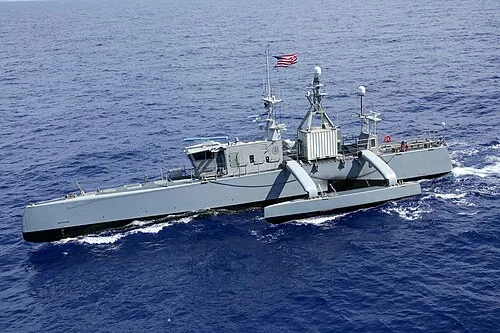
Sea Hunter is an autonomous unmanned surface vehicle (USV) launched in 2016 as part of the DARPA Anti-Submarine Warfare Continuous Trail Unmanned Vessel (ACTUV) program. The ship was christened 7 April 2016 in Portland, Oregon. It was built by Vigor Industrial. The vessel continues the line of experimental "Sea" ships, including Sea Shadow, Sea Fighter, Sea Jet, and Sea Slice. Sea Hunter is classified as a Class III USV and designated the Medium Displacement Unmanned Surface Vehicle (MDUSV).
Description
The initially unarmed prototype, built at a cost of $20 million, is a 132-foot (40 meter)-long trimaran (a central hull with two outriggers). It is an unmanned self-piloting craft with twin screws, powered by two diesel engines with a top speed of . Her weight is 135 tons, including 40 tons of fuel, adequate for a 70-day cruise. Cruising range is "transoceanic," at fully fueled with of diesel, enough "to go from San Diego to Guam and back to Pearl Harbor on a tank of gas." Sea Hunter has a full load displacement of 145 tons and is intended to be operational through Sea State 5, waves up to high and winds up to , and survivable through Sea State 7, seas up to high. The trimaran hull provides increased stability without requiring a weighted keel, giving her a higher capacity for linear trajectories and better operations in shallow waters, though the greater width decreases maneuverability.
A removable operator control station is installed during the testing period "for safety and backup" until it can be determined to reliably operate on her own. Operationally, computers will drive and control the ship, with a human always observing and taking charge if necessary in a concept called Sparse Supervisory Control, meaning a person is in control, but not "joy sticking" the vessel around. The system can patrol without human guidance, using optical guidance and radar to avoid hitting obstacles or other watercraft. The ship has a host of non-standard features because of her lack of crew, including an internal layout that offers enough room for maintenance to be performed but not for any people to be permanently present. It is fitted with quicKutter shaft protection rope/line cutters from Quickwater Marine in Perth. These devices protect the vessel from damage caused by rope or net caught by the propellers without affecting the vessel's performance.
The craft is expected to undergo two years of testing before being placed in service with the U.S. Navy.
From Wikipedia (CC BY-SA 4.0).