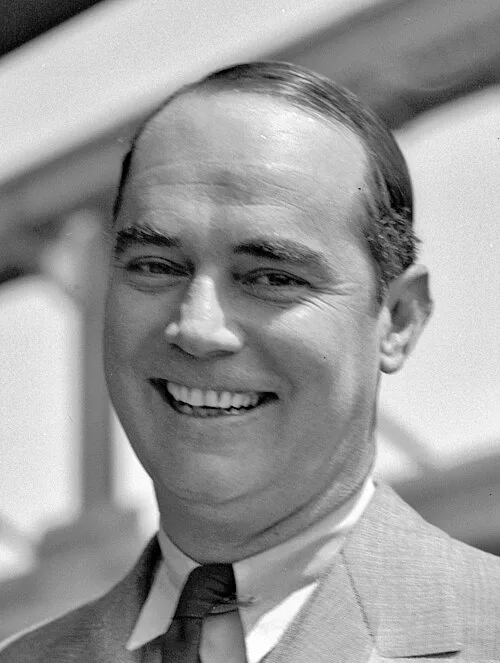
Overview
Serge Alexander Korff (June 5, 1906 - December 1, 1989) was a Finnish-born American physicist and a pioneer of cosmic ray research. He invented the wire proportional counter particle detectors.
Early life
Serge Alexander Korff was born at June 5,1906 in Helsinki. His father, baron was an assistant of Governor-General of Finland, then part of the Russian Empire. His mother was an American, a "daughter of a retired Surgeon General and one time President of The American Red Cross". His father was a professor of the Russian law at the University of Helsinki. The family moved to the US after the Russian Revolution of 1917. Writer Vladimir Nabokov was his cousin.
Career
Korff got a B.A. (1928), M.A. (1929), and Ph.D. (1931) at Princeton University. He was a National Research Fellow at the Mount Wilson Observatory and the California Institute of Technology (1932 - 1935), a Research Fellow of the Bartol Research Foundation of the Franklin Institute (1936 - 1940). Korff joined the Physics Department of New York University in 1941, became a professor in 1945 and retired Emeritus in 1973.
He wrote over 175 papers, a fundamental nuclear instrument treatise, Electron and Nuclear Counters (Van Nostrand, 1946, 1955) and revised a textbook Electron and Nuclear Physics written initially by J. B. Hoag (Van Nostrand, 1948). He also served as a scientific reporter and editor. He developed the wire proportional counter particle detector, that are used for neutron detection. Physicist Willard Libby, who received the 1960 Nobel Prize for radioactive carbon dating, acknowledged his debt to Serge Korff in his Nobel lecture.
From Wikipedia (CC BY-SA 4.0).