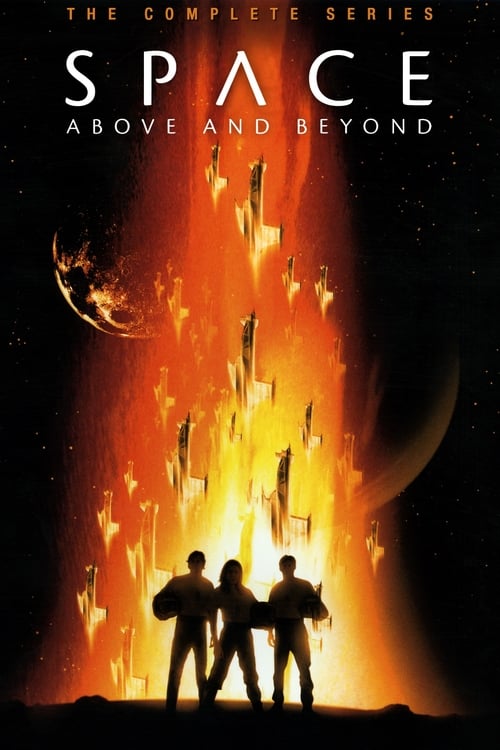



Space: Above and Beyond is an American science fiction television series that aired on Fox, created and written by Glen Morgan and James Wong. Planned for five seasons, it only ran for one season from 1995 to 1996 before being canceled due to low ratings. It was nominated for two Emmy Awards and one Saturn Award. Ranked last in IGN's top 50 Sci-Fi TV Shows, it was described as "yet another sci-fi show that went before its time."
Set in the years 2063–2064, the show focuses on the "Wildcards", members of the United States Marine Corps 58th Squadron of the Space Aviator Cavalry. They are stationed on the space carrier USS Saratoga, acting as both infantry and pilots of SA-43 Endo/Exo-Atmospheric Attack Jet ("Hammerhead") fighters, battling an invading force of extraterrestrials.
Contents
Plot
Lacking technology that would enable faster-than-light (FTL) travel, colonization is accomplished by taking advantage of transient but predictable, naturally occurring wormholes in space, which allow travelers to traverse vast distances. Without warning, a previously unknown alien species, the "Chigs", attack and destroy Earth's first extra-solar colony and then destroy a second colony ship. The bulk of the Earth military forces sent to confront the Chigs are destroyed or outflanked, in part because the Chigs have some form of FTL, affording them greater freedom of movement (although this technology appears limited, the Chigs also often use natural wormholes).
At the opening of the series, the Chigs have defeated all counter-attacks and have entered the Solar System. In desperation, unproven and under-trained outfits like the 58th "Wildcards" are thrown against the Chigs. The Wildcards are the focus of the series, which follows them as they grow from untried cadets into veterans. Although the unified Earth forces come under the control of a reformed United Nations (UN), the UN has no formal armed forces, so navies such as the U.S. Navy and the Royal Navy operate interstellar starships.
Prior to the events of the show, there was a war between humans and androids known as Silicates. These human-looking androids, referred to as "walking personal computers", rebelled, formed their own societies, and waged a guerrilla war against the humans from remote bases. The Silicates are also suspected of conniving with the Chigs. To defeat the Silicates, a new underclass of genetically engineered and artificially gestated humans were bred to quickly swell the ranks of the military. These troops, collectively known as In Vitroes or sometimes, pejoratively, "tanks" or "nipple-necks", are born at the physical age of 18 and trained solely for combat. In the post-war period, the "tanks" have attempted (with mixed success) to re-enter human society.
Story arcs
Space: Above and Beyond connects episodes through prominent story arcs beside that of the main arc, the Chig War. In an approximated descending order of significance, these are:
Chig War (2063)
Chigs (sometimes referred to as Glyphs) are a fictional alien species in the science fiction television series Space: Above and Beyond. Chig is not the species' name for itself but a human-coined nickname (referencing the chigoe flea).
Chigs are humanoid, bipedal aliens that serve as the primary antagonists in the series. They appear to be unable to survive in atmospheres that support human life; they are often seen wearing armored life-support systems that provide them with the methane they need to breathe. Chig armor suits also have a suicide mechanism that is triggered when the helmet is forcibly removed, quickly dissolving the Chig inside. In the episode "Choice or Chance", a Chig is apparently able to take human form and interact with other humans in an ordinary atmosphere until killed, when it turns to slime in the manner of earlier Chig deaths. How this is achieved is not explained. Distinguishing characteristics of the un-armored Chig are small black eyes set deeply in the head, pink skin, a lack of a prominent nose, a protruding upper jaw, and structures resembling gills to either side of the mandible.
The series provides little evidence about the Chigs until the last two episodes, choosing to initially present the Chigs as a traditional science-fiction alien enemy out to destroy humanity. Throughout the series, the writers provide several small clues regarding the nature of the Chigs, their motives, and their biology before devoting the last two episodes of the series to revealing the possibility that Chigs and humans are related species.
As the series presents it, human contact with the Chigs begins when an uncrewed probe, launched by the military-industrial corporation Aero-Tech, lands on "celestial body 2064K" (later given military designation 'Anvil'), the moon orbiting the Chig homeworld. This moon is sacred to the Chigs because it is where life originated via panspermia and where Chigs still go to be born. The Chigs evolved from bacteria that originated on Earth billions of years ago: an asteroid collision threw these bacteria into space, carried by meteorites, where they eventually landed on the Chig sacred moon. Life on Earth had already advanced to the eukaryote stage of development, and the rate of evolution proceeded slightly faster for the bacteria on their new world, allowing life there to evolve to the point that it could produce the sentient Chigs at roughly the same time that modern humans evolved.
Silicates
Silicates are a fictional race of androids created by humanity to be servants.
The Silicates were created to be servants and soldiers, but they developed intelligence and sentience after they were infected by the Take a Chance computer virus created by Dr. Ken Stranahan (name from the show's visual effects supervisor). This sparked an AI rebellion by the Silicates, who attempted to free themselves from human rule. The war continued for many years, until the Silicates captured military spacecraft and escaped into space. As they went into space, the Silicates suffered from a lack of maintenance which caused problems for them. The remnants of the Silicates that fled into deep space serve as mercenaries and actually aid the alien "Chigs" in their war against humanity.
The AIs (Artificial Intelligence) were manufactured by humanity to serve them, and they appear as humans but with enough differences to appear as machine creations, namely their rifle sight-like crosshairs in place of pupils. They were made to be beautiful and physically appealing. The surviving Silicates that fled into deep space have suffered from a lack of adequate maintenance for many years, and they frequently possess minor damage to their outer covering, which reveals their machine parts underneath.
Silicates were designed to be domestic servants or pleasure models and not particularly for hard labor, which would be done by heavy machinery. As a result, standard Silicates are actually not that much stronger than a human, and, because they were not originally designed to fight, it is not particularly difficult for a trained human soldier to defeat them in hand-to-hand combat. This is partially offset by the fact that Silicates are not hindered by physical pain and cannot experience fear.
Silicates communicate with one another through modulation schemes made by wireless telephone which comes across to humans as a series of electronic beeps and chirps. This wireless network allows each AI to know the position and operating status of the other units. Their mechanical nature allows them to store information and retrieve it, making them excellent in information gathering which can be shared with their colleagues when demanded.
As the AI Silicates were created as a "servitor" species, they were programmed to understand abstraction, but their programmes restricted original thought and creativity, leaving them to simply imitate rather than create. Had the "Take a Chance" computer virus not been created, it is likely the Silicates would have remained servile. Risk-taking has become the prime ideology of the AI Silicates, which results in them seeing activities as a risk or gamble. The first "risk" was the indiscriminate killing of their human creators in the AI War, which lasted for ten years. The Silicate robots refer to humans as "carbonites", because they are carbon-based life forms.
In Vitroes
In Vitroes are artificially gestated humans, produced through genetic engineering. Originally, the Silicates were built to be humanity's servants and soldiers, but, after they revolted, the In Vitroes were developed to replace them as the new disposable underclass. Large numbers of In Vitroes were grown as shock troops for use in the AI War.
In Vitroes are created by mix-and-matching chromosomes and genetic sequences from dozens of donors to create optimal traits; they do not have "parents" who ever existed as distinct people. In Vitroes are easily identified by their protruding navel located on the back of the neck, rather than on the abdomen. Some In Vitroes from the same batch contain similar enough genetic material that they could be considered siblings, but they rarely meet. In Vitroes do not generally have "family" members – a fact that affects their morale and loyalty.
In Vitroes do not share social equality with the so-called "naturally born" humans. Literally removed ("born") from their individual gestation tanks at the physical age of eighteen, they are educated swiftly and harshly to enable them to enter society with at least a nominal idea of how to comport themselves. They are derisively termed "tanks" by regular humans, which seems to be a double entendre, describing not only their method of birth but also their physical toughness, which is always greater than "naturals", and their disposable nature as the first to come in battle, the tanks that open the way for the infantry.
Due to their limited emotional development, their deployment in the AI War as troops was not as successful as the pioneers of the In Vitro program nor the military would have liked, as the In Vitro battalions had no emotional connection beyond the most basic to their country, planet, or even race; this led to their racial reputation as "lazy" and "not caring for anything or anyone", which contributed to the prejudice against them from "naturals". In Vitroes also seem to refer to themselves as "tanks" when around each other. Before its abolition, they were subject to indentured servitude. There is still considerable racial segregation within humanity, resentment by normal humans, and governmental abuse for morally dubious purposes. Two main characters, Cooper Hawkes and T. C. McQueen, have to face all the ramifications of such a society from their perspective as In Vitroes.
This repeating theme explores topics such as racism and prejudice in a society and freedom. It differs from other story arcs in its complexity in the form of a division into two sub-stories. One is presented as historical narration by the characters or flashbacks; the second occurs in the present, with the experiences of Hawkes and McQueen, including a subtle sub-story of the shifting relationship between Nathan West and a maturing Hawkes.
Aero-Tech and the UN
The dark Aero-Tech and UN story arcs inject elements of conspiracy and high-level cover-up. Aero-Tech, founded in 2015, appears to be a monopolistic aerospace and defense supplier. It is connected with the United Nations (UN) by Aero-Tech's clearly evident political power with the UN (with a former Aero-Tech director becoming the United Nations Secretary-General early in the series) and with the armed forces, as evidenced by its control over advanced technologies. It is also suspected that Aero-Tech was aware of the Chigs before the rest of humanity, and that they deliberately endangered the Vesta and Tellus colonists. Aero-Tech further gathers, uses, or withholds strategic information in pursuit of its corporate agenda. The Aero-Tech and the UN story arc explores topics such as power, intrigue, politics, the military-industrial complex, perhaps to some degree also the ethics of science in the service of military and corporate interests and moral responsibility.
Ending
The final episode of the series ends in a cliffhanger, with T. C. McQueen badly injured and most of the major cast apparently killed or missing in action, with only Cooper Hawkes and Nathan West left. Yet, with Earth in a much stronger strategic position, there is hope, despite the losses and sacrifices. These closing elements of the plot were written at a point when the producers knew that the show was likely to be canceled.
Cast and characters
Main: 58th Squadron aka Wildcards
Kristen Cloke — Capt. Shane Vansen (USMC), callsign in the first episodes "Ace of Diamonds", later changed to "Queen of Diamonds".
Morgan Weisser — 1st Lt. Nathan West (USMC), callsign "King of Hearts", his Hammerhead is named "Above and Beyond".
Rodney Rowland — 1st Lt. Cooper Hawkes (USMC, In Vitro), callsign "Jack of Spades", his Hammerhead is named "Pag's Payback" after one his pals that was killed in battle.
Joel de la Fuente — 1st Lt. Paul Wang (USMC), callsign "Joker".
Lanei Chapman — 1st Lt. Vanessa Damphousse (USMC), callsign "Ace of Hearts".
James Morrison — Lt. Col. Tyrus Cassius "T. C." McQueen (USMC, In Vitro) callsign "Queen 6".
Recurring
Tucker Smallwood — Commodore Glen van Ross (USN)
David Jean Thomas — General Alcott (USMC)
David St. James — Admiral Broden (USN)
Amanda Douge — Kylen Celina (Aero-Tech, Tellus colonist)
Tasia Valenza — 1st Lt. Kelly Anne Winslow (USMC) callsign "Queen of Spades"
Edmund L. Shaff — "Chaplain" (USN)
Bill Hunter — Secretary General Spencer Chardwell (UN)
Robert Crow — Officer Crow (Lt. Pruitt in last episode) (USN)
Doug Hutchison — Elroy EL (AI)
Kimberly Patton — Feliciti OH (AI)
John Lendale Bennett — "Master at Arms" (USN)
Michael Mantell — Howard Sewell (Aero-Tech, member of the board of directors)
James Lesure — Lt. Charlie Stone (USMC)
Melissa Bowen — LTJG Stroud (USN)
Gennie Nevinson, Loren Chase — Anne West
Angus Grant, Marc Worden — Neil West (Private, USMC)
Iva Franks-Singer — Sabrine EW (AI)
Guest stars
Coolio — The Host (in episode "R & R")
Amanda Douge — Kylen Celina (in episodes "Pilot", "Choice or Chance", "...Tell Our Moms We Done Our Best")
David Duchovny (uncredited) — Alvin El 1543 aka "Handsome Alvin" (Silicate in episode "R & R")
Dale Dye, Capt., USMC (ret.) — Major Jack Colquitt (USMC) (in episode "Who Monitors the Birds?")
R. Lee Ermey, GySgt., USMC (ret.) (uncredited) — Sergeant Major Frank Bougus (USMC) (in the pilot episode)
Adam Goldberg — Sergeant 1st Class Louie Fox, Seventh Cavalry, U.S. Army (in episode "Pearly")
Steve Rankin — Lieutenant Colonel Raymond Thomas Butts, callsign "Kick Butts" (in episode "Raymond Butts")
Harriet Sansom Harris — Ambassador Diane Hayden (Secretary General, UN)
Richard Kind — Colonel Burke (in episode "Level of Necessity")
Martin Jarvis — Major Cyril MacKendrick (British Army - in episode "Pearly")
Ronald G. Joseph — General Oliver Ranford (USMC) (in episode "Stardust")
Gail O'Grady (uncredited) — Colonel Klingman (in episode "Stardust")
Jennifer Balgobin — Communications Lieutenant Price (USN) (in episode "Sugar Dirt")
Production
While drawing comparisons with Robert Heinlein's novel Starship Troopers and the movie of the same name, according to the producers, the main fictional work that influenced Space: Above and Beyond was one written in response to that story, the 1974 science fiction novel The Forever War by Joe Haldeman. In addition, it was inspired by fictional works, such as the 1948 World War II biographic novel The Naked and the Dead by Norman Mailer, the 1895 American Civil War novel The Red Badge of Courage by Stephen Crane, the Iliad, and the 1962 television series Combat! At the same time, Space: Above and Beyond also shares conspiracy elements with other television shows co-produced by the same team, such as The X-Files and Millennium.
Cinematography and visual effects
The series featured a very dark and desaturated color grading, apparently inherited from the cinematography of series as The X-Files and Millennium, co-produced by the same team, but taken to a greater extreme. The strength of desaturation employed in many scenes reaches the level that makes them almost black and white (quantitatively, the saturation in CIE xy color subspace of a typical scene in Space: Above and Beyond is in the range 0.03–0.15, approximately 1/4 of a typical contemporary film or television program).
With the increasing affordability of computer systems with performance suitable for 3D rendering, Space: Above and Beyond relied heavily on computer generated imagery (CGI) for space scenes with physical special effects still playing a significant role. The computer generated effects of Space: Above and Beyond were created by the visual effects company Area 51 using NewTek LightWave 3D. In 1996, the team at Area 51 were nominated for an Emmy Award, for Outstanding Special Visual Effects, with each member being named.
Music
Wong and Morgan were looking for a more traditional musical approach than the synthesiser scoring favored on The X-Files; visual effects supervisor Glenn Campbell introduced the producers to the music of Shirley Walker, who had worked on Batman: The Animated Series. Wong and Morgan were initially unconvinced on hearing Walker's synth demos, until it was explained that her musical ideas would be filled out by an orchestra. Wong went on to describe the scoring session as "(his) favorite part of filmmaking." Walker scored the pilot and the entire series, receiving an Emmy nomination for "The River Of Stars," and she reunited with Wong and Morgan on many of their later projects (her final film score was for their remake of Black Christmas).
In 2011, La-La Land Records issued a three-disc limited edition featuring Walker's score for the pilot and music from most of the episodes ("The Enemy", "Choice or Chance", "Level of Necessity", "R&R", and "Stardust" do not have any score cues on the album).
Sound effects
The sound effects used on the show are often reused on the animated series Futurama.
Criticism
The actor Joel de la Fuente described his perception of a possibly stereotypical nature of his character Lt. Paul Wang, for which he felt discomfort for the role of "a cowardly soldier who betrayed his comrades":
Whenever I see Asians in military uniform, I cannot help but recall common images of Asians from the Vietnam War and World War II. They were "yellow-bellied cowards" who took the lives of loyal Americans. They were treacherous and crafty, impossible to gauge. Wang could be seen as all of these stereotypes, I thought. Even though this ignores the fact that the Americans they were killing had invaded their country and napalmed their children, but people tend to leave out the important details...
Other media
Space: Above and Beyond was released on DVD in the United States and Canada by 20th Century Fox as a set of five DVD-10 discs on November 8, 2005. Episodes feature closed captioning, and the set also contains some of the original television promotional advertisements for the series. Certain pressings feature a distorted image of the Babylon 5 space station, which is unrelated to and does not appear in the series, on the discs' title screens.
In 2011, Space: Above and Beyond was released on Region 2 PAL DVD in Germany by KSM GmbH.
In April 2012, Space: Above and Beyond was released on Region 2 PAL DVD in the UK by Fremantle Media / Medium Rare Entertainment. It contained a new documentary, cast interviews, some episode commentaries, galleries, and deleted scenes. The pilot episode is included in the full season set but has also been released separately with just a commentary.
There were several books and comic books released as well based on the show's episodes.