
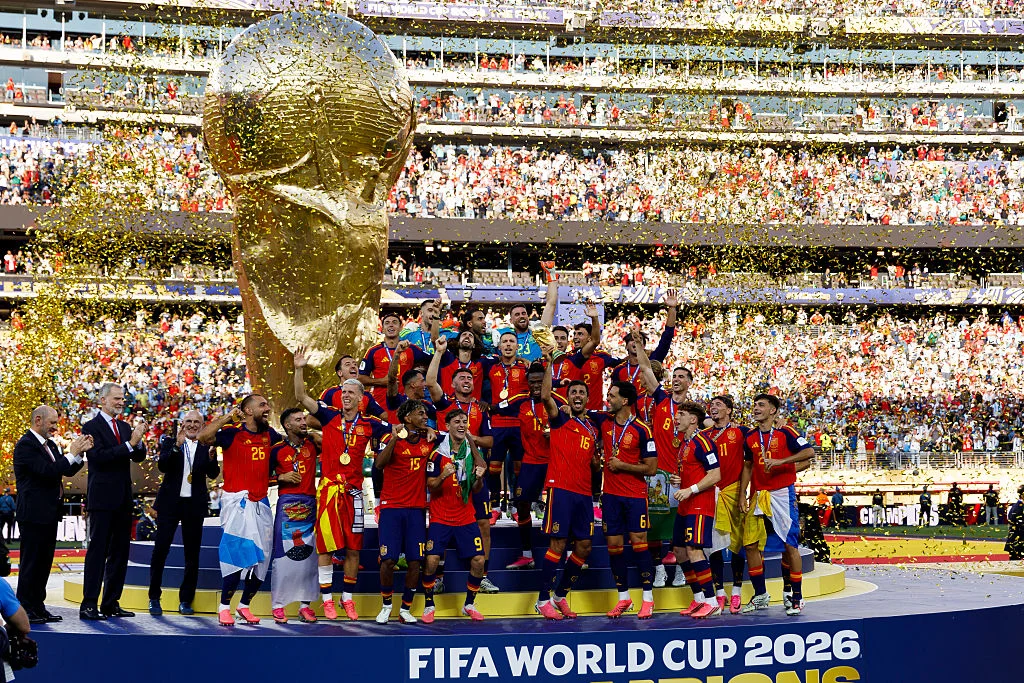

The Spain national football team have represented Spain in men's international football competition since 1920, and are governed by the Royal Spanish Football Federation. They are the reigning World and European champions, having won the most recent FIFA World Cup in 2026 and the latest UEFA European Championship in 2024. Spain also won the World Cup in 2010, and won the UEFA Nations League in 2023. They have competed in 12 of the 17 UEFA European Championships and have won a record four titles. They are one of two national teams, the other being France, to have won all three available major titles: the World Cup, the European Championship, and the Nations League.
The achievements of Spain's team from 2008 to 2012 have led many experts and commentators to consider them one of the best squads in football history. During this period, Spain became the first national team to win three consecutive major titles, including the World Cup in 2010 and back-to-back European Championships in 2008 and 2012. Spain has won the FIFA Team of the Year award seven times, including every year from 2008 to 2013.
Spain has the longest undefeated streak in men's international football, having played 38 consecutive matches since March 2024 without a loss. This streak gave them the highest ever Elo rating, surpassing the 1954 Golden Team from Hungary. Following their 2026 World Cup victory, Spain became the first national team to hold the men’s and women’s World Cup titles simultaneously.
Contents
History
Spain has been a member of FIFA since its founding in 1904, although the Spanish Football Federation was not established until 1909. The first Spain national football team was created in 1920 to compete the 1920 Summer Olympics in Belgium. Spain made their debut at the tournament on 28 August 1920 against Denmark, silver medalists at the last two Olympic tournaments. Spain won the match 1–0 and eventually finished with the silver medal.
Spain qualified for their first FIFA World Cup in 1934. They defeated Brazil in their first game before losing in the quarter-finals to eventual champions Italy. The Spanish Civil War and World War II prevented Spain from playing any competitive matches between the 1934 World Cup and the 1950 World Cup qualifiers. At the 1950 World Cup in Brazil, Spain topped their group and finished fourth in the tournament. Until 2010, this was Spain's highest finish at the World Cup.
Spain won its first major international title when it hosted the 1964 European Nations' Cup, defeating the Soviet Union 2–1 in the final at the Santiago Bernabéu Stadium. The victory would stand as Spain's lone major title for 44 years. Spain was selected as host of the 1982 FIFA World Cup, reaching the second round and four years later they reached the quarter-finals before a penalty shootout defeat to Belgium. At UEFA Euro 1984, they lost the final against France. Spain reached the quarter-finals of the 1994 World Cup. The match became controversial when Italian defender Mauro Tassotti struck Luis Enrique with his elbow inside Italy's penalty area, causing Luis Enrique to bleed profusely from his nose and mouth, but it was not noticed nor sanctioned by referee Sándor Puhl. Had the official awarded a foul, Spain would have received a penalty kick. In the 2002 World Cup, Spain won its three group play matches, then defeated the Republic of Ireland on penalties in the second round. They faced co-hosts South Korea in the quarter-finals, losing in a shootout after having two goals controversially called back for alleged infractions during regular and extra time.
At UEFA Euro 2008, Spain won all their games in Group D. Italy were the opponents in the quarter-finals, where Spain won 4–2 on penalties. They then met Russia again in the semi-finals, beating them 3–0. In the final, Spain defeated Germany 1–0, with Fernando Torres scoring the only goal of the game, as Spain won their first major title since the 1964 European Championship. Xavi was awarded the player of the tournament. The following year the side finished third at the 2009 FIFA Confederations Cup breaking their 35-match unbeaten streak that began in November 2006 after a loss to the United States. In the 2010 World Cup, Spain advanced to the final for the first time ever by defeating Germany 1–0. In the decisive match against the Netherlands, Andrés Iniesta scored the match's only goal, coming in extra time. Spain became the third team to win a World Cup outside their own continent, and the first European team to do so. They then qualified for UEFA Euro 2012, finishing on top of Group I with a perfect 100% record. They became the first team to retain the European Championship, winning the final 4–0 against Italy, while Fernando Torres won the Golden Boot for top scorer of the tournament.
Team image
Nicknames
Spain's team was known in the past by some fans as "La Furia Española", 'the Spanish Fury'; this nickname was originally given by a Dutch newspaper, recalling the "Sack of Antwerp" – an episode in the military history of Spain. More modernly, the team is called "La Roja" ('the Red One'). It's called "La Furia Roja" ('the Red Fury'), only by foreign journalists.
Style of play
Between 2008 and 2012, the team played a style of football dubbed 'tiki-taka', a systems approach to football founded upon the ideal of team unity and a comprehensive understanding in the geometry of space on a football field.
Tiki-taka has been variously described as "a style of play based on making your way to the back of the net through short passing and movement", a "short passing style in which the ball is worked carefully through various channels", and a "nonsensical phrase that has come to mean short passing, patience and possession above all else". The style involves roaming movement and positional interchange amongst midfielders, moving the ball in intricate patterns, and sharp, one or two-touch passing. Tiki-taka is "both defensive and offensive in equal measure" – the team is always in possession, so doesn't need to switch between defending and attacking. Commentators have contrasted tiki-taka with "Route One physicality" and with the higher-tempo passing of Barcelona and Arsène Wenger's 2007–08 Arsenal side, which employed Cesc Fàbregas as the only channel between defence and attack. Tiki-taka is associated with flair, creativity, and touch, but can also be taken to a "slow, directionless extreme" that sacrifices effectiveness for aesthetics.
Tiki-taka was successfully employed by Spain to win Euro 2008, the 2010 World Cup and Euro 2012. The 2008–12 teams are regarded as being among the greatest of international teams in football history.
They have the Barcelona "carousel" of Xavi and Andrés Iniesta augmented by Real Madrid's Xabi Alonso in midfield.
Sid Lowe identifies Luis Aragonés' tempering of tiki-taka with pragmatism as a key factor in Spain's success in Euro 2008. Aragonés used tiki-taka to "protect a defense that appeared suspect [...], maintain possession and dominate games" without taking the style to "evangelical extremes". None of Spain's first six goals in the tournament came from tiki-taka: five came from direct breaks and one from a set play. For Lowe, Spain's success in the 2010 World Cup was evidence of the meeting of two traditions in Spanish football: the "powerful, aggressive, direct" style that earned the silver medal-winning 1920 Antwerp Olympic team the nickname La furia española ('The Spanish Fury') and the tiki-taka style of the contemporary Spain's team, which focused on a collective, short-passing, technical and possession-based game.
Kits and crest
Spain's home kit is traditionally a red jersey with yellow trim, dark blue shorts, and black socks, whilst their current away kit is predominantly yellow, having been white traditionally. The color of the home socks started to alter throughout the 1990s from black to the same blue color as the shorts, then matching either the blue of the shorts or the red of the shirt until the mid-2010s when they returned to their traditional black before continuing the rotation in the 2020s. Spain's kits have been produced by manufacturers including Adidas (from 1981 until 1983), Le Coq Sportif (from 1984 until 1990) and Adidas once again (since 1991). Rather than displaying the logo of the Spanish Football Federation, Spain's jersey traditionally features the country's coat of arms over the left side. After winning the 2010 World Cup, the World Cup winners badge was added to the right side of the jersey and a golden star at the top of Spain's coat of arms. A second gold star was added after their victory at the 2026 FIFA World Cup.
Home stadium
Spain does not have a designated national stadium. The capital city of Madrid (Bernabéu and Metropolitano), Seville (Pizjuán, Villamarín and La Cartuja), Valencia (Mestalla and Orriols) and Barcelona (Camp Nou and Montjuïc), are the four Spanish cities that have hosted more than 15 national team matches, while also being home to the largest stadiums in the country.
Other friendly matches, as well as qualifying fixtures against smaller opponents, are played in provincial stadia. The 2018 FIFA World Cup qualification campaign included matches at the Reino de León in León, Los Cármenes in Granada, El Molinón in Gijón, and the Rico Pérez in Alicante.
Media coverage
Spain's UEFA Nations League, UEFA European Qualifiers and all friendly matches, are televised nationwide by La 1, flagship television channel of the public broadcaster TVE.
Rivalries
Spain has rivalries with seven countries, four of them being Europe's "Big Five" nations and the others with its Iberian neighbour Portugal, the Netherlands, and its southern neighbour Morocco.
Their rivalry with Italy, sometimes referred to as the "Mediterranean derby", has been contested since 1920. Their first meeting was at the Olympic Games, in a 2–0 triumph for Spain on 2 September 1920 in Antwerp. Although the two nations are not immediate geographical neighbours, their rivalry at international level is enhanced by the strong performances of the representative clubs in UEFA competitions, in which they are among the leading associations and have each enjoyed spells of dominance. Since the quarter-final match between the two countries at Euro 2008, the rivalry has renewed, with its most notable match between the two sides being in the UEFA Euro 2012 final, which Spain won 4–0. Spain has the advantage in the head-to-head, with 14 wins, 16 draws, and 11 losses, after 41 games, but both teams evenly split with 6 wins each when only competitive matches are counted.
Their rivalry with Portugal, also known as the "Iberian derby", has been contested since 1921. Their first meeting was a 3–1 triumph for Spain on 18 December 1921 in Madrid, the first ever international game for the Portuguese. Portugal had first draw in 1926, and their first win (4–1) in 1947. In this friendly rivalry, Spain dominates the head-to-head record with 18 victories, 18 draws, and 6 losses, after 42 games. They also lead Portugal in competitive matches, with 6 wins to Portugal's 1 with 6 draws. Their last competitive match resulted in a 1–0 win for Spain during the 2026 FIFA World Cup round of 16.
Their rivalry with France, sometimes referred to as the "Pyrenean derby", has been contested since 1922. Their first meeting was a 4–0 triumph for Spain on 30 April 1922 in Bordeaux, though their first competitive meeting came in the UEFA Euro 1984 final, which France won to receive their first international trophy. Spain has the advantage in the head-to-head, with 19 wins, 7 draws, and 13 losses, after 37 games. France has a slight advantage in competitive matches, with 6 wins compared to 5 of Spain. However, Spain leads in the 21st century, with 10 victories out of 14 matches between both teams, including defeats for France in the semi-finals of the last three major tournaments – 2024 UEFA Euro, 2025 UEFA Nations League and 2026 FIFA World Cup – earning the Spanish side the nickname of France's "Bête Noire".
Results and fixtures
The following is a list of match results in the last 12 months, as well as any future matches that have been scheduled.
Win
Draw
Loss
Fixture
Players
Current squad
The following 26 players were called up to the 2026 FIFA World Cup.
Caps and goals updated as of 19 July 2026, after the match against Argentina.
Recent call-ups
The following players have also been called up for the team in the last twelve months.
Individual records
Player records
Sergio Ramos holds the record for most appearances for the Spain's team with 180. In second place is Iker Casillas with 167, followed by Sergio Busquets with 143.
David Villa holds the title of Spain's highest goalscorer, scoring 59 goals from 2005 to 2017, during which time he played for Spain on 98 occasions. Raúl González is the second highest goalscorer, scoring 44 goals in 102 appearances between 1996 and 2006.
Below is a list of the ten players with the most caps for Spain, as of 19 July 2026.
Players in bold are still active with Spain.
Youngest capped player
Lamine Yamal (16 years and 57 days) vs. Georgia, 8 September 2023
Oldest capped player
Jesús Navas (38 years and 231 days) vs. France, 9 July 2024
Below is a list of the top ten goalscorers for Spain, as of 19 July 2026.
Youngest goalscorer
Lamine Yamal (16 years and 57 days) vs. Georgia, 8 September 2023
Oldest goalscorer
Aritz Aduriz (35 years and 274 days) vs. Macedonia, 12 November 2016
Most goals scored in a single match
Chacho (6 goals) vs. Bulgaria, 13 May 1933
First goal scored
Captains
List of Spain's captains in major tournaments.
Mariano Arrate (3 caps as captain) was captain during the 1920 Summer Olympics.
Pedro Vallana (5) was captain during the 1924 and 1928 Summer Olympics.
Ricardo Zamora (24) was captain during the 1934 FIFA World Cup.
Ignacio Eizaguirre (4) was captain during the 1950 FIFA World Cup.
Joan Segarra (15) was captain during the 1962 FIFA World Cup.
Ferran Olivella (10) was captain during the 1964 European Nations' Cup.
Francisco Gento (15) was captain during the 1966 FIFA World Cup.
Pirri (18) was captain during the 1978 FIFA World Cup.
Juan Manuel Asensi (14) was captain during the UEFA Euro 1980.
Luis Arconada (48) was captain during the 1982 FIFA World Cup and UEFA Euro 1984.
José Antonio Camacho (24) was captain during the 1986 FIFA World Cup and UEFA Euro 1988.
Emilio Butragueño (31) was captain during the 1990 FIFA World Cup.
Andoni Zubizarreta (50) was captain during the 1994 FIFA World Cup, Euro 1996 and the 1998 FIFA World Cup.
Fernando Hierro (32) was captain during Euro 2000 and the 2002 FIFA World Cup.
Manager records
Most manager appearances
Vicente del Bosque: 114
Team records
Most consecutive wins achieved by an international coach from debut: 13 – Vicente del Bosque
Most penalty shoot-outs in one World Cup by one team: 2 at the 2002 FIFA World Cup (shared with Argentina at the 1990 FIFA World Cup, Netherlands and Costa Rica at the 2014 FIFA World Cup, Russia and Croatia at the 2018 FIFA World Cup, and Croatia and Argentina at the 2022 FIFA World Cup)
Highest maximum number of points in World Cup qualification: 30 out of 30 (2010) (shared with Germany for 2018)
Competitive record
FIFA World Cup
Although often entering tournaments as one of the favorites, Spain have sometimes been perceived as underachieving at the World Cup. Spain's first World Cup was in 1934; at that tournament, their campaign started by defeating Brazil 3–1 to advance to the quarter-finals, where they lost to hosts Italy in a replay. Before Spain's success in 2010, their best result came in 1950, where they reached the last four. Spain were paired with the hosts Brazil, as well as Uruguay and Sweden. Spain managed a draw against Uruguay but defeats from Brazil and Sweden meant that Spain would end up in fourth place. At the 2010 FIFA World Cup held in South Africa, Spain became world champions for the first time after defeating the Netherlands 1–0 in the final, becoming the eighth country to win the World Cup.
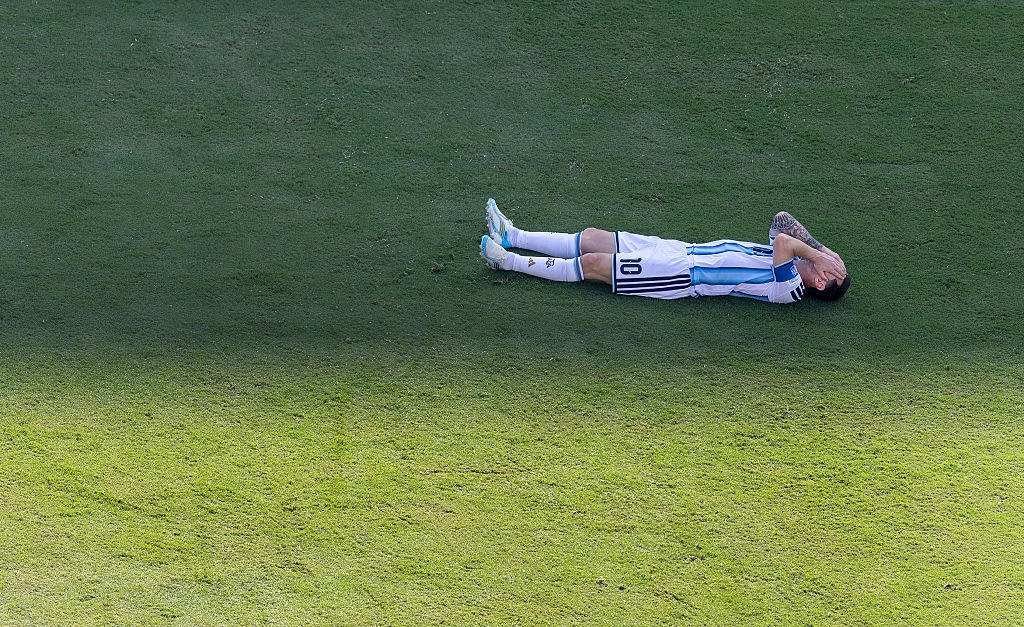
Sixteen years after their victory in South Africa, Spain would reach their second final in history at the 2026 FIFA World Cup, where they went on to win 1–0 against Argentina.
Champions Runners-up Third place Hosts or co-hosts
UEFA European Championship
Spain have won the most UEFA European Championships, with four titles. La Roja are also the only nation to date to have won consecutive championships. They have hosted the tournament once, in 1964 (one city was used to host games at Euro 2020) and have appeared in a total of twelve tournaments.
The team won their first international trophy on home soil in 1964, defeating the Soviet Union 2–1. Spain would reach the final twenty years later in 1984, where they would lose the final to France. Spain would not reach the final again until 2008, where they would defeat Germany 1–0. Four years later, Spain earned back-to-back titles, comprehensively defeating Italy 4–0 in the final in Kyiv.
It would take La Roja twelve years to reach another European final, doing so in 2024 against England, a match they won 2–1 to stand alone as the most successful national team in the competition's history with four titles, while at the same time becoming the first team ever to win all seven matches in a single tournament.
UEFA Nations League
Since the inaugural UEFA Nations League, La Roja have remained in League A and have reached the UEFA Nations League Finals on three occasions, only failing to do so in the inaugural season. At the 2021 finals, Spain won their semi-final after defeating Italy 2–1 but lost to France in the final. In the following campaign, La Roja would again reach the final thanks to another win against Italy. Spain would then beat Croatia on penalties after a 0–0 draw. Spain reached a record third consecutive final at the 2025 edition by defeating the Netherlands in the quarter-finals, and France in the semi-finals 5–4. In the first ever Iberian final, Spain faced Portugal in Munich. Despite dominating the game, Spain were unable to break through the Portuguese defense. The score ended 2–2 after 90 minutes and extra time, and Spain lost on penalties.
CONMEBOL–UEFA Cup of Champions
After winning a record fourth European Championship in 2024, Spain qualified to their first ever CONMEBOL–UEFA Cup of Champions, where they were scheduled to face Argentina, the champions of the 2024 Copa América. However, the match was later cancelled after both sides could not come to an agreement as to which stadium would host the game.
FIFA Confederations Cup
Spain made two appearances at the FIFA Confederations Cup. Their first appearance came in 2009 as European champions when they won a third place medal, after losing 2–0 to the United States in the semi-finals. At the next edition, Spain qualified as both World and European champions. La Roja reached the final in Brazil, but lost 3–0 to the hosts.
Olympic Games
Spain made their debut at the 1920 Summer Olympics, where they played their first ever international match, a 1–0 victory over Denmark. At the conclusion of the tournament, Spain won their first silver medal.
Honours
Global
FIFA World Cup
Champions: 2010, 2026
FIFA Confederations Cup
Runners-up: 2013
Third place: 2009
Olympic Games
Runners-up: 1920
Continental
UEFA European Championship
Champions: 1964, 2008, 2012, 2024
Runners-up: 1984
UEFA Nations League
Champions: 2023
Runners-up: 2021, 2025
Awards
FIFA Team of the Year: 2008, 2009, 2010, 2011, 2012, 2013, 2025
Laureus World Team of the Year: 2011
World Soccer Team of the Year: 2008, 2010, 2012, 2024
Gazzetta Sports World Team of the Year: 2010, 2012
Prince of Asturias Award for Sports: 2010
FIFA World Cup Fair Play Trophy: 2006, 2010, 2018
FIFA Confederations Cup Fair Play Award: 2013
Source: