
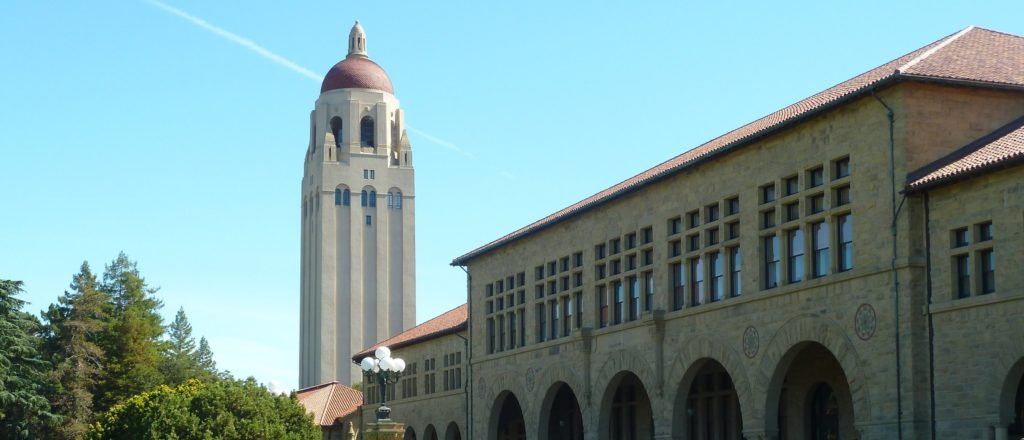
The Stanford University School of Medicine is the medical school of Stanford University and is located in Stanford, California, United States. It traces its roots to the Medical Department of the University of the Pacific, founded in San Francisco in 1858. This medical institution, then called Cooper Medical College, was acquired by Stanford in 1908. In 1959, the medical school moved to the Stanford campus near Palo Alto, California.
The School of Medicine, along with Stanford Health Care and Lucile Packard Children's Hospital, is part of Stanford Medicine.
Contents
History
In 1855, Illinois physician Elias Samuel Cooper moved to San Francisco in the wake of the California Gold Rush. In cooperation with the University of the Pacific (also known as California Wesleyan College), Cooper established the Medical Department of the University of the Pacific, the first medical school on the West Coast, in 1858, on Mission Street near 3rd Street in San Francisco. However, Cooper died in 1862, and without his leadership, the Medical Department of the University of the Pacific declined.
In 1870, Cooper's nephew, Levi Cooper Lane, reactivated and reorganized the University of the Pacific's medical department. In 1882, Lane donated a new building at the intersection of Webster and Sacramento Streets and established the department as a separate school, the Cooper Medical College. Lane built a hospital and a nursing school and provided for the creation of Lane Medical Library.
In 1908, Cooper Medical College was deeded to Stanford University as a gift. It became Stanford's medical institution, initially called the Stanford Medical Department and later the Stanford University School of Medicine. In the 1950s, the Stanford Board of Trustees decided to move the school to the Stanford main campus near Palo Alto. The move was completed in 1959. The San Francisco medical campus became Presbyterian Hospital and later California Pacific Medical Center.
In the 1980s, the Medical Center underwent a major expansion. A new hospital was added in 1989 with 20 new operating rooms, intensive care and inpatient units, and other technological additions. The Beckman Center for Molecular and Genetic Medicine opened in May 1989 as an interdisciplinary center focusing on the molecular and genetic basis of disease. The Lucile Packard Children's Hospital was completed in 1991, further expanding Stanford Medicine.
In the early years of the 21st century, the School of Medicine underwent rapid construction to further expand teaching and clinical opportunities. The Li Ka Shing Center for Learning and Knowledge opened in 2010. It serves as the gateway to the School of Medicine and provides a new model of medical education by combining biomedical research with clinical education and information technology. The Lorry I. Lokey Stem Cell Research Building also opened in 2010; it is the largest stem cell and regenerative medicine facility in North America. The Stem Cell Research Building is the first of the planned Stanford Institutes of Medicine and houses offices for faculty from the Stanford Cancer Center and "hotel space" offices for visiting researchers.
Academic programs and students
The School of Medicine has reversed the traditional teaching method, reserving classroom time for problem-solving exercises instead of lectures, which are completed outside of school as homework. With funding from the Robert Wood Johnson Foundation, school leaders are collaborating on the use of the "flipped classroom" approach to content delivery.
The School of Medicine also has a history of educating physician assistants (PAs). Stanford University partnered with Foothill College in 1971 to form the Primary Care Associate Program (PCAP), which has graduated more than 1,500 PAs. The last PCAP class graduated in 2018. Today, the Stanford School of Medicine offers a Master of Science in PA Studies program that trains clinical PAs to practice in any area of medicine and to be leaders in community health, research, and medical education. The program offers a novel approach to curriculum delivery, expanded clinical opportunities, and interprofessional education, with PA students taking courses alongside MD students. The 30-month program accepts 27 students each year and has an acceptance rate of less than 2%.
Rankings and admissions
In the 2021 U.S. News & World Report rankings, Stanford was ranked fourth in the nation among medical schools for research. Admission to the MD program at Stanford is highly competitive: in 2019, 6,894 people applied, 422 were interviewed, and 175 were accepted for 90 spots.
Stanford is one of several schools in the United States to use the multiple mini-interview system, developed at McMaster University Medical School in Canada, to evaluate candidates.
Along with the School of Humanities and Science, the Stanford School of Medicine also runs the Biosciences PhD Program, which was ranked first in 2019 among graduate programs in the biological sciences by U.S. News & World Report. According to U.S. News for 2019, Stanford's graduate school specialties were ranked #1 in genetics, genomics, and bioinformatics, #1 in neuroscience and neurobiology, #1 in cell biology, #3 in biochemistry, biophysics, and structural biology, and #4 in ecology and evolutionary biology.
Faculty
The School of Medicine has 1,948 full-time faculty. Over the past six decades, eight faculty members have won Nobel Prizes, and among its 2019 faculty members are:
37 members of the National Academy of Sciences
49 members of the National Academy of Medicine
4 MacArthur Foundation "geniuses"
15 Howard Hughes Medical Institute investigators
26 National Institutes of Health Innovator and Young Innovator Awards
Notable alumni
Lori Alvord – first board-certified female Diné surgeon, author of The Scalpel and the Silver Bear, and 2013 nominee for U.S. Surgeon General
John C. Baldwin – former dean of Dartmouth Medical School and former president of the Texas Tech University Health Sciences Center
Cheri Blauwet – professional cyclist, winner of Boston Marathon
Linda M. Boxer – hematologist, vice dean and Stanley McCormick Memorial Professor
William Brody – president of the Salk Institute and former president of Johns Hopkins University
David D. Burns – psychiatrist and author
Amy Chow – Olympic gold medalist
Alexander A. Clerk – psychiatrist and sleep medicine specialist
Toby Freedman – aerospace medical director/sports medicine (Los Angeles Rams and Los Angeles Lakers)
Bill Frist – cardiothoracic surgery fellow, United States Senator, former presidential candidate
Randall B. Griepp – cardiothoracic surgeon who collaborated with Norman Shumway in the development of the first successful heart transplant procedures in the U.S.
Mary Halton – physician, suffragist, and early IUD researcher; graduated in 1900 from Cooper Medical College
John C. Handy – physician and surgeon in Tucson, Arizona (graduate of Medical College of the Pacific)
Notable faculty
John R. Adler – Professor of Neurosurgery, inventor of the Cyberknife
Ben Barres – Professor of Neurobiology, renowned for research on glial biology
George W. Beadle – Professor of Biology, winner of the 1958 Nobel Prize in Physiology or Medicine
Paul Berg – biochemist, winner of the 1980 Nobel Prize in Chemistry for discovery of recombinant DNA
Jay Bhattacharya – 18th Director of the National Institutes of Health, research associate at the National Bureau of Economic Research, and Director of Stanford's Center for Demography and Economics of Health and Aging
Andra Blomkalns – professor and chair of the department of emergency medicine
Melissa Bondy – inaugural chair of the department of epidemiology and population health
Eugene C. Butcher – Professor of Pathology, winner of the 2004 Crafoord Prize
Howard Y. Chang - Chief Scientific Officer of Amgen; winner of the 2024 Albany Medical Center Prize, 2024 Lurie Prize in Biomedical Sciences, 2024 King Faisal Prize in Biology, 2024 Stanley J. Korsmeyer Award, and 2018 NAS Award in Molecular Biology
Robert A. Chase – Professor of Surgery, founder of Stanford Plastic & Reconstructive Surgery
Gilbert Chu – Professor of Biochemistry and Medicine
Alexander A. Clerk – Clinical Associate Professor of Psychiatry; director of the Stanford Center for Sleep Sciences and Medicine (1990–1998)