
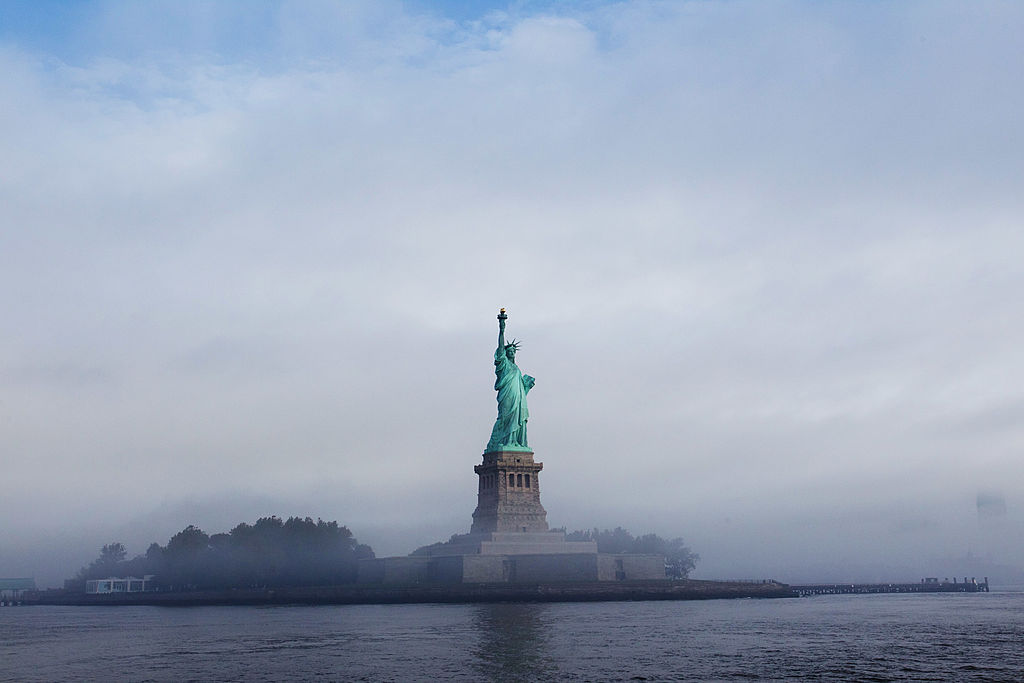
The Statue of Liberty (Liberty Enlightening the World; French: La Liberté éclairant le monde) is a colossal neoclassical sculpture of a robed and crowned woman on Liberty Island, part of New York City, in New York Harbor. The copper-clad statue, a gift to the United States from the people of France, was designed by French sculptor Frédéric Auguste Bartholdi, and its metal framework built by Gustave Eiffel. The statue was dedicated on October 28, 1886.
The statue is a figure of a classically draped woman, inspired by the Roman goddess of liberty, Libertas. She holds a torch above her head with her right hand, and in her left hand carries a tabula ansata inscribed JULY IV MDCCLXXVI (July 4, 1776, in Roman numerals), the date of the U.S. Declaration of Independence. With her left foot she steps on a broken chain and shackle, commemorating the national abolition of slavery following the American Civil War.
In 1865, the French historian and abolitionist Édouard de Laboulaye proposed a monument to commemorate the upcoming centennial of U.S. independence (1876), the perseverance of American democracy and the liberation of the nation's slaves. The Franco-Prussian War delayed progress until 1875, when Laboulaye proposed that the people of France finance the statue and the United States provide the site and build the pedestal. Bartholdi completed the head and the torch-bearing arm before the statue was fully designed, and these pieces were exhibited for publicity at international expositions. The torch-bearing arm was displayed at the Centennial Exposition in Philadelphia in 1876, and in Madison Square Park in Manhattan from 1876 to 1882. Fundraising proved difficult, especially for the Americans; publisher Joseph Pulitzer of the New York World started a drive for donations to finish the project. The statue was built in France, shipped overseas in crates, and assembled on the completed pedestal on what was then called Bedloe's Island. The statue's completion was marked by New York's first ticker-tape parade and a dedication ceremony presided over by President Grover Cleveland.
The statue became an icon of freedom and of the United States, seen as a symbol of welcome to immigrants arriving by sea. The statue was administered by the United States Lighthouse Board until 1901 and then by the Department of War; since 1933, it has been maintained by the National Park Service as part of the Statue of Liberty National Monument, and is a major tourist attraction. Limited numbers of visitors can access the rim of the pedestal and the interior of the statue's crown from within; public access to the torch has been barred since 1916.
Contents
Development
Origin
According to the National Park Service, the idea of a monument presented by the French people to the United States was first proposed by Édouard René de Laboulaye, president of the French Anti-Slavery Society and a prominent and important political thinker of his time. The project is traced to a mid-1865 conversation between Laboulaye, a staunch abolitionist, and Frédéric Auguste Bartholdi, a sculptor. In after-dinner conversation at his home near Versailles, Laboulaye, an ardent supporter of the Union in the American Civil War, is supposed to have said: "If a monument should rise in the United States, as a memorial to their independence, I should think it only natural if it were built by united effort—a common work of both our nations." The National Park Service, in a 2000 report, however, deemed this a legend traced to an 1885 fundraising pamphlet, and that the statue was most likely conceived in 1870. In another essay on their website, the Park Service suggested that Laboulaye was minded to honor the Union victory and its consequences, "With the abolition of slavery and the Union's victory in the Civil War in 1865, Laboulaye's wishes of freedom and democracy were turning into a reality in the United States. In order to honor these achievements, Laboulaye proposed that a gift be built for the United States on behalf of France. Laboulaye hoped that by calling attention to the recent achievements of the United States, the French people would be inspired to call for their own democracy in the face of a repressive monarchy."
According to sculptor Bartholdi, who later recounted the story, Laboulaye's alleged comment was not intended as a proposal, but it inspired Bartholdi. Given the repressive nature of the regime of Napoleon III, Bartholdi took no immediate action on the idea except to discuss it with Laboulaye. Bartholdi was in any event busy with other possible projects. In 1856, he traveled to Egypt to study ancient works. In the late 1860s, he approached Isma'il Pasha, Khedive of Egypt, with a plan to build Progress or Egypt Carrying the Light to Asia, a huge lighthouse in the form of an ancient Egyptian female fellah or peasant, robed and holding a torch aloft, at the northern entrance to the Suez Canal in Port Said. Sketches and models were made of the proposed work, though it was never erected. There was a classical precedent for the Suez proposal, the Colossus of Rhodes: an ancient bronze statue of the Greek god of the sun, Helios. This statue is believed to have been over 100 feet (30 m) high, and it similarly stood at a harbor entrance and carried a light to guide ships. Both the khedive and Ferdinand de Lesseps, developer of the Suez Canal, declined the proposed statue from Bartholdi, citing the high cost. The Port Said Lighthouse was built instead, by François Coignet in 1869.
Design, style, and symbolism
Bartholdi and Laboulaye considered how best to express the idea of American liberty. In early American history, two female figures were frequently used as cultural symbols of the nation. One of these symbols, the personified Columbia, was seen as an embodiment of the United States in the manner that Britannia was identified with the United Kingdom, and Marianne came to represent France. Columbia had supplanted the traditional European Personification of the Americas as an "Indian princess", which had come to be regarded as uncivilized and derogatory toward Americans. The other significant female icon in American culture was a representation of Liberty, derived from Libertas, the goddess of freedom widely worshipped in ancient Rome, especially among emancipated slaves. A Liberty figure adorned most American coins of the time, and representations of Liberty appeared in popular and civic art, including Thomas Crawford's Statue of Freedom (1863) atop the dome of the United States Capitol Building.
Artists of the 18th and 19th centuries striving to evoke republican ideals commonly used representations of Libertas as an allegorical symbol. A figure of Liberty was also depicted on the Great Seal of France. However, Bartholdi and Laboulaye avoided an image of revolutionary liberty such as that depicted in Eugène Delacroix's famed Liberty Leading the People (1830). In this painting, which commemorates France's July Revolution, a half-clothed Liberty leads an armed mob over the bodies of the fallen. Laboulaye had no sympathy for revolution, and so Bartholdi's figure would be fully dressed in flowing robes. Instead of the impression of violence in the Delacroix work, Bartholdi wished to give the statue a peaceful appearance and chose a torch, representing progress, for the figure to hold. Its second toe on both feet is longer than its big toe, a condition known as Morton's toe or 'Greek foot'. This was an aesthetic staple of ancient Greek art and reflects the classical influences on the statue.
Crawford's statue was designed in the early 1850s. It was originally to be crowned with a pileus or "liberty cap", the cap given to emancipated slaves in ancient Rome. Secretary of War Jefferson Davis, a Southerner who would later serve as President of the Confederate States of America, was concerned that the pileus would be taken as an abolitionist symbol. He ordered that it be changed to a helmet. Delacroix's figure wears a pileus, and Bartholdi at first considered placing one on his figure as well. Instead, he used a radiate halo, nimbus, to top its head. In so doing, he avoided a reference to Marianne, who invariably wears a pileus. Many believed they evoke the sun, the seven seas, and the seven continents, and represent another means, besides the torch, whereby Liberty enlightens the world, but research has not confirmed this.
Announcement and early work
By 1875, France was enjoying improved political stability and a recovering postwar economy. Growing interest in the upcoming Centennial Exposition to be held in Philadelphia led Laboulaye to decide it was time to seek public support. In September 1875, he announced the project and the formation of the Franco-American Union as its fundraising arm. With the announcement, the statue was given a name, Liberty Enlightening the World. The French people were to finance the statue (contrary to the common misconception of it being funded by the French national government); and Americans would be expected to pay for the pedestal. The announcement provoked a generally favorable reaction in France, though many Frenchmen resented the United States for not coming to their aid during the war with Prussia. French monarchists opposed the statue, if for no other reason than it was proposed by the liberal Laboulaye, who had recently been elected a senator for life. Laboulaye arranged events designed to appeal to the rich and powerful, including a special performance at the Paris Opera on April 25, 1876, that featured a new cantata by the composer Charles Gounod. The piece was titled La Liberté éclairant le monde, the French version of the statue's announced name.
Initially focused on the elites, the Union was successful in raising funds from across French society. Schoolchildren and ordinary citizens gave, as did 181 French municipalities. Laboulaye's political allies supported the call, as did descendants of the French contingent in the American Revolutionary War. Less idealistically, contributions came from those who hoped for American support in the French attempt to build the Panama Canal. The copper may have come from multiple sources and some of it is said to have come from a mine in Visnes, Norway, though this has not been conclusively determined after testing samples. According to Cara Sutherland in her book on the statue for the Museum of the City of New York, 200,000 pounds (91,000 kg) was needed to build the statue, and the French copper industrialist Eugène Secrétan donated 128,000 pounds (58,000 kg) of copper.
Although plans for the statue had not been finalized, Bartholdi moved forward with fabrication of the right arm, bearing the torch, and the head. Work began at the Gaget, Gauthier & Co. workshop. In May 1876, Bartholdi traveled to the United States as a member of a French delegation to the Centennial Exhibition, and arranged for a huge painting of the statue to be shown in New York as part of the Centennial festivities. The arm did not arrive in Philadelphia until August; because of its late arrival, it was not listed in the exhibition catalogue, and while some reports correctly identified the work, others called it the "Colossal Arm" or "Bartholdi Electric Light". The exhibition grounds contained a number of monumental artworks to compete for fairgoers' interest, including an outsized fountain designed by Bartholdi. Nevertheless, the arm proved popular in the exhibition's waning days, and visitors would climb up to the balcony of the torch to view the fairgrounds. After the exhibition closed, the arm was transported to New York City, where it remained on display in Madison Square Park for several years before it was returned to France to join the rest of the statue.
Construction in France
On his return to Paris in 1877, Bartholdi concentrated on completing the head, which was exhibited at the 1878 Paris World's Fair. Fundraising continued, with models of the statue put on sale. Tickets to view the construction activity at the Gaget, Gauthier & Co. workshop were also offered. The French government authorized a lottery; among the prizes were valuable silver plate and a terracotta model of the statue. By the end of 1879, about 250,000 francs had been raised.
The head and arm had been built with assistance from Viollet-le-Duc, who fell ill in 1879. He soon died, leaving no indication of how he intended to transition from the copper skin to his proposed masonry pier. The following year, Bartholdi was able to obtain the services of the innovative designer and builder Gustave Eiffel. Eiffel and his structural engineer, Maurice Koechlin, decided to abandon the pier and instead build an iron truss tower. Eiffel opted not to use a completely rigid structure, which would force stresses to accumulate in the skin and lead eventually to cracking. A secondary skeleton was attached to the center pylon, then, to enable the statue to move slightly in the winds of New York Harbor, and, since the metal would expand on hot summer days, he loosely connected the support structure to the skin using flat iron bars or springs, which culminated in a mesh of metal straps, known as "saddles", that were riveted to the skin, providing firm support. In a labor-intensive process, each saddle had to be crafted individually. To prevent galvanic corrosion between the copper skin and the iron support structure, Eiffel insulated the skin with asbestos impregnated with shellac.
Eiffel's design made the statue one of the earliest examples of curtain wall construction, in which the exterior of the structure is not load bearing, but is instead supported by an interior framework. He included two interior spiral staircases, to make it easier for visitors to reach the observation point in the crown. Access to an observation platform surrounding the torch was also provided, but the narrowness of the arm allowed for only a single ladder, 40 feet (12 m) long. As the pylon tower arose, Eiffel and Bartholdi coordinated their work carefully so that completed segments of skin would fit exactly on the support structure. The components of the pylon tower were built in the Eiffel factory in the nearby Parisian suburb of Levallois-Perret.
The change in structural material from masonry to iron allowed Bartholdi to change his plans for the statue's assembly. He had originally expected to assemble the skin on-site as the masonry pier was built; instead, he decided to build the statue in France and have it disassembled and transported to the United States for reassembly in place on Bedloe's Island.
Dedication
A ceremony of dedication was held on the afternoon of October 28, 1886. President Grover Cleveland, the former New York governor, presided over the event. On the morning of the dedication, a parade was held in New York City; estimates of the number of people who watched it ranged from several hundred thousand to a million. President Cleveland headed the procession, then stood in the reviewing stand to see bands and marchers from across America. General Stone was the grand marshal of the parade. The route began at Madison Square, once the venue for the arm, and proceeded to the Battery at the southern tip of Manhattan by way of Fifth Avenue and Broadway, with a slight detour so the parade could pass in front of the World building on Park Row. As the parade passed the New York Stock Exchange, traders threw ticker tape from the windows, beginning the New York tradition of the ticker-tape parade.
A nautical parade began at 12:45 p.m., and President Cleveland embarked on a yacht that took him across the harbor to Bedloe's Island for the dedication. Lesseps made the first speech, on behalf of the French committee, followed by the chairman of the New York committee, Senator William M. Evarts. A French flag draped across the statue's face was to be lowered to unveil the statue at the close of Evarts's speech, but Bartholdi mistook a pause as the conclusion and let the flag fall prematurely. The ensuing cheers put an end to Evarts's address. President Cleveland spoke next, stating that the statue's "stream of light shall pierce the darkness of ignorance and man's oppression until Liberty enlightens the world". Bartholdi, observed near the dais, was called upon to speak, but he declined. Orator Chauncey M. Depew concluded the speechmaking with a lengthy address.
No members of the general public were permitted on the island during the ceremonies, which were reserved entirely for dignitaries. The only women granted access were Bartholdi's wife and Lesseps's granddaughter; officials stated that they feared women might be injured in the crush of people. The restriction offended area suffragists, who chartered a boat and got as close as they could to the island. The group's leaders made speeches applauding the embodiment of Liberty as a woman and advocating women's right to vote. A scheduled fireworks display was postponed until November 1 because of poor weather.
Shortly after the dedication, The Cleveland Gazette, an African American newspaper, suggested that the statue's torch not be lit until the United States became a free nation "in reality":
After dedication
Lighthouse Board and War Department (1886–1933)
When the torch was illuminated on the evening of the statue's dedication, it produced only a faint gleam, barely visible from Manhattan. The World characterized it as "more like a glowworm than a beacon." Bartholdi suggested gilding the statue to increase its ability to reflect light, but this proved too expensive. The United States Lighthouse Board took over the Statue of Liberty in 1887 and pledged to install equipment to enhance the torch's effect; in spite of its efforts, the statue remained virtually invisible at night. When Bartholdi returned to the United States in 1893, he made additional suggestions, all of which proved ineffective. He did successfully lobby for improved lighting within the statue, allowing visitors to better appreciate Eiffel's design. In 1901, President Theodore Roosevelt, once a member of the New York committee, ordered the statue's transfer to the War Department, as it had proven useless as a lighthouse. A unit of the Army Signal Corps was stationed on Bedloe's Island until 1923, after which military police remained there while the island was under military jurisdiction.
Wars and other upheavals in Europe prompted large-scale emigration to the United States in the late 19th and early 20th century; many entered through New York and saw the statue not as a symbol of enlightenment, as Bartholdi had intended, but as a sign of welcome to their new home. The association with immigration only became stronger when an immigrant processing station was opened on nearby Ellis Island. This view was consistent with Lazarus's vision in her sonnet—she described the statue as "Mother of Exiles"—but her work had become obscure. In 1903, the sonnet was engraved on a plaque that was affixed to the base of the statue.
Oral histories of immigrants record their feelings of exhilaration on first viewing the Statue of Liberty. One immigrant who arrived from Greece recalled:
I saw the Statue of Liberty. And I said to myself, "Lady, you're such a beautiful! [sic] You opened your arms and you get all the foreigners here. Give me a chance to prove that I am worth it, to do something, to be someone in America." And always that statue was on my mind.
The statue rapidly became a landmark. Originally, it was a dull copper color, but shortly after 1900 a green patina, also called verdigris, caused by the oxidation of the copper skin, began to spread. As early as 1902 it was mentioned in the press; by 1906 it had entirely covered the statue. Believing that the patina was evidence of corrosion, Congress authorized US$62,800 (equivalent to $2,250,000 in 2025) for various repairs, and to paint the statue both inside and out. There was considerable public protest against the proposed exterior painting. The Army Corps of Engineers studied the patina for any ill effects to the statue and concluded that it protected the skin, "softened the outlines of the Statue and made it beautiful." The statue was painted only on the inside. The Corps of Engineers also installed an elevator to take visitors from the base to the top of the pedestal.
Early National Park Service years (1933–1982)
In 1933, President Franklin Roosevelt ordered the statue to be transferred to the National Park Service (NPS). In 1937, the NPS gained jurisdiction over the rest of Bedloe's Island. With the Army's departure, the NPS began to transform the island into a park. The Works Progress Administration (WPA) demolished most of the old buildings, regraded and reseeded the eastern end of the island, and built granite steps for a new public entrance to the statue from its rear. The WPA also carried out restoration work within the statue, temporarily removing the rays from the statue's halo so their rusted supports could be replaced. Rusted cast-iron steps in the pedestal were replaced with new ones made of reinforced concrete; the upper parts of the stairways within the statue were replaced, as well. Copper sheathing was installed to prevent further damage from rainwater that had been seeping into the pedestal. The statue was closed to the public from May until December 1938.
During World War II, the statue remained open to visitors, although it was not illuminated at night due to wartime blackouts. It was lit briefly on December 31, 1943, and on D-Day, June 6, 1944, when its lights flashed "dot-dot-dot-dash", the Morse code for V, for victory. New, powerful lighting was installed in 1944–1945, and beginning on V-E Day, the statue was once again illuminated after sunset. The lighting was for only a few hours each evening, and it was not until 1957 that the statue was illuminated every night, all night. In 1946, the interior of the statue within reach of visitors was coated with a special plastic so that graffiti could be washed away.
In 1956, an Act of Congress officially renamed Bedloe's Island as Liberty Island, a change advocated by Bartholdi generations earlier. The act also mentioned the efforts to found an American Museum of Immigration on the island, which backers took as federal approval of the project, though the government was slow to grant funds for it. Nearby Ellis Island was made part of the Statue of Liberty National Monument by the proclamation of President Lyndon Baines Johnson in 1965. In 1972, the immigration museum in the statue's base was finally opened in a ceremony led by President Richard Nixon. The museum's backers never provided it with an endowment to secure its future and it closed in 1991 after the opening of an immigration museum on Ellis Island.
In 1970, Ivy Bottini led a demonstration at the statue where she and others from the National Organization for Women's New York chapter draped an enormous banner over a railing which read "WOMEN OF THE WORLD UNITE!" Beginning December 26, 1971, fifteen anti-Vietnam War veterans occupied the statue, flying a US flag upside down from her crown. They left on December 28 following a federal court order. The statue was also several times taken over briefly by demonstrators who were publicizing causes such as Puerto Rican independence, opposition to abortion, and opposition to US intervention in Grenada. Demonstrations with the permission of the Park Service included a Gay Pride Parade rally and the annual Captive Baltic Nations rally.
Renovation and rededication (1982–2000)
The statue was examined in great detail by French and American engineers as part of the planning for its centennial in 1986. In 1982, it was announced that the statue was in need of considerable restoration. The engineers were faced with a lack of detailed drawings and documentation, as well as major structural changes in prior decades. A careful study had revealed that the right arm had been improperly attached to the main structure. It was swaying more and more when strong winds blew and there was a significant risk of structural failure. In addition, the head had been installed 2 feet (0.61 m) off center, and one of the rays was wearing a hole in the right arm when the statue moved in the wind. The armature structure was badly corroded, and about two percent of the exterior plates needed to be replaced. Although problems with the armature had been recognized as early as 1936, when cast iron replacements for some of the bars had been installed, much of the corrosion had been hidden by layers of paint applied over the years.
In May 1982, President Ronald Reagan announced the formation of the Statue of Liberty–Ellis Island Centennial Commission, led by Chrysler Corporation chair Lee Iacocca, to raise the funds needed to complete the work. Through its fundraising arm, the Statue of Liberty–Ellis Island Foundation, Inc., the group raised more than $350 million in donations for the renovations of both the Statue of Liberty and Ellis Island. The Statue of Liberty was one of the earliest beneficiaries of a cause marketing campaign. A 1983 promotion advertised that for each purchase made with an American Express card, the company would contribute one cent to the renovation of the statue. The campaign generated contributions of $1.7 million to the restoration project.
In 1984, the statue was closed to the public for the duration of the renovation. Workers erected the world's largest free-standing scaffold, which obscured the statue from view. Liquid nitrogen was used to remove layers of paint that had been applied to the interior of the copper skin over decades, leaving two layers of coal tar, originally applied to plug leaks and prevent corrosion. Blasting with baking soda powder removed the tar without further damaging the copper. The restorers' work was hampered by the asbestos-based substance that Bartholdi had used—ineffectively, as inspections showed—to prevent galvanic corrosion. Workers within the statue had to wear protective gear, dubbed "Moon suits", with self-contained breathing circuits. Larger holes in the copper skin were repaired, and new copper was added where necessary. The replacement skin was taken from a copper rooftop at Bell Labs, which had a patina that closely resembled the statue's; in exchange, the laboratory was provided some of the old copper skin for testing. The torch, found to have been leaking water since the 1916 alterations, was replaced with an exact replica of Bartholdi's unaltered torch. Consideration was given to replacing the arm and shoulder; the National Park Service insisted that they be repaired instead. The original torch was removed and replaced in 1986 with the current one, whose flame is covered in 24-karat gold. The torch reflects the Sun's rays in daytime and is lit by floodlights at night.
Closures and reopenings (2001–present)
Immediately following the September 11 attacks, the statue and Liberty Island were closed to the public. The island reopened at the end of 2001, while the pedestal and statue remained off-limits. The pedestal reopened in August 2004, but the National Park Service announced that visitors could not safely be given access to the statue due to the difficulty of evacuation in an emergency. The Park Service adhered to that position through the remainder of the Bush administration. New York Congressman Anthony Weiner made the statue's reopening a personal crusade. On May 17, 2009, President Barack Obama's Secretary of the Interior, Ken Salazar, announced that as a "special gift" to America, the statue would be reopened to the public as of July 4, but that only a limited number of people would be permitted to ascend to the crown each day.
The statue, including the pedestal and base, closed on October 29, 2011, for installation of new elevators and staircases and to bring other facilities, such as restrooms, up to code. The statue was reopened on October 28, 2012, but then closed again a day later in advance of Hurricane Sandy. Although the storm did not harm the statue, it destroyed some of the infrastructure on both Liberty and Ellis Islands, including the dock used by the ferries that ran to Liberty and Ellis Islands. On November 8, 2012, a Park Service spokesperson announced that both islands would remain closed for an indefinite period for repairs to be done. Since Liberty Island had no electricity, a generator was installed to power temporary floodlights to illuminate the statue at night. The superintendent of Statue of Liberty National Monument, David Luchsinger—whose home on the island was severely damaged—stated that it would be "optimistically ... months" before the island was reopened to the public. The statue and Liberty Island reopened to the public on July 4, 2013. Ellis Island remained closed for repairs for several more months but reopened in late October 2013.
The Statue of Liberty has also been closed due to government shutdowns and protests, as well as for disease pandemics. During the October 2013 United States federal government shutdown, Liberty Island and other federally funded sites were closed. In addition, Liberty Island was briefly closed on July 4, 2018, after a woman protesting against American immigration policy climbed onto the statue. However, the island remained open during the 2018–19 United States federal government shutdown because the Statue of Liberty–Ellis Island Foundation had donated funds. It closed beginning on March 16, 2020, due to the COVID-19 pandemic. On July 20, 2020, the Statue of Liberty reopened partially under New York City's Phase IV guidelines, with Ellis Island remaining closed. The crown did not reopen until October 2022.
Access and attributes
Location and access
The statue is situated in Upper New York Bay on Liberty Island south of Ellis Island, which together comprise the Statue of Liberty National Monument. Both islands were ceded by New York to the federal government in 1800. As agreed in an 1834 compact between New York and New Jersey that set the state border at the bay's midpoint, the original islands remain New York territory though located on the New Jersey side of the state line. Liberty Island is one of the islands that are part of the borough of Manhattan in New York. Land created by reclamation added to the 2.3-acre (0.93 ha) original island at Ellis Island is New Jersey territory.
No charge is made for entrance to the national monument, but there is a cost for the ferry service that all visitors must use, as private boats may not dock at the island. A concession was granted in 2007 to Statue City Cruises to operate the transportation and ticketing facilities, replacing Circle Line, which had operated the service since 1953. The ferries, which depart from Liberty State Park in Jersey City and the Battery in Lower Manhattan, also stop at Ellis Island when it is open to the public, making a combined trip possible. All ferry riders are subject to security screening, similar to airport procedures, prior to boarding.
Visitors intending to enter the statue's base and pedestal must obtain pedestal access for a nominal fee when purchasing their ferry ticket. Those wishing to climb the staircase within the statue to the crown must purchase a special ticket departing from either Battery Park or Liberty State Park, which may be reserved up to five months in advance for groups of up to four people. About 425 people per day may purchase tickets for the combined ferry, pedestal, and crown.
Climbers may bring only medication, plastic water bottles, phones, and cameras—lockers are provided for other items—and must undergo a second security screening. The balcony around the torch was closed to the public following the munitions explosion on Black Tom Island in 1916, and has never been reopened. The balcony can however be seen live via webcam.
Inscriptions, plaques, and dedications
There are several plaques and dedicatory tablets on or near the Statue of Liberty.
A plaque on the copper just under the figure in front declares that it is a colossal statue representing Liberty, designed by Bartholdi and built by the Paris firm of Gaget, Gauthier et Cie (Cie is the French abbreviation analogous to Co.).
A presentation tablet, also bearing Bartholdi's name, declares the statue is a gift from the people of the Republic of France that honors "the Alliance of the two Nations in achieving the Independence of the United States of America and attests their abiding friendship."
A tablet placed by the American Committee commemorates the fundraising done to build the pedestal.
The cornerstone bears a plaque placed by the Freemasons.
In 1903, a bronze tablet that bears the text of Emma Lazarus's sonnet, "The New Colossus" (1883), was presented by friends of the poet. Until the 1986 renovation, it was mounted inside the pedestal; later, it resided in the Statue of Liberty Museum, in the base.
"The New Colossus" tablet is accompanied by a tablet given by the Emma Lazarus Commemorative Committee in 1977, celebrating the poet's life.
A group of statues stands at the western end of the island, honoring those closely associated with the Statue of Liberty. Two Americans—Pulitzer and Lazarus—and three Frenchmen—Bartholdi, Eiffel, and Laboulaye—are depicted. They are the work of Maryland sculptor Phillip Ratner.
Historical designations
President Calvin Coolidge officially designated the Statue of Liberty as part of the Statue of Liberty National Monument in 1924. The monument was expanded to also include Ellis Island in 1965. The following year, the Statue of Liberty and Ellis Island were jointly added to the National Register of Historic Places, and the statue individually in 2017. On the sub-national level, the Statue of Liberty National Monument was added to the New Jersey Register of Historic Places in 1971, and was made a New York City designated landmark in 1976.
In 1984, the Statue of Liberty was designated a UNESCO World Heritage Site. The UNESCO "Statement of Significance" describes the statue as a "masterpiece of the human spirit" that "endures as a highly potent symbol—inspiring contemplation, debate and protest—of ideals such as liberty, peace, human rights, abolition of slavery, democracy and opportunity."
Depictions
Hundreds of replicas of the Statue of Liberty are displayed worldwide. A smaller version of the statue, one-fourth the height of the original, was given by the American community in Paris to that city. It now stands on the Île aux Cygnes, facing west toward her larger sister. A replica 30 feet (9.1 m) tall stood atop the Liberty Warehouse on West 64th Street in Manhattan for many years; it now resides at the Brooklyn Museum. In a patriotic tribute, the Boy Scouts of America, as part of their Strengthen the Arm of Liberty campaign in 1949–1952, donated about two hundred replicas of the statue, made of stamped copper and 100 inches (2.5 m) in height, to states and municipalities across the United States. Though not a true replica, the statue known as the Goddess of Democracy temporarily erected during the Tiananmen Square protests of 1989 was similarly inspired by French democratic traditions—the sculptors took care to avoid a direct imitation of the Statue of Liberty. Among other recreations of New York City structures, a replica of the statue is part of the exterior of the New York-New York Hotel and Casino in Las Vegas.
As an American icon, the Statue of Liberty has been depicted on the country's coinage and stamps. It appeared on commemorative coins issued to mark its 1986 centennial, and on New York's 2001 entry in the state quarters series. An image of the statue was chosen for the American Eagle platinum bullion coins in 1997, and it was placed on the reverse, or tails, side of the Presidential Dollar series of circulating coins. Two images of the statue's torch appear on the current ten-dollar bill. The statue's intended photographic depiction on a 2010 forever stamp proved instead to be of the replica at the Las Vegas casino.
Depictions of the statue have been used by many regional institutions. Between 1986 and 2000, New York State issued license plates with an outline of the statue. The Women's National Basketball Association's New York Liberty use both the statue's name and its image in their logo, in which the torch's flame doubles as a basketball. The New York Rangers of the National Hockey League depicted the statue's head on their third jersey, beginning in 1997. The National Collegiate Athletic Association's 1996 Men's Basketball Final Four, played at New Jersey's Meadowlands Sports Complex, featured the statue in its logo. The Libertarian Party of the United States uses the statue in its emblem.
The statue is a frequent subject in popular culture. In music, it has been evoked to indicate support for American policies, as in Toby Keith's 2002 song "Courtesy of the Red, White and Blue (The Angry American)", and in opposition, appearing on the cover of the Dead Kennedys' album Bedtime for Democracy, which protested the Reagan administration. In film, the torch is the setting for the climax of director Alfred Hitchcock's 1942 movie Saboteur. The statue makes one of its most famous cinematic appearances in the 1968 picture Planet of the Apes, in which it is seen half-buried in sand. It is knocked over in the science-fiction film Independence Day and in Cloverfield the head is ripped off. In Jack Finney's 1970 time-travel novel Time and Again, the right arm of the statue, on display in the early 1880s in Madison Square Park, plays a crucial role. Robert Holdstock, consulting editor of The Encyclopedia of Science Fiction, wondered in 1979: