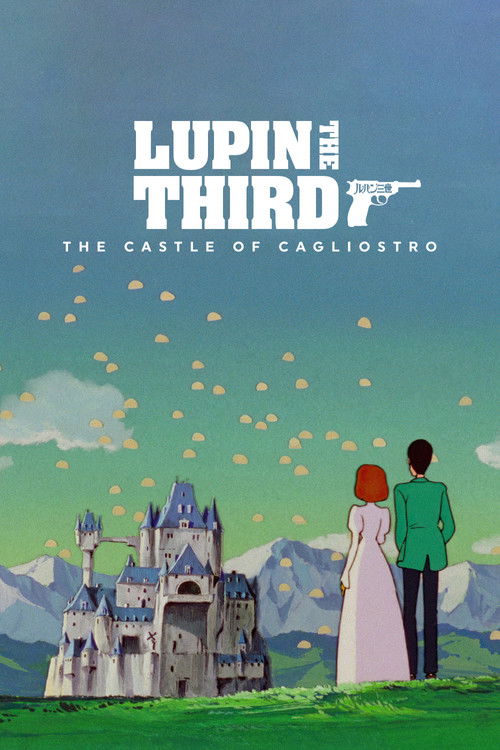


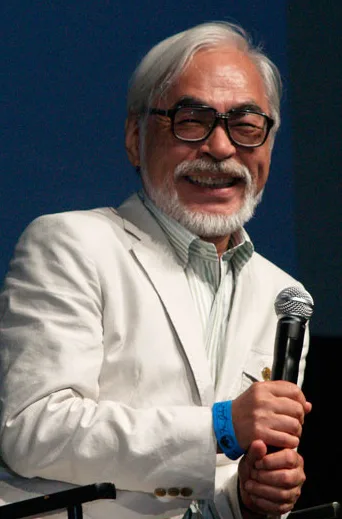










Lupin III: The Castle of Cagliostro (Japanese: ルパン三世 カリオストロの城, Hepburn: Rupan Sansei: Kariosutoro no Shiro) is a 1979 Japanese animated action adventure comedy film directed and co-written by Hayao Miyazaki. It is the second animated feature film based on the 1967–69 manga series Lupin III by Monkey Punch. The film was Miyazaki's feature directorial debut after having previously worked as an animator for Toei Animation and Telecom Animation Film, and directing several animated television series, including Lupin III Part I.
The Castle of Cagliostro follows gentleman thief Lupin III, who successfully robs a casino—only to find the money to be counterfeit. He heads to the tiny country of Cagliostro, the rumoured source of the bills, and attempts to save the runaway Princess Clarisse from Count Cagliostro's men; the Count plans to marry Clarisse in order to cement his power and recover the fabled ancient treasure of Cagliostro, requiring Clarisse's ancestral ring. Lupin enlists his associates, Jigen and Goemon, and sends his calling card to the Count to get Inspector Zenigata, his longtime nemesis, to the castle. After becoming trapped in the dungeon under the castle, Lupin and Zenigata form a pact to escape and foil the Count's counterfeit operation and save Clarisse from her forced marriage to the Count.
The original theatrical release in Japan occurred on 15 December 1979, distributed by Toho. In North America, it was screened at various festivals in the early 1980s, while a heavily edited and shortened version became available in the form of an arcade LaserDisc video game, Cliff Hanger (1983), combined with footage from the previous Lupin III film, The Mystery of Mamo (1978). The Castle of Cagliostro eventually made its American theatrical debut on 3 April 1991, with the home release following in October 1992. This first theatrical dub was produced by Streamline Pictures and released on home video the following year. A new dubbed version was produced by Manga Entertainment in 2000 and has had several releases.
Despite initially underperforming at the box office, The Castle of Cagliostro has garnered high praise, with critics and historians noting the film's influence on Miyazaki's later works, becoming the most popular and well-regarded entry in the entire Lupin III franchise, and has since been recognised as a cult film. However, some have disapproved of its depiction of Lupin as a gallant hero instead of his original persona as a ruthless criminal. The film has served as a major influence on animators and directors worldwide, such as filmmaker John Lasseter and several Walt Disney Animation Studios films, including titles of the Disney Renaissance. The Japanese computer animated film Lupin III: The First (2019) also has a plot structure loosely modelled after The Castle of Cagliostro.
Lupin III: The Castle Of Cagliostro is the first anime with stereo sound. Later on 1980 all the anime series changed to mono to stereo
Contents
Plot
Master thief Lupin III and his colleague, Daisuke Jigen, flee the Monte Carlo Casino with huge quantities of stolen money, but as they celebrate their latest heist, Lupin recognizes the bills as distinctively high-quality counterfeits. Deciding to seek out the source, they head to the Grand Duchy of Cagliostro, the alleged wellspring of the counterfeits.
Shortly after arriving, the two are passed by a young woman in a wedding gown driving a red car being chased by a group of armed thugs. They attempt to rescue the young woman, but in the ensuing mayhem Lupin is knocked unconscious and the woman gets captured. However, she leaves him a signet ring. After seeing the ring, Lupin recognizes the woman as Clarisse, the princess of Cagliostro, who will soon be married to Count Cagliostro, the country's regent against her will. The Count's arranged marriage will cement his power and recover the fabled ancient treasure of Cagliostro, for which he needs both his and Clarisse's ancestral rings.
The next night, a squad of assassins attack Lupin and Jigen at their inn, but they escape. Lupin leaves his calling card on the back of Jodot, the Count's butler and chief assassin, announcing he is going to steal Clarisse. Lupin summons Goemon Ishikawa XIII and tips off his longtime pursuer, Inspector Koichi Zenigata, to his whereabouts to provide a distraction. Lupin disguises himself as Zenigata and makes his way into the castle, while the real Zenigata ends up trapped in the castle's catacombs. After meeting his on-off lover Fujiko Mine posing as Clarisse's lady-in-waiting, Lupin makes his way to Clarisse and returns her ring, vowing to help her to escape. Before he can act, the Count drops Lupin down a trapdoor into the catacombs. Lupin mocks the Count through the ring he gave to Clarisse—a fake containing a transmitter—and the Count sends three assassins to retrieve the real ring.
Lupin encounters Zenigata, and they form a pact to help each other escape. After overpowering the assassins, they escape into a room full of printing presses, the source of the counterfeits which Cagliostro has used throughout history to form a global shadow empire. Zenigata wants to collect evidence, but Lupin points out they must escape the castle first. They start a fire as a distraction and steal the Count's autogyro, but as they attempt to rescue Clarisse, Lupin is seriously wounded. Clarisse offers the ring to the Count in exchange for Lupin's life, but after securing the ring, the Count's attempt at betrayal is foiled when Fujiko's actions allow her, Lupin, and Zenigata to flee. As Lupin recovers from his injuries, Zenigata tries convincing his superiors at Interpol to prosecute the Count for counterfeiting, but fearing political repercussions, they halt the investigation and remove him from the case. Lupin intends to stop the wedding and rescue the princess, revealing to his companions that ten years earlier she had saved his life during his unsuccessful first attempt to find the treasure of Cagliostro. Fujiko tips off Lupin regarding how to sneak into the castle, and forms a plan with Zenigata to publicly reveal the counterfeiting operation under the cover of pursuing Lupin.
Production
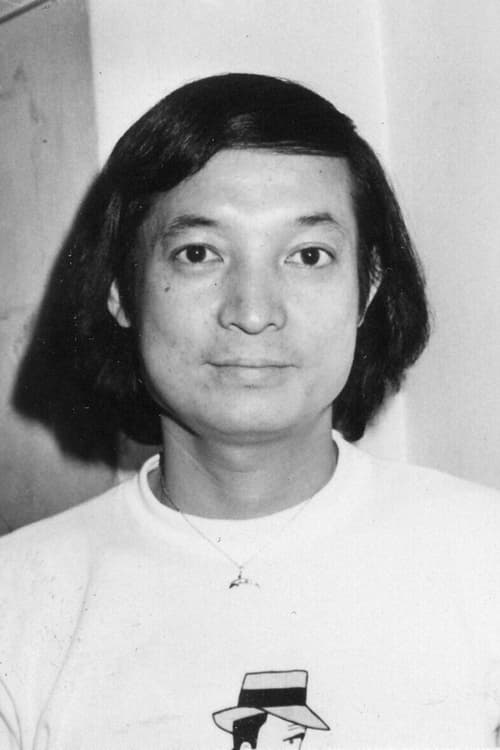
Lupin III began as a Japanese manga series written and illustrated by Monkey Punch. The title character, Lupin III, was inspired by (and is claimed in the series to be the grandson of) Maurice Leblanc's fictional character Arsène Lupin, a gallant and famous outlaw able to outsmart even Sherlock Holmes. Lupin III is a gentleman thief and announces his intentions to steal valuable objects by sending a calling card to the owners of the desired items. The manga's popularity led to two anime series, titled Lupin III and Lupin III Part II. The first film, The Mystery of Mamo, was released on 16 December 1978. The Castle of Cagliostro released a year later following the financial success of that film. This is marked as the first feature-length film to be directed by Hayao Miyazaki, who had previously co-directed episodes of the first Lupin anime series with Isao Takahata. The two directors along with Toshio Suzuki would give birth to Studio Ghibli in 1985. He was also a writer and director of two episodes in the second series under the pseudonym "Telecom", both produced a year after Cagliostro. In works other than Castle of Cagliostro and the series episodes directed by Miyazaki and Takahata, Lupin III is portrayed as a scheming and lecherous thief, sometimes supported by his former enemies Jigen and Goemon. Miyazaki's film conflicts with the typical behaviour and personality of the characters, a change that has been described as Lupin "growing up".
Castle of Cagliostro marked Miyazaki's debut as a theatrical movie director, but he also was a writer, a designer, and a storyboardist on the movie.
The production for the film began in May 1979 with the writing of the story and storyboarding for the film. Miyazaki began by drawing a bird's eye view of the setting before creating the story to completion. After the first draft scenario was returned to Miyazaki without change, he began the storyboards. The story was divided into four parts, but after reaching the third part changes had to be made at the storyboard phase in order to not exceed the decided running time. Animation work began in July while the storyboards were only a quarter complete; Miyazaki had to complete them during the animation production. Production wrapped up at the end of November and the film's premiere on 15 December 1979 was a short seven and a half months from the project's undertaking, with only five months of production time.
The film draws upon many sources of inspiration that were important in the production of the film. McCarthy writes that a research trip was not specifically undertaken for the film, but says Miyazaki's Heidi, Girl of the Alps sketchbooks were useful for the scenery. Miyazaki would cite Italian Mountain Cities and the Tiber Estuary from Kagoshima Publishing as influencing the production of the film. The film included elements that were seen in other Arsène Lupin works, including La Justice d'Arsène Lupin by Boileau-Narcejac, involving the discovery of a tremendous stash of forged franc notes with which World War I–era Germany had planned to destabilize the French economy. Maurice Leblanc's The Green-eyed Lady also featured a secret treasure hidden at the bottom of a lake. The design of mechanisms with secret tunnels in the clock tower, and the adventure plotted around beauty is inspired from Ghost Tower by Edogawa Ranpo. The castle is visually influenced by that of the original 1952 unfinished release of The King and the Mockingbird. Greenberg writes, "Cagliostro also borrowed many narrative and visual elements from Grimault's film: the basic plotline of disrupting the wedding of an evil tyrant and a beautiful innocent girl, the tyrant's luxuriously-decorated palace that is also full of traps, and a gang of henchmen serving the tyrant – both oversized goons and ninja-like assassins..." The staff added personal touches to the film, the most iconic being Lupin's car, the Fiat 500, was the car of head animator Yasuo Ōtsuka. Clarisse's car in the chase scene is a Citroën 2CV, which was Miyazaki's first car.
Release
The film's Japanese theatrical release was on 15 December 1979.
Box office
In Japan, the film grossed ¥610 million, equivalent to $2,784,000 (equivalent to $12,000,000 in 2025), in 1979. The MX4D release in 2017 grossed a further ¥76 million ($678,000) in Japan. The film's overseas screenings in 2007 and 2017 grossed $152,775 in Italy and South Korea, and $142,425 in the United States, adding up to at least $3,753,200 grossed in Asia, Italy and the United States.
In terms of box office admissions, the film sold 900,000 tickets in Japan as of 2006, 109,072 tickets in France and Italy, 58,000 tickets in the United States, and 1,729 tickets in South Korea, adding up to at least 1,068,801 tickets sold worldwide.
English releases
In 1980, Tokyo Movie Shinsha began screen testing the film in North America and it was notably shown at the World Science Fiction Convention in Boston for a marketing survey. It was later screened at other festivals during the 1980s, including FILMEX 82 in Los Angeles. Despite resounding acclaim from the screenings, many of them were unsuccessful. According to Fred Patten, the primary reason was that, "most people did not bother to come to it since it was 'only' an animated-cartoon feature, not a 'serious' live-action movie." A heavily edited and shortened version of the film eventually became available in North America in the form of an arcade laserdisc video game, Cliff Hanger (1983), which combined an English-dubbed version of the film's footage with that of the previous Lupin film Mystery of Mamo.
The American theatrical debut was on 3 April 1991 in New York City by Carl Macek's Streamline Pictures, with the home release following in October 1992. Due to copyright issues with the estate of Maurice Leblanc, the creator of the original Arsène Lupin, Lupin is referred to as "Wolf". Inspector Koichi Zenigata is erroneously named "Keibu Zenigata," likely due to a translation error (keibu being the Japanese title for a police inspector). The UK release followed on 10 June 1996 by Manga Video. Optimum Releasing re-released Cagliostro in the UK after Manga Entertainment lost its licence in the UK. The new DVD features an anamorphic widescreen print with the original Japanese audio track as well as the Streamline dub, both in stereo.
On 25 April 2000, Manga released the film on home video in the United States with a newly commissioned dub that adhered closer to the original script with the correct names restored. The DVD preserves the film in its original aspect ratio of 1.85:1 widescreen and is non-anamorphic. It additionally features remastered audio and picture, but contains no extras. The same company later released a new special edition DVD of Cagliostro on 29 August 2006. The disc is double-sided with the film on side A and the extras on side B. It includes a new digital transfer; Manga's English dub in 2.0 and 5.1 surround plus Japanese, Spanish, and French language tracks in mono; the complete film in storyboard format, accompanied by Japanese audio with English subtitles; an original Japanese trailer; a sketch and still gallery; a 26-minute interview with animation director Yasuo Ōtsuka, and animated menus. The film is presented in 16:9 anamorphic widescreen; however, the opening credits have been heavily re-edited to remove the Japanese credits, instead using selected still-frames of scenes that appear without Japanese writing. The English-translated names are superimposed over these stills. This change was negatively received by fans of the film. Both DVD releases are out-of-print, with Manga no longer owning the U.S. film rights.
Reception
While the film was not initially a box-office success, it developed a cult following through numerous re-releases and was even voted as "the best anime in history" by the readers of Animage in November 2001. Following a July 1992 release by Streamline Pictures, Janet Maslin said she thought the film "should fare nearly as well [as Akira] with animation fans of any age, provided they are unwavering in their devotion to the form and do not think 100 minutes is an awfully long time." According to Maslin, the film is an "interestingly wild hybrid of visual styles and cultural references" whose "animation is weak when it comes to fluid body movements, but outstanding in its attention to detail." According to Marc Savlov of The Austin Chronicle, "C of C refrains from the Technicolor ultra-violence that helped make films like Golgo 13, Akira, and Vampire Hunter D such audience favorites, and instead focuses on broad, almost slapstick humor and chaos to keep viewers riveted. Sometimes it works, and unfortunately, sometimes it doesn't."
On the review aggregator website Rotten Tomatoes, 96% of 23 critics' reviews are positive, with an average rating of 7.7/10. According to Metacritic, which compiled 7 reviews and calculated an average rating of 72 out of 100, the film received "generally favorable reviews". Some fans maintain that it is not a "true" Lupin title, due to Miyazaki's altering of the titular character into a bumbling hero, rather than his original ruthless criminal self. Monkey Punch, creator of Lupin III, called Castle of Cagliostro an "excellent" film, but agreed Miyazaki's vision of Lupin differs from his own.
The film received the Ōfuji Noburō Award from the 1979 Mainichi Film Concours. Cagliostro, the country and setting, is depicted in meticulous detail and unconstrained by limitations of architecture, geography and culture, which can be described as "akogare no Paris" (Paris of our dreams), which is a fantastical view of Europe through Eastern eyes. The use of unexpected and unique camera angles and attention to individual movement of the characters are distinctive signatures of Miyazaki's style, including the opening heist scene which provides characterization and spirit to understanding the character of Lupin. The changes made to the portrayal of the cast, depicting a heroic and selfless Lupin, a friendly Jigen, funny Goemon, and un-sexualized Fujiko, were initially not well received by fans. Otaku USA's Surat compared this shift to "a James Bond movie where [James Bond] stayed at Motel 6 and his 'Bond mobile' was a Toyota Camry!"
Legacy
Several critics have noted similarities between The Castle of Cagliostro and the Indiana Jones films, particularly the first entry Raiders of the Lost Ark (1981). These similarities include a rollicking adventure, humorous tone, similar overall action style, treasure hunting plot, a clever protagonist (Lupin and Indiana Jones) thrown into very difficult situations, overcoming obstacles with his wits, the use of gadgets, the help of several competent sidekicks, and a high-speed car chase down winding mountain roads. This has led to rumours, though unconfirmed, that the film may have influenced the Indiana Jones franchise. However, both the script and most of the filming for Raiders of the Lost Ark was completed by early 1981, years before The Castle of Cagliostro first became available in English.
In 1983, TMS Entertainment and Stern Electronics wanted to capitalize on the success of animated laserdisc video games at the time. They released the arcade game, Cliff Hanger, which used footage from this film, along with the previous Lupin film Mystery of Mamo. Even though the films themselves weren't available in North America at the time, the Cliff Hanger game was featured in an episode of the 1980s game show Starcade. The arcade game also made an appearance in The Goonies (1985)..
The character of Clarisse has been cited as a potential ancestral example of moe character design.
Cagliostro deeply influenced Pixar Animation Studios co-founder John Lasseter, along with Miyazaki's later films; in October 2014, Lasseter delivered a keynote address to the Tokyo International Film Festival describing how Miyazaki's influence upon his own life and work began when he first saw a clip from Cagliostro.
Walt Disney Animation Studios' 1986 film The Great Mouse Detective, co-directed by John Musker and Ron Clements, paid homage to Cagliostro with the film's climactic Big Ben sequence. The two-minute climax scene used computer-generated imagery (CGI), making it the first Disney film to extensively use computer animation, a fact that Disney used to promote the film during marketing. In turn, The Great Mouse Detective paved the way for the Disney Renaissance.
Another reference to the clock-tower fight is in "The Clock King" episode of Batman: The Animated Series. In the original video animation (OVA) Here Is Greenwood, students set a play where the scene of Lupin saving Clarisse on the clock tower is re-enacted.