


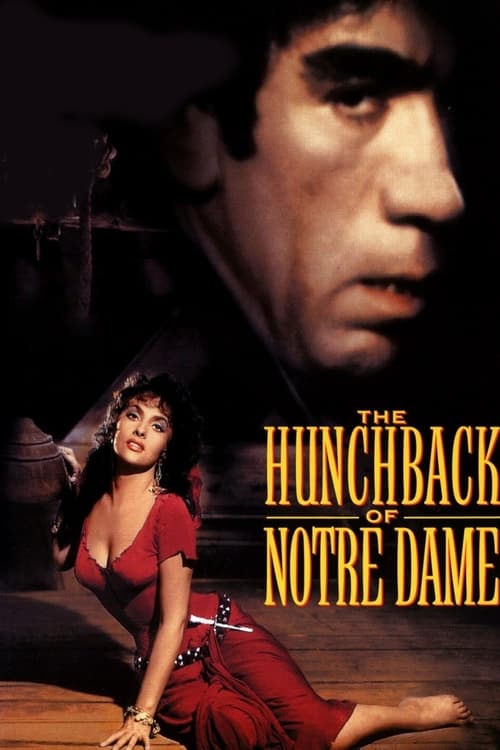
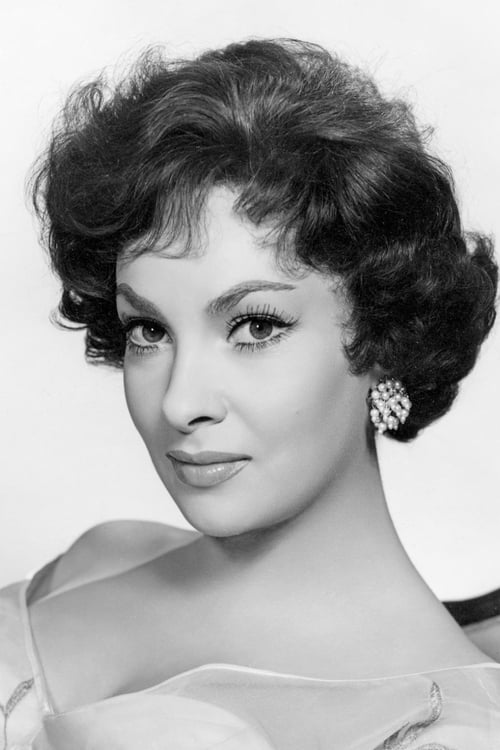
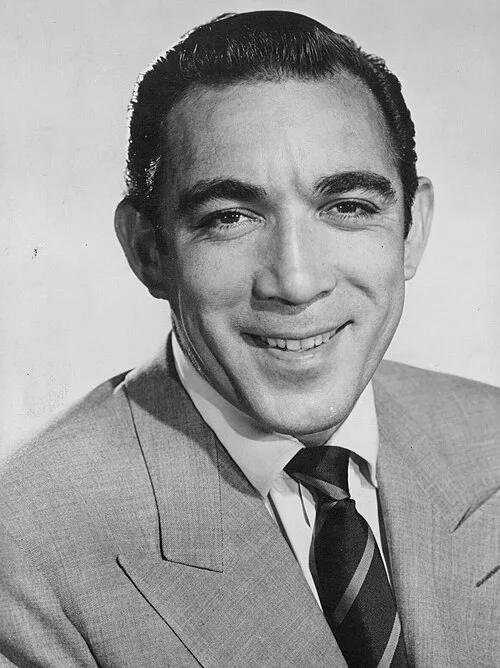






The Hunchback of Notre Dame (in French Notre-Dame de Paris) is a 1956 CinemaScope drama horror film version of Victor Hugo's 1831 novel, directed by Jean Delannoy and produced by Raymond Hakim and Robert Hakim. It stars American actor Anthony Quinn and Italian actress Gina Lollobrigida. The film is the first version of the novel to be made in color.
In the tradition of many sword and sandal spectacles, Quinn and Lollobrigida are the only two actors in the film who actually speak in English; the rest of the cast is made up of French actors who have had their voices dubbed into English. In the French version both Quinn and Lollobrigida speak French.
Anthony Quinn's portrayal of the hunchback Quasimodo is less disfigured than most other portrayals. Instead of having a huge hump and a hideously deformed face, he only has a small curve in his spine and a slightly deformed face.
The film is one of the few adaptations to use Victor Hugo's original ending; although Esmeralda is killed by a stray arrow rather than hanged. Esmeralda's last words were: "Life is wonderful" ("C'est beau, la vie"). A voiceover narration tells us at the end that several years afterward, an excavation group finds the skeletons of Quasimodo and Esmeralda intertwined in an embrace.
Contents
Plot
In Paris, Pierre Gringoire watches a crowd of hecklers ridicule his play. Clopin Trouillefou, the leader of the Roma, interrupts the play and disperses the crowd to attend the Feast of Fools, where Esmeralda performs an exotic dance. Claude Frollo becomes infatuated with her, and orders Quasimodo, his servant and the hunchbacked bellringer of the Notre-Dame Cathedral, to destroy their rituals. Shortly after, Quasimodo is crowned the King of the Fools and paraded throughout the streets. By nighttime, Frollo removes Quasimodo from the festivities. As they return home, Frollo orders Quasimodo to abduct Esmerelda. Quasimodo traps Esmeralda, but soldiers under the command of Captain Phoebus arrest him. He takes Esmeralda to an inn where he hopes to sleep with her, but she leaves.
Meanwhile, Gringoire is taken to the Court of Miracles and is sentenced to hang unless a woman is willing to marry him. Esmeralda arrives and agrees to marry him to spare his life. The next day, Quasimodo is flogged for the attempted kidnapping as Frollo practices alchemy to determine how to create gold. As Quasimodo begs the crowd for water, Esmeralda arrives and feeds him a vase of water. Quasimodo is later freed, and Frollo is angered when he learns Gringoire has married Esmeralda. As Frollo approaches her when she spells out Phoebus's name, he accuses Esmeralda of witchcraft.
Phoebus arrives at the residence of Fleur-de-Lys de Gondelaurier, his fiancée, but agrees to meet Esmeralda at the inn later that night. Frollo learns of their meeting and spies on them from below as Phoebus and Esmeralda embrace. Phoebus throws out Esmeralda's knife, and a jealous Frollo stabs Phoebus in the back (though Phoebus survives). Esmeralda is charged with attempted murder, and during her trial, the innkeeper and a dwarf accuse her of sorcery but claim they saw a dark-hooded figure outside. Esmeralda is escorted to the dungeon, and under torture, she confesses she stabbed Phoebus.
As Esmeralda is given her final sacraments before her execution, Quasimodo swings down, grabs and carries her into the cathedral balcony, where she is granted sanctuary. Esmeralda wakes up and is initially repulsed by Quasimodo, who has fallen in love with her. He hands her a whistle to use whenever she is in trouble. Frollo, now consumed with guilt, returns to the balcony where he learns Esmeralda is still alive. There, Esmeralda deduces that Frollo had stabbed Phoebus and alerts Quasimodo with the whistle. Quasimodo comes to her aid, and Frollo leaves.
Production
Allied Artists invested $1,250,000 in the film.
Reception
Box office
The film was the biggest grosser in Paris in the 1956–1957 season with a gross of $603,000 on admissions of 1,064,061. It had the third most admissions in France for films released in 1956 with 5,687,222 admissions.
The film earned rentals of $2.25 million in the United States and Canada.
Comic book adaptation
Dell Four Color #854 (July 1957)