



The United Nations Framework Convention on Climate Change (UNFCCC) is the UN process for negotiating an agreement to limit dangerous climate change. It is an international treaty among countries to combat "dangerous human interference with the climate system". The main way to do this is limiting the increase in greenhouse gases in the atmosphere. The Convention established the principle of "common but differentiated responsibilities," which asserts that all countries share responsibility for addressing climate change. However, developed countries are expected to assume a leading role because of their greater historical emissions. It was signed in 1992 by 154 states at the UN Conference on Environment and Development (UNCED), known as the Earth Summit. The treaty entered into force in 1994. "UNFCCC" is also the name of the Secretariat charged with supporting the operation of the convention, with offices on the UN Campus in Bonn, Germany.
The treaty calls for continuing scientific research into the climate. This research supports meetings and negotiations to lead to agreements. The aim is to allow ecosystems to adapt to climate change. At the same time it aims to ensure there are no threats to food production from climate change or measures to address it. And it aims to enable economic development to proceed in a sustainable manner. The UNFCCC's work currently focuses on implementing the Paris Agreement, which entered into force in 2016. It aims to limit the rise in global temperature to well below 2 °C (3.6 °F) above levels before the Industrial Revolution, and even aiming to hold it at 1.5 °C (2.7 °F). The treaty sets out responsibilities for three categories of states: developed countries, developed countries with special financial responsibilities, and developing countries. The developed countries are called Annex I countries, and should adopt national policies and take corresponding measures to limit their emissions of greenhouse gases. They should report on steps for returning individually or jointly to their 1990 greenhouse gas emission levels.
By 2022, the UNFCCC had 198 parties. Its supreme decision-making body, the Conference of the Parties (COP), meets annually. Other meetings at the regional and technical level take place throughout the year. The Paris Agreement mandates a review or "global stocktake" of progress towards meeting its goals every five years. The first of these took place at COP28 in the United Arab Emirates (UAE) in 2023.
It is problematic that key signatory states are not adhering to their commitments. For this reason, the UNFCCC has been criticized as being unsuccessful in reducing greenhouse gas emission. Parties to the convention have not agreed on a process allowing for majority voting. All decisions are taken by consensus, giving individual parties or countries a veto. The effectiveness of the Paris Agreement to reach its climate goals is under debate, especially with regards to its more ambitious goal of keeping global temperature rise to under 1.5 °C. A hybrid meeting cycle alternating in-person summits with virtual sessions is proposed as a means of enhancing equity and effectiveness in climate governance under the UNFCCC.
Contents
Development
The IPCC's First Assessment Report appeared in 1990. The report gave a broad overview of climate change science and the scientific consensus to date. It discussed uncertainties and provided evidence of warming. The authors said they are certain that greenhouse gases are increasing in the atmosphere because of human activity. This is resulting in more warming of the Earth's surface. The report led to the establishment of the United Nations Framework Convention on Climate Change (UNFCCC).
Convention Agreement in 1992
The text of the convention was produced during the meeting of an Intergovernmental Negotiating Committee in New York from 30 April to 9 May 1992. The convention was adopted on 9 May 1992 and opened for signature on 4 June 1992 at the United Nations Conference on Environment and Development (UNCED) in Rio de Janeiro (known by its popular title, the Earth Summit). On 12 June 1992, 154 nations signed the UNFCCC, which upon ratification committed signatories' governments to reduce atmospheric concentrations of greenhouse gases with the goal of "preventing dangerous anthropogenic interference with Earth's climate system". This commitment would require substantial reductions in greenhouse gas emissions (see the later section, "Stabilization of greenhouse gas concentrations"). Parties to the Convention have met annually from 1995 in Conferences of the Parties (COPs) to assess progress in dealing with climate change.
Article 3(1) of the Convention states that Parties should act to protect the climate system on the basis of "common but differentiated responsibilities and respective capabilities", and that developed country Parties should "take the lead" in addressing climate change. Under Article 4, all Parties make general commitments to address climate change through, for example, climate change mitigation and adapting to the eventual impacts of climate change. Article 4(7) states:
The extent to which developing country Parties will effectively implement their commitments under the Convention will depend on the effective implementation by developed country Parties of their commitments under the Convention related to financial resources and transfer of technology and will take fully into account that economic and social development and poverty eradication are the first and overriding priorities of the developing country Parties.
The Convention specifies the aim of Annex I Parties was stabilizing their greenhouse gas emissions (carbon dioxide and other anthropogenic greenhouse gases not regulated under the Montreal Protocol) at 1990 levels, by 2000.
Overarching objective
The ultimate objective of the Framework Convention is specified in Article 2: "stabilization of greenhouse gas concentrations in the atmosphere at a level that would prevent dangerous anthropogenic [i.e., human-caused] interference with the climate system". Article 2 of the convention says this "should be achieved within a time-frame sufficient to allow ecosystems to adapt naturally to climate change, to ensure that food production is not threatened and to enable economic development to proceed in a sustainable manner".
Six priority areas (Action for Climate Empowerment)
Action for Climate Empowerment (ACE) is a term adopted by the UNFCCC in 2015 to have a better name for this topic than "Article 6". It refers to Article 6 of the convention's original text (1992), focusing on six priority areas: education, training, public awareness, public participation, public access to information, and international cooperation on these issues. The implementation of all six areas has been identified as the pivotal factor for everyone to understand and participate in solving the challenges presented by climate change. ACE calls on governments to develop and implement educational and public awareness programmes, train scientific, technical and managerial personnel, foster access to information, and promote public participation in addressing climate change and its effects. It also urges countries to cooperate in this process, by exchanging good practices and lessons learned, and strengthening national institutions. This wide scope of activities is guided by specific objectives that, together, are seen as crucial for effectively implementing climate adaptation and mitigation actions, and for achieving the ultimate objective of the UNFCCC.
Key agreements and protocols
Further commitments
In addition to the Kyoto Protocol (and its amendment) and the Paris Agreement, parties to the Convention have agreed to further commitments during UNFCCC Conferences of the Parties. These include the Bali Action Plan (2007), the Copenhagen Accord (2009), the Cancún agreements (2010), and the Durban Platform for Enhanced Action (2012).
Bali Action Plan
As part of the Bali Action Plan, adopted in 2007, all developed country Parties have agreed to "quantified emission limitation and reduction objectives, while ensuring the comparability of efforts among them, taking into account differences in their national circumstances". Developing country Parties agreed to "[nationally] appropriate mitigation actions context of sustainable development, supported and enabled by technology, financing and capacity-building, in a measurable, reportable and verifiable manner." 42 developed countries have submitted mitigation targets to the UNFCCC secretariat, as have 57 developing countries and the African Group (a group of countries within the UN).
Copenhagen Accord and Cancún agreements
As part of the 2009 Copenhagen negotiations, a number of countries produced the Copenhagen Accord. The Accord states that global warming should be limited to below 2.0 °C (3.6 °F). The Accord does not specify what the baseline is for these temperature targets (e.g., relative to pre-industrial or 1990 temperatures). According to the UNFCCC, these targets are relative to pre-industrial temperatures.
114 countries agreed to the Accord. The UNFCCC secretariat notes that "Some Parties ... stated in their communications to the secretariat specific understandings on the nature of the Accord and related matters, based on which they have agreed to [the Accord]." The Accord was not formally adopted by the Conference of the Parties. Instead, the COP "took note of the Copenhagen Accord."
As part of the Accord, 17 developed country Parties and the EU-27 submitted mitigation targets, as did 45 developing country Parties. Some developing country Parties noted the need for international support in their plans.
Secretariat and offices
"UNFCCC" is also the name of the Secretariat charged with supporting the operation of the convention, with offices on the UN Campus in Bonn, Germany. Offices were formerly located in Haus Carstanjen and in a building on the UN Campus known as Langer Eugen.
The secretariat is established under Article 8 of the convention and headed by the Executive Secretary. The secretariat, augmented through the parallel efforts of the Intergovernmental Panel on Climate Change (IPCC), aims to gain consensus through meetings and the discussion of various strategies. Since the signing of the UNFCCC treaty, Conferences of the Parties (COPs) have discussed how to achieve the treaty's aims.
From 2010 to 2016 the head of the secretariat was Christiana Figueres, following by Patricia Espinosa who was appointed Executive Secretary on 18 May 2016 by United Nations Secretary-General Ban Ki-moon and took office on 18 July 2016. Espinosa retired on 16 July 2022. UN Under Secretary General Ibrahim Thiaw served as the acting Executive Secretary in the interim. On 15 August 2022, Secretary-General António Guterres appointed former Grenadian climate minister Simon Stiell as Executive Secretary, replacing Espinosa.
Current and former executive secretaries are:
Processes
Relationship with IPCC reports
The reports published by IPCC play a key role in the annual climate negotiations held by the UNFCCC. For example, the UNFCCC invited the IPCC to prepare a report on global warming of 1.5 °C. The IPCC subsequently released the Special Report on Global Warming of 1.5 °C (SR15) in 2018. The report showed that it was possible to keep warming below 1.5 °C during the 21st century. But this would mean deep cuts in emissions. It would also mean rapid, far-reaching changes in all aspects of society. The report showed warming of 2 °C would have much more severe impacts than 1.5 °C. In other words: every bit of warming matters. SR15 had an unprecedented impact for an IPCC report in the media and with the public. It put the 1.5 °C target at the center of climate activism.
Conferences of the Parties (CoP)
The United Nations Climate Change Conference are yearly conferences held in the framework of the UNFCCC. They serve as the formal meeting of the UNFCCC Parties (Conferences of the Parties) (COP) to assess progress in dealing with climate change, and beginning in the mid-1990s, to negotiate the Kyoto Protocol to establish legally binding obligations for developed countries to reduce their greenhouse gas emissions. Since 2005 the Conferences also served as the Meetings of Parties of the Kyoto Protocol (CMP) and since 2016 the Conferences also serve as Meeting of the Parties to the Paris Agreement (CMA).
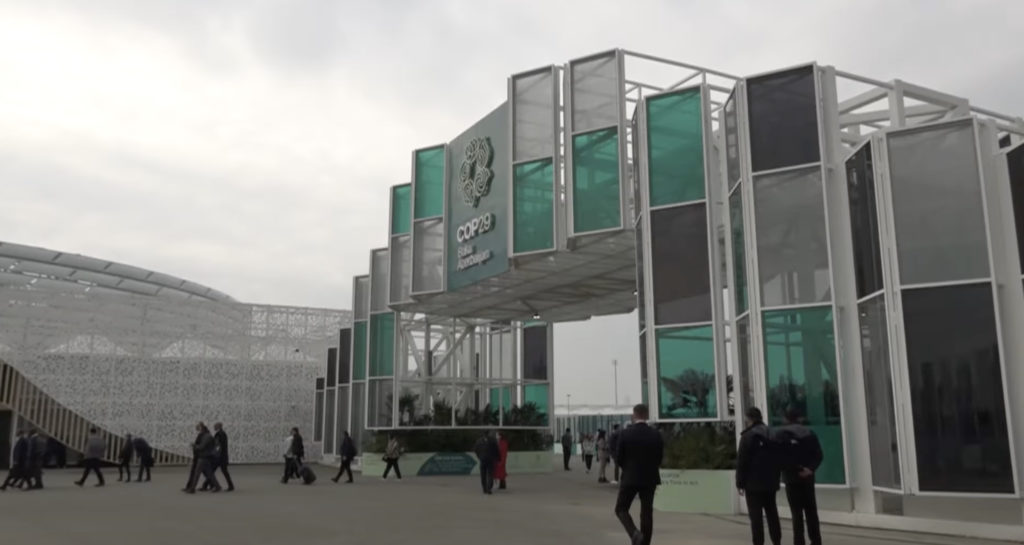
The first conference (COP1) was held in 1995 in Berlin. The 3rd conference (COP3) was held in Kyoto and resulted in the Kyoto protocol, which was amended during the 2012 Doha Conference (COP18, CMP 8). The COP21 (CMP11) conference was held in Paris in 2015 and resulted in adoption of the Paris Agreement. COP28 took place in the United Arab Emirates in 2023 and included the first global stocktake under the Paris Agreement. The UAE nominated Sultan al-Jaber, who is also head of Abu Dhabi's national oil company ADNOC, to preside over COP28. Azerbaijan hosted COP29 in 2024. COP30 was hosted in Brazil.
A subsidiary body is a committee that assists the Conference of the Parties. Subsidiary bodies include:
Permanents:
The Subsidiary Body of Scientific and Technological Advice (SBSTA) is established by Article 9 of the convention to provide the Conference of the Parties and, as appropriate, its other subsidiary bodies with timely information and advice on scientific and technological matters relating to the convention. It serves as a link between information and assessments provided by expert sources (such as the IPCC) and the COP, which focuses on setting policy.
The Subsidiary Body of Implementation (SBI) is established by Article 10 of the convention to assist the Conference of the Parties in the assessment and review of the effective implementation of the convention. It makes recommendations on policy and implementation issues to the COP and, if requested, to other bodies.
Temporary:
National communication
A "National Communication" is a type of report submitted by the countries that have ratified the United Nations Framework Convention on Climate Change (UNFCCC). Developed countries are required to submit National Communications every four years and developing countries should do so. Some Least Developed Countries have not submitted National Communications in the past 5–15 years, largely due to capacity constraints.
National Communication reports are often several hundred pages long and cover a country's measures to mitigate greenhouse gas emissions as well as a description of its vulnerabilities and impacts from climate change. National Communications are prepared according to guidelines that have been agreed by the Conference of the Parties to the UNFCCC. The (Intended) Nationally Determined Contributions (NDCs) that form the basis of the Paris Agreement are shorter and less detailed but also follow a standardized structure and are subject to technical review by experts.
Nationally Determined Contributions
At the 19th session of the Conference of the Parties in Warsaw in 2013, the UNFCCC created a mechanism for Intended Nationally Determined Contributions (INDCs) to be submitted in the run up to the 21st session of the Conference of the Parties in Paris (COP21) in 2015. Countries were given freedom and flexibility to ensure that these climate change mitigation and adaptation plans were nationally appropriate. This flexibility, especially regarding the types of actions to be undertaken, allowed for developing countries to tailor their plans to their specific adaptation and mitigation needs, as well as towards other needs.
In the aftermath of COP21, these INDCs became Nationally Determined Contributions (NDCs) as each country ratified the Paris Agreement, unless a new NDC was submitted to the UNFCCC at the same time. The 22nd session of the Conference of the Parties (COP22) in Marrakesh focused on these Nationally Determined Contributions and their implementation, after the Paris Agreement entered into force on 4 November 2016.
Membership and participation
As of 2022, the UNFCCC has 198 parties including all United Nations member states, United Nations General Assembly observers the State of Palestine and the Holy See, UN non-member states Niue and the Cook Islands, and the supranational union European Union.
The United States announced its intention to withdraw from the treaty in January 2026, the only country to do so.
Classification of Parties and their commitments
Parties to the UNFCCC are classified as:
Annex I: There are 43 Parties to the UNFCCC listed in Annex I of the convention, including the European Union. These Parties are classified as industrialized (developed) countries and "economies in transition" (EITs). The 14 EITs are the former centrally-planned (Soviet) economies of Russia and Eastern Europe.
Annex II: Of the Parties listed in Annex I of the convention, 24 are also listed in Annex II of the convention, including the European Union. These Parties are made up of members of the Organisation for Economic Co-operation and Development (OECD): these Parties consist of the members of the OECD in 1992, minus Turkey, plus the EU. Annex II Parties are required to provide financial and technical support to the EITs and developing countries to assist them in reducing their greenhouse gas emissions (climate change mitigation) and manage the impacts of climate change (climate change adaptation).
Least-developed countries (LDCs): 49 Parties are LDCs, and are given special status under the treaty in view of their limited capacity to adapt to the effects of climate change.
Non-Annex I: Parties to the UNFCCC not listed in Annex I of the convention are mostly low-income developing countries. Developing countries may volunteer to become Annex I countries when they are sufficiently developed.
Annex I countries
There are 43 Annex I Parties including the European Union. These countries are classified as industrialized countries and economies in transition. Of these, 24 are also Annex II Parties, including the European Union, and 14 are Economies in Transition.
Annex I countries (24 of these are also Annex II Parties):
Annex I countries that are Economies in Transition:
Notes
Engagement of civil society
In 2014, The UN with Peru and France created the Global Climate Action Portal NAZCA for writing and checking all the climate commitments.
Thousands of observers from civil society, business and academia attend the COPs. They organize a huge programme of activities including officially coordinated "side events". These complement and inform the official negotiations.
Civil Society Observers under the UNFCCC have organized themselves in loose groups, covering about 90% of all admitted organisations. Some groups remain outside these broad groupings, such as faith groups or national parliamentarians. The UNFCCC secretariat also recognizes the following groups as informal NGO groups (2016): Faith-based organizations, Education and Capacity Building and Outreach NGOs, parliamentarians.
An overview is given in the table below:
Analysis
Interpreting ultimate objective in Article 2
The ultimate objective of the Framework Convention contains some key words that are discussed further below and shown here in italics: "stabilization of greenhouse gas concentrations in the atmosphere at a level that would prevent dangerous anthropogenic [i.e., human-caused] interference with the climate system".
To stabilize atmospheric GHG concentrations, global anthropogenic GHG emissions would need to peak then decline (see climate change mitigation). Lower stabilization levels would require emissions to peak and decline earlier compared to higher stabilization levels. These lower stabilization levels are associated with lower magnitudes of global warming compared to higher stabilization levels.
There are a range of views over what level of climate change is dangerous. Scientific analysis can provide information on the risks of climate change, but deciding which risks are dangerous requires value judgements.
The global warming that has already occurred poses a risk to some human and natural systems. Higher magnitudes of global warming will generally increase the risk of negative impacts. Climate change risks are "considerable" with 1 to 2 °C of global warming, relative to pre-industrial levels. 4 °C warming would lead to significantly increased risks, with potential impacts including widespread loss of biodiversity and reduced global and regional food security.
Climate change policies may lead to costs that are relevant to the article 2. For example, more stringent policies to control GHG emissions may reduce the risk of more severe climate change, but may also be more expensive to implement.
In decision making, the precautionary principle is considered when possibly dangerous, irreversible, or catastrophic events are identified, but scientific evaluation of the potential damage is not sufficiently certain. The precautionary principle implies an emphasis on the need to prevent such adverse effects. Following the precautionary principle, uncertainty (about the exact effects of climate change) is not a reason for inaction, and this is acknowledged in Article 3.3 of the UNFCCC.
International trade
Academics and environmentalists criticize article 3(5) of the convention, which states that any climate measures that would restrict international trade should be avoided.
Reception
Criticism of processes
The overall umbrella and processes of the UNFCCC and the adopted Kyoto Protocol have been criticized by some as not having achieved their stated goals of reducing the emission of greenhouse gases. The UNFCCC is a multilateral body concerned with climate change and can be an inefficient system for enacting international policy: Because the framework system includes over 190 countries and because negotiations are governed by consensus, small groups of countries can often block progress.
There has been a failure to achieve effective greenhouse gas emission reduction policy treaties since 1992. This has driven some countries like the United States to hold back from ratifying the UNFCCC's most important agreement—the Kyoto Protocol—in large part because the treaty did not cover developing countries which now include the largest CO2 emitters. However, this failed to take into account both the historical responsibility for climate change since industrialization, which is a contentious issue in the talks, and also responsibility for emissions from consumption and importation of goods (see carbon footprint). It has also led Canada to withdraw from the Kyoto Protocol in 2011 out of a wish not to make its citizens pay penalties that would result in wealth transfers out of Canada. Both the US and Canada are looking at internal Voluntary Emissions Reduction schemes to curb carbon dioxide emissions outside the Kyoto Protocol.
The perceived lack of progress has also led some countries to seek and focus on alternative high-value activities like the creation of the Climate and Clean Air Coalition to Reduce Short-Lived Climate Pollutants which seeks to regulate short-lived pollutants such as methane, black carbon and hydrofluorocarbons (HFCs), which together are believed to account for up to one third of current global warming but whose regulation is not as fraught with wide economic impacts and opposition.
In 2010, Japan stated that it will not sign up to a second Kyoto term, because it would impose restrictions on it not faced by its main economic competitors, China, India and Indonesia. A similar indication was given by the Prime Minister of New Zealand in November 2012. At the 2012 conference, last-minute objections at the conference by Russia, Ukraine, Belarus and Kazakhstan were ignored by the governing officials, and they have indicated that they will likely withdraw or not ratify the treaty. These defections place additional pressures on the UNFCCC process that is seen by some as cumbersome and expensive: in the UK alone, the climate change department has taken over 3,000 flights in two years at a cost of over £1,300,000 (British pounds sterling).
Awards
In 2016, the UNFCCC received the "Prince or Princess of Asturias Award for International Cooperation" by the Princess of Asturias Awards.
Meetings of the Parties
A Conference of the Parties (COP) has been held annually for most years since 1995.