


The United States Naval Academy (USNA, Navy, or Annapolis) is a federal service academy adjacent to Annapolis, Maryland. It was established on 10 October 1845 during the tenure of George Bancroft as Secretary of the Navy. The Naval Academy is the second oldest of the five U.S. service academies and it educates midshipmen for service in the officer corps of the United States Navy and United States Marine Corps. It is part of the Naval University System. The 338-acre (137 ha) campus is located on the former grounds of Fort Severn at the confluence of the Severn River and Chesapeake Bay in Anne Arundel County, 33 miles (53 km) east of Washington, D.C., and 26 miles (42 km) southeast of Baltimore. The entire campus, known colloquially as the Yard, is a National Historic Landmark and home to many historic sites, buildings, and monuments. It replaced Philadelphia Naval Asylum in Philadelphia that had served as the first United States Naval Academy from 1838 to 1845, at which time the Naval Academy formed in Annapolis.
Candidates for admission generally must apply directly to the academy and apply separately for a nomination, usually from a member of Congress. Students are officers-in-training with the rank of midshipman. Tuition for midshipmen is fully funded by the Navy in exchange for an active duty service obligation upon graduation. Approximately 1,200 "plebes" (an abbreviation of the Ancient Roman word plebeian) enter the academy each summer for the rigorous Plebe Summer. About 1,000 midshipmen graduate and commission. Graduates are commissioned as either ensigns in the Navy or second lieutenants in the Marine Corps, but a small number can also be cross-commissioned as officers in other U.S. services, and the services of allied nations. The United States Naval Academy has some of the highest-paid graduates in the country according to starting salary. The academic program grants a Bachelor of Science degree with a curriculum that grades midshipmen's performance upon a broad academic program, military leadership performance, and mandatory participation in competitive athletics. Midshipmen are required to adhere to the academy's Honor Concept.
Contents
Other Navy schools
The Navy operates the Naval Postgraduate School and the Naval War College separately. The Naval Academy Preparatory School (NAPS) in Newport, Rhode Island, is the official preparatory school for the Naval Academy.
History
The first nautical school for officers was conceived by Commodore Arthur Sinclair in 1819 while in command of the Norfolk Navy Yard. Due to his zeal and perseverance, the "Nautical School" was opened on board the frigate Guerriere on 3 December 1821 with between 40 and 50 midshipmen attached to the ship. The curriculum was diversified with naval tactics, astronomy, geography, French, history, English grammar, and international relations. The school operated until 1828, when USS Guerriere was ordered to duty in the Pacific. It was from that small start that the U.S. Naval Academy at Annapolis grew.
The history of the academy can be divided into four eras: the use of original Fort Severn from 1845 to 1861, "Porter's Academy" between 1865 and 1903, "Flagg Academy" from 1903 to 1941, and the modern era since 1941.
The academy's Latin motto is Ex Scientia Tridens, which means 'Through Knowledge, Sea Power'. It appears on a design devised by naval academy graduate (1867) Park Benjamin, Jr. It was adopted by the Navy Department in 1898 due to the efforts of another graduate (also 1867) and collaborator, Jacob W. Miller.
Early years
The institution was founded as the Naval School on 10 October 1845 by Secretary of the Navy George Bancroft. The campus was established at Annapolis on the grounds of the former U.S. Army post Fort Severn. The school opened with 50 midshipman students and seven professors. The decision to establish an academy on land may have been in part a result of the Somers Affair, an alleged mutiny involving the Secretary of War's son that resulted in his execution at sea. Commodore Matthew Perry had a considerable interest in naval education, supporting an apprentice system to train new seamen, and helped establish the curriculum for the United States Naval Academy. He was also a vocal proponent of modernization of the navy.
Originally a course of study for five years was prescribed. Only the first and last were spent at the school with the other three being passed at sea. The present name was adopted when the school was reorganized in 1850 and placed under the supervision of the chief of the Bureau of Ordnance and Hydrography. Under the immediate charge of the superintendent, the course of study was extended to seven years with the first two and the last two to be spent at the school and the intervening three years at sea. The four years of study were made consecutive in 1851 and practice cruises were substituted for the three consecutive years at sea. The first class of naval academy students graduated on 10 June 1854. They were considered as passed midshipmen until 1912, when graduates were first sworn in as officers.
In 1850, Edward Seager joined the faculty as the first instructor of drawing, and he also served as the first fencing instructor. He held the position of teacher of the art of defence from 1851 to 1859.
In 1860, the Tripoli Monument was moved to the academy grounds. Later that year in August, the model of the USS Somers experiment was resurrected when USS Constitution, then 60 years old, was recommissioned as a school ship for the fourth-class midshipmen after a conversion and refitting begun in 1857. She was anchored at the yard, and the plebes lived on board the ship to immediately introduce them to shipboard life and experiences.
American Civil War
The American Civil War was disruptive to the Naval Academy. Southern sympathy ran high in Maryland. Although riots broke out, Maryland did not declare secession. The United States government was planning to move the school, when the sudden outbreak of hostilities forced a quick departure. Almost immediately the three upper classes were detached and ordered to sea, and the remaining elements of the academy were transported to Fort Adams in Newport, Rhode Island by the USS Constitution in April 1861, where the academy was set up in temporary facilities and opened in May. The Annapolis campus, meanwhile, was turned into a United States Army Hospital.
The United States Navy was stressed by the situation – 24% of its officers resigned to join the Confederate States Navy, including 95 graduates and 59 midshipmen, along with many key leaders who influenced USNA's founding. As the first superintendent of the United States Naval Observatory, Commander Matthew Fontaine Maury, who advocated for creating the United States Naval Academy, also resigned his commission.
The first superintendent, Admiral Franklin Buchanan, joined the Confederate States Navy as its first and primary admiral. Captain Sidney Smith Lee, the second commandant of midshipmen, and older brother of Robert E. Lee, left Federal service in 1861 for the Confederate States Navy. Lieutenant William Harwar Parker, CSN, class of 1848, and instructor at USNA, joined the Virginia State Navy, and then went on to become the superintendent of the Confederate States Naval Academy.
Lieutenant Charles "Savez" Read may have been "anchor man" (graduated last) in the class of 1860, but his later service to the Confederate States Navy included defending New Orleans, service on CSS Arkansas and CSS Florida, and command of a series of captured Union ships that culminated in seizing the U.S. Revenue Cutter Caleb Cushing in Portland, Maine. Lieutenant James Iredell Waddell, CSN, a former instructor at the U.S. Naval Academy, commanded the CSS Shenandoah.
The midshipmen and faculty returned to Annapolis in the summer of 1865, just after the war ended.
Porter's Academy: Civil War to Spanish–American War
Civil War hero Admiral David Dixon Porter became superintendent in 1865. He found the infrastructure at Annapolis a shambles, the result of ill military use during the War. Porter attempted to restore the facilities. He concentrated on recruiting naval officers as opposed to civilians, a change of philosophy. He recruited teachers Stephen B. Luce, future admirals Winfield Scott Schley, George Dewey, and William T. Sampson. The midshipman battalion consisted of four companies. These were bunked in a single wooden building containing 100 rooms, one company to a floor. They held dress parades every evening except Sunday. Students were termed "cadets", though sometimes "cadet midshipmen"; other appellations were used. Porter began organized athletics, usually intramural at the time.
Antoine Joseph Corbesier, an immigrant from Belgium, was appointed to the position of Assistant Swordmaster in 1864, and then Swordmaster at USNA in October 1865. He coached Navy fencers in intercollegiate competition from 1896, when the Naval Academy joined the Intercollegiate Fencing Association, until 1914, when he retired. By special act of Congress, he was commissioned a 1st lieutenant in the Marine Corps on 4 March 1914. He died on 26 March 1915 and is buried on Hospital Point.
In 1867, indoor plumbing and water was supplied to the family quarters. In 1868, the figurehead of Tamanend from USS Delaware (later nicknamed "Tecumseh") was erected in the yard. Class rings were first issued in 1869. Weekly dances were held. Wags called the school "Porter's Dancing Academy". President U.S. Grant distributed diplomas to the class of 1869. Porter ensured continued room for expansion by overseeing the purchase of 113 acres (46 ha) across College Creek, later known as Hospital Point.
In 1871, the color competition began, along with the selection of the color company and "color girl".
In the 1870s, cuts in the military budget resulted in graduating much smaller classes. In 1872, 25 graduated. Eight of these made the Navy a career. The third class physically hazed the fourth class so ruthlessly that Congress passed an anti-hazing law in 1874. Hazing continued in more stealthy forms.
The Flagg Academy: Spanish–American War to WWI
The Spanish–American War of 1898 greatly increased the academy's importance and the campus was almost wholly rebuilt and much enlarged between 1899 and 1906. The ground on which most of the academy sat was dredged from the surrounding bodies of water and consisted of silt. This was too fragile for the newer heavy stone buildings. Pilings were sunk from 100 feet (30 m) to 400 feet (120 m) deep. Some wooden with iron caps; modern ones of steel. Today's campus dates from that era. In 1905, Isherwood Hall, containing the Department of Marine Engineering, was constructed.
Prior to that era, about 43 men entered annually. There were 114 joining the class of 1905, 201 with the class of 1908.
The academy built a modern hospital in 1907, the fourth in sequence, on what is today called "Hospital Point".
In 1910, the academy established its own dairy farm. In 1913, the Navy purchased the Howard's Adventure estate in nearby Gambrills, Maryland to expand their dairy operations. The farm is also home to Bill the Goat. The Naval Academy dairy was closed in 1998.
On 23 August 1911, the Navy officers on flight duty at Hammondsport, New York, and Dayton, Ohio, were ordered to report for duty at the Engineering Experiment Station, Naval Academy, "in connection with the test of gasoline motors and other experimental work in the development of aviation, including instruction at the aviation school" being set up on Greenbury Point, Annapolis. The "aerodrome" at Greenbury Point sat on 1000 square feet of land and consisted of a building with a rubber-reinforced roof containing three hangars (one for each of the newly purchased airplanes), a workshop, an office, and several bunk rooms. All three airplanes cost a total of $14,000. Over 100 officers applied for aviation duty prior to August 1911. Swimming was among a set of other qualifications that a pilot candidate must have passed before being accepted to aviation duty. Pilot qualifications were in accordance with Federation Aeronautique Internationale (FAI) standards. In the presence of a committee of the Aero Club of America, a pilot candidate had to fly five figure eights around two flags buoyed 1500 feet apart then land within 150 feet of an established mark. This course had to be completed twice. The test also required the prospective aviator to climb to a minimum altitude of 150 ft (officially 50 meters). It was estimated by CAPT Washington Irving Chambers that a student could qualify as a new pilot in about a month, weather permitting. All students wore life preservers. The control wheel of the Curtiss machines featured a "shift control" where the controls could be "thrown" between the student and instructor at any time. The Wright machine was delivered to Greenbury by August 1911, but was not yet configured with water gear. Navy flight training moved to NAS Pensacola, Florida, in January 1914.
Modern era: World War II to present
The academy and its support facilities became part of the Severn River Naval Command from 1941 to 1962.
A total of 3,319 graduates were commissioned during World War II. Dr. Chris Lambertsen held the first closed-circuit oxygen SCUBA course in the United States for the Office of Strategic Services maritime unit at the academy on 17 May 1943. In 1945, A Department of Aviation was established. That year a vice admiral, Aubrey W. Fitch, became superintendent. The naval academy celebrated its centennial. During the century of its existence, roughly 18,563 midshipmen had graduated, including the class of 1946.
The academy was accredited in 1947 by the Middle States Commission on Higher Education.
On January 15, 1947, James L. Holloway became the 35th superintendent of the United States Naval Academy, succeeding Vice Admiral Aubrey W. Fitch. At 48, Holloway was the youngest superintendent in fifty years, having been handpicked by Secretary of the Navy Forrestal to implement the academic changes suggested by the Holloway Board, which had recommended that the Naval Academy curriculum move away from rote recitation and continuous crams "to give a stronger emphasis to basic and general education, rendering more fundamental and less detailed instruction in strictly naval material and techniques."
An accelerated course was given to midshipmen during the war years which affected classes entering during the war and graduating later. The students studied year around. This affected the class of 1948 most of all. For the only time, a class was divided by academic standing. 1948A graduated in June 1947; the remainder, called 1948B, a year later.
From 1946 to 1961, N3N amphibious biplanes were used at the academy to introduce midshipmen to flying.
On 3 June 1949, Wesley A. Brown, the sixth African-American to enter the academy, became the first to graduate, followed several years later by Lawrence Chambers, who became the first African-American graduate to make flag rank.
Rank structure
The student body is known as the Brigade of Midshipmen. Students attending the U.S. Naval Academy are appointed to the rank of midshipman and serve on active duty in that rank. "Naval Academy midshipmen are classified as officers of the line but are officers only in a qualified sense. They rank just below chief warrant officers."
Legally, midshipmen are a special grade of officer that ranks above the most senior enlisted grades (E-9) and below the lowest grade of chief warrant officer (W-2) in the Navy and Coast Guard (the Navy and Coast Guard discontinued the rank of warrant officer, WO-1, in 1975). Additionally, midshipmen rank below warrant officer (W-1) in the Marine Corps and the Army, and below second lieutenant (O-1) in the Air Force (the Air Force ceased appointing warrant officers in 1959 and the last USAF WO died in 2008).
Midshipmen are classified not as freshmen, sophomores, juniors, and seniors, but as fourth class, third class, second class, and first class, respectively.
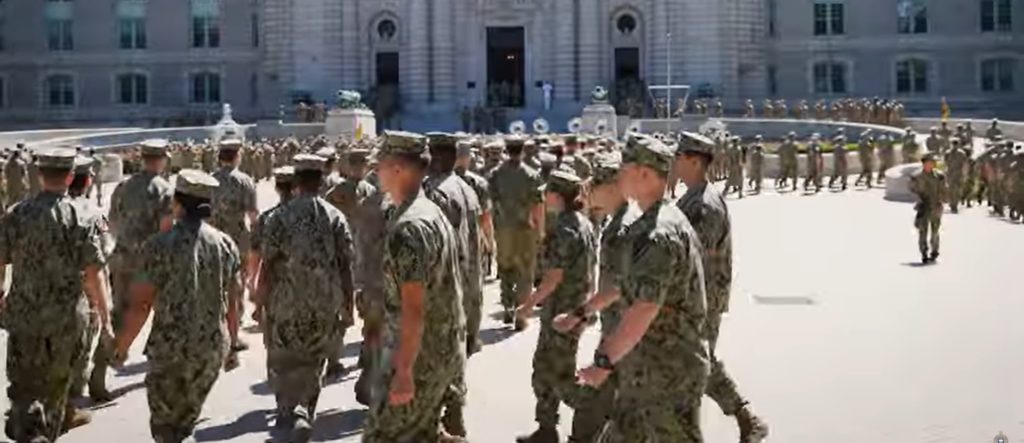
A member of the entering class—the fourth class, the lowest rank of midshipmen—is also known as a "plebe" (plural plebes). Because the first year at the academy is one of transformation from a civilian into a military officer, plebes must conform to a number of rules and regulations not placed on their seniors—the upper three classes of midshipmen—and have additional tasks and responsibilities that disappear upon promotion to midshipman third class.
Third class midshipmen have been assimilated into the brigade and are treated with more respect because they are upperclassmen. They are commonly called "youngsters". Because of their new stature and rank, the youngsters are allowed such privileges as watching television, listening to music, and wearing non-issued Navy and Marine Corps related clothing.
Second class midshipmen are charged with training plebes. They report directly to the first class, and issue orders as necessary to carry out their responsibilities. Second class midshipmen are allowed to drive their own cars (but may not park them on campus) and are allowed to enter or exit the Yard (campus) in civilian attire (weekends only).
Uniforms
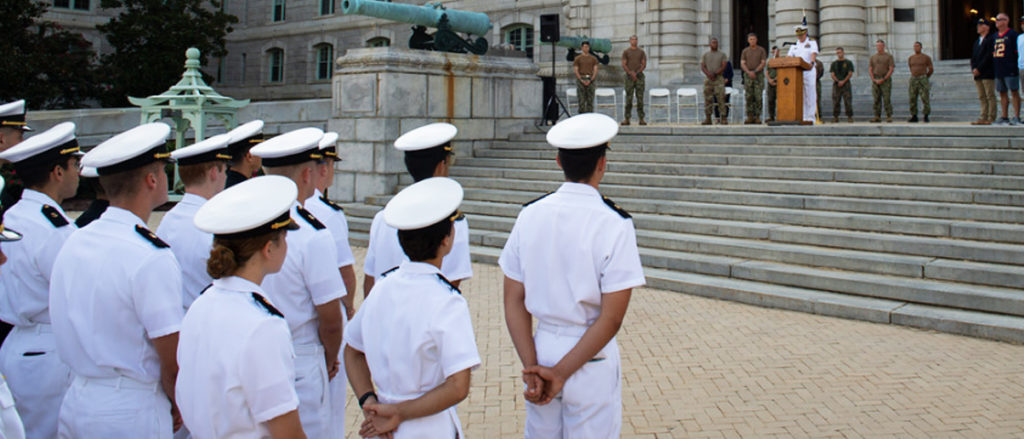
Midshipmen at the academy wear service dress uniforms similar to those of U.S. Navy officers, with shoulder-board and/or sleeve insignia varying by school year or midshipman officer rank. All wear gold anchor insignia on both lapel collars of the service dress blue jacket. Shoulder boards, worn on summer white, service/full dress white, dinner dress uniforms, and the shirt of the service/full dress blue uniform have a gold anchor and a number of stripes indicating year or rank. Midshipman officer (also first class) shoulder boards have a small gold star in place of the anchor and have 1 through 6 horizontal stripes indicating their rank.
On the working blue uniform shirt collar, a freshman (Midshipman Fourth Class or "plebe") wears no collar insignia, a sophomore (Midshipman Third Class or "youngster") wears a single fouled anchor on the right collar point, a Junior (Midshipman Second Class) fouled anchors on each collar point, and a Senior (Midshipman First Class or "firstie") wears fouled anchors with perched eagles. First class midshipmen in officer billets replace those devices with their respective midshipman officer collar insignia. Midshipman officer collar insignia are a series of gold bars, from the rank of Midshipman Ensign (one bar or stripe) to Midshipman Captain (six bars or stripes).
Depending on the season, midshipmen wear Summer White or Service Dress Blue as their service dress uniform, and Working Blue as their daily class uniform. In 2008, the first class midshipmen wore the Service Khaki as the daily uniform, but this option was repealed following the graduation of the class of 2011. First class midshipmen may wear their service assignment uniform on second semester "Tactical Thursdays" (i.e., naval aviator and naval flight officer selectees wear flight suits; submarine and surface warfare selectees wear coveralls or Navy Working Uniforms with their new command ballcaps; Marine Corps selectees wear MARPAT camouflage utilities). A unique uniform consisting of a Navy blue double-breasted jacket with brass buttons and high collar, blue or white high-rise trousers (white worn during Graduation Week), and duty belt with silver NA buckle, is worn for formal parades during spring and autumn parade seasons.
During commissioning week (formerly known as "June week"), the uniform is Summer White.
Campus
The campus (or "Yard") has grown from a 40,000 square meters (9.9 acres) Army post named Fort Severn in 1845 to a 1.37 square kilometres (340 acres) campus in the 21st century. By comparison, the United States Air Force Academy is 73 square kilometres (18,000 acres) and United States Military Academy (Army) is 65 square kilometres (16,000 acres).
Halls and principal buildings
Bancroft Hall is the largest building at the Naval Academy and the largest college dormitory in the world. It houses all midshipmen. Open to the public are Memorial Hall, a midshipman-maintained memorial to graduates who have died during military operations, and the Rotunda, the ceremonial entrance to Bancroft Hall. The Commander-in-Chief's Trophy resides in the Rotunda while Navy is in possession of it. It was named for the academy's founder, Secretary of the Navy George Bancroft, and designed by Ernest Flagg.
The Naval Academy Chapel, at the center of the campus, across from Herndon Monument, has a high dome that is visible throughout Annapolis. Designed by Ernest Flagg. The chapel was featured on the U.S. Postal Service postage stamp honoring the academy's 150th anniversary in 1995. John Paul Jones lies in the crypt beneath the chapel.
Commodore Uriah P. Levy Center and Jewish Chapel, primarily funded with private donations, was dedicated on 23 September 2005. The chapel was named for Commodore Uriah P. Levy and houses a Jewish chapel, the honor board, ethics, character learning center, officer development spaces, a social director, and academic boards. Built featuring Jerusalem stone, the architecture of the exterior is consistent with nearby Bancroft Hall.
Alumni Hall is the primary assembly hall for the Brigade of Midshipmen and has two dining facilities. It hosts various sporting events (including the men's and women's intercollegiate basketball games) and is used by alumni for reunions. The Bob Hope Performing Arts Center is located there.
Halsey Field House contains an indoor track, squash and tennis courts, five basketball courts, a 65 tatami dojo for Aikido/Judo, a climbing wall, and assorted athletic and workout facilities and offices. Before construction of Alumni Hall, it was used by Navy basketball teams and was the site of midshipman assemblies. It was named for William F. Halsey, Jr.
Hubbard Hall, used by the crew team, is a three-story building on Dorsey Creek, 250 yards (230 m) from the Severn River. Also known as the Boat House, it was renovated in 1993 and now includes the Fisher Rowing Center. It was named for Rear Admiral John Hubbard (Class of 1870).
Monuments and memorials
Gokoku-ji Bell. A copy of the original bell which was brought back to the United States in 1855 by Commodore Matthew Perry following his mission to Japan. The bell is placed in front of Bancroft Hall and rung in a semi-annual ceremony for each victory that Navy has registered over Army, to include one of the nation's oldest football rivalries, the Army–Navy Game. The current bell is an exact replica of the original, which the United States Navy returned to the people of Okinawa in 1987.
Enterprise Bell. Originally serving on the USS Enterprise (CV-6), the ship's bell was brought to the academy in 1950. It is sounded after most games when Navy wins over Army in any one of the three sports seasons.
USS Delaware figurehead. This is a bronze replica of the original figurehead of ship-of-the-line USS Delaware. It was presented to the academy by the Class of 1891. This replica, one of the most famous monuments on campus, was commonly known as Tecumseh. However, when it adorned the American man-of-war, it commemorated Tamanend, the revered Delaware chief who welcomed William Penn to America, not Tecumseh. In times past, the bronze replica was considered a good-luck "mascot" for the midshipmen, who threw pennies at the quiver and offered left-handed salutes whenever they needed good luck, such as a sports win over West Point and spiritual help for examinations. It is also referred to as the God of 2.0 because 2.0 is the minimum passing GPA at USNA, and the mids offer pennies to help achieve this. It was used as a morale booster during football weeks and on special occasions when the face was painted using themes like super heroes, action heroes, humorous figures, a leprechaun (before Saint Patrick's Day), and a naval officer during Commissioning Week.
Battle ensigns. Famous flags of the U.S. Navy and captured flags from enemy ships are displayed throughout the academy. The most famous, perhaps, is the "Don't Give Up the Ship" flag flown by Commodore Oliver Hazard Perry at the Battle of Lake Erie on 10 September 1813; it bears the dying words of Captain James Lawrence, captain of the USS Chesapeake. It was displayed in Memorial Hall, which is in the portion of Bancroft Hall open to the general public until 2004. It underwent conservation and is now on display in the United States Naval Academy Museum in Preble Hall. The only British royal standard taken by capture was displayed in Mahan Hall. It was taken at Toronto (then York) in the War of 1812.
Brigade sports complex
The complex includes McMullen Hockey Arena where the men's ice-hockey team is located; rugby venues, an indoor hitting, chipping and putting facility for the golf team, and the Tose Family Tennis Center – including the Fluegel-Moore Tennis Stadium.
Terwilliger Brothers Field
The academy baseball team plays at the Terwilliger Brothers Field at Max Bishop Stadium.
Sea level rise and flooding
In recent decades, Academy grounds have experienced increased flooding. Flooding has occurred not only because of increasingly intense storms such as Hurricane Isabel ($100 million damage), but also because of high-tide flooding occurring atop a sea level that has risen about 1 foot (30 cm) over the past 100 years. The Academy's Sea Level Rise Advisory Council created a climate change adaptation plan including seawall repair, door dams, doorway barriers, backflow preventers in storm drain systems, and elevated building entrances. A $37 million sea wall was completed in 2024 to adapt to flooding occurring 30 to 40 times a year. However, adaptation approaches such as sea walls and building up the height of roadways and athletic fields are predicted to last only a few decades.
Supervision of the Academy
In 1850, the academy was placed under the jurisdiction of the Navy's Bureau of Ordnance and Hydrography but was transferred to the Bureau of Navigation when that organization was established in 1862. The academy was placed under the direct care of the Navy Department in 1867, but for many years the Bureau of Navigation provided administrative routine and financial management.
As of 2004, the Superintendent of the Naval Academy reports directly to the Chief of Naval Operations. The Board of Visitors annually audits the academy. Its recommendations constitute a mandate to the administration. It is composed of officials appointed by Congress and the president. The 2020 recommendations include changing the historic names of buildings named after people who deserted the Union for the Confederacy during the American Civil War.
Faculty
Roughly 500 faculty members are evenly divided between civilian professors and military instructors. The civilian professors nearly all have a PhD and can be awarded tenure, usually upon promotion from assistant professor to associate professor. Fewer of the military instructors have a PhD but nearly all have a master's degree. Most of them are assigned to the academy for only two or three years. Additionally, there are adjunct professors, hired to fill temporary shortages in various disciplines. The adjunct professors are not eligible for tenure.
Permanent military professors (PMP)
A small number of officers at the academy are designated as permanent military professors (PMP), initially at the academic rank of assistant professor. All PMPs have PhDs, and remain at the academy until statutory retirement. Most are commanders in the Navy; a few are captains. Like civilian professors, they seek academic promotion to the rank of associate professor and professor. However, they are not eligible for tenure.
Class of 1957 Distinguished Chair of Naval Heritage
The Class of 1957 Distinguished Chair of Naval Heritage is an academic professorial chair in the history department. In order to preserve and promote a better understanding of professional naval heritage in midshipmen at the U.S. Naval Academy, the academy's Class of 1957 donated the funds to permanently endow this position. It is designed to be a visiting position for a distinguished senior academic historian, who is to hold the post for one or two years. The position was first occupied in 2006 and, in addition to teaching requirements, the occupant is expected to give the McMullen Seapower Lecture at the academy's biennial McMullen Naval History Symposium.
Williamson Murray, January 2006 – June 2007
Andrew Gordon, August 2007 – June 2009
Ronald H. Spector, August 2009 – June 2010
John H. Schroeder, August 2010 – June 2011
Craig Symonds, August 2011 – June 2012
James C. Bradford. August 2012 – June 2013
Gene Allen Smith, August 2013 – June 2014
William F. Trimble, August 2014 – June 2015
David Alan Rosenberg, August 2015 – June 2016
Nicholas A. Lambert, August 2016 – June 2018
Kathleen Broome Williams, August 2018 –
McCain-Fulbright Distinguished Visiting Professor Program
The program was created by Congress to bring mid-career international academics to USNA to teach classes on subjects pertaining to their regional background. Scholars will also practice outreach to D.C. area think tanks and military higher education institutions around the country.
Sebastian Bruns, August 2021 - May 2022
Sinderpahl Singh, August 2022 - December 2022.
Appointment process
By an Act of Congress passed in 1903, two midshipman appointments were allowed for each senator, representative, and delegate in Congress, two for the District of Columbia, and five each year at large. Currently each member of Congress and the vice president of the United States can have five appointees attending the Naval Academy at any time. When any appointee graduates or otherwise leaves the academy, a vacancy is created. Candidates are nominated by their senator, representative, or delegate in Congress, and those appointed at large are nominated by the vice president. The applicants do not have to know their Congressman to be nominated. Congressmen generally nominate 15 people per vacancy. They can nominate people in a competitive manner, or they can have a principal nomination. In a competitive nomination, all ten applicants are reviewed by the academy, to see who is the most qualified. If the congressman appoints a principal nominee, then as long as that candidate is physically, medically, and academically found qualified by the academy, he or she will be admitted, even if there are more qualified applicants. The degree of difficulty in obtaining a nomination varies greatly according to the number of applicants in a particular state. The process of obtaining a nomination typically consists of completing an application, completing one or more essays, and obtaining one or more letters of recommendation and often requires an interview either in person or over the phone. These requirements are set by the respective senator or representative and are in addition to the USNA application.
The Secretary of the Navy may appoint 170 enlisted members of the Regular and Reserve Navy and Marine Corps to the Naval Academy each year. Additional sources of appointment are open to children of career military personnel (100 per year) and 65 appointments are available to children of military members who were killed in action, or were rendered 100% disabled due to injuries received in action, or are currently prisoners of war or missing in action. Typically five to ten candidates are nominated for each appointment, which are normally awarded competitively; candidates who do not receive the appointment they are competing for may still be admitted to the academy as a qualified alternate. If a candidate is considered qualified but not picked up, they may receive an indirect admission to either a Naval Academy Foundation prep school or the Naval Academy Preparatory School in Newport; the following year, these candidates enlist in the Navy Reserve (or, in the case of prior enlisted members, remain in the Navy) and are eligible for Secretary of the Navy nominations, which are granted as a matter of course. To receive an appointment to the Naval Academy, students at the Naval Academy Preparatory School must first pass with a 2.2 QPA (a combination of GPA and Fitness Assessments), although this is waiverable. A candidate must also receive a recommendation for appointment from the commanding officer. The appointment process has been criticized as giving preferential treatment towards athletes.
Admissions requirements
To be admitted, candidates must be between seventeen and twenty-three years of age upon entrance, unmarried with no children, and of good moral character. The current process includes a college application, personality testing, standardized testing, and personal references. Candidates for admission must also undergo a physical aptitude test (the CFA or Candidate Fitness Assessment [formerly the Physical Readiness Examination]) as well as a complete physical exam including a separate visual acuity test to be eligible for appointment. A medical waiver will automatically be sought on behalf of candidates with less than 20/20 vision, as well as a range of other injuries or illnesses. The physical aptitude test is most often administered by a high school physical education teacher or sports team coach.
A small number of international students, usually from smaller allied or friendly countries, are admitted into each class. (International students from larger allies, such as France and the United Kingdom, typically come as shorter-term exchange students from their national naval colleges or academies.) The Class of 2025 includes 16 international students from: Egypt (1), Fiji (1), Ghana (1), Indonesia (2), Jordan (1), Malaysia (1), Maldives (1), Peru (1), Philippines (2), Sri Lanka (1), Taiwan (1), Thailand (1), and Tunisia (2).
Seven second class cadets each from West Point, the Air Force Academy, and the Coast Guard Academy, spend a fall semester at Annapolis. The same applies for midshipmen exchanged out to those academies at the same time. The exchange process is competitive.
Academics
The Naval Academy received accreditation as an approved "technological institution" in 1930. In 1933, President Franklin Roosevelt signed into law an act of Congress providing for the Bachelor of Science degree for the Naval, Military, and Coast Guard Academies. The Class of 1933 was the first to receive this degree and have it written in the diploma. In 1937, an act of Congress extended to the superintendent of the Naval Academy the authority to award the Bachelor of Science degree to all living graduates. The academy later replaced a fixed curriculum taken by all midshipmen with the present core curriculum plus 22 major fields of study.
Academic departments at the Naval Academy are organized into three divisions: Engineering and Weapons, known as Division I, Mathematics and Science, known as Division II, and Humanities and Social Sciences, known as Division III.
In its 2021 edition, U.S. News & World Report ranked the U.S. Naval Academy as the No. 1 top public school, No. 6 in national liberal arts colleges in the U.S., and No. 5 for Best Undergraduate Engineering program at schools where doctorates are not offered. In 2016, Forbes ranked the U.S. Naval Academy as No. 24 overall in its report "America's Top Colleges".
Moral education
Moral and ethical development is fundamental to all aspects of the Naval Academy. From Plebe Summer through graduation, the Officer Development Program, a four-year integrated program, focuses on integrity, honor, and mutual respect based on the moral values of respect for human dignity, respect for honesty and respect for the property of others.
One of the goals of the program is to develop midshipmen to possess a sense of their own moral beliefs and the ability to express them. Honor is emphasized through the Honor Concept of the Brigade of Midshipmen, which states:
Midshipmen are persons of integrity: They stand for that which is right.
They tell the truth and ensure that the full truth is known. They do not lie.
They embrace fairness in all actions. They ensure that work submitted as their own is their own, and that assistance received from any source is authorized and properly documented. They do not cheat.
They respect the property of others and ensure that others are able to benefit from the use of their own property. They do not steal.
Similar ideals are expressed in the honor codes of the other service academies. However, midshipmen are allowed to confront someone they see violating the code without formally reporting it. It is believed that this method is a better way of developing the honor of midshipmen as opposed to the non-toleration clauses of the other service academies and is a better way of building honor and trust.
Brigade Honor Committees composed of upper-class midshipmen are responsible for the education and training of the Honor Concept. Depending on the severity of the offense, midshipmen found in violation of the Honor Concept by their peers can be separated from the Naval Academy.
Naval Academy Foreign Affairs Conference (NAFAC)
Since 1961, the academy has hosted the annual Naval Academy Foreign Affairs Conference (NAFAC), the country's largest undergraduate, foreign-affairs conference. NAFAC provides a forum for addressing pressing international concerns and seeks to explore current issues from both a civilian and military perspective.
Each year a unique theme is chosen for NAFAC. Noteworthy individuals with expertise in relevant fields are then invited to address the conference delegates, who represent civilian and military colleges from across the United States and around the globe.
The entire conference is organized and run by midshipmen, who also serve as moderators, presenters, and delegates. The midshipman director is responsible for every aspect of the conference, including the conference theme, and is generally charged with leading a staff of over 250 midshipmen.
Naval Academy Science and Engineering Conference (NASEC)
The Naval Academy Science and Engineering Conference (NASEC), hosted annually since 2000, is an undergraduate STEM conference. Held in November each year, approximately 45 midshipmen join 150 attendees from other colleges and universities across the country meet and discuss significant science and engineering challenges. The delegates hear from leaders in scientific research and policy from academia, industry, and government, and participate in group discussions on the conference themes.
The conference serves as both a leadership opportunity for the midshipmen staff who organize and run the event, and as a venue to expose midshipmen to cutting-edge science and engineering challenges.
McMullen Naval History Symposium
Since 1973, the Naval Academy has hosted a major international conference for naval historians. In 2006 it was named after John J. McMullen, USNA Class of 1940.
Small Satellite Program
The United States Naval Academy (USNA) Small Satellite Program (SSP) was founded in 1999 to actively pursue flight opportunities for miniature satellites designed, constructed, tested, and commanded or controlled by midshipmen.
The USNA MidSTAR Program's first satellite, MidSTAR I was launched 8 March 2007. The planned MidSTAR II was canceled.
Postgraduate studies
Because the majority of graduates commence directly into their military commissions, the Naval Academy offers no graduate degree programs. However, a number of programs allow midshipmen to obtain graduate degrees before fulfilling their service obligation. The Immediate Graduate Education Program (IGEP) allows newly commissioned Ensigns or Second Lieutenants to proceed directly to graduate school and complete a master's degree. The Voluntary Graduate Education Program (VGEP) allows the midshipman to begin their studies the second semester of their senior year at a local university, usually University of Maryland, Johns Hopkins University, Georgetown University, or George Washington University, and complete the degree by the following semester. Midshipmen accepted into prestigious scholarships, such as the Rhodes Scholarship are permitted to complete their studies before fulfilling their service obligation. Finally, the Bowman Scholarship allows Navy Nuclear Power candidates to complete their master's degrees at the Naval Postgraduate School before continuing into the Navy.
Student life
Athletics
Participation in athletics is, in general, mandatory at the Naval Academy and most midshipmen not on an intercollegiate team must participate actively in intramural or club sports. There are exceptions for non-athletic Brigade Support Activities such as the YP Squadron (a professional surface warfare training activity providing midshipmen the opportunity to earn the Craftmaster Badge) or the Drum and Bugle Corps.
Varsity-letter winners wear a specially issued blue cardigan with a large gold "N" patch affixed. Teams that beat Army in a year are awarded a gold star to affix near the "N" for each such victory.
The U.S. Naval Academy's varsity sports teams have no official name but usually are referred to in media as "the Midshipmen" (since all athletes are, in fact, midshipmen), or more informally as "the Mids". The term "middies" is generally considered derogatory. The sports teams' mascot is a goat named "Bill".
The Midshipmen participate in the NCAA's Division I FBS as a member of the American Athletic Conference in football and in the NCAA Division I-level Patriot League in many other sports. The academy fields 33 varsity sports teams and 15 club sports teams (along with 19 intramural sports teams).
The most important sporting event at the academy is the annual Army–Navy Game, in football. The three major service academies (Navy, Air Force, and Army) compete for the Commander-in-Chief's Trophy, which is awarded to the academy that defeats the others in football that year (or retained by the previous winner in the event of a three-way tie). Keenan Reynolds (quarterback 2012–2015) set numerous Navy and NCAA records, including the FBS career rushing touchdown record, arguably becoming Navy's best quarterback ever. Reynolds finished fifth in the prestigious Heisman Trophy voting. In the Army-Navy rivalry, Reynolds became the first quarterback to beat Army in four seasons.
Naval Academy sports teams have many accomplishments at the international and national levels. In 1926, Navy's football team won the U.S. national championship based on both the Boand and Houlgate mathematical poll systems. and the Navy men's lacrosse team won 21 USILL or USILA national championships and was the NCAA Division I runner-up in 1975 and 2004. The men's fencing team won NCAA Division I championships in 1950, 1959, and 1962 and was runner-up in 1948, 1953, 1960, and 1963, and NCAA Division I championships were also earned by the 1945 men's outdoor track and field team and the 1964 men's soccer team.
Other extra-curricular activities
Midshipmen have the opportunity to participate in a broad range of other extracurricular activities including musical performance groups (Drum & Bugle Corps, Men's Glee Club, Women's Glee Club, Gospel Choir, an annual musical, a midshipman orchestra, and a bagpipe band, the Pipes & Drums), religious organizations, academic honor societies such as Omicron Delta Epsilon (an economics honor society), Campus Girl Scouts, the National Eagle Scout Association, a radio station (WRNV), and Navy and Marine Corps professional activities (diving, flying, seamanship, and the Semper Fidelis Society for future Marines). The midshipman theatrical company, The Masqueraders, put on one production annually in Mahan Hall. There is an intercollegiate debate team. Colleges from along the East Coast attend the annual U.S. Naval Academy Debate Tournament. Midshipmen also participate in the Sandhurst Competition, a military skills event.
The brigade began publishing a humor magazine called The Log in 1913. This magazine was discontinued in 2001 but returned to print in the fall of 2008. Among The Log's usual features were "Salty Sam", an anonymous member of the senior class who served as a gossip columnist, and the "Company Cuties", photos of male midshipmen's girlfriends. (This last was deemed offensive to women, and despite attempts to incorporate the boyfriends of female midshipmen in some issues, the "Company Cuties" were dropped from The Log's format by 1991.) The Log was once featured in Playboy Magazine for its parody of the famous periodical, called "Playmid". Playmid was an issue of The Log in 1989 and was ordered destroyed by Rear Admiral Virgil L. Hill Jr., the Academy Superintendent at the time, but a handful of copies survived. Earlier Log attempts to parody were much more successful, with the 18 April 1969 issue as the most famous; some sections of this issue can be seen online at an alumni website. In September 1949, The Log began publishing a half-sized Splinter bi-weekly, to alternate with its larger sized publication.
Song
Notable among a number of songs commonly played and sung at various events such as commencement and convocation, and athletic games is: "Anchors Aweigh", the United States Naval Academy fight song. According to "College Fight Songs: An Annotated Anthology" published in 1998, "Anchors Aweigh" ranks as the fifth greatest fight song of all time. "Blue and Gold" is the name of Naval Academy's Alma Mater.
Police
The Naval District Washington-Naval Support Activity Annapolis Police Department, formerly known as the U.S. Naval Academy Police Department until 2010, is a full DOD law enforcement agency. It is composed of both DoD Department of Navy Civilian Police, and Navy Masters-at-Arms who are responsible for policing the U.S. Naval Academy complex. They enforce Maryland, federal and military law and local instructions, offer assistance to those in need, and provide a visible deterrent for criminal activity.
Library
Nimitz Library is the main library for the Annapolis Area Naval Complex, located at the United States Naval Academy campus in Maryland, United States. The academy's first library was organized in 1845. The current library building was opened in 1973. The building architects were John Carl Warnecke and Associates, who also designed Michelson Hall and Chauvenet Hall, in partnership with George M. Ewing Company. As of 2017, the library had roughly 300,000 patron visits annually. A major renovation of the ground floor of the building was completed in August 2021. Circulation in the 2021–22 was slightly more than 11,000 physical books and other media.
Women and the Naval Academy
The Naval Academy first accepted women as midshipmen in 1976, after Congress authorized the admission of women to all of the service academies. Women account for about 22 percent of entering plebes. They pursue the same academic and professional training as do their male classmates, except that certain physical aptitude standards for women are lower than for men, mirroring the standards of the Navy itself. Women have most recently composed about 17 percent of each graduating class, however this number continues to rise. The first pregnant midshipman graduated in 2009. While regulations expressly forbade this, the woman was able to receive a waiver from the Department of the Navy.
In 2006, Michelle J. Howard, class of 1982, became the first female graduate of the Naval Academy to be selected for admiral; she was also the first admiral from her class. Margaret D. Klein, class of 1981, became the first female commandant of midshipmen in December 2006.
Following the 2003 U.S. Air Force Academy sexual assault scandal and due to concern with sexual assault in the U.S. military the Department of Defense was required to establish a task force to investigate sexual harassment and assault at the United States military academies in the law funding the military for fiscal 2004. The report, issued 25 August 2005 showed that during 2004 50% of the women at Annapolis reported instances of sexual harassment while 99 incidents of sexual assault were reported. There had been an earlier incident in 1990 which involved male midshipmen chaining a female midshipman to a urinal and then taking pictures of her after she threw a snowball at them.
Academy Superintendent Vice Admiral Rodney Rempt issued a statement: "With the benefit of the Defense Task Force's assessment and recommendations, we will continue to strive to establish a climate which encourages reporting of these incidents, so we can support the victim and deal with allegations fairly and appropriately. The very idea that any member of the Naval Academy family could be part of an environment that fosters sexual harassment, misconduct, or even assault is of great concern to me, and it is contrary to all we are trying to do and achieve. Preventing and deterring this unacceptable behavior is a leadership issue that I and all the Academy leaders take to heart. The public trusts that the Service Academies will adhere to the highest standards and that we will serve as beacons that exemplify character, dignity and respect. We will increase our efforts to meet that trust." Superintendent Rempt was criticized in 2006 for not allowing former Navy quarterback Lamar Owens to graduate, despite his acquittal on a rape charge. Some alumni have attributed this to an overeagerness on Rempt's part to placate critics urging a crackdown on sexual assault and harassment.
Traditions
Anchors Aweigh is a popular song written historically at the Naval Academy, subsequently coming to stand for the entire United States Navy. The lyrics are by Midshipman Alfred H. Miles, set to music by 2nd Lieutenant Zimmerman, USMC, bandmaster of the Naval Academy Band starting in 1887. After writing "Anchors Aweigh" they dedicated it to the Class of 1907. The song is sung during sporting events, pep rallies, and played by the Drum and Bugle Corps during noon meal formations. Members of the Navy and Marine Corps, unless marching, are supposed to come to attention while it is playing. The original verse (quoted below) is learned by midshipmen as plebes.
"Blue and Gold" is the name of Naval Academy's Alma Mater. The song is sung at the conclusion of every sporting event, at the end of pep rallies and at alumni gatherings. It is also sung in most companies by the plebes at the conclusion of the day during Plebe Summer and end of the week during the academic year; this event is also referred to as "Blue and Gold", which is a short gathering to review the day for better or worse with the upperclass midshipmen.
Herndon Monument Climb – a year-end informal ritual (analogous to the "cover toss" at graduation) marking the passage from plebe to third-classman. The new upperclassmen raise a classmate to the top of the monument to replace a dixie cup sailor cover with the combination cover traditional to midshipmen. For the event, Herndon is covered with lard. Only teamwork will result in the changing of caps. In 2008, the dixie cup removed and the cover placed belonged to Midshipman Kristen Dickmann, Class of 2011, who had died a few days previously. These were the first women's caps used for the Climb.
Notable alumni
Graduates include over 50 U.S. astronauts, including six who flew to the Moon, more than from any other undergraduate institution in the U.S. Over 990 noted scholars in a variety of academic fields are Academy graduates, including 46 Rhodes Scholars and 24 Marshall Scholars. Alumni include one President of the United States, Jimmy Carter, who is also a Nobel laureate, as is Albert A. Michelson (1907 – Nobel Prize in Physics). 73 alumni have earned the Medal of Honor.