

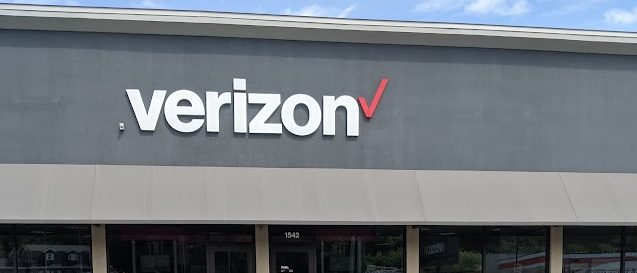
Verizon Communications Inc. ( və-RY-zən) is an American telecommunications company headquartered in New York City. It is the world's second-largest telecommunications company by revenue and its mobile network is the largest wireless carrier in the United States, with 146.8 million subscribers as of March 31, 2026. The company was founded as Bell Atlantic Corporation and renamed to Verizon on June 30, 2000 as a result of a merger with GTE.
Bell Atlantic was originally headquartered in Philadelphia and operated in the states of Pennsylvania, New Jersey, Delaware, Maryland, Virginia, and West Virginia. In 1997, the company expanded into New York and the New England states by merging with fellow Baby Bell NYNEX. While Bell Atlantic was the surviving company, it moved its head office to NYNEX's old headquarters in New York City. In 2000, Bell Atlantic merged with GTE, which operated telecommunications companies across most of the rest of the country not already in Bell Atlantic's footprint.
In 2015, Verizon expanded into content ownership by acquiring AOL, and two years later, it acquired Yahoo! Inc. AOL and Yahoo were amalgamated into a new division named Oath Inc., which was rebranded as Verizon Media in January 2019, and was spun off and rebranded to Yahoo! Inc. after its sale to Apollo Global Management.
As of 2026, Verizon is one of three remaining companies with roots in the former Baby Bells. The other two, like Verizon, exist as a result of mergers among fellow former Baby Bell members. SBC Communications bought the Bells' former parent AT&T Corporation and began using the AT&T name, while CenturyLink acquired Qwest (formerly US West) in 2011, renaming to Lumen Technologies in 2020.
Contents
History
Bell Atlantic and mergers with NYNEX, GTE and Vodafone (1984–2002)
In 1983, the US Department of Justice came to a settlement with the original AT&T to break up the Bell System. Bell Atlantic Corporation was created as one of the original "Baby Bell" Regional Bell Operating Companies (RBOCs) in 1984.
Bell Atlantic's original roster of operating companies included:
The Bell Telephone Company of Pennsylvania
New Jersey Bell
Diamond State Telephone
C&P Telephone (itself comprising four subsidiaries)
In 1996, CEO and Chairman Raymond W. Smith orchestrated Bell Atlantic's merger with fellow Baby Bell NYNEX, which had received New York Telephone and New England Telephone in the breakup. When it merged, it moved its corporate headquarters from Philadelphia to New York City. NYNEX was consolidated into the Bell Atlantic name by 1997.
In April 2000, two months before the Federal Communications Commission (FCC) gave final approval on the merger with GTE, Bell Atlantic formed Verizon Wireless in a joint venture with the British telecommunications company Vodafone, which owned the mobile operator AirTouch. The companies established Verizon Wireless as its own business operated by Bell Atlantic, which owned 55% of the venture. Vodafone retained 45% of the company. The deal was valued at approximately $70 billion and created a mobile carrier with 23 million customers. Verizon Wireless merged Bell Atlantic's wireless network, Vodafone's AirTouch and PrimeCo holdings, and the wireless division of GTE. Due to its size, Verizon Wireless was able to offer national coverage at competitive rates, giving it an advantage over regional providers typical of the time.
Bell Atlantic became Verizon Communications in June 2000, when the FCC approved the merger with telephone company GTE, nearly two years after the deal was proposed in July 1998. The merger was announced on April 4. The name Verizon derives from the combination of the words veritas, Latin for truth, and horizon.
Early expansion (2003–2010)
The Dow Jones Industrial Average added Verizon Communications to its stock market index in April 2004. Verizon replaced telecom competitor AT&T, which had been a part of the index since the Great Depression.
Verizon launched its Fios Internet service, which transmits data over fiber optic cables, in Keller, Texas, in 2004. The company launched Fios TV in September 2005, also in Keller. Twenty percent of qualified homes had signed up by the end of 2004. By January 2006, Fios offered over 350 channels in seven states, including 20 high-definition television channels and video on demand.
Mail servers at Verizon.net were configured in December 2004 to not accept connections from Europe by default in an attempt to reduce spam email that was originating from the region. Individual domains would only be unblocked upon request. The move was criticized by its customers for disrupting their communications without notice, causing them to initiate a class-action lawsuit. Verizon proposed a settlement in April 2006.
Beginning in 2005, Verizon reinforced its focus on its mobile phone, Internet, and TV businesses by selling a number of its U.S.-based wireline-focused businesses and international assets. It sold 700,000 lines in Hawaii in 2005, and spun off lines in Maine, New Hampshire and Vermont in January 2007, which were then purchased by FairPoint Communications for $2.72 billion. Verizon also shed its telephone directory business in 2006. In May 2009, the company spun off wirelines in Arizona, Idaho, Illinois, Indiana, Michigan, Nevada, North Carolina, Ohio, Oregon, South Carolina, Washington, West Virginia, and Wisconsin into a company that then merged with Frontier Communications in a deal valued at $8.6 billion. It sold its interests in telecommunications providers in the Dominican Republic (Verizon Dominicana, previously CODETEL), Puerto Rico and Venezuela to América Móvil. A decade later, it would continue moves to invest in wireless. In 2015, American Tower Corp. acquired the exclusive right to lease, acquire or otherwise operate and manage many of Verizon's wireless towers for an upfront payment of $5.1 billion, which also included payment for the sale of approximately 165 towers. Verizon used the funds from this sale to support a $10.4 billion purchase of AWS-3 spectrum licenses at an FCC auction. In 2016, Verizon sold its wireline operations in Texas, Florida, and California to Frontier.
Expansion of services (2011–2021)
Verizon acquired Terremark, an information technology services company, for $1.4 billion in early 2011.
Ivan Seidenberg retired as Verizon's CEO on August 1, 2011, and was succeeded by Lowell McAdam.
In December 2011, the non-partisan organization Public Campaign criticized Verizon for its tax avoidance procedures after it spent $52.34 million on lobbying while collecting $951 million in tax rebates between 2008 and 2010 and making a profit of $32.5 billion. The same report also criticized Verizon for increasing executive pay by 167% in 2010 for its top five executives while laying off 21,308 workers between 2008 and 2010. However, in its Form 10-K filed with the SEC on February 24, 2012, Verizon reported having paid more than $11.1 billion in taxes (including income, employment and property taxes) from 2009 to 2011. In addition, the company reported in the 10-K that most of the drop in employment since 2008 was due to a voluntary retirement offer.
Verizon purchased Hughes Telematics, a producer of wireless features for automobiles, for $612 million in June 2012 as part of its strategy to expand into new growth areas in its wireless business. The same month, Verizon's E-911 service failed in the aftermath of the June 2012 derecho storm in several northern Virginia suburbs of Washington, D.C., with some problems lasting several days. The FCC conducted an investigation and released a report detailing the problems that led to the failure in January 2013. Verizon reported that it had already addressed or was addressing a number of the issues related to the FCC report, including the causes of generator failures, conducting audits of backup systems, and making its monitoring systems less centralized, although the FCC indicated that Verizon still needed to make additional improvements.
The FCC ruled that Verizon must stop charging users an added fee for using 4G smartphones and tablets as Wi-Fi hotspots (known as "tethering"). Verizon had been charging its customers, even those with "unlimited" plans, $20 per month for tethering. As part of the 2012 settlement, Verizon made a voluntary payment of $1.25 million to the U.S. Treasury.
In August 2012, the Department of Justice approved Verizon's purchase of Advanced Wireless Services (AWS) spectrum from a consortium of cable companies, including Comcast, Time Warner Cable and Bright House Networks, for $3.9 billion. Verizon began expanding its LTE network utilizing these extra airwaves in October 2013.
Post-Aol and Yahoo era (2022-present)
In 2022, Verizon and AT&T delayed 5G network deployment because the service could interfere with airplane cockpit security systems. In early January 2022, the companies announced 5G deployment but agreed to a two-week delay. In mid-January, Verizon said the high-speed wireless service would still launch, but with a temporary restriction around airports. In late January 2022, the Federal Aviation Administration agreed with AT&T and Verizon on a list of measures that would make it possible to activate 5G on more towers. As a result, carriers have been able to pinpoint areas around airports where the 5G signal should be attenuated, and the FAA reported that about 90% of US commercial aircraft are equipped with approved radio altimeters, allowing them to land in areas of poor visibility with a deployed 5G network. The agency also said work is continuing to ensure that all aircraft can operate within range of the service.
In December 2023, Verizon announced plans to open a new global center of excellence in Limerick, Ireland, in early 2024, aiming to create over 400 jobs in the next two years. This expansion, which adds to its existing workforce of 1,000 employees in Dublin, will offer various positions in technology and communications, including financial operations and network engineering.
In May 2024, Verizon announced a partnership to access direct-to-cell capabilities with satellite manufacturer AST SpaceMobile, which will improve cellular and broadband access in remote areas of the United States.
On September 5, 2024, Verizon announced its intent to acquire Frontier in an all-stock deal for $38.50 per-share, valuing the company at $20 billion. Vestberg stated that the proposed acquisition was a "strategic fit" to expand its fiber network. On May 16, 2025, the Federal Communications Commission approved the acquisition. In January 2026, the California Public Utilities Commission approved the proposed acquisition of Frontier, subject to a series of regulatory conditions relating to affordability, service quality, infrastructure investment, and workforce and supplier diversity. The approval (following the FCC's approval in May 2025) cleared a major remaining regulatory hurdle for the acquisition. The acquisition was completed on January 20, 2026.
In May 2025, Verizon announced that they would end diversity, equity and inclusion programs after the Trump administration opened a probe into them.
Finances
For the fiscal year 2024, Verizon reported earnings of US$17.95 billion, with an annual revenue of US$134.788 billion, an increase of 0.6% over the previous fiscal cycle. Verizon's shares traded at over $45 per share, and its market capitalization was valued at over US$163.96 billion in January 2025. Verizon is currently ranked #31 in the Fortune 500 for 2023 and #68 in the Fortune Global 500.
States
The company offers Internet, traditional landline phone or VoIP, home security, pay television, web hosting and wholesale data in nine states across the eastern United States.
Marketing campaigns
Since its inception, Verizon Communications has run several marketing campaigns, including:
Can you hear me now?
The "Can you hear me now?" campaign, which was created for the newly formed Verizon Wireless, started running in 2001, and featured actor Paul Marcarelli in the role of "Test Man", a character based on a Verizon network tester, who travels the country asking "Can you hear me now?". The campaign, originally conceived by New York agency Bozell, ran from early 2001 to September 2010. Data from the technology tracking firm The Yankee Group showed that, in the early years of the campaign, net customers grew 10% to 32.5 million in 2002 and 15% more to 37.5 million in 2003. In addition, customer turnover dropped to 1.8% in 2001, down from 2.5% in 2000. In 2011, Marcarelli parted ways with Verizon, and in 2016, he became a spokesperson for Sprint.
There's a map for that
The "There's a map for that" campaign was launched in late 2009, designed as a parody of AT&T's "There's an app for that" campaign. The ads depicted a side-by-side comparison of Verizon and AT&T network coverage maps. In early November 2009, AT&T filed a lawsuit in Atlanta federal court, claiming that the coverage maps being used in the ads were misleading. The suit was dropped later that month in conjunction with Verizon dropping a similar suit against AT&T.
Corporate governance
Executives
As of 2025:
Dan Schulman, chief executive
Sowmyanarayan Sampath, head of Verizon consumer
Kyle Malady, head of Verizon Business
Corporate responsibility
Verizon grants money to organizations through its philanthropic arm, The Verizon Foundation. The company ran HopeLine, which had provided mobile phones to victims of domestic violence. Verizon's educational initiatives include the Verizon Innovative Learning Schools program that provides children access to STEM education programs.
Between 2019 and 2023, Verizon issued five green bonds for a total of $5 billion. Proceeds from its 2023 issue were earmarked to transition to more environmentally friendly electrical grids.
In 2020, Verizon launched its "Citizen Verizon" plan with an outline of social and environmental goals. Among this plan is a pledge to be completely carbon neutral by 2035. The plan also includes digital-skills training for young people.
Criticism
Security concerns
According to Google Project Zero researcher Tavis Ormandy, Verizon applies a simplistic certification methodology to give its "Excellence in Information Security Testing" award, e.g. to Comodo Group. It focuses on GUI functions instead of testing security relevant features. Not detected were Chromodo browser disabling of the same-origin policy, a VNC-delivered with a default of weak authentication, not enabling address space layout randomization (ASLR) when scanning, and using access control lists (ACLs) throughout its product.
Verizon was reported to have been affected by a 2024 attack from the Salt Typhoon advanced persistent threat linked to the Chinese government.
Net neutrality
Verizon and Comcast have been actively lobbying for current changes in the FCC's regulations that require internet service providers to offer all content at one internet speed regardless of the type of content since the early 2000s. In 2014, Verizon unsuccessfully sued the FCC for these powers.
In July 2017, it was reported that Verizon's mobile network had been limiting streaming services such as Netflix and YouTube to a speed of 10 Mbit/s; Verizon stated to Ars Technica that it had been testing a system to "optimize the performance of video applications on our network", and that it would not affect video quality.
Deceptive advertising of 5G
In May 2020, the Better Business Bureau criticized Verizon for claiming it was "building the most powerful 5G experience for America" and recommended that the company make clear and conspicuous disclosures to consumers about the limited actual availability of its 5G network. Verizon had been cited by the Better Business Bureau in March 2019 for ads that "convey the message that Verizon has achieved the important milestone of deploying the first mobile wireless 5G network" prior to 5G availability, falsely conveying that the technology was currently available.
Privacy
Verizon has a one-star privacy rating from the Electronic Frontier Foundation.
In April 2024, Verizon was fined nearly $47 million by the FCC for illegally sharing access to customers' real-time location data.
Sponsorships and venues
Verizon is the title sponsor of several large performance and sports venues as well as a sponsor of many major sporting organizations.
National Hockey League
In January 2007, Verizon secured exclusive marketing and promotional rights with the National Hockey League. The deal was extended for another three years in 2012 and included new provisions for the league to provide exclusive content through Verizon's GameCenter app.
Motorsports
In 2009 and 2010 Verizon sponsored Justin Allgaier in the NASCAR Nationwide Series, before they chose to opt out of a two-year-old NASCAR team sponsorship with Penske Racing in order to pursue an expanded presence with the IndyCar Series. In March 2014 Verizon became title sponsor of the series through 2018.
Verizon also sponsored a race in the 2021 NASCAR Cup Series season, the Verizon 200 at the Brickyard at Indianapolis Motor Speedway.
National Football League
In late 2010, Verizon Communications joined with Vodafone Group in a joint partnership to replace Sprint as the official wireless telecommunications partner of the National Football League. The four-year deal was estimated at $720 million. In June 2013, Verizon announced a four-year extension with the NFL in a deal reportedly valued at $1 billion. The new agreement gave Verizon the right to stream every NFL regular-season and playoff game.
USA Team Handball
In January 2020, Verizon became a founding partner of USA Team Handball through the year 2020, with an option to extend the deal until 2024. They are the jersey sponsor for the men's and women's national handball team and the men's and women's national beach handball teams. They are presenter of the USA Team Handball College Nationals.
In 2020 USA Team Handball CEO Barry Siff that they are planning to create an American professional team handball league sponsored by Verizon. They are planning to have the owners until the end of 2020. They are planning to launch the league in 2023 with 10 teams with each team initially worth $3 million to $5 million and want to cooperate with NBA or NHL owners in one-tenant arena situations. To create multisports clubs like FC Barcelona or Paris Saint-Germain.
2026 FIFA World Cup
In September 2024, Verizon announced they would be a sponsor for the 2026 FIFA World Cup in the United States, Canada, and Mexico, where they will provide access to their cellular network for visiting fans at stadiums, fan fests, and the metropolitan areas of the host cities.
Branded venues
The main home concert hall of the Philadelphia Orchestra at the Kimmel Center for the Performing Arts is named Verizon Hall.
Verizon was the former sponsor for a number of sporting and entertainment arenas, including Simmons Bank Arena (formerly Verizon Arena) in North Little Rock, Arkansas, the Mayo Clinic Health System Event Center (formerly Verizon Center) in Mankato, Minnesota, and the SNHU Arena in Manchester, New Hampshire, which was originally known as the Verizon Wireless Arena until September 2016 when Southern New Hampshire University acquired the naming rights for a period of at least 10 years. Verizon was also the title sponsor of entertainment amphitheaters in locations throughout the United States, including four individually referred to as the "Verizon Wireless Amphitheatre" in Irvine, California, Maryland Heights, Missouri, Selma, Texas, and Alpharetta, Georgia.
Verizon is a former sponsor of the Capital One Arena in Washington, DC.